What Operations Manager Interviews Test
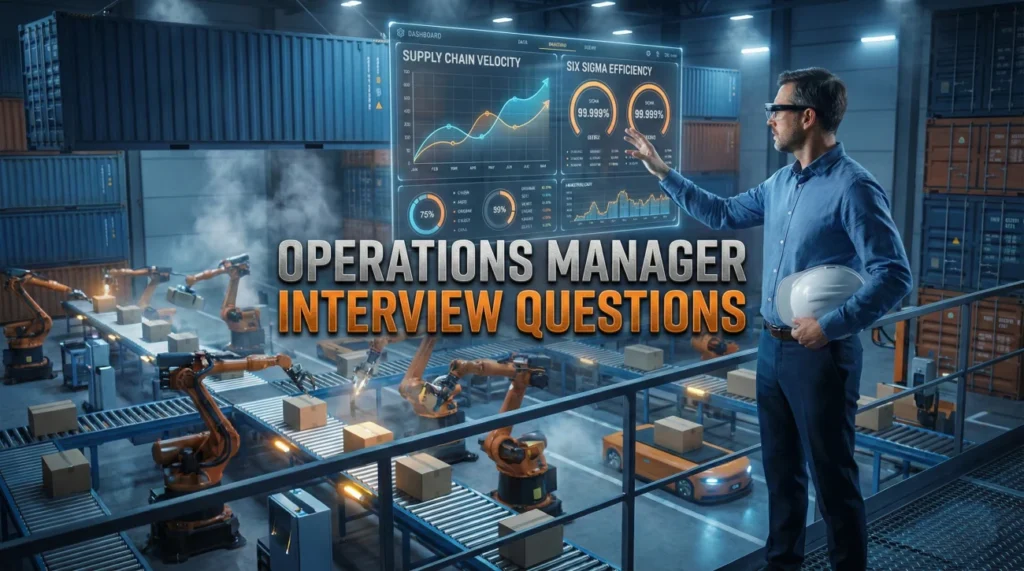
Operations manager interview questions assess your ability to be the “Fixer” of the organization. While the CEO sets the vision, the Operations Manager builds the machine that executes it. Today, this role often requires a hybrid skillset: the analytical mindset to optimize workflows, the financial acumen to manage the P&L, and the people skills to lead cross-functional teams.
This comprehensive guide focuses on the four critical pillars of the modern Ops Manager role: Process Optimization (using Lean/Six Sigma to eliminate waste), Supply Chain & Logistics (navigating global complexity), Financial Stewardship (budgeting and cost control), and Change Leadership (getting buy-in for new systems). Show that you don’t just keep the lights on – you make operations more reliable and cost-conscious.
Process Efficiency & Improvement
Efficiency is your product. Interviewers want to see your methodology for diagnosing and curing operational bottlenecks.
Q: Walk me through a time you improved an inefficient process. What was the ROI?
I use the DMAIC framework (Define, Measure, Analyze, Improve, Control). For example, our invoicing process was taking far too long, causing cash flow delays. Define: Goal was to reduce cycle time to a few days. Measure: I mapped the value stream and found that 4 days were spent waiting for manual approvals. Analyze: The root cause was a redundant sign-off requirement. Improve: I implemented an automated approval workflow in our ERP for invoices under a set threshold. Control: I set up a dashboard to track speed. Result: Cycle time dropped sharply and improved cash flow in a measurable way.
Q: How do you decide whether to automate a process or keep it manual?
I apply the “Volume vs. Complexity” matrix. High-volume, low-complexity tasks (like data entry) are prime candidates for automation (RPA). High-complexity, low-volume tasks (like resolving a VIP client complaint) require a human touch. I also look at the “Cost of Error.” If a manual error costs very little but automation costs a lot, the ROI may not be there. I automate to free up human talent for strategic work, not just to use new tech.
Q: Explain your experience with Lean or Six Sigma principles.
I focus on the “8 Wastes” of Lean (DOWNTIME). My most common target is “Waiting” (bottlenecks) and “Non-Utilized Talent” (people doing busy work). I lead “Kaizen” events – short, focused workshops where the team identifies problems and implements immediate fixes. I believe Six Sigma isn’t just about statistics; it is a cultural mindset of continuous improvement where people feel safe raising defects early.
Q: How do you handle resistance from a team when implementing a new workflow?
Resistance usually comes from fear or lack of understanding. I use the “Ikea Effect” – people value what they help build. I involve key influencers from the team in the design phase of the new workflow so they become co-owners. I focus on “WIIFM” (What’s In It For Me) – showing them how the new process will save them time or frustration, rather than just emphasizing company profit. I provide training and a “grace period” for adoption before enforcing compliance.
Logistics & Supply Chain Management
Whether moving physical goods or digital assets, logistics is about reliability. You need to show you can handle disruption.
Q: How do you manage supply chain risk in a volatile market?
I believe in redundancy and diversification. I never rely on a “Single Point of Failure.” I maintain a “Primary + Backup” vendor strategy for all critical components (for example, a primary vendor plus a backup vendor) to keep the backup channel warm. I also map our supply chain tiers to understand their suppliers. If our Tier 1 supplier relies on a single factory in a fragile region, that becomes our risk too. I build inventory buffers (Safety Stock) for high-risk items, balancing the carrying cost against the cost of a stockout.
Q: Describe how you negotiate with vendors to reduce costs.
I prepare by understanding their cost drivers and my “BATNA” (Best Alternative to a Negotiated Agreement). I don’t just squeeze them on price, which can hurt quality. Instead, I look for “win-win” levers. Can we sign a longer-term contract in exchange for a discount? Can we consolidate shipping to reduce their logistics cost? Can we offer improved payment terms in exchange for a price break? I treat vendors as partners; a bankrupt vendor helps no one.
Q: How do you track inventory accuracy?
I move away from the annual physical count to “Cycle Counting.” We count a small subset of high-value (A-items) inventory frequently and lower-value items (C-items) on a planned cadence. This helps maintain strong accuracy without shutting down operations for a full count. I investigate variances immediately to find the root cause (e.g., theft, receiving error, BOM error) rather than just writing it off. Inventory is cash sitting on a shelf; I protect it accordingly.
Financial Management & KPIs
Operations is where the money is spent. You need to speak the language of the CFO.
Q: How do you manage a P&L (Profit & Loss) statement?
I treat the P&L as a report card. I focus on the “Controllable Expenses” – COGS (Cost of Goods Sold), Labor, and Overhead. I review the “Budget vs. Actuals” variance report on a regular cadence. If Labor is over budget, I dig in: Is it overtime? Is it inefficiency? I forecast expenses ahead of time to avoid end-of-year surprises. My goal is to lower the “Break-Even Point” of the business by turning fixed costs into variable costs where possible (e.g., leasing vs. buying), making the company more resilient to revenue dips.
Q: Which operational KPIs do you track regularly?
I track a mix of Efficiency, Quality, and Safety metrics. Efficiency: Throughput (units per hour) and Utilization Rate. Quality: First Pass Yield (percentage of units correct the first time) and Return Rate. Safety: Days Without Incident. I also track OTIF (On-Time In-Full) delivery because it directly correlates to customer satisfaction. I display these on a visual dashboard for the team so everyone knows if we are “winning” or “losing” the day early.
Q: How do you determine staffing levels for a fluctuating workload?
I use a “Capacity Planning” model. I analyze historical data to predict seasonal peaks and troughs. I build a “Core” team of full-time employees to handle the baseline volume and a “Flex” layer of contractors or temp staff for the peaks. This reduces the risk of layoffs during slow periods and burnout during busy ones. I cross-train the Core team so they can move between departments (e.g., Customer Service helping Warehouse) to smooth out daily spikes.
Behavioral Scenarios & Leadership
Operations is high-stress. Interviewers test your ability to make tough calls under pressure.
A critical piece of equipment breaks down during peak production. What do you do?
I initiate the Business Continuity Plan immediately. 1. Containment: Is it safe? If yes, can we use a manual workaround or a backup machine? 2. Communication: I inform stakeholders (Sales/Customer Service) of the potential delay so they can manage client expectations proactively. 3. Resolution: I call the repair vendor using the agreed escalation path. 4. Recovery: I schedule overtime shifts to catch up on the backlog once fixed. Post-crisis, I conduct a “5 Whys” analysis to determine why it failed and implement a preventative maintenance fix (for example, replacing the part on a planned schedule instead of waiting for failure).
Two department heads (Sales and Production) are fighting over deadlines. How do you resolve it?
I act as the objective mediator using data. Sales wants it “now,” and Production wants it “perfect.” I bring them together to look at the “Iron Triangle” of Project Management: Speed, Cost, Quality. I explain, “We can rush this order (Speed), but it will require overtime (Cost) and risk errors (Quality). Is the client willing to pay for the overtime, or accept the risk?” By quantifying the trade-offs, I move the conversation from emotional blaming to a business decision about resource allocation.
Operations Management IQ Quiz
Test Your Ops Skills
1. “Kaizen” refers to:
- Continuous improvement involving all employees
- A type of Japanese food
- Firing low performers
- Buying new machines
2. “COGS” stands for:
- Cost of General Services
- Cost of Goods Sold
- Company Operating Gross Sales
- Cash On Gold Standard
3. The “Pareto Principle” (80/20 Rule) suggests:
- 80% of effects come from 20% of causes
- You should work 80 hours a week
- Inventory should be 80% full
- Profits are always 20%
4. “Just-in-Time” (JIT) inventory aims to:
- Stockpile goods “just in case”
- Receive goods only as they are needed in the production process
- Delay orders
- Use slow shipping
5. “Six Sigma” targets a defect rate of:
- Zero defects
- 3.4 defects per million opportunities
- 6% defects
- 1 defect per hundred
6. A “Bottleneck” is:
- A narrow bottle
- The stage in a process that limits the overall capacity
- A lazy employee
- A broken computer
7. “SLA” stands for:
- Service Level Agreement
- Standard Logistics Action
- Sales Lead Account
- System Level Access
8. “KPI” stands for:
- Keep People Interested
- Key Performance Indicator
- Known Profit Index
- Key Process Input
9. “Supply Chain” encompasses:
- Only shipping trucks
- The entire flow of goods/information from raw material to end consumer
- Buying chains
- Warehouse storage only
10. “Standard Operating Procedure” (SOP) ensures:
- Creativity
- Consistency and quality in repeating a task
- Speed only
- Secrecy
11. “Inventory Turnover” measures:
- How often shelves are cleaned
- How many times a company sells and replaces its inventory in a period
- The weight of the stock
- The number of returns
12. “Root Cause Analysis” (e.g., 5 Whys) is used to:
- Blame someone
- Identify the underlying cause of a problem to prevent recurrence
- Plant trees
- Calculate costs
13. “Lead Time” is:
- The weight of lead
- The time between initiating a process and its completion
- Being the leader
- Working time only
14. “Change Management” is critical for:
- Counting coins
- Ensuring successful adoption of new processes or systems
- Changing clothes
- Ordering lunch
15. “TQM” stands for:
- Total Quantity Measure
- Total Quality Management
- Time Quote Manager
- Team Question Method
16. “Safety Stock” acts as:
- A danger to the warehouse
- A buffer against demand spikes or supply delays
- Expired inventory
- Free samples
17. “Cross-Training” employees helps to:
- Make them tired
- Ensure coverage and flexibility when staff are absent
- Confuse them
- Pay them less
18. “Benchmarking” involves:
- Sitting on a bench
- Comparing your performance metrics against industry standards
- Marking a bench
- Guessing goals
19. “Lean Management” focuses on:
- Starving employees
- Maximizing value by minimizing waste
- Leaning on walls
- Increasing inventory
20. “First-In, First-Out” (FIFO) is a method for:
- Hiring staff
- Inventory valuation and management (using oldest stock first)
- Parking cars
- Sending emails
❓ FAQ
🕒 Is this an office job or a warehouse job?
It can be both. An Operations Manager in a tech company works in an office managing workflows and software. In a manufacturing or retail company, you might spend time on the floor managing physical logistics. Clarify the “Gemba” (where the work happens) during the interview.
📜 What certifications are valuable?
Six Sigma Green/Black Belt is highly valued for process improvement. PMP (Project Management Professional) is great for project-heavy roles. CPIM (Certified in Planning and Inventory Management) is widely recognized for supply chain roles.
💻 What software do Ops Managers use?
You need to be an Excel power user. You will also use ERP systems for resource planning, CRM tools for customer data, and project management tools to track initiatives.
💰 What is the salary potential?
Operations Managers are well-paid because they directly impact profitability. Compensation varies by industry, company size, and scope, and senior operations leaders often earn significantly more. Bonuses are often tied to efficiency, service levels, or cost-saving targets.
🚀 What is the career path?
The natural progression is Director of Operations, then VP of Operations, and ultimately COO (Chief Operating Officer). Operations is one of the most common pathways to the C-Suite because it touches every part of the business.
Final Thoughts
To succeed in answering operations manager interview questions, you need to show that you are obsessed with “better.” You are never satisfied with the status quo. Interviewers want to see a candidate who looks at a process and immediately sees the waste, the risk, and the opportunity.
Focus on your metrics. Don’t just say “I improved the process.” Say “I reduced cycle time meaningfully and saved real costs annually.” Operations is a numbers game. If you can prove that you pay for yourself through the efficiencies you create, you will be an easy hire. For more insights on business management, explore our hub on administrative and hr interview questions.
⚠️ Disclaimer: The interview strategies, sample answers, and negotiation tips provided in this guide are for educational purposes only. Hiring decisions are subjective and vary by company and industry. While these strategies are based on professional HR standards, they do not guarantee a specific job offer or result.