Command, Control, and Communication
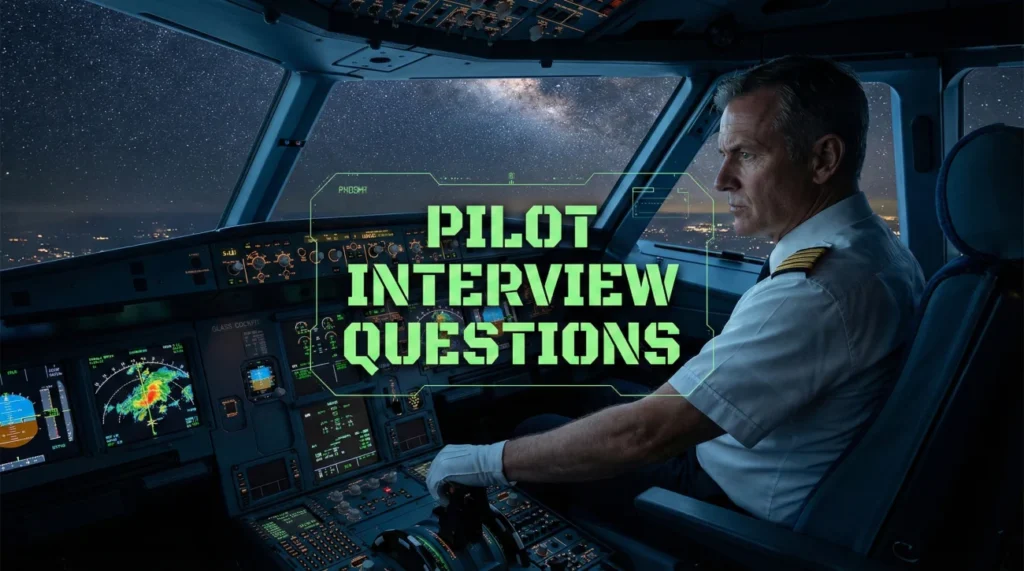
Pilot interview questions are among the most rigorous in any industry. In 2025, airlines have moved beyond simply testing your stick-and-rudder skills. With modern aircraft being highly automated, the interview focus has shifted heavily towards Crew Resource Management (CRM), emotional stability, and decision-making under extreme pressure. Recruiters are asking: “Can this person manage a complex system failure while maintaining a cohesive team environment?”
This guide is your pre-flight checklist for the airline interview process. We cover the essential behavioral questions where you must demonstrate your leadership style, the technical scenarios that test your knowledge of systems and meteorology, and the “startle effect” situations designed to see if you freeze or fight. Whether you are a Cadet looking for your first right-hand seat or a seasoned Captain transitioning to a legacy carrier, this guide ensures your answers are cleared for takeoff.
CRM & Leadership Philosophy
CRM is the backbone of modern aviation safety. You must demonstrate that you view the cockpit not as a hierarchy of power, but as a hierarchy of responsibility.
Q: Define Crew Resource Management (CRM) in your own words.
Answer: CRM is the effective use of all available resources – hardware, software, and people – to achieve safe and efficient flight operations. It is not just about being polite; it is about creating an environment where the First Officer feels safe to challenge the Captain, and the Captain listens to input before making a decision. It involves situational awareness, communication, and leadership to trap errors before they become accidents.
Q: Describe the “Trans-Cockpit Authority Gradient.” What is the ideal gradient?
Answer: This refers to the balance of power between pilots. A “Steep Gradient” means the Captain is too dominant (dictatorial), causing the FO to shut down. A “Flat Gradient” means the roles are too blurred (too friendly), leading to a lack of leadership. The ideal is a “Shallow Gradient,” where the Captain has the final authority and respect, but the First Officer is empowered and expected to speak up assertively when safety is compromised.
Q: How do you handle a Captain who is willfully violating a Standard Operating Procedure (SOP)?
Answer: I use the PACE model (Probe, Alert, Challenge, Emergency). First, I Probe: “Captain, I see we are slightly high on the approach.” If ignored, I Alert: “Captain, we are unstable.” If still ignored, I Challenge: “Captain, you must go around now for safety.” Finally, if the aircraft is in danger, I take Emergency action: “I have control.” I must prioritize the safety of the passengers over politeness or rank.
Q: What is the “Startle Effect” and how do you mitigate it?
Answer: The Startle Effect is the involuntary physical and mental reaction to a sudden, unexpected event (like a loud bang or sudden autopilot disconnect), which can cause a temporary inability to act. I mitigate this by maintaining a high state of situational awareness so fewer things are “unexpected,” and by adhering to the golden rule: “Aviate, Navigate, Communicate.” In a crisis, I force myself to pause for one second to analyze before reacting, preventing a knee-jerk input on the controls.
Emergency & Non-Normal Scenarios
These questions simulate the simulator check. Interviewers want to hear your decision-making process (FORDEC/DODAR) rather than just a memory item checklist.
Q: You have an engine fire at V1. What do you do?
The Strategy: Go vs. Stop Decision.
Answer: At V1, we are committed to fly. Stopping is more dangerous than flying. I continue the takeoff, call “Rotate,” and stabilize the aircraft at a safe altitude (typically 400ft or acceleration altitude). Only once the aircraft is under control do we perform the “Engine Fire” memory items. My priority is to fly the plane first, not to fight the fire on the runway.
Q: Your Captain becomes incapacitated during the approach. Actions?
The Strategy: Two-In / Two-Out Rule.
Answer: I immediately call “I have control” loud and clear. I press the autopilot disconnect to ensure I am flying. I declare a “Mayday” to ATC to get priority handling. I instruct the Senior Cabin Crew member to secure the Captain (lock shoulder harness, move seat back) so they don’t interfere with controls. I then perform a single-pilot landing. I do not try to diagnose them medically; I just get the plane on the ground safely.
Q: You are at cruising altitude and fuel is leaking. You can reach your destination but with minimum reserves. Divert or Continue?
The Strategy: Conservative Decision Making.
Answer: I divert to the nearest suitable airport. A fuel leak is an unpredictable variable; it could worsen rapidly. Continuing to destination with minimum reserves leaves no margin for error (weather, hold, runway closure). In aviation, if there is a doubt, there is no doubt. I land ASAP.
Q: ATC gives you a clearance that violates a safety regulation. Do you accept?
The Strategy: PIC Responsibility.
Answer: Negative. I use the phrase “Unable.” ATC provides a service, but the Pilot in Command (PIC) is responsible for the safety of the flight. If they clear me to descend below Minimum Sector Altitude (MSA) in clouds, I refuse. I explain why briefly: “Unable, safety altitude.” I suggest an alternative course of action.
Q: You smell alcohol on your Captain’s breath during the pre-flight briefing.
The Strategy: Integrity & Ethics.
Answer: I cannot let the flight depart. I would pull the Captain aside privately first: “Captain, I smell alcohol. Are you fit to fly?” If they deny it or insist on flying, I must report it to the Chief Pilot or Duty Manager immediately and refuse to fly the aircraft. It is a career-ending report for them, but flying would endanger hundreds of lives. I have a moral and legal duty to intervene.
Q: Both engines fail at high altitude (Volcanic Ash / Fuel Starvation).
The Strategy: Energy Management.
Answer: “Start, Glide, Mayday.” My first priority is to establish the optimal glide speed to maximize range. I instruct the PM (Pilot Monitoring) to attempt an engine relight checklist. I declare Mayday. I immediately look for the nearest suitable landing field (airport, highway, field). I do not get fixated on restarting the engines to the point where I lose situational awareness of the ground proximity.
Technical Knowledge & Meteorology
You cannot bluff your way through technical questions. Review your ATPL theory notes, specifically Meteorology and Principles of Flight.
Q: Explain the difference between a METAR and a TAF.
Answer: A METAR (Meteorological Aerodrome Report) is an observation of the current weather conditions at an airport, updated typically every 30 or 60 minutes. A TAF (Terminal Aerodrome Forecast) is a prediction of future weather conditions for a specific period (usually 24 or 30 hours). I use METAR for current departure/arrival feasibility and TAF for flight planning and alternate selection.
Q: What is “Coffin Corner” regarding high-altitude aerodynamics?
Answer: Coffin Corner (or Q-Corner) is the altitude where the aircraft’s stall speed (low speed buffet) and critical Mach number (high speed buffet/shockwaves) converge. At this specific altitude, the margin between stalling and overspeeding is extremely narrow. If you slow down, you stall; if you speed up, you exceed structural limits. We avoid this region to maintain a safe operating envelope.
Q: Describe the conditions required for thunderstorm formation.
Answer: Three ingredients are needed: Moisture (humidity), Instability (lapse rate), and a Lifting Action (fronts, terrain, or thermal heating). Thunderstorms pose severe risks including severe turbulence, hail, lightning, and microbursts. I always use the weather radar to deviate around a cell by at least 20 nautical miles on the upwind side.
Q: What is “Dutch Roll” and how is it corrected?
Answer: Dutch Roll is an oscillatory instability where the aircraft rolls and yaws simultaneously out of phase. It happens often in swept-wing aircraft. Modern jets have a Yaw Damper system to prevent this automatically. If the Yaw Damper fails, I would manually correct it and may need to descend to a lower altitude or reduce speed as per the QRH (Quick Reference Handbook).
Behavioral & Personal Attributes
Airlines hire people, not robots. These questions test your maturity, humility, and ability to learn from mistakes.
Tell me about a time you made a mistake in the cockpit.
The Strategy: Ownership and Learning.
Answer: During a training flight, I misheard an altitude clearance of “3,000” as “4,000.” I read it back as 4,000, but ATC didn’t catch it. My instructor intervened. I realized I was fatigued and my confirmation bias made me hear what I expected. I now strictly adhere to “write it down, read it back” and if there is any doubt, I ask “Say again.” I learned that admitting confusion is safer than assuming correctness.
How do you handle fatigue during a long-haul flight?
The Strategy: Physiology Management.
Answer: I treat rest as a duty. I use “Controlled Rest” in the cockpit (napping for 20-40 mins) if procedures allow and my colleague is alert. I stay hydrated and avoid heavy meals before flying. Crucially, if I am too fatigued to fly safely before the flight begins, I call in “Fatigued.” It is better to delay a flight than to crash it. I respect the biological limits of the human body.
Why should we hire you over a pilot with more hours?
The Strategy: Attitude over Aptitude.
Answer: Hours show experience, but they don’t show attitude. You should hire me because I am standard-driven, open to feedback, and view every flight as an opportunity to improve. I bring a strong background in CRM and a dedication to the “Service” aspect of the job – keeping passengers informed and comfortable. I am looking for a career home, not just a logbook builder, and I align with your airline’s safety culture.
Automation & Modern Cockpit
A critical topic for 2025. You must show you are the master of the Flight Management System (FMS), not its servant.
Q: What is “Automation Dependency” and are you susceptible to it?
Answer: It is the erosion of manual flying skills due to over-reliance on autopilot. Yes, every modern pilot is susceptible. To combat this, I hand-fly the aircraft during low-workload departures or arrivals (when weather permits and briefed) to keep my scan and motor skills sharp. I adhere to the philosophy: “Use the appropriate level of automation for the task.”
Q: The automation does something you didn’t expect (“What’s it doing now?”). Steps?
Answer: I revert to basic modes immediately. If the VNAV path is weird, I select “Level Change” or “Vertical Speed.” If the LNAV is wandering, I select “Heading Select.” I degrade the automation level to something I directly control. I never sit and watch a confused computer; I take over. “Click, Click, Boom” (Disconnect AP, Disconnect AT, Fly the plane).
Aviation Knowledge Check
Test Your Flight Deck IQ
1. “V1” speed is defined as:
- Rotation speed
- The maximum speed at which a rejected takeoff can be initiated
- The speed to retract flaps
- Stall speed
2. “Sterile Cockpit Rule” applies:
- At all times
- Below 10,000 feet (excluding cruise)
- Only during landing
- When the door is locked
3. “Squawk 7700” means:
- Radio failure
- Hijack
- General Emergency
- VFR flight
4. “Squawk 7600” means:
- Radio Communication Failure
- Emergency
- Hijack
- Military intercept
5. “Bleed Air” is taken from:
- The fuel tank
- The compressor stage of the turbine engine
- The outside scoop
- The hydraulic system
6. “VFR” stands for:
- Very Fast Route
- Visual Flight Rules
- Vertical Flight Radar
- Variable Fuel Rate
7. The “Chord Line” of a wing is:
- The top surface
- An imaginary straight line joining the leading and trailing edges
- The length of the wing
- The angle of attack
8. “Hypoxia” is:
- Fear of heights
- A deficiency of oxygen reaching the tissues of the body
- Excessive carbon dioxide
- Motion sickness
9. “ILS” stands for:
- Integrated Landing System
- Instrument Landing System
- International Landing Standard
- Internal Lighting Switch
10. A “Go-Around” is:
- A failure
- A safe maneuver to discontinue an approach and climb away
- Flying in circles
- Asking ATC for a delay
11. “MEL” stands for:
- Maximum Engine Limit
- Minimum Equipment List
- Main Electric Line
- Manual Emergency Landing
12. “Wake Turbulence” is strongest behind an aircraft that is:
- Small, fast, and light
- Heavy, clean, and slow
- Climbing rapidly
- On the ground
13. “APU” (Auxiliary Power Unit) provides:
- Extra thrust for takeoff
- Electrical power and air conditioning on the ground (and backup in air)
- Hydraulic pressure only
- Fuel to the engines
14. “Crosswind Component” calculates:
- How fast you can fly
- The amount of wind acting perpendicular to the runway
- Headwind benefit
- Temperature drop
15. “PAPI” lights are used for:
- Runway lighting
- Visual glide slope indication (Precision Approach Path Indicator)
- Taxiway guidance
- Obstacle clearance
16. “Black Hole Effect” occurs:
- In space
- During night approaches over featureless terrain/water, causing altitude illusions
- In clouds
- During engine failure
17. “ETOPS” allows twin-engine aircraft to:
- Fly faster
- Fly routes further than 60 mins from an alternate airport
- Land on water
- Take off with one engine
18. “Clear Air Turbulence” (CAT) is dangerous because:
- It has cats
- It is invisible to weather radar (no moisture)
- It happens only low to the ground
- It causes engine failure
19. “PF” and “PM” stand for:
- Pilot Fast and Pilot Medium
- Pilot Flying and Pilot Monitoring
- Primary Flaps and Power Management
- Pilot First and Pilot Middle
20. “Bottle to Throttle” refers to:
- Using oxygen bottles
- The required time gap between consuming alcohol and flying (usually 8-12 hours minimum)
- Engine start sequence
- Fuel tank switching
❓ FAQ
🩺 What are the medical requirements?
You need a Class 1 Medical Certificate. This checks your vision (glasses are usually okay if correctable to 20/20), hearing, heart health (ECG), and mental health. Conditions like color blindness or diabetes may be disqualifying or require special waivers. Get this checked before spending money on flight training.
🏫 Integrated vs. Modular training: Which is better?
Airlines generally accept both. Integrated (Cadet Programs) is faster and more structured but expensive. Modular allows you to pay as you go and work while training. The end license (Frozen ATPL) is the same. Focus on getting good grades and high first-time pass rates, regardless of the path.
📉 What if I failed a checkride?
Be honest. One failure is not a career killer. Airlines look for integrity. Explain what happened, what you learned, and how you improved. A pattern of failures is a red flag, but a single learning moment can show resilience.
🕒 How many hours do I need?
It varies. For a cadet position, you might only need 200 hours (fresh from school). For a Direct Entry First Officer role at a major airline, you often need 1,500+ hours (total time) and sometimes 500+ hours on a multi-crew jet/turboprop.
🧠 Is the psychometric test hard?
Yes. It tests coordination, spatial awareness, multitasking, and math. You can prepare for these using online tools like “PilotAptitudeTest” or “SkyTest.” Practice helps improve your reaction times significantly.
Final Thoughts
To succeed in answering pilot interview questions, you must project the image of a “Safe Captain in Training.” Even if you are applying for a junior First Officer role, the airline is hiring you for your potential to command the jet one day. Confidence is good; arrogance is a disqualifier.
Show that you respect the regulations, value your crew, and can think clearly when the red lights start flashing. Your logbook gets you the interview, but your personality gets you the job. To understand the perspective of your closest colleague in the cabin, review our flight attendant interview questions guide to build better crew synergy.
⚠️ Disclaimer: The interview strategies, sample answers, and negotiation tips provided in this guide are for educational purposes only. Hiring decisions are subjective and vary by company and industry. While these strategies are based on professional HR standards, they do not guarantee a specific job offer or result.