- Core definition: Psychological safety means people can speak up, ask questions, admit mistakes, and disagree without ridicule or retaliation.
- Why fear blocks solutions: Low safety creates silence, hidden mistakes, and false agreement, so problems surface late and conflict turns destructive instead of useful.
- What it is and is not: It is not “niceness” or lower standards, it is the permission to take interpersonal risks so teams can learn, debate, and improve.
- How it shows up: Safe teams ask “dumb” questions, challenge ideas openly, and fix errors fast, unsafe teams self censor, avoid eye contact, and share truth only in private.
- How to build and assess: Leaders model vulnerability, thank dissent, run blameless learning loops, and in interviews you can ask for real examples of mistakes, disagreements, and what happened next.
Why Fear Prevents Problem-Solving
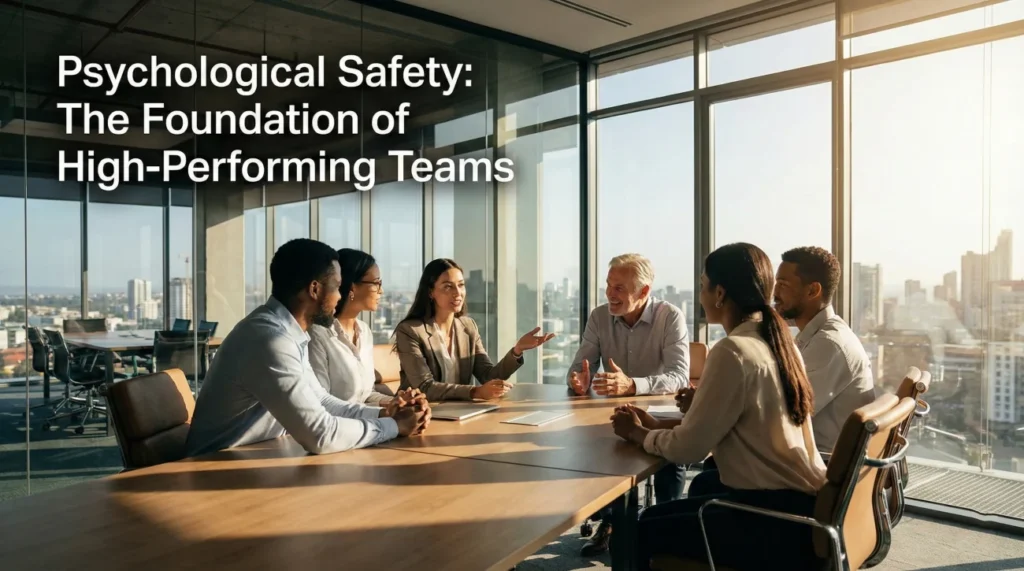
Teams with psychological safety at work address conflicts directly, admit mistakes openly, and challenge ideas without fear of punishment or humiliation. Teams without it suppress problems until they explode, hide mistakes until they compound, and avoid disagreeing with authority even when they see disasters approaching. The difference isn’t the presence or absence of conflict – it’s whether people feel safe enough to surface and resolve tensions constructively.
Psychological safety means team members believe they can speak up, ask questions, admit errors, and disagree without facing rejection, ridicule, or retaliation. This concept, researched extensively by Harvard professor Amy Edmondson, explains why some teams with average talent outperform teams with stars. When discussing conflict resolution during behavioral interview questions, understanding psychological safety helps explain how healthy environments enable productive disagreement while toxic ones suppress honest communication.
What Psychological Safety Actually Means
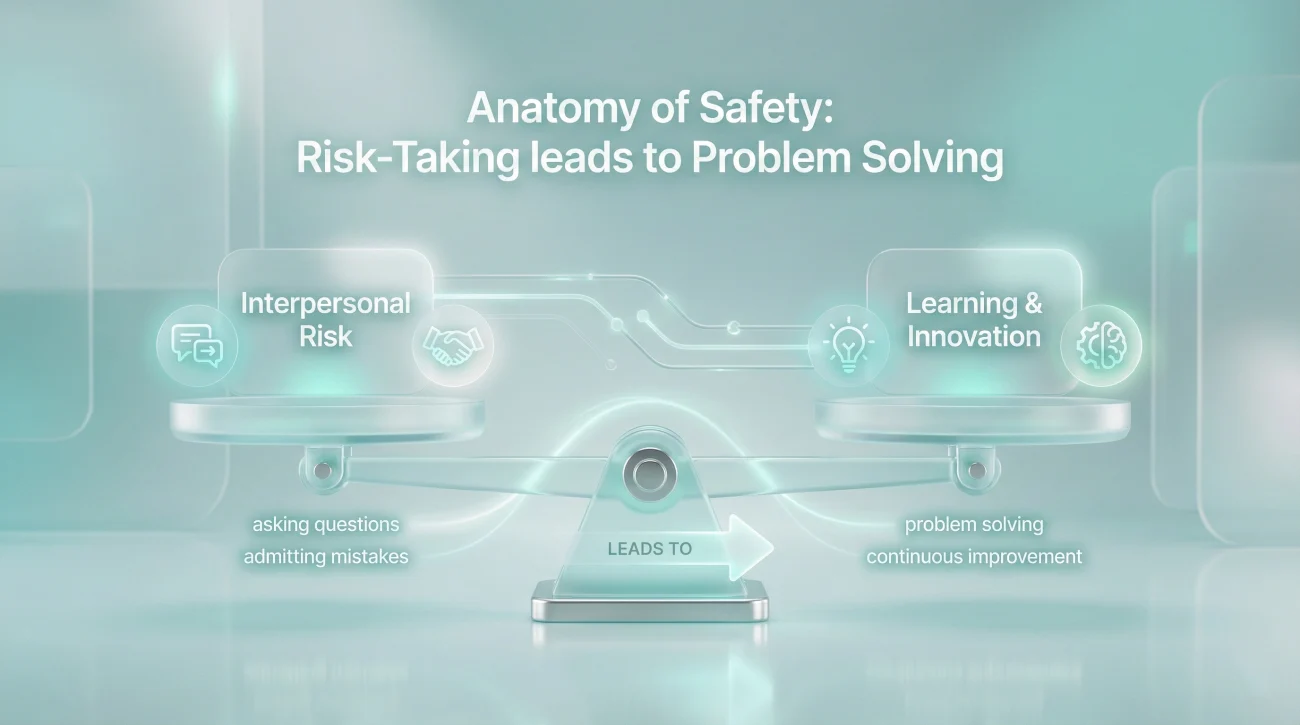
Understanding team psychological safety requires dispelling common misconceptions. It’s not about being nice, avoiding accountability, or creating comfort zones. It’s about creating environments where people take interpersonal risks necessary for learning and problem-solving.
What Psychological Safety Is Not
Psychological safety doesn’t mean everyone gets along perfectly, disagreements never happen, or standards drop to avoid discomfort. Teams with high psychological safety often have vigorous debates and high standards precisely because people feel safe enough to challenge each other and admit when they’re struggling.
| Psychological Safety IS | Psychological Safety IS NOT |
|---|---|
| Feeling safe to admit mistakes | Eliminating accountability for mistakes |
| Ability to disagree with authority | Disrespecting leadership or ignoring hierarchy |
| Asking questions without judgment | Never expecting people to know things |
| Taking interpersonal risks for learning | Creating comfort zones that avoid challenge |
| Candid feedback flowing freely | Only giving positive feedback to be nice |
💡 Pro tip: High-performing teams with psychological safety often have more conflict than dysfunctional teams, not less. The difference is they address conflicts openly rather than letting them fester underground.
The Four Stages of Psychological Safety
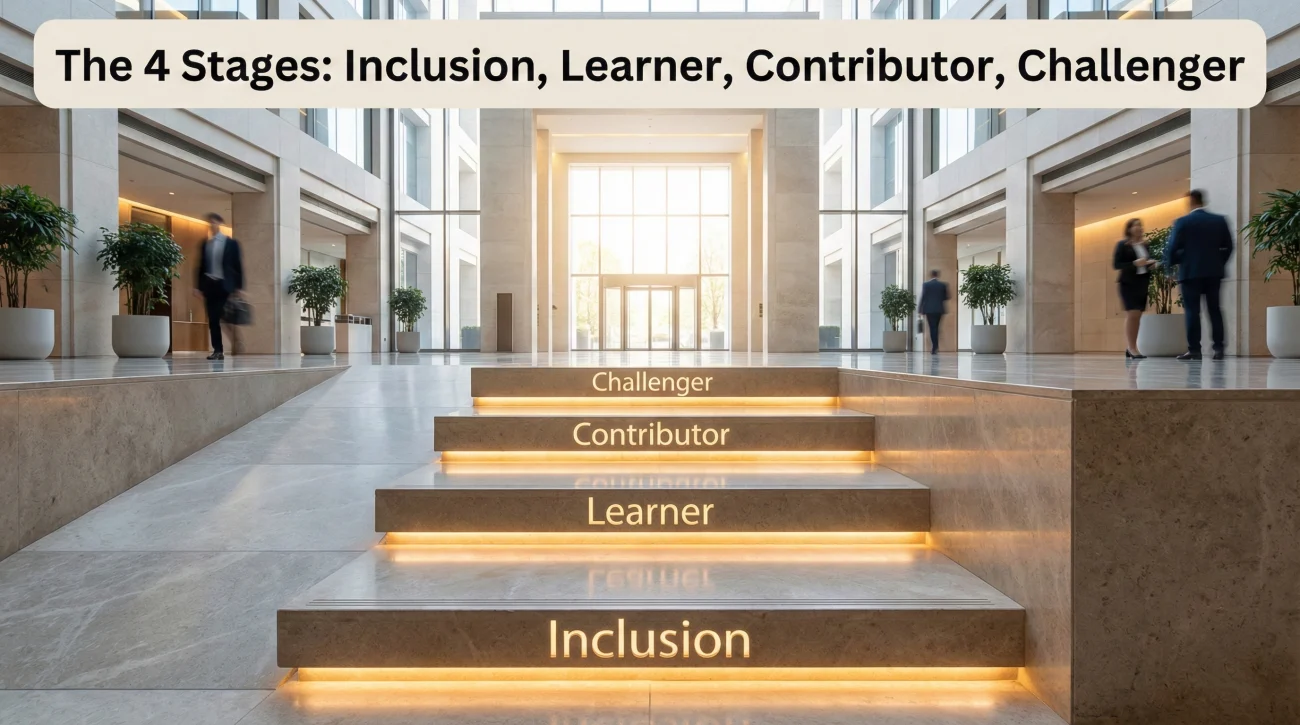
Psychological safety develops progressively. Teams typically move through stages from basic inclusion to full innovation, with each stage building on the previous foundation of trust.
- 🤝 Inclusion Safety: Feeling accepted as a team member
- 📚 Learner Safety: Feeling safe to ask questions and make mistakes while learning
- 💼 Contributor Safety: Feeling safe to contribute fully using your skills
- 💡 Challenger Safety: Feeling safe to challenge status quo and suggest improvements
Why Psychological Safety Enables Conflict Resolution
Understanding creating safe work environment reveals why some teams navigate conflicts productively while others either suppress problems or let them explode into destructive confrontations.
Early Problem Detection and Resolution
Teams with psychological safety catch problems early because people speak up when they notice issues. Teams without it only discover problems when they become catastrophic and impossible to hide. The earlier you address conflicts, the easier they are to resolve.
Expert advice: Google’s Project Aristotle studied hundreds of teams and found psychological safety was the most important factor in team effectiveness – more important than individual talent, resources, or strategy.
Honest Disagreement Without Fear
Psychologically safe teams can disagree vigorously about ideas without people taking it personally or fearing retaliation. This enables better decision-making because bad ideas get challenged rather than implemented to avoid conflict.
| With Psychological Safety | Without Psychological Safety |
|---|---|
| People raise concerns when they notice problems | People stay quiet to avoid being messenger shot |
| Mistakes admitted and corrected quickly | Mistakes hidden until they compound or explode |
| Vigorous debate leads to better decisions | False consensus where everyone pretends to agree |
| Conflicts addressed directly and resolved | Conflicts suppressed publicly, explode privately |
| Innovation happens as people try new approaches | Stagnation as people avoid risking failure |
Learning from Failure
Psychological safety allows teams to treat failures as learning opportunities rather than occasions for blame. When people fear punishment for mistakes, they hide problems, deflect blame, and miss chances to improve processes that led to failures.
In fear-based cultures, the question after failure is “Who screwed up?” In psychologically safe cultures, it’s “What can we learn and what systems need improvement?”
Signs Psychological Safety Exists
Recognizing psychologically safe teams helps you evaluate whether environments foster healthy conflict resolution or suppress necessary disagreements through fear.
Observable Team Behaviors
Psychological safety manifests in concrete behaviors you can observe during interviews or workplace visits. These signals reveal whether team members feel safe taking interpersonal risks.
- ✅ People ask questions freely: Including “dumb” questions without ridicule
- ✅ Mistakes admitted openly: Team members say “I messed up” without fear
- ✅ Disagreements happen publicly: People challenge ideas in meetings, not just hallway whispers
- ✅ Risks get taken: Team tries new approaches despite failure possibility
- ✅ Humor and laughter present: Lightness indicates comfort, not fear
Communication Patterns
How team members talk to each other – and especially to leadership – reveals psychological safety levels. Safe teams challenge authority respectfully, admit uncertainty, and offer dissenting opinions without coded language or excessive hedging.
Expert advice: Notice who speaks in meetings and how leadership responds to challenges. If only senior people talk or if leaders shut down dissent, psychological safety is low regardless of what the company claims about open culture.
Red Flags of Low Psychological Safety
Fear-based environments create specific patterns that signal psychological safety doesn’t exist. Recognizing these red flags during interviews helps you avoid toxic workplaces where conflict resolution becomes impossible.
Silence and Self-Censorship
The most obvious sign of low psychological safety is what you don’t hear. People stay quiet in meetings, avoid asking questions, and only speak when called upon. Silence doesn’t mean agreement – it means fear.
| Red Flag Behavior | What It Signals |
|---|---|
| Silent meetings where only leadership speaks | Fear of speaking up or challenging authority |
| People avoiding eye contact or looking down | Trying to stay invisible to avoid attention |
| Excessive politeness and formal language | Fearful compliance rather than authentic engagement |
| Information shared only in private conversations | People afraid to speak candidly in public settings |
| Leaders answering their own questions | Team doesn’t feel safe offering input |
Blame Culture Indicators
Environments that punish mistakes destroy psychological safety. Watch for how leaders respond to failures – do they ask “what happened and how do we prevent it?” or “who screwed up and how do we punish them?”
- Public criticism or humiliation of team members
- Focus on finding culprits rather than fixing systems
- Defensive responses to any questioning or feedback
- People covering tracks and deflecting blame
- Mistakes hidden until they become catastrophic
If leaders publicly criticize or humiliate team members, psychological safety is absent. No amount of team-building activities or claimed values will overcome leadership behavior that creates fear.
How Leaders Build Psychological Safety
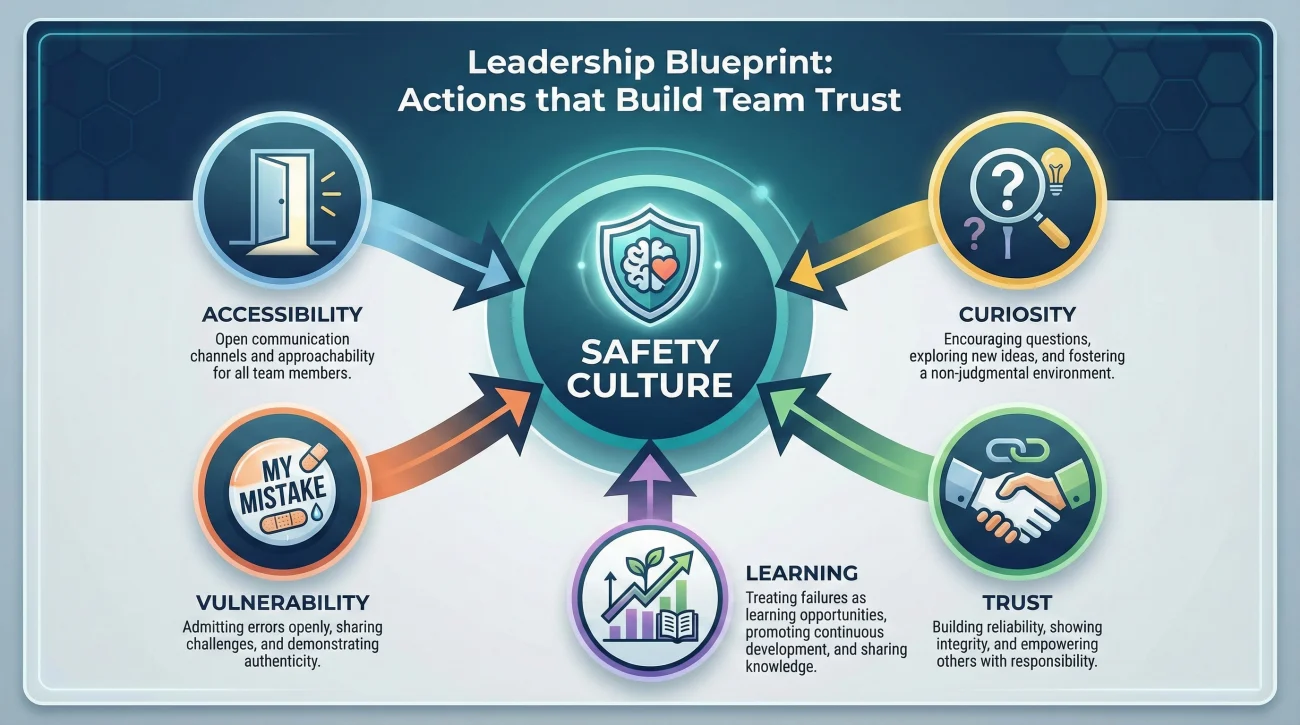
Creating trust in workplace teams requires consistent leadership behaviors that signal it’s safe to take interpersonal risks. Single actions don’t establish safety – patterns of response to vulnerability, mistakes, and dissent build trust over time.
Essential Leadership Behaviors
Leaders create psychological safety through how they respond when people speak up, admit mistakes, or challenge ideas. Responses either reinforce that it’s safe to take risks or teach people to stay quiet and avoid attention.
- 🎯 Acknowledge own mistakes: Leaders who admit errors model that mistakes are learning opportunities
- 💬 Ask genuine questions: Curiosity signals interest in others’ perspectives
- 🤝 Thank people for dissent: “I appreciate you raising that concern” reinforces challenging authority
- 📊 Frame failure as learning: “What did we learn?” instead of “Who messed up?”
- ✅ Act on input: When people see their ideas implemented, they keep contributing
Expert advice: Leaders build psychological safety by responding well when challenged, not by never being challenged. How you handle dissent determines whether people will risk disagreeing with you again.
Team Norms and Structures
Beyond individual leader behavior, team structures and norms either support or undermine psychological safety. Explicit agreements about how to handle mistakes, disagreements, and failures create shared understanding of what’s acceptable.
| Safety-Building Norm | How It Helps |
|---|---|
| Blameless post-mortems after failures | Focus on systems improvement, not punishment |
| Regular retrospectives for process feedback | Creates dedicated space for sharing concerns |
| Celebrating productive disagreements | Reinforces that debate improves decisions |
| Anonymous feedback mechanisms | Allows surfacing sensitive issues safely |
| Clear escalation paths for concerns | People know how to raise issues beyond immediate team |
Assessing Psychological Safety in Interviews
Smart candidates evaluate psychological safety during interviews to avoid joining fear-based environments where conflict resolution becomes impossible and mistakes get punished rather than learned from.
Questions to Reveal Safety Levels
Ask questions that invite examples of how teams handle mistakes, disagreements, and challenges. Listen for specific stories versus vague corporate platitudes about “open culture.”
- “Tell me about a time when someone on the team made a mistake. How was it handled?”
- “Describe a recent disagreement within the team and how it was resolved”
- “How does leadership respond when team members raise concerns or challenge decisions?”
- “What happens when someone tries a new approach that doesn’t work out?”
💡 Pro tip: Pay attention to whether interviewers give specific examples or speak in generalities. Real psychological safety produces concrete stories about mistakes, disagreements, and learning. Generic answers about “open communication” signal aspirational culture, not reality.
Observe Team Dynamics
Watch how interviewers interact with each other and with you. Do junior people speak freely? Do team members challenge each other’s ideas? Does leadership welcome questions or seem defensive? These observations reveal more than any claimed values.
❓ FAQ
🎯 Can psychological safety exist without strong leadership?
Rarely. While team members can treat each other with respect, true psychological safety requires leadership creating conditions where people feel safe challenging authority and admitting mistakes without punishment. Leaders either build safety through their responses or destroy it through fear-inducing reactions.
💼 Does psychological safety mean lowering standards?
No. High-performing teams often have both high standards and high psychological safety. Safety allows people to admit when they’re struggling and ask for help before problems escalate. Without safety, people hide difficulties until they become disasters. Accountability and safety are compatible – punishment and safety are not.
⏰ How long does it take to build psychological safety?
Building safety takes consistent positive interactions over months. Destroying it takes one incident of punishing vulnerability. Leaders build safety slowly through repeated demonstrations that speaking up is safe. They destroy it instantly through public humiliation, retaliation, or punishing mistakes. Trust accumulates slowly but disappears quickly.
📋 Can you have psychological safety with some team members but not others?
Partial safety is common but problematic. If only certain people feel safe speaking up – typically those similar to leadership or with seniority – the team loses diverse perspectives. True psychological safety means everyone, regardless of rank or background, feels equally safe taking interpersonal risks.
✨ What if I’m in a low psychological safety environment?
If you’re not in leadership, you can’t single-handedly create psychological safety – it requires leader commitment. You can model desired behaviors in your sphere of influence and build safety within smaller groups. Long-term, consider whether staying in a fear-based environment aligns with your career development needs and values.
Final Thoughts
Understanding psychological safety at work explains why some teams navigate conflicts productively while others suppress problems until they explode. Safety doesn’t eliminate conflict – it enables healthy conflict resolution by creating environments where people speak up about concerns, admit mistakes openly, and challenge ideas without fearing punishment or humiliation.
Teams with psychological safety address problems early when they’re manageable, learn from failures instead of hiding them, and engage in vigorous debates that improve decisions. Teams without it suppress dissent, hide mistakes until they compound, and create false consensus where everyone pretends to agree while privately doubting decisions. The presence or absence of psychological safety determines whether conflicts become opportunities for growth or sources of toxicity.
Building psychological safety requires consistent leadership behaviors that respond well to vulnerability, mistakes, and dissent. Single actions don’t establish trust – patterns of response over time teach people whether it’s safe to take interpersonal risks. Leaders create safety by acknowledging their own mistakes, genuinely soliciting input, thanking people for challenging ideas, and framing failures as learning opportunities rather than occasions for blame. Without this foundation, all other conflict resolution techniques fail because people won’t surface problems in the first place.
⚠️ Disclaimer: The interview strategies, sample answers, and negotiation tips provided in this guide are for educational purposes only. Hiring decisions are subjective and vary by company and industry. While these strategies are based on professional HR standards, they do not guarantee a specific job offer or result.