The Final Touchpoint of the Customer Journey
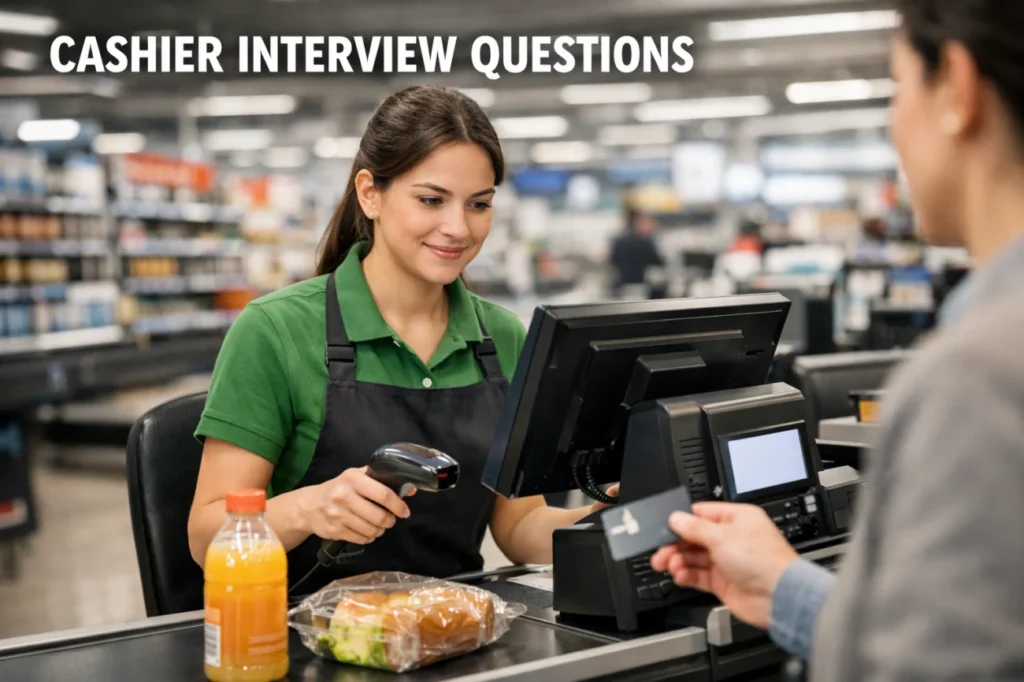
Retail cashier interview questions are designed to test two critical traits: Integrity and Efficiency. In the modern retail environment, the role of a cashier has moved beyond simple scanning. You are the last person the customer sees, the gatekeeper of the store’s revenue, and the first line of defense against fraud. Hiring managers need to know that you can handle thousands of dollars accurately while maintaining a smile during a rush.
Interviewers will focus on your ability to multitask. Can you memorize PLU codes while engaging in small talk? Can you spot a counterfeit bill without offending the customer? Can you troubleshoot a frozen POS terminal without panicking? This guide covers the essential Accuracy & POS strategies you need to prove you are a trustworthy and skilled professional.
Behavioral & Integrity Questions
Q: Describe a time you made a mistake with cash. How did you handle it?
Why they ask: Everyone makes mistakes. They want to know if you are honest enough to own it. Hiding a shortage is a fireable offense; admitting it shows integrity.
Sample Answer: In my previous role, I once gave a customer $10 extra in change because two bills were stuck together. I realized it when I balanced my drawer at the end of the shift and was short. I immediately reported the discrepancy to my manager rather than trying to cover it up. We reviewed the camera footage, confirmed the error, and I voluntarily underwent retraining on cash handling techniques to ensure it didn’t happen again. My manager appreciated my honesty.
Q: What would you do if you saw a coworker stealing from the register?
Why they ask: This is a direct integrity test. There is only one right answer.
Sample Answer: I would report it to the manager or Loss Prevention immediately. Theft hurts the entire team because it affects the store’s profitability and our potential bonuses or hours. I would not confront the coworker directly to avoid a conflict, but I would provide the time and details to the proper authority. I believe in maintaining a strictly honest work environment.
Q: How do you handle repetitive tasks without losing focus?
Why they ask: Cashiering can be monotonous. Loss of focus leads to errors.
Sample Answer: I turn it into a personal challenge. I set mini-goals for myself, like trying to improve my “Items Per Minute” (IPM) score while maintaining 100% accuracy. I also focus on the customer interaction. Every person is different, so engaging with them keeps the job fresh. Staying mentally active prevents me from going into “autopilot” mode where mistakes happen.
Q: How do you define “Excellent Customer Service” as a cashier?
Why they ask: It’s not just about speed. It’s about the feeling the customer leaves with.
Sample Answer: Excellent service is the balance of speed, accuracy, and warmth. It means scanning their items efficiently so they aren’t waiting, but also making eye contact and thanking them sincerely. It’s checking the eggs to make sure they aren’t cracked before bagging them. It’s ending their shopping trip on a high note so they look forward to coming back.
Situational Scenarios & Crisis Management
A customer presents a coupon that is expired or valid only for a different item.
I scan it first to see if the system accepts it. If it rejects, I explain politely: “I’m sorry, the system isn’t accepting this coupon because it expired last week.” I show them the date on the coupon.
If they get upset, I look for a solution. If the store policy allows, I might offer a generic store discount or check our app for a valid digital coupon. I try to save them money in a different way to soften the disappointment, but I do not override the system unless authorized.
An item does not scan, and the customer jokes, “It must be free!”
I laugh politely because I hear this joke ten times a day. I say, “I wish I had that power! Let me just look up the code.” I keep the mood light.
I quickly type in the item description or check the PLU list. If I can’t find it, I call for a price check immediately (“Code 4 on Register 3”). While waiting, I continue scanning their other items so the transaction doesn’t stall. I apologize for the delay and thank them for their patience.
You suspect a bill the customer handed you is counterfeit.
I remain calm and do not accuse them. Often, customers don’t know they have a fake bill. I use the detector pen or check the watermark and security thread discreetly.
If it looks fake, I hand it back and say, “I’m sorry, my manager requires us to double-check large bills, and this one isn’t passing our security check. Do you have another form of payment?” I put the burden on “store policy” rather than accusing them of a crime. If they act suspicious or aggressive, I alert security.
Technical Skills & Operations
Q: What is your process for balancing your drawer at the end of a shift?
I follow a strict routine. First, I organize the bills and coins. I count the cash twice to ensure accuracy. I compare the total against the “Z-Read” or system report.
If there is a discrepancy, I recount immediately. I verify checks and credit card slips. I ensure I leave the required “starting bank” (e.g., $200) for the next shift. I sign off on the deposit slip only when I am 100% confident in the numbers.
Q: How do you handle a rush with a long line?
I focus on the customer in front of me, not the line. Rushing causes errors which take longer to fix. I use “two-handed scanning” to maximize speed.
I acknowledge the customers waiting: “Thanks for waiting, I’ll be right with you!” If the line exceeds the store’s limit (e.g., 3 people), I page for backup immediately. I maintain my rhythm – scan, bag, payment – without panicking.
Q: How do you handle age-restricted items (Alcohol/Tobacco)?
I Card Everyone (or adhere strictly to the “Under 40” visual check policy). I ask for ID before scanning the item. I hold the ID in my hand to verify the date of birth and the photo.
I do not accept expired IDs or photos of IDs on a phone. If a customer gets angry, I say, “I’d love to sell this to you, but I could lose my job and get fined if I don’t scan a valid ID.” I never compromise on legal compliance.
Q: What experience do you have with POS systems?
I am proficient with systems like [Square, NCR, Shopify, Toast]. I know how to process split payments, handle tax-exempt transactions, and issue gift receipts.
I am also comfortable with PLU (Price Look-Up) codes for produce. I memorize the common ones (Bananas 4011) quickly to avoid looking them up every time. I am quick to learn new touchscreen interfaces.
Q: How do you handle returns without a receipt?
I listen to the customer and ask if they used a credit card or loyalty account so I can look up the transaction. This protects the store from fraud.
If we can’t find it, I follow strict store policy – usually offering a merchandise credit for the current selling price, not cash. I ask for their ID to log the return (to track serial returners). I explain the policy clearly so they understand I am helping as much as I can within the rules.
Q: What are your bagging techniques?
Bagging is part of product safety. I always separate chemicals (cleaning supplies) from food. I put heavy items (cans, jars) on the bottom and fragile items (bread, eggs) on top.
I group cold items together to keep them cool. I ask the customer, “Would you like milk in a bag?” as some prefer handles. Good bagging prevents breakage and shows care for their purchase.
Customer Service & Sales
Q: How do you handle a customer who claims a price is wrong?
Why they ask: Pricing errors happen. They want to see if you can resolve conflict without holding up the line.
Sample Answer: I check the screen immediately. If the difference is small (under $5) and store policy allows, I override it to “Customer Satisfaction” to keep the line moving. If it’s a large difference, I ask a floor associate to do a price check. I apologize for the confusion. If the customer is right, I thank them for catching the error. I prioritize the relationship over a few cents.
Q: How do you promote the store credit card or loyalty program?
Why they ask: Cashiers are expected to sell. They need to hear you are comfortable pitching.
Sample Answer: I use a “Benefit-First” approach. Instead of asking “Do you want a credit card?”, I look at their total and say, “You’re buying $100 worth of stuff today; if you open a card, I can save you $20 right now.” Showing them the immediate math makes it a rational choice rather than a sales pitch. If they say no, I smile and move on without being pushy.
Q: A customer’s card is declined. How do you handle it discreetly?
Why they ask: This is an embarrassing moment. Your reaction defines the experience.
Sample Answer: I lower my voice and blame the machine. I say, “It looks like the chip reader is being finicky and didn’t take that. Do you want to try sliding it or using a different card?” I never say “Declined” loudly. I stay calm and patient, giving them time to check their banking app or find cash. I treat them with dignity.
Cashier Skills Quiz
Take the 20-Question Challenge
1. The code “4011” is universally known in retail for:
- Apples
- Bananas
- Oranges
- Onions
2. “Balancing the drawer” means:
- Making sure the drawer is physically level
- Ensuring the cash in the till matches the sales report exactly
- Counting the tips
- Asking for a raise
3. If a customer is buying cleaning supplies and raw meat, you should:
- Bag them together to save plastic
- Bag them separately to prevent contamination
- Tell them to buy fewer items
- Put the meat on top of the bleach
4. “PLU” stands for:
- Price Look Up
- Price Look-Up
- Product Line Unit
- Public Listed Unit
5. When checking a $100 bill, you should look for:
- A picture of George Washington
- The color-shifting ink, watermark, and security thread
- The store logo
- A signature on the back
6. If you are short $20 at the end of the shift, you should:
- Put $20 from your pocket into the register
- Report it to the manager immediately
- Change the report numbers
- Borrow from another register
7. “Split Payment” means:
- Creating two receipts
- Paying for one transaction using two different methods (e.g., Cash + Card)
- Splitting the items into two bags
- Paying half now, half next month
8. “Voiding” a transaction usually requires:
- A customer signature
- A manager’s approval or key card
- Restarting the computer
- Calling the police
9. The most secure way to accept a credit card is:
- Typing the numbers manually
- Using the Chip Insert or Tap (NFC) method
- Swiping the magnetic stripe
- Writing the numbers on paper
10. “Facing” bills means:
- Looking at the money
- Organizing bills so they all face the same direction and are right-side up
- Drawing faces on them
- Counting them out loud
11. If a customer refuses to show ID for alcohol, you must:
- Sell it anyway if they look old
- Refuse the sale politely but firmly
- Ask them to promise they are 21
- Call their parents
12. “Cash Back” is a feature where:
- The store returns money for bad service
- Customers can withdraw cash from their debit account during a purchase
- The cashier keeps the change
- Items are free
13. When giving change, it is best practice to:
- Hand it over in a wad
- Count it back aloud to the customer
- Throw it on the counter
- Keep the pennies
14. A “Rain Check” is:
- Checking the weather
- A voucher allowing a customer to buy an out-of-stock sale item later at the sale price
- A receipt for an umbrella
- A refund for wet items
15. “PCI Compliance” relates to:
- Food safety standards
- Credit card data security standards
- Parking lot rules
- Employee dress code
16. If a child is screaming in line, you should:
- Yell at the child
- Smile at the parent, be patient, and maybe offer a sticker if allowed
- Close your register
- Tell the parent to leave
17. “Bob” in retail acronyms (LISA/BOB) stands for:
- Bring Own Bag
- Bottom of Basket (checking for hidden items)
- Be on Break
- Back of Box
18. The “Till” refers to:
- The time clock
- The removable drawer insert that holds the money
- The floor manager
- The bathroom key
19. If scanning an item prompts “Call Manager,” it likely means:
- You are fired
- The item is restricted, recalled, or needs an override
- The internet is down
- The customer is banned
20. Speed is important, but accuracy is:
- Optional
- Critical (Speed comes with practice, accuracy is a mindset)
- Less important than speed
- Only for managers
❓ FAQ
🦵 Do I have to stand all day?
In the US, yes, most cashiers stand for their entire shift (except breaks). Comfortable shoes and anti-fatigue mats are essential. In some European retailers (like Aldi), cashiers sit, but standing is the industry standard here to show “readiness.”
🧮 Do I need to be good at math?
The POS does the hard math (calculating change), but you need “Mental Math” skills. You need to know that if a bill comes to $10.05 and they hand you $20.05, the change is $10. You also need to count back change confidently if the screen goes dark.
🚽 What if I need the bathroom during a rush?
You cannot just leave your register unattended with cash in it. You must turn on your blinking light or call a manager to cover you. It is a job where you have to plan your breaks, unfortunately.
🛡️ Is the job dangerous?
Cashiers are targets for robbery, but it is rare. Stores have strict “Robbery Protocols” (usually: comply, don’t resist, observe). Your safety is always more important than the money. Most modern stores also have minimal cash on hand due to card usage.
🤝 Is this a dead-end job?
No. It teaches responsibility, money management, and conflict resolution. Many Customer Service Managers, Bookkeepers, and Bank Tellers started as cashiers. It is the best place to learn how the business actually makes money.
Final Thoughts
To land the job, your answers to retail cashier interview questions must highlight your reliability. Managers lose sleep over two things: theft and angry customers. If you can prove that your drawer will always balance and your customers will always leave happy, you will be hired on the spot.
Remember that speed comes with practice, but integrity is a choice you make every day. By demonstrating a solid grasp of POS operations and a commitment to protecting the store’s assets, you position yourself not just as a cashier, but as a trusted financial guardian of the business.
⚠️ Disclaimer: The interview strategies, sample answers, and negotiation tips provided in this guide are for educational purposes only. Hiring decisions are subjective and vary by company and industry. While these strategies are based on professional HR standards, they do not guarantee a specific job offer or result.