The Frontline of the Brand Experience
Retail interview questions have evolved significantly. Gone are the days when hiring managers only cared if you could operate a cash register and show up on time. In the modern retail landscape, the physical store has become an “experience hub.” Hiring committees are looking for candidates who are part brand ambassador, part visual merchandiser, and part data analyst. They want to know: Can you use a tablet to save a sale? Do you understand the difference between upselling and cross-selling? Can you spot potential shrinkage before it happens?
The rise of “Omnichannel” retailing – where online and offline shopping merge – means you might be fulfilling a “Buy Online, Pick Up In-Store” (BOPIS) order one minute and styling a mannequin the next. Interviewers will test your adaptability, your tech-savviness, and your emotional intelligence. They are looking for the “Human Element” that e-commerce algorithms cannot replicate: genuine empathy and personalized persuasion.
This comprehensive guide covers the full spectrum of the retail floor. We explore advanced strategies for merchandising, mastering the art of the soft sell, handling operational crises, and navigating complex customer interactions. Whether you are applying for a seasonal sales role or a department lead position, these answers will help you prove that you are not just an employee, but a revenue-generating asset to the store.
Behavioral & Adaptability Questions
Q: Tell me about a time you turned a negative customer experience into a positive one.
Why they ask: This is the classic “Service Recovery” question. Retailers know mistakes happen; they want to know if you panic or problem-solve. They are looking for the “LEAST” method (Listen, Empathize, Apologize, Solve, Thank) or a similar framework.
Sample Answer: I once had a customer who was furious because the item she reserved online was sold by mistake before she arrived. She needed it for an event that night. I listened to her frustration without interrupting and apologized sincerely for the system error. Instead of just saying “sorry,” I immediately checked inventory at our nearby locations. I found the item at a store 15 minutes away. I called them to physically hold it, arranged for a store transfer courier to bring it to her home within two hours, and offered her a 15% discount on her next purchase for the inconvenience. She left the store calm, and later wrote a positive review about how we went the extra mile to save her evening.
Q: How do you handle a slow day when there are few customers in the store?
Why they ask: Managers hate “leaners” – employees who stand around checking their phones when foot traffic is low. This question tests your initiative and work ethic. They want to hear that you are self-directed and focus on “non-selling revenue activities.”
Sample Answer: I view downtime as “preparation time.” If there are no customers to assist, I shift my focus to store standards. I start by “zoning” or “facing” the shelves to ensure products are pulled forward and organized. I check the fitting rooms for discarded items to return to the floor. I also use this time to restock low inventory from the backroom or update price tags if there are new markdowns. If the store is immaculate, I take time to study the new arrivals so I can speak knowledgeably about the fabrics and features when customers do come in. There is always something to do in retail.
Q: Describe a time you had to adapt to a sudden change in policy or procedure.
Why they ask: Retail changes fast. New POS systems, new return policies, or new safety protocols are common. They need someone who is flexible and doesn’t complain about “how we used to do it.”
Sample Answer: At my previous job, the company switched from a traditional register to mobile POS tablets overnight. Many staff were frustrated with the learning curve. I embraced the change immediately by downloading the training manual at home. The next day, I helped train two of my colleagues who were struggling with the interface. I focused on the benefits – we could now check out customers in the fitting room area, reducing line abandonment. My positive attitude helped stabilize the team’s morale during the transition.
Q: How do you balance attending to a customer while completing a time-sensitive task?
Why they ask: Retail is a constant juggling act between “Tasking” (stocking, folding) and “Selling.” The correct answer is always: Customer First.
Sample Answer: The customer is the priority, always. If I am in the middle of a complex planogram reset and a customer approaches, I stop immediately to assist them. However, I communicate effectively. I might say, “I’d be happy to help you find that size. Let me just place this box safely on the cart so it’s not a tripping hazard.” Once the customer is served, I return to the task. If the store is busy, I might ask a colleague to cover the floor while I finish the urgent reset, but I never ignore a shopper to finish a task.
Sales Techniques & Merchandising Strategy
Q: What is the difference between Upselling and Cross-selling? Give examples.
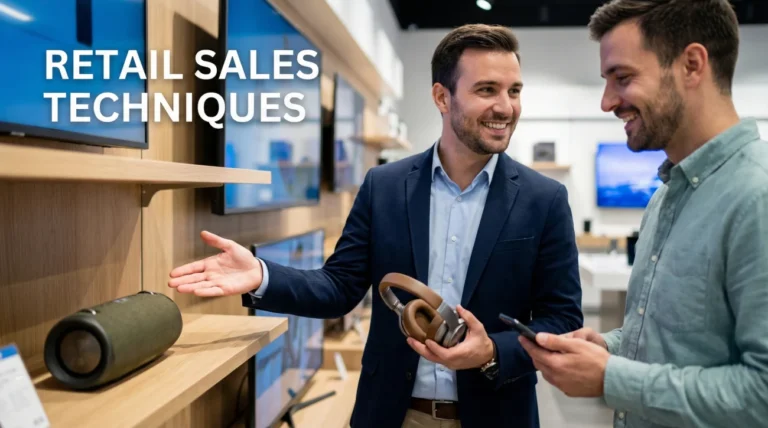
Upselling is persuading the customer to buy a more expensive version of the item they are looking at. For example, if a customer is looking at a basic 32GB tablet, I might explain the benefits of the 64GB model with a better processor for only $50 more, highlighting how it will last them longer.
Cross-selling is suggesting complementary items that add value to the original purchase. If that same customer buys the tablet, I would cross-sell a protective case, a screen protector, or a stylus. The goal isn’t just to increase the ticket size, but to ensure the customer has the complete solution they need.
Q: How do you approach a customer who says “I’m just looking”?
I respect their space but keep the connection open. The phrase “Just looking” is often a defense mechanism against aggressive salespeople. I respond with a warm, “That’s great! Take your time. My name is [Name], and I’ll be over there folding shirts if you have any questions.”
I then use the “check-back” technique. After a few minutes, if I see them lingering on a specific item, I re-approach with a specific comment, not a generic “Can I help you?”. I might say, “That jacket is one of our new arrivals; the waterproof lining is really popular for this season.” This transitions the interaction from sales pressure to helpful product knowledge.
Q: What are the key principles of Visual Merchandising you follow?
I follow the rule of “Sight Lines” and “Color Stories.” Products should be arranged to draw the eye from the entrance to the back of the store. I use the “Pyramid Principle” for table displays, building height in the center or back to create visual interest rather than a flat surface.
I also prioritize “Facing” and “Density.” Shelves should look full but not cluttered. I ensure size runs are organized (Left to Right, Small to Large). An organized display suggests a high-value product; a messy pile suggests a discount bin. My goal is to make the product look irresistible.
Q: How do you track and improve your KPIs (Key Performance Indicators)?
I focus on UPT (Units Per Transaction) and ADS (Average Dollar Sale). If my UPT is low, it means I am not cross-selling enough. I make a conscious effort to suggest add-ons like socks with shoes or batteries with electronics.
I also track my Conversion Rate. If I speak to 10 people and only 1 buys, I need to improve my closing techniques. I review my performance daily, not just monthly. I ask my manager for feedback on my interactions to identify where I might be losing the sale.
Q: How do you handle merchandise that isn’t selling (Dead Stock)?
First, I check the placement. Is it hidden on a bottom shelf or in a “dead zone” of the store? Often, simply moving an item to eye level or an end-cap can revive interest. I might re-style it on a mannequin to show customers how to wear it.
If it still doesn’t sell, I ensure the signage is clear and the price is correct. Sometimes a missing price tag kills a sale because customers don’t want to ask. If I’ve tried everything, I provide this feedback to the Store Manager so they can make a data-driven decision on a markdown or a return to vendor.
Q: What is “Clienteling” and how do you use it?
Clienteling is building long-term relationships with customers rather than focusing on a one-time transaction. I use the store’s CRM tool or a client book to note down customer preferences, sizes, and past purchases.
For example, if I know a customer loves a specific brand of denim, I will text or email them (with permission) when the new collection drops. I send thank-you notes for large purchases. This personal touch turns a casual shopper into a loyal brand advocate who comes back specifically to see me.
Situational Scenarios & Crisis Management
You suspect a customer is shoplifting. What do you do?
I follow the company’s “Loss Prevention” policy strictly. In most retail environments, I am not authorized to accuse or physically stop a shoplifter due to safety and liability risks. Instead, I use “Aggressive Hospitality.”
I approach the individual and offer excessive customer service: “Can I help you hold those items at the register?” or “Do you need a basket for that?” This lets them know they are being watched without making an accusation. I alert my manager and security immediately. I maintain visual contact but never put myself in physical danger. My goal is to deter the theft, not to be a hero.
A customer’s credit card is declined, and they are embarrassed. How do you handle it?
I handle this with extreme discretion and empathy to preserve the customer’s dignity. I never say “Declined” loudly. I lower my voice and say, “It looks like the system is having trouble reading this card today. Do you have another method of payment we could try?”
I blame the “system” or the “chip reader” to take the fault away from them. If they don’t have another card, I offer to suspend the transaction and hold the items for them until the end of the day so they can call their bank. I treat them with the same respect as if the card had gone through.
You are the only cashier, and the line is getting long. Customers are getting annoyed.
Communication is key. I acknowledge the line immediately. I make eye contact with the people waiting and say, “Thank you for your patience, folks! I’ll be with you as fast as I can.” This simple acknowledgement reduces tension.
I then call for backup using the headset or paging system: “Code 3 to the front” or “Backup cashier needed.” While scanning, I work efficiently but don’t rush to the point of making errors. When the customer reaches the front, I apologize for the wait: “Thanks for sticking with me.” Most customers are understanding if they see you are working hard and acknowledging them.
Operations, Tech & Loss Prevention
Q: How do you ensure inventory accuracy?
Why they ask: Inventory shrinkage (loss) kills profit. They need to know you understand the connection between physical counting and system data.
Sample Answer: Accuracy starts at the register. I double-check that I am scanning the correct SKU, especially for items that look similar (like different flavors or sizes). I don’t just quantity-key (e.g., typing “5x” instead of scanning 5 times) unless I am 100% sure they are identical. During shipment processing, I verify the packing slip against the physical goods before signing off. If I find a discrepancy or a tag on the floor, I investigate immediately rather than ignoring it. Accurate data ensures the system reorders the right product.
Q: What is your experience with POS (Point of Sale) systems?
Why they ask: They want to know if they need to train you from scratch. Even if you haven’t used their specific system, showing tech confidence is key.
Sample Answer: I have extensive experience with [System Names like Shopify, Lightspeed, Salesforce, or Oracle]. I am comfortable with complex transactions including split payments, returns without receipts (following protocol), and gift card redemptions. I am also quick to learn new interfaces. In my last role, I was a “Super User” who helped troubleshoot minor printer jams or connectivity issues so we didn’t have to wait for IT support during a rush.
Q: How do you handle a return that doesn’t fit the return policy?
Why they ask: This tests your judgment. Are you a “Rule Follower” or a “Customer Pleaser”? The right answer is a balance.
Sample Answer: I listen to the customer’s reason first. If the item is clearly worn or damaged by the customer, I stand by the policy firmly but politely: “I can’t accept this return because it shows signs of wear, which prevents us from reselling it.” If it’s a gray area (e.g., 1 day past the 30-day window but item is pristine), I might make a “one-time exception” to keep the customer loyal, emphasizing that I am doing this for them. If the customer escalates, I involve a manager. I document the interaction so there is a record.
Q: Why is “Shrinkage” a concern for a sales associate, not just a manager?
Why they ask: They want to see if you have “Ownership” mentality.
Sample Answer: Shrinkage affects everyone. It’s not just theft; it’s administrative errors, damaged goods, and vendor fraud. If shrinkage is high, the store loses profit, which impacts the hours budget and potential bonuses for the staff. As an associate, I prevent shrink by being accurate at the register, keeping the floor tidy to prevent damage, and providing great customer service to deter theft. I treat the inventory as if I paid for it myself.
Retail Knowledge & Scenarios Quiz
Take the 20-Question Challenge
1. “BOPIS” stands for:
- Buy On Phone, In Store
- Buy Online, Pick Up In-Store
- Bring Our Product In Store
- Best Online Price Is Standard
2. “Shrinkage” refers to:
- Clothes getting smaller in the wash
- Loss of inventory due to theft, error, or damage
- Reducing the staff count
- A discount promotion
3. A “Planogram” is:
- A schedule for staff shifts
- A visual diagram of where products should be placed on shelves
- A marketing plan for Instagram
- A fire safety map
4. “FIFO” is a stocking method that stands for:
- Fit In, Fit Out
- First In, First Out (selling older stock first)
- Fast In, Fast Out
- First In, Final Offer
5. “UPT” is a KPI measuring:
- Units Per Time
- Units Per Transaction
- Universal Price Tag
- Users Per Tablet
6. An “End-Cap” is located:
- In the backroom
- At the end of an aisle, used for promotional displays
- At the checkout counter only
- On the ceiling
7. “Clienteling” is best described as:
- Cleaning the store for clients
- Building long-term relationships with individual customers to drive sales
- Arguing with clients
- Checking client IDs
8. A “SKU” (Stock Keeping Unit) is:
- A brand name
- A unique alphanumeric code identifying a specific product
- A type of shelving unit
- A security guard code
9. “Facing” or “Zoning” the store means:
- Smiling at customers
- Pulling product to the front of the shelf to make it look full
- Counting the money in the safe
- Closing the store for the night
10. “Conversion Rate” in retail measures:
- How many people return items
- The percentage of store visitors who actually make a purchase
- Converting currency
- The speed of the checkout line
11. If a customer is angry, you should first:
- Tell them to calm down
- Listen actively and empathize without interrupting
- Call security immediately
- Walk away
12. “Point of Sale” (POS) refers to:
- The marketing poster in the window
- The system/place where the transaction is completed (register)
- The worst product in the store
- The manager’s office
13. A “Loss Leader” is:
- A manager who loses money
- A product sold at a loss to attract customers into the store
- A stolen item
- A lost shipment
14. “Dead Stock” is inventory that:
- Is made of animal products
- Has not sold for a long period of time
- Is damaged and unsellable
- Has been stolen
15. To safely lift a heavy box, you should:
- Bend your back
- Bend your knees and lift with your legs
- Ask a customer to do it
- Drag it across the floor
16. “Omnichannel” retailing means:
- Selling only one channel of products
- Providing a seamless shopping experience across online, mobile, and brick-and-mortar
- Selling only on TV
- Playing music in the store
17. “Mystery Shoppers” are:
- Customers who steal
- Evaluators hired to assess store service and compliance anonymously
- Lost customers
- New employees in training
18. Suggesting a tie to go with a shirt is an example of:
- Upselling
- Cross-selling
- Downselling
- Short-selling
19. “Markdown” refers to:
- Writing on the wall
- A permanent reduction in price to clear inventory
- Marking a defect on a product
- The store opening procedure
20. The most effective deterrent to shoplifting is:
- Locking the doors
- Excellent customer service and acknowledging every guest
- Yelling at teenagers
- Hiding in the backroom
❓ FAQ
👕 Is there a strict dress code?
Yes, almost always. It varies by brand. Luxury stores may require business attire (suits/dresses), while casual brands may allow jeans but require you to wear the current season’s merchandise. Always ask about the dress code before your first day, and for the interview, dress “one level up” from what the staff wears.
🗓️ Do I have to work weekends and holidays?
In retail, yes. Weekends and holidays are the “Prime Time” for sales. If you have zero flexibility for nights, weekends, or Black Friday, retail might be difficult. However, many managers are willing to work with school schedules if you communicate your availability clearly during the interview.
🦵 Is the job physically demanding?
More than you think. You will be on your feet for 8+ hours, climbing ladders, lifting boxes (up to 25-50 lbs), and moving constantly. Comfortable shoes are your most important tool. It is an active job, which many people prefer over sitting at a desk.
💰 Is there commission?
It depends on the sector. Electronics, luxury fashion, jewelry, and furniture often have commission structures (either individual or team pooled). General apparel and grocery usually pay an hourly wage. Always clarify the compensation structure so you understand how your performance impacts your paycheck.
📈 Can I grow a career in retail?
Absolutely. Retail has a very clear promotion path: Sales Associate → Keyholder → Assistant Manager → Store Manager → District Manager. Many corporate executives started folding shirts on the sales floor. If you show leadership, reliability, and business acumen, you can move up quickly.
Final Thoughts
To secure a position in today’s competitive market, your responses to retail interview questions must showcase more than just friendliness. You need to demonstrate “Commercial Awareness.” Stores need problem solvers who understand that every interaction is an opportunity to build the brand and secure revenue. By highlighting your ability to merge exceptional service with operational efficiency and merchandising savvy, you prove that you are the complete package ready for the sales floor of tomorrow.
⚠️ Disclaimer: The interview strategies, sample answers, and negotiation tips provided in this guide are for educational purposes only. Hiring decisions are subjective and vary by company and industry. While these strategies are based on professional HR standards, they do not guarantee a specific job offer or result.