When the Answer Is a Part Number
A customer slides a greasy bolt onto the counter and says, “I need this.” The phone starts ringing with a shop asking for brake pads, and the line behind the customer is not getting shorter. That is the world behind auto parts specialist interview questions.
Parts work is a blend of detective work and discipline. You ask the right questions, verify fitment, and stay calm when people are frustrated or in a hurry. You also protect the store: clean documentation, smart inventory habits, and consistent security awareness so shrink does not quietly eat your margins.
In this guide, focus your answers on speed with accuracy. Show that you can use an Electronic Parts Catalog (EPC), confirm details without guessing, and handle both DIY customers and pro mechanics without losing control of the counter.
Technical Knowledge & Cataloging
Q: How do you ensure you are selling the correct part when a model year has a “split”?
I never guess. I always ask for the VIN (Vehicle Identification Number). A 2004 Ford F-150, for example, has a “Heritage” model and a “New Body Style” model. Relying on the year alone guarantees a return.
If the customer doesn’t have the VIN, I ask specific qualifying questions: “Is the door handle vertical or horizontal?” or “Which engine displacement is stamped on the emissions sticker?” I use the visual diagrams in the EPC (Electronic Parts Catalog) to verify the component with the customer before finalizing the sale. Accuracy prevents “comebacks.”
Q: Explain the difference between OEM, Aftermarket, and Remanufactured parts.
I explain it based on the customer’s needs and budget. OEM (Original Equipment Manufacturer) is the exact part the car was built with; it offers the best fit and guarantee but is the most expensive.
Aftermarket parts are made by third parties; they are often cheaper and sometimes re-engineered to fix factory flaws, but quality varies. Remanufactured parts (like starters or alternators) are used cores that have been rebuilt with new internal components; they are eco-friendly and cost-effective. I help the customer choose based on how long they plan to keep the car.
Q: What is a “Core Charge” and how do you explain it to a customer?
I explain that a Core Charge is a deposit on the recyclable metal of the old part. “The price includes a $30 deposit. When you bring your old battery/caliper back to us in the box, we refund that $30 immediately.”
I frame it as a recycling incentive. It ensures we get the old unit back to send to the manufacturer for rebuilding. I make sure to highlight the “Net Price” so they understand the final cost after the return, reducing sticker shock.
Q: How do you handle a customer who insists a part is wrong, but the catalog says it fits?
I trust the mechanic’s eyes over the computer screen. Catalogs have errors. I ask the customer to bring in the old part so we can compare them side-by-side on the counter.
I look for subtle differences in mounting points or electrical connectors. If they are different, I call the vendor or checking the “interchange” numbers. I validate the customer’s frustration; telling them “the computer is right” when the bolt holes don’t line up helps no one. I am there to solve the puzzle, not defend the software.
Customer Service & “The DIY Mechanic”
A customer describes a sound (“clunking noise”) and asks you to diagnose it.
I am careful not to diagnose, as I am not a mechanic and don’t want to sell them parts that won’t fix the issue (creating a return). I say, “That sounds frustrating. A clunk usually points to suspension, like a ball joint or strut, but it could be many things.”
I suggest, “I can sell you the parts if you know what you need, but I highly recommend having a mechanic inspect it first so you don’t spend money unnecessarily.” I might offer to scan their OBDII codes if the Check Engine Light is on, as that gives hard data, but I stop short of telling them “replace this sensor” without verification.
A commercial client (mechanic) calls screaming because you sent the wrong brake pads.
I take ownership immediately. “I am so sorry, Bill. I know that ties up your lift and costs you money.” I don’t make excuses about the system.
I act fast. “I am pulling the correct pads right now. I will have a driver rush them over to you immediately, and they will pick up the wrong ones.” Speed is the only apology a mechanic accepts. I double-check the replacement personally to ensure I don’t strike out twice.
A retail customer is angry about the price of a headlight bulb ($100 for HID).
I validate the shock. “I know, modern lighting technology is incredibly expensive compared to the old glass bulbs.” I explain the value.
“This is a Xenon/HID bulb, which is basically a high-voltage arc lamp. It lasts much longer and is brighter for safety.” I offer a lower-tier brand if available, or check for coupons. I educate them that this isn’t just a lightbulb; it’s a piece of safety equipment.
Inventory Management & Logistics
Q: How do you manage “Cycle Counts” and inventory accuracy?
I believe inventory is money sitting on the shelf. I perform daily cycle counts of specific sections (e.g., spark plugs on Monday, filters on Tuesday) rather than waiting for a yearly audit.
If the computer says we have 4 and the shelf has 3, I investigate immediately. Did it get sold under the wrong SKU? Was it a warranty swap not recorded? Was it theft? Keeping the counts accurate ensures we don’t promise a customer a part we don’t have, which is the quickest way to lose business.
Q: How do you organize the backroom/warehouse?
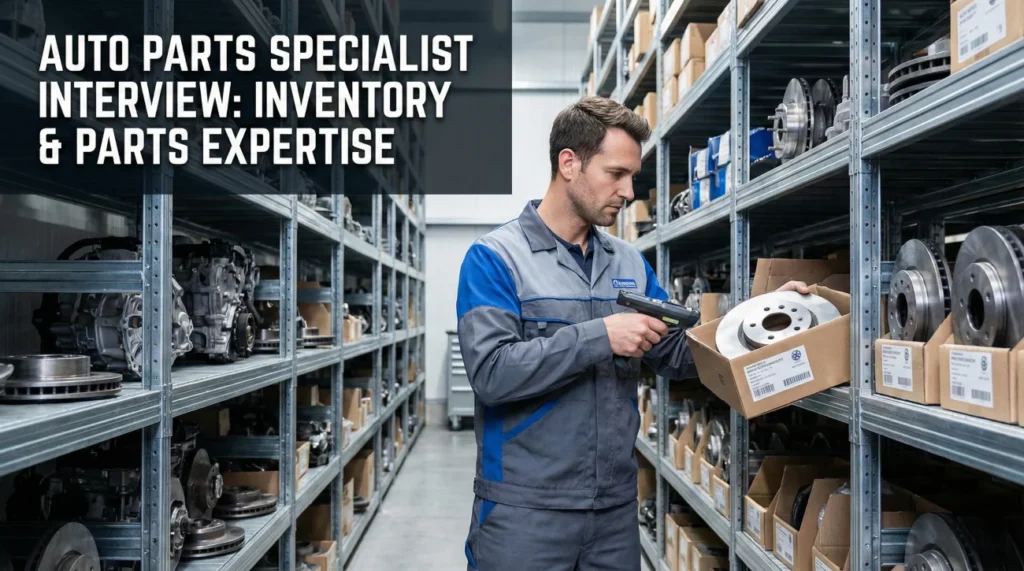
I use a logical alphanumeric system (Aisle, Shelf, Bin). I keep high-velocity items (oil, filters, wipers) at eye level and near the front for speed. Heavy items (rotors, batteries) go on lower shelves for safety.
I keep the aisles clear of “freight” (boxes). Receiving must be processed immediately. A messy warehouse leads to lost parts, “shrinkage,” and tripping hazards. I treat the backroom with the same respect as the showroom.
Q: How do you handle “Special Orders” (SOS)?
Special orders are high risk for “dead stock.” I require a deposit or prepayment, especially for non-returnable electrical parts. I verify the fitment three times before ordering.
When the part arrives, I call the customer immediately. I place it in a designated “Hold” bin with the date. If they don’t pick it up in 14 days, I follow up or process the return to the vendor so we aren’t stuck with a fuel pump for a 1990 Jaguar that we will never sell.
Q: What is your process for checking in a freight delivery?
I inspect the boxes for damage before the driver leaves. If a radiator box is crushed, I refuse it or mark it “Damaged” on the bill of lading.
I check the packing slip against the contents line by line. It is easy to miss a small sensor box mixed in with packing peanuts. I scan them into inventory immediately so they are available for sale. “Dock to Stock” time should be minimized.
Sales Strategies & Upselling
Q: How do you upsell effectively (“Related Selling”)?
I don’t call it upselling; I call it “completing the job.” If a customer buys brake pads, I ask about the rotors and brake grease. If they buy a water pump, I ask about the timing belt and coolant.
I explain, “You’re going to have the car apart anyway; it saves you time to replace the belt now rather than having to take it all apart again in 6 months.” I am saving them a future headache. I use the “recommended items” screen in the catalog to ensure I don’t miss any gaskets or seals they might need.
Q: How do you handle a “price shopper” calling for quotes?
I give the price quickly, but I add value. “The alternator is $150, and that includes a lifetime warranty and free testing of your battery when you come in.”
I ask for the sale: “I have that in stock right now. Would you like me to put your name on it so it’s waiting for you at the counter?” Creating urgency and convenience often wins the sale over a competitor who is $5 cheaper but doesn’t have it in stock.
Q: How do you build relationships with Commercial Accounts (Shops)?
Commercial accounts care about two things: Speed and Accuracy. I learn their preferences (“Bill only buys Wix filters”). I prioritize their calls.
I don’t waste their time with small talk when they are busy, but I visit their shops occasionally to put a face to the voice. I advocate for them with warranty claims. If I take care of them when things go wrong, they will stick with me even if my prices are slightly higher.
Q: Why do you want to work as an Auto Parts Specialist?
I love the puzzle of it. Every customer comes in with a problem, and I get to find the missing piece to fix it. I enjoy the combination of technical research and customer interaction. Whether it’s helping a single mom fix her car cheaply or helping a pro mechanic finish a job on time, I find satisfaction in keeping people mobile and safe.
Situational Problem Solving
Q: The computer system crashes during a busy rush.
I revert to manual mode. I use paper invoices and calculators. I verify prices using shelf tags or my own knowledge.
I communicate with customers: “Our system is down, but I can still help you; it might just take a moment longer.” I process the transactions later when the system is up. I don’t close the store; I keep selling. Resourcefulness is key.
Q: A customer tries to return an electrical part that has been installed.
This is a strict policy issue. Most stores do not accept returns on installed electrical parts because a bad car ground could have fried the new part.
I explain, “For safety and quality reasons, once an electrical part is plugged in, we cannot resell it.” I offer to warranty it if it is defective, but I cannot give a refund just because it didn’t solve their problem (misdiagnosis). I stand firm but polite.
Q: You suspect a customer is stealing small items (shrinkage).
I use “Aggressive Hospitality.” I walk over and say, “Can I help you find a specific fuse?” or “Do you need a basket for those items?”
Making eye contact and letting them know they are seen usually deters theft. I do not physically confront or accuse. I inform my manager and keep a close watch. Safety is more important than a $5 spark plug.
Q: A commercial driver calls and says the part delivered is broken.
I apologize and solve it instantly. I don’t ask for the broken part back first before sending the new one (which delays the mechanic). I send the replacement immediately.
I instruct the driver to pick up the damaged one upon delivery. I treat the commercial account with trust to maintain the business relationship, then handle the damage claim with the vendor on my own time.
Q: A customer wants to use a fluid that is not recommended for their car.
I advise against it strongly. “Your Honda requires Asian Vehicle Formula coolant; using this generic green one can corrode your seals.”
If they insist (usually due to price), I note it on the receipt: “Customer advised against product usage.” I protect the store from liability while respecting the customer’s right to make a bad decision after being warned.
Q: The phone is ringing, a customer is at the counter, and a driver needs dispatch.
I triage. 1. Driver/Dispatch (takes 10 seconds to hand off keys/paperwork) to keep the logistics moving. 2. Customer at the counter (acknowledge them). 3. Phone.
I place the phone on hold: “Thank you for calling, can you hold please?” I help the counter customer. The person in front of me usually takes priority over the phone, but keeping the delivery drivers moving is critical for commercial sales.
Auto Parts Competency Quiz
Take the 20-Question Challenge
1. “OEM” stands for:
- Old Engine Manufacturer
- Original Equipment Manufacturer
- Operational Equipment Maintenance
- Optional Engine Modification
2. A “Core Charge” is:
- A tax on car parts
- A refundable deposit on a recyclable part (like a battery or alternator)
- The center of the engine
- A delivery fee
3. The “VIN” has how many characters (since 1981)?
- 10
- 17
- 12
- 20
4. Viscosity (e.g., 5W-30) refers to:
- The color of the oil
- The thickness or resistance to flow of the fluid
- The brand of the oil
- The price of the oil
5. “Bank 1” on an engine refers to:
- The side where the driver sits
- The side of the engine containing Cylinder #1
- The fuel tank
- The battery bank
6. A “Planogram” is:
- A wiring diagram
- A visual diagram showing where products should be placed on the shelf
- A scheduling tool
- A weight loss plan
7. “SKU” stands for:
- Standard Kit Unit
- Stock Keeping Unit
- Store Keeper Union
- Safety Key Usage
8. A “Caliper” is part of which system?
- Exhaust
- Braking (it squeezes the pads against the rotor)
- Cooling
- Electrical
9. If a battery is “AGM,” it stands for:
- Automotive General Motor
- Absorbent Glass Mat
- Acid Gel Mix
- Automatic Gas Monitor
10. “FIFO” inventory method means:
- First In, First Out (Sell older stock first)
- First In, First Out (Sell older stock first to prevent expiration)
- Fast In, Fast Out
- Fit In, Fit Out
11. A “Serpentine Belt” drives:
- The wheels
- Accessories like the alternator, power steering, and AC compressor
- The windshield wipers
- The timing only
12. “Shrinkage” in retail refers to:
- Parts getting smaller in the cold
- Loss of inventory due to theft, damage, or administrative error
- Removing plastic wrap
- Closing the store early
13. Which sensor typically triggers a “Check Engine Light” related to emissions?
- ABS Sensor
- O2 (Oxygen) Sensor
- TPMS Sensor
- Impact Sensor
14. “Dormant Stock” is:
- Stock sold daily
- Inventory that has not sold in a long period (e.g., 12 months)
- Stock for sleeping
- Broken stock
15. A “Master Cylinder” is found in the:
- Engine block
- Brake system (creates hydraulic pressure)
- Transmission
- Fuel tank
16. “Cross-Reference” or “Interchange” means:
- Getting angry at customers
- Finding a compatible part number from a different brand
- Crossing the street
- Returning a part
17. A “Bill of Lading” is:
- A receipt for lunch
- A document detailing the type, quantity, and destination of goods being shipped
- A bill for electricity
- A mechanic’s paycheck
18. “Turning Rotors” means:
- Spinning them by hand
- Machining the surface of the brake disc to make it smooth again
- Replacing them
- Painting them
19. “Z-strip” or “Face-Facing” helps to:
- Hide products
- Pull products to the front of the shelf to look full and organized
- Scan items
- Count money
20. The “10th Digit” of the VIN usually indicates:
- The engine type
- The Model Year
- The plant of manufacture
- The color
❓ FAQ
🧰 Do I need to be a mechanic to do well in this role?
No. You are the parts and logistics specialist, not the technician turning the wrench. What matters is that you can verify fitment, understand basic systems, and communicate clearly about options, warranties, and returns. If you have ASE parts knowledge or similar training, mention it as an advantage.
🏋️ Is the job physically demanding?
Yes. You will move batteries, rotors, cases of fluids, and shipments. A strong interview answer is that you can handle active shifts safely, lift correctly, and keep the backroom organized so heavy items are stored smartly and accessed without risk.
💵 How should I talk about commission or bonuses?
Keep it businesslike. Say you are comfortable with targets and that you focus on correct parts first, then recommend add-ons that complete the job, like gaskets, grease, coolant, or a belt with a water pump. Good selling in parts is preventing the second trip.
🔧 What should I say about discounts and perks?
Some stores offer employee pricing, but do not lead with that. In interviews, it is better to show you respect policies, understand inventory control, and care about protecting margin and reducing returns.
⏲️ What hours and pace should I expect?
Retail parts counters often run long hours and weekends, while dealerships typically follow service department hours. The pace can swing fast, especially at opening, lunch, and end of day. Reliability and calm under pressure are usually more important than perfect availability.
Final Thoughts
To land the job, your answers to auto parts specialist interview questions should make one thing obvious: you do not guess. You verify, you communicate clearly, and you keep the counter moving without sacrificing accuracy.
If you can tell a short story about catching a fitment issue, recovering a frustrated customer, or preventing a return by asking one extra question, you will sound like the person a busy parts department can trust from day one.
⚠️ Disclaimer: The interview strategies, sample answers, and negotiation tips provided in this guide are for educational purposes only. Hiring decisions are subjective and vary by company and industry. While these strategies are based on professional HR standards, they do not guarantee a specific job offer or result.