The Architects of Fit
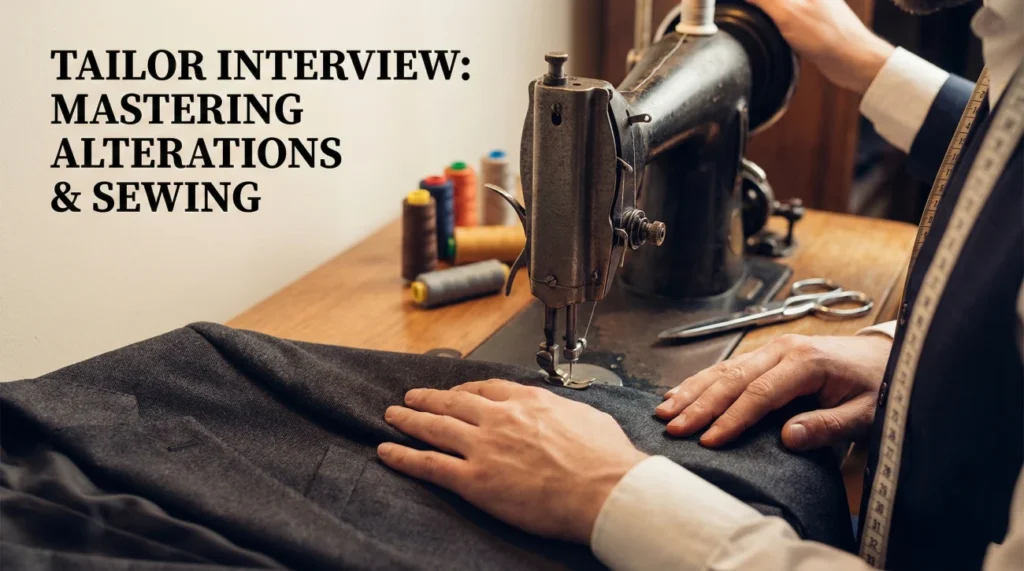
Tailor interview questions are designed to find a craftsman who understands that “off the rack” is rarely perfect. A tailor (or alterations specialist) is part engineer, part artist, and part diplomat. They must look at a garment, deconstruct it mentally, and rebuild it to flatter a unique human body, all while managing the customer’s expectations and timeline. Hiring managers are looking for candidates who can hem a delicate silk chiffon dress as confidently as they can taper a heavy wool suit jacket.
The industry is seeing a resurgence in “Mending” and “Upcycling” due to sustainability trends. Interviewers will ask: How do you handle a bride whose dress is two sizes too small three weeks before the wedding? Can you explain the difference between a blind hem and a rolled hem? How do you manage your workflow during prom season? Your answers must prove that you possess the needle skills to execute the vision and the people skills to keep the client calm.
This comprehensive guide stitches together the technical and interpersonal demands of the job. We explore the anatomy of a suit jacket, strategies for fitting non-standard body types, and the delicate art of telling a customer that an alteration isn’t possible. Whether you are applying to a high-end department store alteration shop or a local dry cleaner, these strategies will help you measure up to the competition.
Customer Consultation & Fittings
A customer wants to take a suit jacket down 3 sizes. Is this possible?
I explain the structural limits. “We can take it in, but usually only up to 2 sizes before the pockets start to wrap around the back and the shoulders collapse.”
I show them in the mirror by pinning it. “See how the lapel buckles? It would require recutting the entire jacket (recutting shoulders/armholes), which costs more than buying a new one.” I advise them honestly to buy a size closer to their fit for the best result, rather than taking their money for a bad outcome.
A bride is panicking because she gained weight and the zipper won’t close.
I stay calm to lower her anxiety. I inspect the seam allowance (the extra fabric inside). “Let’s look inside. Good news, we have an inch here we can let out.”
If there is no allowance, I propose creative solutions: “We can change the zipper to a corset back (lace-up), which is forgiving and adds a beautiful detail.” I focus on the solution, not the weight gain, ensuring she leaves feeling relieved and beautiful.
A customer complains that the pants are “still too long” after you hemmed them.
I ask them to put the pants on with the shoes they plan to wear. Often, they are wearing different shoes than the fitting. I check the “break” (where the pant hits the shoe).
If it was my error, I fix it immediately for free. If they changed their mind on the break preference (e.g., full break vs. no break), I explain, “We pinned it to the ‘half break’ you requested, but I am happy to shorten it further to a ‘no break’ for a small adjustment fee.”
Technical Skills & Fabric Knowledge
Q: How do you hem a pair of jeans while keeping the original hem?
I use the “Original Hem” (or Euro Hem) technique. I measure the desired length, fold up the excess fabric, and sew closely to the original hemline.
I then trim the excess fabric inside (or press it up if not too bulky) and press the hem flat. This preserves the factory distressing and stitching pattern at the bottom, which is crucial for premium denim aesthetics.
Q: What needle and thread do you use for silk chiffon?
I use a very fine needle, like a size 60/8 or 70/10 Universal or Microtex, to avoid punching large holes or causing runs. I use a fine silk or high-quality polyester thread.
I adjust the tension on the machine to prevent puckering. For the hem, I would likely do a “Rolled Hem” (using a serger or rolled hem foot) because a standard fold-over hem looks too heavy on such delicate, sheer fabric.
Q: How do you shorten suit jacket sleeves with functioning buttonholes?
This is a complex alteration. I cannot just cut the bottom because of the buttonholes. I must take the sleeve up from the shoulder.
I carefully remove the sleeve cap, trim the excess from the top, and reattach it. This maintains the proportion of the buttons to the cuff. It is labor-intensive and expensive, so I always explain this to the customer beforehand.
Q: What is the difference between a “Dart” and a “Pleat”?
A Dart is a triangular fold stitched to taper the fabric to the body’s curves (usually bust or waist), creating shape. A Pleat is a fold of fabric that adds fullness or ease (usually at the waist of trousers or skirts).
If a client wants a garment more fitted, I might add darts. If they need more room, I might release pleats (if possible). Knowing when to use which is key to structuring a garment.
Q: How do you repair a moth hole in a wool sweater?
I use “Darning.” I find a matching yarn (sometimes pulling a thread from an inside seam). I weave the thread over and under the hole, creating a new fabric grid that mimics the knit.
If the hole is too large, I might suggest a visible mending technique (like embroidery) as a design feature, or using a patch, depending on the client’s style preference.
Q: How do you handle velvet?
Velvet is tricky because of the “nap” (direction of the pile). I always sew in the direction of the nap to prevent shifting. I use a “Walking Foot” or tissue paper between layers to stop them from sliding against each other.
I never iron velvet directly, as it crushes the pile. I use a steamer or a needle board if pressing is absolutely necessary. One mistake with velvet is permanent, so I measure twice and cut once.
Measuring & Fitting Techniques
Q: What is the most important rule when pinning a garment on a customer?
Ask them to move. A dress might look perfect standing still, but can they sit? Can they raise their arms? Can they breathe?
I pin it, then ask them to sit down on the fitting stool. If the skirt pulls too tight or the waistband digs in, I release the pins slightly. I prioritize comfort alongside aesthetics. I also ensure they are wearing the correct undergarments (e.g., Spanx, push-up bra) because that changes the fit entirely.
Q: How do you measure for a men’s dress shirt?
I measure the neck (leaving one finger of space for comfort), the sleeve length (from center back of neck, over the shoulder, to the wrist bone), the chest (under armpits), and the waist.
I also check the “Yoke” width (shoulder to shoulder). If the yoke is too narrow, the shirt will pull; if too wide, it looks sloppy. I ask if they prefer a “Slim,” “Modern,” or “Classic” fit, as personal preference dictates how much ease I leave.
Q: How do you fix a “gaping” neckline on a wrap dress?
I can add a small snap closure for modesty. Or, more structurally, I can lift the shoulders (taking them up) which pulls the neckline flush against the chest.
Sometimes, simply adding a small dart in the neckline edge solves it. I pin various options to see which one fixes the gape without distorting the bust line.
Q: Why do you want to work as a Tailor?
I love the engineering of clothing. I see a garment as a puzzle – how to take a 2D fabric and make it fit a 3D body perfectly. There is immense satisfaction in watching a client look in the mirror and smile because, for the first time, the clothes actually fit them, not the mannequin. I take pride in my precision and my ability to extend the life of quality garments.
Workflow & Shop Operations
Q: How do you prioritize your workload in a busy shop?
I organize by “Due Date,” not “Drop-Off Date.” I use a color-coded tag system (Red = Due Today/Tomorrow). I leave a “buffer day” whenever possible – if it’s due Friday at 5 PM, I aim to finish it Thursday.
I group similar tasks. I might do all the jean hems in one batch (keeping the heavy-duty thread on the machine) and all the suit linings in another. This “batch processing” saves time on re-threading machines.
Q: How do you calculate the cost of an alteration?
I estimate the time. If a hem takes 15 minutes and my shop rate is $60/hour, the base is $15. Then I add complexity: Is there a lining? Is it a wide leg? Is there beading to remove?
I am transparent with the customer. “A standard hem is $20, but because this dress has three layers of chiffon and a horsehair braid, it will be $45.” I quote the price before I cut, so there are no surprises at pickup.
Q: How do you maintain your sewing machines?
I clean the lint out of the bobbin case daily. I oil the machines weekly (or daily if used heavily). I change the needle after every major project or 8 hours of sewing.
A dull needle damages fabric and causes skipped stitches. I treat my machines like partners; if they go down, I can’t work. I also keep a log of professional servicing dates.
Tailoring Competency Quiz
Take the 20-Question Challenge
1. The “Grainline” runs:
- Diagonally
- Parallel to the selvage edge (lengthwise)
- Perpendicular to the selvage
- In a circle
2. A “Serger” (Overlock machine) is used to:
- Iron the fabric
- Trim the raw edge and enclose it with thread to prevent fraying
- Sew buttons
- Cut patterns
3. “Bias” cut fabric has:
- No stretch
- Natural stretch and drape because it is cut at a 45-degree angle
- A stiff texture
- Stripes only
4. A “Blind Hem” looks like:
- A visible straight line
- Ideally invisible from the outside of the garment
- A rolled edge
- A raw edge
5. “Taking In” a garment means:
- Making it larger
- Making it smaller/tighter
- Shortening it
- Adding sleeves
6. The “Inseam” is measured from:
- The waist to the floor
- The crotch seam to the hem
- The knee to the ankle
- The hip bone to the knee
7. A “French Seam” is used for:
- Heavy denim
- Sheer or delicate fabrics to hide raw edges completely
- Coats only
- Leather
8. “Basting” stitches are:
- Permanent
- Temporary long stitches used to hold fabric in place before final sewing
- Decorative only
- Used for zippers only
9. A “Vent” on a jacket is:
- An air hole
- A slit at the back hem to allow for movement
- The pocket flap
- The collar
10. “Interfacing” is used to:
- Change the color
- Add structure, stiffness, or support to areas like collars and cuffs
- Make the fabric waterproof
- Soften the fabric
11. A “Walking Foot” helps when sewing:
- Cotton only
- Thick layers (quilts) or slippery fabrics (velvet) to feed them evenly
- Zippers
- Buttons
12. “Letting Out” a garment requires:
- Cutting it
- Existing seam allowance (extra fabric inside)
- Glue
- New fabric always
13. A “Gusset” is:
- A gust of wind
- A piece of fabric inserted into a seam (like the underarm) to add room/movement
- A type of button
- A hem style
14. When sewing leather, you should use:
- Pins
- Clips (because pins leave permanent holes) and a leather needle
- A ballpoint needle
- Regular thread
15. “Ease” refers to:
- Doing nothing
- The extra room in a garment allowing for movement and comfort
- The price
- The difficulty
16. A “Ballpoint Needle” is designed for:
- Woven fabrics
- Knits (it pushes fibers aside rather than piercing them)
- Leather
- Denim
17. “Tapering” a pant leg means:
- Shortening it
- Narrowing the width gradually toward the ankle
- Adding a cuff
- Making it wider
18. The “Break” in trousers refers to:
- A tear in the fabric
- Where the pant leg creates a fold or crease when resting on the shoe
- Lunch break
- The zipper
19. A “Thimble” protects:
- The fabric
- The finger while hand sewing
- The needle
- The machine
20. “Preshrinking” fabric prevents:
- Stains
- The finished garment from shrinking after the first wash
- Fading
- Wrinkles
❓ FAQ
📜 Do I need formal schooling?
Not always. Many tailors are self-taught or learned through apprenticeships. However, a portfolio of your work (photos of before/after) is essential to prove your skills.
✂️ Is there a sewing test?
Almost certainly. Expect a “Bench Test.” They might hand you a jacket and ask you to shorten a sleeve or hem a pair of pants on the spot to check your speed and quality.
⏱️ How fast do I need to be?
Speed equals money in alterations. While quality is #1, you cannot take 2 hours to hem jeans. Industry standard is often 15-20 minutes for a basic jean hem.
👔 Can I work from home?
Yes, many tailors run successful freelance businesses. However, working in a shop (dry cleaner, bridal boutique) provides a steady stream of clients and equipment you might not afford starting out.
🩹 Is it physically demanding?
It requires dexterity and good eyesight. You are hunched over machines, which can cause back/neck strain. Pinning requires squatting and kneeling constantly. It is harder on the body than it looks.
Final Thoughts
To secure a position, your answers to tailor interview questions must demonstrate that you are a master of construction. Shops need tailors who can execute precise alterations quickly while making customers feel comfortable in the fitting room. By highlighting your knowledge of fabrics, your problem-solving approach to fit issues, and your efficient workflow, you prove that you are the perfect fit for their team.
⚠️ Disclaimer: The interview strategies, sample answers, and negotiation tips provided in this guide are for educational purposes only. Hiring decisions are subjective and vary by company and industry. While these strategies are based on professional HR standards, they do not guarantee a specific job offer or result.