Curating Confidence, Not Just Clothes
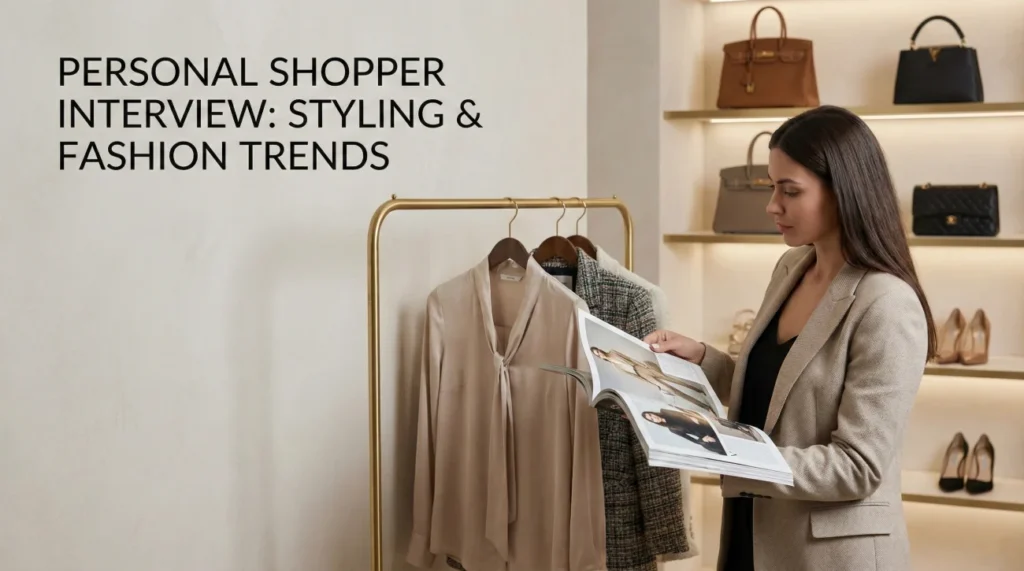
Personal shopper interview questions look for a unique blend of empathy, organization, and taste. A personal shopper (or wardrobe consultant) is not just someone who likes to shop; they are a strategic partner in their client’s personal brand. Whether working for a luxury department store like Nordstrom or running a freelance business, the goal is the same: to help clients look and feel their best while saving them time and stress. Hiring managers are looking for candidates who can translate high-fashion trends into wearable reality for real bodies and real budgets.
The industry is focusing on “Capsule Wardrobes” and “Sustainable Fashion.” Clients want to buy less but buy better. Interviewers will ask: How do you style a client who hates their body? Can you mix high-end designer pieces with accessible basics? How do you handle a client who insists on a trend that does not flatter them? Your answers must prove that you possess the tactile knowledge of fabrics and fit, as well as the emotional intelligence to navigate a client’s insecurities.
This comprehensive guide helps you accessorize your interview skills. We explore the methodology of the closet audit, strategies for sourcing sold-out items, and the delicate art of telling a client that a garment doesn’t work without hurting their feelings. Whether you are styling celebrities or busy executives, these strategies will help you tailor your responses to fit the role perfectly.
Styling Strategy & Body Types
Q: How do you determine a client’s personal style?
I start with a visual interview. I ask them to show me three outfits they love and three they hate. I use a “Style Quiz” with images (e.g., Boho, Minimalist, Classic) because clients often lack the vocabulary to describe what they like.
I also analyze their lifestyle. A lawyer needs different power suits than a tech CEO. I look for the “Style DNA” – the recurring themes in their preferences – and build a mood board to align our visions before I pull a single garment.
Q: How do you style a “Pear-Shaped” body (smaller top, wider hips)?
The goal is balance. I draw the eye upward. I use statement necklaces, bright colors, or interesting necklines (like boat neck or cowl) on the top.
For the bottom, I choose darker colors and structured fabrics that skim rather than cling. A bootcut or wide-leg trouser helps balance the hip width. I avoid side pockets or horizontal stripes on the hips. It is about creating a vertical line that harmonizes the silhouette.
Q: What is your philosophy on “Trends vs. Classics”?
I believe in the “80/20 Rule.” 80% of the wardrobe should be timeless staples (the Capsule) – a great trench coat, perfect denim, a tailored blazer. These are the investment pieces.
The remaining 20% is for trends. This keeps the look modern without wasting money. I advise clients to spend less on trends (buy the trendy neon top at Zara) and invest heavily in classics (buy the cashmere sweater at Loro Piana). This creates a sustainable and stylish wardrobe.
Q: How do you mix patterns (Print Mixing)?
I teach the “Scale and Commonality” rule. You can mix prints if they share a common color family. I mix a large-scale print (like a big floral) with a small-scale print (like a stripe or polka dot).
I also use “neutrals” as a buffer. Leopard print, surprisingly, acts as a neutral in many wardrobes. I encourage clients to start small, perhaps mixing a patterned tie with a checked shirt, before attempting a full head-to-toe print clash.
Q: How do you handle Color Analysis?
I look at the undertones of the skin (Cool, Warm, or Neutral). I do the “Vein Test” (blue veins = cool, green veins = warm) and the “Jewelry Test” (silver vs. gold).
However, I don’t let the “Season” rules limit us too strictly. If a “Winter” loves a warm orange, I style it away from the face (e.g., as a skirt or shoe) rather than a scarf. I want the client to glow, not look washed out, but I also want them to feel happy in their clothes.
Q: What is the most important item in a wardrobe?
Undergarments. The most expensive dress looks cheap if the foundation is wrong. I ensure my clients have a proper bra fitting.
Seamless underwear and shapewear (if desired) smooth the lines and allow the fabric to drape as the designer intended. I often start a styling session by auditing their “intibates” drawer because good style starts from the skin out.
The Closet Audit & Organization
Q: Describe your process for a “Closet Cleanse.”
I use the “Keep, Toss, Tailor” method. We touch every single item. If it hasn’t been worn in a year, doesn’t fit, or is damaged beyond repair, it goes.
I am ruthless but kind. I ask, “Does this earn its rent in your closet?” I organize the “Keep” pile by category and color (e.g., sleeveless tops, short sleeve, long sleeve; light to dark). This visual organization makes getting dressed easier and highlights the gaps we need to fill.
Q: How do you handle a client who is emotionally attached to old clothes?
I respect the memory but remove the clutter. If they are keeping a dress because “it was expensive” or “I wore it on my honeymoon,” but it doesn’t fit, I suggest moving it to a sentimental storage box or framing it.
It doesn’t belong in the active wardrobe where it causes guilt every morning. I help them see that letting go of the past makes room for the version of themselves they are today.
Q: What do you do with the “Toss” pile?
I offer a full-service solution. I separate items into “Resale” (The RealReal, Poshmark), “Donate” (local charities, Dress for Success), and “Recycle” (textile recycling for damaged goods).
I handle the logistics of consignment for them, which often offsets my fee. This sustainability angle is very important to modern clients who worry about fashion waste.
Q: How do you identify “Gaps” in a wardrobe?
After the purge, I look for what’s missing to make outfits connect. Often, clients have plenty of “statement pieces” (sparkly tops) but no “connectors” (plain white tees, good jeans).
I create a “Shopping List” based on these gaps. “You have 5 beautiful blazers but no trousers that fit. We need to buy 3 pairs of pants to unlock 15 new outfits.” This turns shopping into a strategic mission, not an impulse spree.
Difficult Client Scenarios
A client insists on buying a size that is too small (“I’ll lose weight”).
I advise against “aspirational sizing.” It is psychologically damaging to open a closet full of clothes that don’t fit. I say, “Let’s buy for the body you have today so you look amazing today.”
I explain that sizing varies wildly by brand anyway. I offer to cut the tags out if the number bothers them. I focus on the fit and the silhouette. “If you lose weight later, we can tailor this down, but we can’t make the small one bigger.”
A client wants a trend that does not flatter them at all.
I use the “Sandwich Technique.” I validate their interest (“I love that oversized blazer look too”). Then I gently pivot based on proportion (“However, because you are petite, that much fabric might swallow you up”).
I offer a modified alternative (“Let’s try a cropped version of the blazer or belt it to show your waist”). I never say “No”; I say “Let’s tweak it to make it work for you.”
You pulled 20 items, and the client hates all of them.
I don’t get defensive. I get curious. I ask, “Tell me specifically what isn’t working. Is it the fabric? The fit? The color?”
I treat it as data collection. “Okay, so wool feels too scratchy and you dislike high necks. That is helpful.” I pivot immediately. I might go back to the floor and pull new options while they wait, or reschedule if I need to source from elsewhere. I thank them for their honesty because it helps me refine my eye for them.
Sourcing & Business Operations
Q: How do you source a “Sold Out” item?
I am tenacious. I call flagship stores in other cities. I check international websites (Farfetch, Net-a-Porter). I set alerts on resale sites like Vestiaire Collective.
I leverage my network of sales associates at other brands. I once tracked down a specific handbag by calling a boutique in Las Vegas at 10 AM their time. My value proposition is doing the legwork that the client doesn’t have time to do.
Q: How do you mix High and Low fashion?
This is the secret to modern style. I teach the “High-Low Mix.” I might pair a Uniqlo t-shirt and vintage Levi’s with a Chanel bag and Manolo Blahnik heels.
The accessories (shoes, bags, belts) elevate the look. I advise clients to spend money on items that get daily wear (coats, bags) and save money on trendy items or basics (tanks, sundresses). It creates a look that is effortless and cool, rather than “bought the mannequin.”
Q: How do you structure your fees?
(If Freelance): I charge a project fee or hourly rate. I do not take commissions from stores because I want my advice to remain unbiased. If I work for a store (e.g., Nordstrom), my service is complimentary, and I am compensated through salary/commission on sales.
I explain my value: “My fee is an investment that saves you from ‘mistake purchases.’ If I stop you from buying three shirts you never wear, I’ve paid for myself.”
Q: Why do you want to be a Personal Shopper?
I love the psychology of it. Clothing is the armor we wear to face the world. When a client puts on an outfit that fits perfectly, their posture changes, their smile changes. I want to give people that armor. I enjoy the hunt for the perfect piece and the satisfaction of organizing chaos into a functional, beautiful wardrobe.
Styling Competency Quiz
Take the 20-Question Challenge
1. A “Capsule Wardrobe” is:
- A closet in a spaceship
- A curated collection of versatile, interchangeable items (usually 30-40 pieces)
- A wardrobe full of hats
- Clothes for camping
2. “Monochromatic” styling means:
- Wearing only black
- Wearing different shades and textures of a single color family
- Wearing one brand only
- Wearing prints only
3. The “Inseam” measures:
- The waist size
- The length of the inner pant leg from crotch to hem
- The outer leg length
- The width of the pant
4. An “Apple” body shape typically carries weight:
- In the hips
- In the midsection/abdomen
- In the shoulders
- Evenly distributed
5. “Fast Fashion” refers to:
- Clothes for running
- Inexpensive clothing produced rapidly in response to mass-market trends
- Couture fashion
- Express shipping
6. A “Lookbook” is:
- A mirror
- A collection of photographs showcasing a designer’s collection or styled outfits
- A textbook on fashion
- A client’s diary
7. “Pre-Sale” or “Presale” allows shoppers to:
- Sell their old clothes
- Reserve items before they are available to the general public
- Buy damaged goods
- Return items early
8. A “Statement Piece” is:
- A t-shirt with words
- A bold, eye-catching item that becomes the focal point of an outfit
- A boring item
- A pair of socks
9. “Cost Per Wear” (CPW) is calculated by:
- Price + Tax
- Price of item divided by the number of times it is worn
- Price multiplied by days owned
- The resale value
10. “Bespoke” tailoring is:
- Buying off the rack
- Clothing made from scratch to the client’s exact measurements
- Altering a store-bought suit
- Ironing clothes
11. A “Silhouette” refers to:
- The brand logo
- The overall outline or shape of a garment
- The fabric type
- The price point
12. “Color Blocking” involves:
- Wearing black to block color
- Pairing solid blocks of contrasting colors
- Painting clothes
- Using bleach
13. The “Third Piece Rule” suggests adding:
- A third shoe
- An extra layer (jacket, scarf, hat) to a top and bottom to finish the look
- A third color
- Three pairs of pants
14. “Deadstock” is:
- Animals
- Brand new, unsold vintage merchandise that still has tags
- Damaged returns
- Items that are out of style
15. A “Trunk Show” allows clients to:
- Buy luggage
- Shop a designer’s full collection (often pre-season) directly at a boutique
- See a fashion show
- Buy swimsuits
16. “Athleisure” is a style that:
- Is only for the gym
- Blends athletic wear with leisure wear for everyday use
- Is formal wear
- Is for sleeping
17. “Investment Pieces” are typically:
- Cheap and trendy
- High-quality, classic items that will last for years (e.g., a trench coat)
- Stocks and bonds
- Jewelry only
18. To “Cuff” a pant leg means to:
- Cut it off
- Roll or fold the hem upward
- Iron it flat
- Rip it
19. A “Mood Board” is used to:
- Test the client’s mood
- Visually communicate the style direction and inspiration for the client
- Display prices
- Hang clothes
20. “Consignment” means:
- Throwing clothes away
- Selling used items where the owner gets a percentage of the sale
- Donating to charity
- Buying new clothes
❓ FAQ
📜 Do I need a degree in Fashion?
No. While helpful, a portfolio (Instagram or website) showing your styling ability is more important. Experience in retail sales is crucial. Some certifications (like from the Image Consultant Association) can add credibility but are not mandatory.
💸 How much do Personal Shoppers charge?
Freelancers typically charge $50-$150+ per hour, or package rates ($500 for a closet audit). Store-based shoppers (Nordstrom) are usually free to the client and paid via salary/commission by the store.
🛍️ Is it just shopping all day?
No. It is 40% shopping, 30% returns/logistics (carrying heavy bags), and 30% client management/marketing. It is physically demanding and requires a lot of admin work (invoicing, scheduling).
🤝 Do I need to be stylish myself?
Yes. You are your own business card. You don’t need to be a supermodel, but you must look polished and put-together. Clients need to trust your taste before they let you dress them.
📱 How important is social media?
Critical. Instagram/TikTok is your portfolio. Posting “OOTD” (Outfit of the Day), styling tips, and client transformations is how you attract new business and showcase your aesthetic.
Final Thoughts
To secure a position, your answers to personal shopper interview questions must show that you are a trusted advisor, not just a salesperson. Clients invite you into their closets (a very private space) because they need help. By highlighting your systematic approach to styling, your ability to mix high and low fashion, and your empathy for body image struggles, you prove that you are the partner they need to look and feel their best.
⚠️ Disclaimer: The interview strategies, sample answers, and negotiation tips provided in this guide are for educational purposes only. Hiring decisions are subjective and vary by company and industry. While these strategies are based on professional HR standards, they do not guarantee a specific job offer or result.