
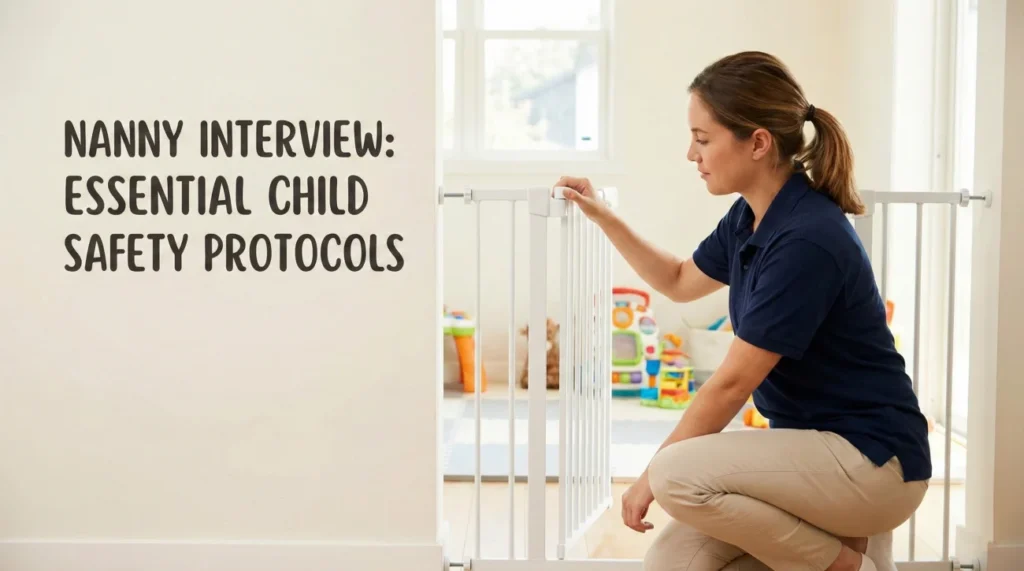
More Than Just a Babysitter
Nanny interview questions are designed to find a professional who can be a co-parenting partner, not just a supervisor. Unlike a casual babysitter, a nanny is deeply integrated into the family’s life, shaping the child’s development, routine, and emotional well-being. Parents are looking for someone who combines the warmth of a family member with the reliability of an employee. They need to know: Can you handle a choking emergency? How do you discipline a toddler without yelling? Will you respect their parenting style even if it differs from your own?
The focus is on “Gentle Parenting” and “Screen-Free Activities.” Interviewers will ask: How do you handle screen time limits? Can you prepare healthy, allergy-safe meals? How do you manage separation anxiety in a pandemic-era child who has never been left alone? Your answers must prove that you are proactive, safety-conscious, and capable of fostering a nurturing environment.
This comprehensive guide helps you prepare for the most personal interview of your career. We explore the safety protocols that every nanny must know, strategies for managing tantrums effectively, and the delicate art of maintaining professional boundaries in a private home. Whether you are applying for a full-time live-in position or an after-school care role, these strategies will help you secure the family’s trust.
Safety & Emergency Protocols
Q: What steps do you take to “baby-proof” a new environment?
I get down on the child’s level (literally crawling if needed) to see what they see. I look for choking hazards (coins, legos), unsecured cords, and sharp corners. I check that cleaning supplies and medications are locked away or out of reach.
I also check for water hazards (open toilets, buckets) and ensure gates are securely latched. I ask the parents for a tour to identify specific off-limits areas. My vigilance is constant; I never assume a room is safe just because it looks tidy.
Q: Describe how you would handle a choking emergency.
I am CPR and First Aid certified. If a child is coughing, I encourage them to keep coughing. If they are silent and turning blue, I act immediately.
For an infant, I use back blows and chest thrusts. For a toddler/child, I perform the Heimlich maneuver (abdominal thrusts). I would have someone call 911 immediately while I perform aid. I stay calm to keep the child calm. I refresh my certification every two years to ensure my muscle memory is ready.
Q: What is your protocol for water safety (pool/bath)?
I practice “Touch Supervision.” This means I am always within arm’s reach of the child when they are in or near water. I do not look at my phone or read a book.
I ignore the doorbell. If I must leave the bathroom/pool area, the child comes with me, wrapped in a towel. I know that drowning is silent and quick. I also ensure pool gates are locked immediately after entry/exit.
Q: How do you handle safe sleep for infants?
I follow the “Back to Sleep” guidelines strictly. I place the baby on their back on a firm mattress with a fitted sheet. No pillows, blankets, bumpers, or stuffed animals in the crib.
I ensure the room is a comfortable temperature to prevent overheating. I do not let them sleep in swings or car seats once we are home. If parents request unsafe sleep practices (like tummy sleeping), I respectfully decline and explain that I must follow safety standards to protect their child and my liability.
Handling Tantrums & Behavior
A toddler throws a tantrum in a public park because it’s time to leave.
I stay calm and validate their feelings. “I know you are having fun and don’t want to leave. It’s hard to stop playing.” I do not yell or bribe.
I use a “transition warning” beforehand (5 minutes, 2 minutes). If the tantrum persists, I ensure they are safe and wait it out or gently remove them to a quieter spot. I offer a choice: “Do you want to walk to the car or hop like a bunny?” This gives them a sense of control.
Two siblings are fighting over a toy.
I intervene to stop physical aggression but try to let them solve the conflict if possible. I narrate the situation: “It looks like you both want the red truck.”
I introduce a timer. “Brother plays for 5 minutes, then Sister plays for 5 minutes.” If they cannot share, the toy goes into “time out” on a high shelf. I teach turn-taking and empathy (“Look at her face, she is sad”) rather than just punishing.
A child refuses to eat the healthy lunch you prepared.
I follow the Division of Responsibility: I decide what is served, they decide if and how much to eat. I do not force-feed or become a short-order cook making a separate meal.
I encourage them to try a “no-thank-you bite.” If they refuse, I say, “Okay, that is what is for lunch. We will have a snack at 3 PM.” Usually, hunger wins. I model healthy eating by eating with them.
Daily Routine & Activities
Q: How do you plan a day for a preschooler without screens?
I structure the day around “Active/Passive” balance. Morning is for high-energy activity: park outing, nature walk, or obstacle course.
After lunch/nap, we do focus activities: puzzles, sensory bins (rice/water), or arts and crafts. I incorporate “Practical Life” skills like baking or gardening. I keep a “Boredom Buster” jar of ideas so we never default to the TV.
Q: How do you handle homework help for school-aged children?
I set up a designated homework station that is quiet and stocked with supplies. We do homework before play to get it done.
I act as a guide, not a doer. If they are stuck, I ask guiding questions: “Where can we look in the book to find the answer?” rather than giving the answer. I communicate with parents if the child is struggling consistently with a subject.
Q: How do you manage nap time resistance?
I rely on a solid pre-nap routine (diaper change, book, white noise, dark room). This signals the body it is time to sleep.
If they refuse to sleep, I enforce “Quiet Time.” They must stay in their room/bed with books or soft toys for 45 minutes to rest their body. Often, they fall asleep anyway. Consistency is key; we do it at the same time every day.
Q: How do you handle a child with separation anxiety when parents leave?
I advise parents to make the goodbye quick and confident. A lingering, sad goodbye makes it worse. “Mommy always comes back. Love you, bye!”
Once the parent leaves, I distract immediately with a high-value activity or a change of scenery (go outside). I validate the sadness (“I know you miss Mom”) but pivot quickly (“Let’s go find the red ball”). They usually recover within minutes.
Q: What is your approach to discipline?
I practice Positive Discipline. I focus on what they should do, not just what they shouldn’t. Instead of “Don’t run,” I say “Walking feet, please.”
I use natural consequences. “If you throw the blocks, the blocks go away for today.” I stay calm and firm. I align my discipline strategy with the parents’ preferences to ensure consistency for the child.
Q: How do you manage multiple children of different ages?
I prioritize safety. The baby is either strapped to me (babywearing) or in a safe zone while I help the toddler potty.
I create inclusive activities. The older child can help “teach” the younger one, or build a complex Lego tower while the younger one plays with Duplos. I ensure each child gets 10 minutes of dedicated 1-on-1 time daily (e.g., during the other’s nap) to fill their emotional cup.
Professionalism & Communication
Q: How do you communicate with parents about their child’s day?
I use a daily log (app or notebook). I record eating, sleeping, diaper changes, and mood. I also include one “highlight” or funny story so they feel connected.
If there was a behavioral issue or injury, I communicate it honestly but tactfully at handover, not via text during the day (unless urgent), so we can discuss it face-to-face. I send photos during the day to reassure them their child is happy.
Q: How do you handle privacy and social media?
I have a strict policy: I never post photos of the children on my personal social media. Their digital footprint is the parents’ decision, not mine.
I respect the privacy of the home. What I see and hear in the house stays in the house (unless it is a safety concern). I am a discreet professional, not a source of gossip.
Q: How do you handle a disagreement with a parent about parenting style?
I remember that they are the employer and the parent. Unless it is a safety issue, I defer to their preference. “I understand you prefer X method; I will do my best to implement that.”
If I feel strongly that a method is harming the child or making my job impossible, I ask for a sit-down meeting to discuss it professionally. “I’ve noticed that when we do X, the child reacts with Y. Could we try Z?” I frame it as problem-solving together.
Q: Why do you want to be a Nanny?
I choose to be a nanny because I find deep fulfillment in nurturing the next generation. I love the bond that forms with a family. Unlike a classroom teacher with 30 kids, I get to focus intensely on the development of 2 or 3. I take pride in creating a safe, loving, and stimulating environment where they can thrive. It is not just a job; it is a calling.
Nanny Competency Quiz
Take the 20-Question Challenge
1. “SIDS” prevention includes:
- Putting baby on stomach
- Placing baby on back to sleep on a firm surface
- Using lots of blankets
- Co-sleeping on a sofa
2. A “Transition Warning” helps children:
- Run faster
- Prepare mentally for a change in activity, reducing tantrums
- Ignore you
- Eat more
3. The Heimlich maneuver is used for:
- A scraped knee
- Choking (clearing the airway)
- Fever
- Drowning
4. “Positive Reinforcement” involves:
- Yelling when they are bad
- Praising specific good behaviors to encourage repetition
- Ignoring them
- Giving candy for everything
5. If a child has a fever of 104°F, you should:
- Put them in a cold bath
- Call the parents immediately and possibly emergency services
- Wait it out
- Give them aspirin
6. “Tummy Time” is important for:
- Digestion only
- Strengthening neck and shoulder muscles in infants
- Sleeping
- Changing diapers
7. A “Mandated Reporter” must report:
- Bad behavior
- Suspected child abuse or neglect
- A messy house
- Late parents
8. “Touch Supervision” near water means:
- Watching from the window
- Being within arm’s reach of the child at all times
- Touching the water to check temp
- Holding hands while walking
9. Foods that are common choking hazards for toddlers include:
- Mashed potatoes
- Whole grapes, hot dogs, popcorn, nuts
- Yogurt
- Applesauce
10. “Separation Anxiety” typically peaks around:
- 1 month
- 9-18 months
- 5 years
- 10 years
11. A “Sensory Bin” helps develop:
- Running speed
- Fine motor skills and tactile exploration
- Reading skills
- Hearing only
12. If a child drinks a cleaning product, you call:
- The parents first
- Poison Control (1-800-222-1222 in US) immediately
- The police
- A friend
13. “Parallel Play” is when children:
- Play together cooperatively
- Play side-by-side but not with each other (common in toddlers)
- Play alone in different rooms
- Fight
14. To prevent “Shaken Baby Syndrome,” you should:
- Shake the baby gently
- Never shake a baby; if frustrated, put baby in a safe crib and walk away for 5 mins
- Bounce the baby vigorously
- Jog with the baby
15. “Baby-led Weaning” involves:
- Purees only
- Offering soft, graspable finger foods for the baby to feed themselves
- Feeding with a bottle only
- Giving candy
16. If a stranger comes to the door, you:
- Open it immediately
- Do not open it; speak through the door or ignore it unless expected
- Invite them in
- Leave the house
17. A “Time In” (vs. Time Out) involves:
- Isolating the child
- Sitting with the child to help them co-regulate their emotions
- Adding time to the clock
- Watching TV
18. The “Ferber Method” is a technique for:
- Cooking
- Sleep training (Graduated Extinction)
- Potty training
- Swimming
19. When driving children, the most important check is:
- The radio station
- That car seats are properly installed and buckled according to height/weight
- The cleanliness of the car
- The destination
20. “Fine Motor Skills” involve:
- Running and jumping
- Small movements using fingers/hands (e.g., drawing, buttoning)
- Speaking clearly
- Driving a car
❓ FAQ
📜 Do I need CPR certification?
Yes. It is non-negotiable for professional nannies. Infant/Child CPR and First Aid certification (Red Cross or AHA) must be current. Parents will check this.
🚗 Do I need a car?
Usually, yes. Even if you don’t drive the kids, you need reliable transport to get to work. If you drive the kids, you need a clean driving record and a safe vehicle (or be willing to drive the family car).
🧹 Is housekeeping included?
“Light housekeeping” related to the child (cleaning bottles, picking up toys, kid’s laundry) is standard. Deep cleaning (scrubbing toilets, parent’s laundry) is a different job (“Nanny-Housekeeper”) and commands higher pay.
💰 How is pay handled?
Legally, nannies are W-2 employees, not independent contractors (1099). You should be paid hourly with overtime (time and a half) over 40 hours. “Under the table” puts you at risk.
📝 Should I have a contract?
Absolutely. A Nanny Contract protects both parties. It outlines hours, pay, duties, vacation time, sick leave, and termination notice. Never accept a long-term position without one.
Final Thoughts
To secure a position, your answers to nanny interview questions must show that you are a competent caregiver who takes the safety of children seriously. Families need nannies who can handle the chaos of childhood with grace and structure. By highlighting your emergency preparedness, your philosophy on positive discipline, and your respect for the family’s privacy, you prove that you are the trustworthy partner they need to help raise their children.
⚠️ Disclaimer: The interview strategies, sample answers, and negotiation tips provided in this guide are for educational purposes only. Hiring decisions are subjective and vary by company and industry. While these strategies are based on professional HR standards, they do not guarantee a specific job offer or result.