The First Line of Defense
Security guard interview questions are designed to find the candidate who is alert, disciplined, and calm under pressure. A security officer is not just a person in a uniform; they are the eyes and ears of the property, responsible for protecting assets, people, and reputation. Hiring managers are looking for someone who can follow strict protocols (“Post Orders”) while also possessing the judgment to handle the unexpected, from a lost child to a hostile intruder.
The industry focus is on “Customer Service Security” and “De-escalation.” It is no longer enough to be tough; you must be approachable. Interviewers will ask: How do you handle a visitor who refuses to show ID? Can you write a detailed incident report that would stand up in court? How do you stay awake and alert during a 12-hour night shift? Your answers must prove that you are a professional who prioritizes safety without escalating conflict.
This comprehensive guide helps you secure your position. We explore the critical importance of observation skills, the legal boundaries of use of force, and the specific details required in daily activity reports (DAR). Whether you are applying for an unarmed retail post or an armed corporate security role, these strategies will help you stand guard over your career.
Patrol Procedures & Observation
Q: Describe your routine for a foot patrol.
I follow the “Random but Thorough” method. I do not walk the exact same path at the exact same time every hour, as that creates a predictable pattern for criminals. Instead, I vary my route.
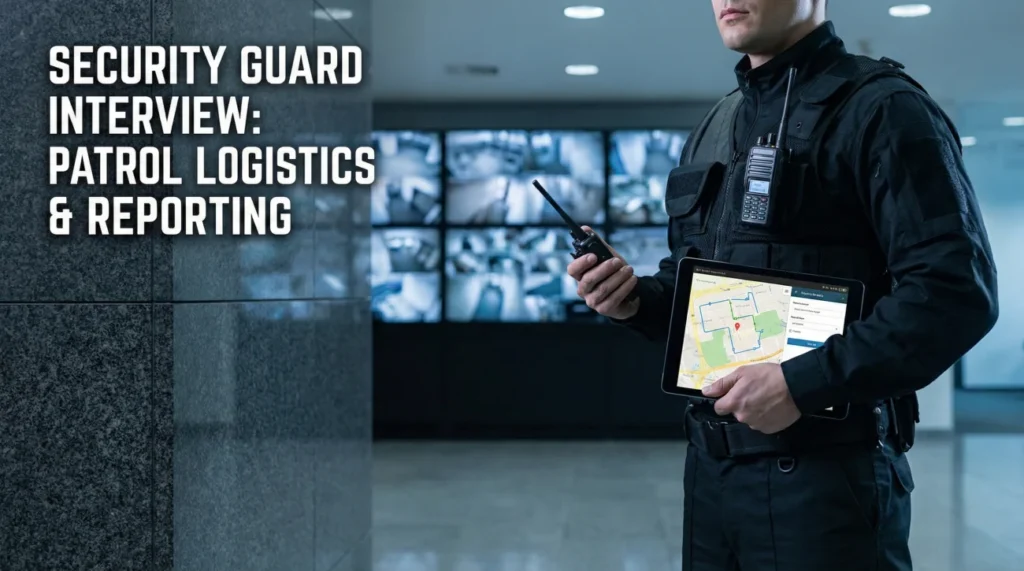
I check all access points (doors, windows, gates) to ensure they are locked. I look for safety hazards (burnt-out lights, spills) as well as security threats. I use all my senses – listening for unusual noises or smelling for smoke. I log my checkpoints electronically (e.g., scanning QR codes) to prove my presence.
Q: What are you looking for when monitoring CCTV?
I am not just watching the screen; I am looking for anomalies. I look for “loitering” behavior, people wearing inappropriate clothing for the weather (e.g., heavy coat in summer), or individuals testing door handles.
I also monitor “blind spots” and high-traffic areas. If I see something suspicious, I don’t just watch; I dispatch a patrol to verify or log the timestamp immediately for future evidence. Active monitoring is about prevention, not just recording a crime.
Q: How do you stay alert during a graveyard (overnight) shift?
I treat my sleep schedule with discipline. I use blackout curtains and sleep continuously during the day, not in naps. During the shift, I stay mobile.
I get out of the chair and do my rounds frequently. I drink water and eat light protein snacks rather than heavy carbs that cause drowsiness. I keep the guard shack cool. I understand that falling asleep is an immediate termination offense and a safety risk, so I take full responsibility for my alertness.
Q: How do you handle a “False Alarm”?
I never assume it is false until verified. I treat every alarm as real. I respond to the location cautiously.
I check the perimeter for signs of forced entry. If it appears secure, I check the sensor itself (maybe a spider web or loose magnet). I document the finding, reset the panel if authorized, and notify the client. Repeated false alarms cause “alarm fatigue,” so identifying the cause is crucial.
Incident Response & Reporting
Q: What are the key elements of a good Incident Report?
I use the “5 Ws and 1 H”: Who, What, Where, When, Why, and How. My report is factual and objective, avoiding opinions like “He was angry.”
Instead, I write, “The subject shouted and clenched his fists.” I include specific times, names of witnesses, and descriptions of property damage. I write it assuming it will be read by a judge or insurance adjuster, so clarity and detail are non-negotiable.
Q: You catch a vandal in the act. What do you do?
I prioritize safety over property. I do not engage physically unless attacked. I call for backup/police immediately and observe from a safe distance.
I shout a verbal command: “Security! Stop!” to deter them. I take a mental (or physical) photo of their description. My job is to observe and report, not to punish. Confrontation can escalate property damage into personal injury.
Q: How do you handle a medical emergency (e.g., heart attack)?
I call 911 immediately. I secure the scene to ensure it is safe for me to approach. I check for responsiveness.
I am CPR/AED certified, so I begin life-saving measures if needed until EMTs arrive. I assign someone to wait at the entrance to guide the ambulance. Afterward, I write a detailed report of the timeline and actions taken, as liability is a major concern.
Q: You find an unlocked door that should be secured.
I do not just lock it and walk away. I enter cautiously to ensure no unauthorized person is inside (“Clear the room”).
Once verified empty, I lock it. I log the incident in my Daily Activity Report (DAR), noting the time and the specific door. I notify the client because it might indicate an employee error or a broken lock that needs repair.
Q: How do you control access at a busy front desk?
I enforce the “Access Control Policy” strictly but politely. Everyone must show ID or a badge. No tailgating allowed.
If a visitor has no appointment, I call their contact to verify. I do not let them up “just this once.” I maintain a visitor log. My presence is the first layer of security; if I am lax, the whole building is compromised.
Q: How do you handle lost and found property?
I log it immediately in the Lost and Found ledger: Date, Time, Description, Location Found. I store it in a secure, locked location.
I never guess the owner. If someone claims it, I ask them to describe it in detail (e.g., “What is the screensaver on the phone?”) before handing it over. Chain of custody prevents accusations of theft against security staff.
Conflict Resolution & De-escalation
An angry employee is fired and refuses to leave the building.
I approach calmly and maintain a non-threatening stance (hands visible). I explain, “Sir, your access has been revoked, and I need to escort you to the exit now.”
I do not touch them unless they become violent. I use the “Broken Record” technique, repeating the instruction calmly. “I understand you are upset, but you must leave now.” I keep myself between them and other employees. If they refuse, I call the police for trespassing.
A visitor calls you a derogatory name or tries to provoke you.
I have thick skin. I do not react emotionally. I understand they are trying to get a reaction to record a viral video or start a fight.
I remain professional: “I hear you, but I still need to see your ID.” I focus on the objective. Losing my temper means losing my authority and possibly my job. I kill them with kindness and rigid adherence to policy.
You see a fellow guard sleeping on duty.
This is a serious safety breach. I wake them up immediately. I explain, “You cannot sleep; it puts us all at risk.”
I report it to the supervisor. It is not “snitching”; it is safety. If an intruder enters while they are asleep, people could get hurt. Integrity means holding the team to the standard, even when it’s uncomfortable.
Legal Authority & Use of Force
Q: What is your understanding of “Use of Force”?
I understand that as a private security officer (unless sworn), my powers are generally limited to that of a private citizen. I use force only as a last resort for self-defense or the defense of others from imminent bodily harm.
I follow the “Force Continuum”: Presence, Verbal Direction, Soft Hands, Hard Hands, Less-Lethal (if equipped), Lethal. I always aim for the minimum force necessary to de-escalate. I never use force to protect property alone.
Q: Can you detain a suspect?
It depends on state law and post orders (Citizen’s Arrest). Generally, I can detain only if a felony has been committed in my presence or for shoplifting (Shopkeeper’s Privilege) if I have unbroken continuity of observation.
However, I prefer to “observe and report” to the police. Detaining someone carries high liability for false imprisonment. I usually ask them to stay; if they run, I let them go and give the description to the police rather than chasing.
Q: How do you handle a “Chain of Command” issue?
I follow the chain strictly. If I have an issue, I go to my Shift Supervisor first, not the Client directly. Going to the client confuses the reporting structure and looks unprofessional.
However, if the issue involves the supervisor doing something illegal or unsafe, I go to the Account Manager or HR. I respect the hierarchy that keeps the operation organized.
Q: Why do you want to be a Security Guard?
I take pride in being a protector. I possess strong situational awareness and a calm demeanor that fits this role perfectly. I like the responsibility of being the one people look to when things go wrong. I want to provide a safe environment so that employees and visitors can go about their day without fear. It is a role of service and integrity that I respect deeply.
Security Officer Competency Quiz
Take the 20-Question Challenge
1. The primary duty of a security guard is to:
- Arrest criminals
- Observe, Deter, and Report
- Fight intruders
- Clean the building
2. “DAR” stands for:
- Daily Arrest Record
- Daily Activity Report
- Direct Action Response
- Day Afternoon Report
3. The best way to patrol is:
- At the exact same time every hour
- Random intervals and varied routes to avoid predictability
- Only when you feel like it
- Running fast
4. If a fire alarm goes off, your first action is:
- Run away
- Verify the alarm (if safe) or assist with evacuation according to Post Orders
- Silence it immediately
- Call your mom
5. “Access Control” means:
- Controlling the TV remote
- Regulating who enters and exits a facility (badges, IDs)
- Locking all doors forever
- Checking bags for food
6. In a medical emergency, you should call:
- The supervisor only
- 911 immediately, then the client/supervisor
- The janitor
- No one
7. To describe a suspect, you start from:
- The shoes up
- The head down (Head, hair, face, shirt, pants, shoes)
- The middle
- Their personality
8. “Chain of Custody” refers to:
- Handcuffs
- The documentation of who handled evidence/property to preserve its legal integrity
- A command structure
- A fence chain
9. “Post Orders” are:
- Letters from the post office
- Written instructions specific to a site detailing the guard’s duties
- Orders for lunch
- Suggestions only
10. De-escalation involves:
- Yelling louder
- Using calm voice and body language to lower the tension
- Drawing a weapon
- Ignoring the person
11. A “Code Red” usually signifies:
- Free lunch
- Fire or Medical Emergency (depending on site)
- Rain
- Visitor arrival
12. If you see a safety hazard (spill), you should:
- Walk around it
- Secure the area (stand by it or place a cone) and report it for cleanup
- Leave it for someone else
- Laugh at it
13. “Tailgating” or “Piggybacking” at a door is:
- Cooking food
- An unauthorized person following an authorized person through a secure door
- Driving close
- Carrying a pig
14. When using a radio, you should speak:
- In long sentences
- Clearly, briefly, and using professional codes/language
- Whisper
- In slang
15. “Use of Force” is authorized:
- Whenever you are angry
- Only as a last resort for self-defense or defense of others
- To protect property at all costs
- To teach someone a lesson
16. The “Perimeter” is:
- The center of the room
- The outer boundary of the protected property
- The bathroom
- The roof only
17. If a reporter asks you for a statement, you:
- Tell them everything
- Say “No comment” and refer them to the Client/Media Relations
- Make up a story
- Get angry
18. “CCTV” stands for:
- Central City TV
- Closed-Circuit Television
- Computer Controlled TV
- Camera Control TV
19. A “Master Key” opens:
- One door
- All or most doors in a facility
- The car only
- The safe only
20. If you fall asleep on duty, it is considered:
- A mistake
- Gross misconduct and grounds for immediate termination
- A nap
- Acceptable on night shift
❓ FAQ
📜 Do I need a “Guard Card”?
Yes. In most states/countries, you must complete a state-mandated training course and pass a background check to get a Security Guard License (“Guard Card”) before you can work. Some employers pay for this training.
🔫 Should I be armed?
Most entry-level posts are Unarmed. Armed posts require additional, rigorous licensing and firearms training. Armed guards are paid more but carry significantly higher liability and risk.
⏱️ What are the hours like?
Security is 24/7. Expect to work nights, weekends, and holidays. Shifts are often 8 or 12 hours. Flexibility and reliability (showing up on time) are the most valued traits.
📱 Can I use my phone on duty?
Generally, no. Personal phone use is a distraction and a safety risk. You may use a work phone for reporting (apps), but watching Netflix or texting is usually prohibited and can get you fired.
🛑 Is the job dangerous?
It can be, but “Observe and Report” minimizes risk. Your job is to call the police, not to fight. Retail and hospital security tend to have more physical confrontations than corporate or night watch posts.
Final Thoughts
To secure a position, your answers to security guard interview questions must show that you are alert, obedient to protocol, and capable of good judgment. Clients need guards who prevent problems by their presence and handle emergencies with a cool head. By highlighting your observation skills, your report writing accuracy, and your de-escalation mindset, you prove that you are the professional protector they need.
⚠️ Disclaimer: The interview strategies, sample answers, and negotiation tips provided in this guide are for educational purposes only. Hiring decisions are subjective and vary by company and industry. While these strategies are based on professional HR standards, they do not guarantee a specific job offer or result.