When a Customer Says “This Is Not Okay”
A good support rep can turn a bad moment into a customer who stays. That is why customer service interview questions focus less on “being nice” and more on what you do when emotions spike.
In the interview, you are being evaluated on how you handle friction: how you ask questions without sounding defensive, how you explain policies without hiding behind them, and how you choose a solution that feels fair. The fastest answer is not always the best answer, especially when trust is on the line.
If you can describe a clear approach that works across phone, chat, and email, you instantly sound more senior. This page helps you say it in a way that feels human, practical, and ready for real customers.
Empathy & Service Philosophy
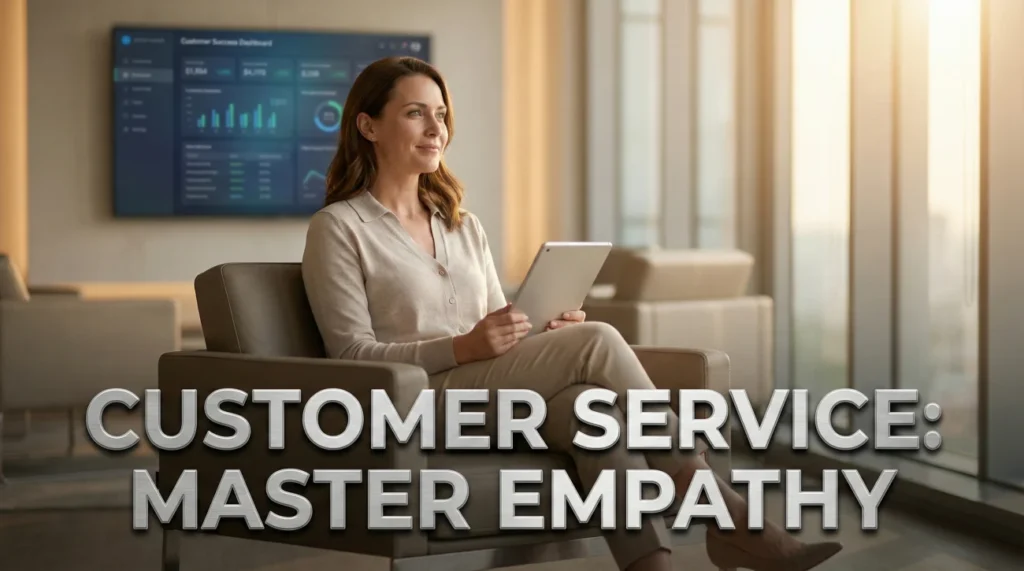
Q: What does “Empathy” mean to you in a customer service context?
Why they ask: Empathy is the #1 required skill. They want a definition that leads to action.
Sample Answer: Empathy is the ability to step into the customer’s shoes and understand their frustration without judgment. It is not just saying “I’m sorry”; it is validating their feelings.
For example, if a customer is upset about a late delivery, I don’t just quote the policy. I say, “I can hear how stressed you are, especially since this was a gift. I would be frustrated too.” By validating them first, I lower their defensive wall, which allows us to move to a solution faster. Empathy transforms a transaction into a relationship.
Q: Describe a time you went above and beyond for a customer.
Why they ask: They want to see your “Service Hero” moment.
Sample Answer: I had a customer who called in panic because she ordered the wrong size dress for her daughter’s wedding, which was in two days. The correct size was out of stock online.
Instead of just apologizing, I called three physical stores in her region personally. I found one that had the dress. I arranged for the store manager to set it aside and even coordinated with a courier service to get it to her the next morning. She sent a thank-you note saying I “saved the wedding.” To me, going above and beyond means taking ownership of the problem until it is fully resolved.
Q: How do you handle a customer who is wrong but convinced they are right?
Why they ask: Tests your diplomacy. You can’t win an argument with a customer.
Sample Answer: I never use the word “Wrong.” That triggers a fight. I use the “Feel, Felt, Found” method or a pivot technique.
I might say, “I can see why that would be confusing. Many customers have felt the same way because the manual is a bit technical. What we have found is that pressing this specific button actually resets the device.” I guide them to the correct answer by making it a shared discovery, not a correction. My goal is to fix the issue, not to prove I am smart.
Q: What is your definition of “Excellent Customer Service”?
Why they ask: This aligns your values with the company culture.
Sample Answer: Excellent service is the intersection of Speed, Accuracy, and Warmth. It means respecting the customer’s time by solving their issue quickly, ensuring the solution is correct so they don’t have to call back, and treating them with genuine kindness so they feel valued.
It is anticipating needs – like offering a return label before they ask – and ensuring that the customer leaves the interaction feeling better than when they started.
Handling Difficult Situations & De-escalation
A customer is screaming at you and using abusive language. How do you handle it?
I stay calm and do not take it personally. I know their anger is directed at the situation, not me. However, I have boundaries. I use a “Warning Statement” politely: “I really want to help you, but I cannot do that while you are yelling. Please lower your voice so we can solve this.”
If they continue to be abusive, I follow company protocol, which usually involves placing them on a brief hold to let them cool down or transferring them to a supervisor. I never scream back. Maintaining my professionalism effectively highlights their unreasonable behavior.
You have to say “No” to a customer’s request (e.g., a refund outside policy).
I use the “Yes, but…” or “Alternative Solution” technique. I never start with “No.” I start with what I can do.
For example: “While I cannot offer a cash refund because the 30-day window has passed, what I can do is offer you a store credit for the full amount that never expires.” I explain the limitation briefly but focus 90% of the conversation on the solution I am providing. This makes the rejection feel like a compromise.
You don’t know the answer to a customer’s question.
I never guess, and I never say “I don’t know” and stop there. I say, “That is a great question. I want to be 100% sure I give you the correct information, so let me double-check that with my specialist right now.”
This builds trust. They would rather wait 2 minutes for a correct answer than get a fast, wrong answer. I keep them updated while I search so they don’t feel abandoned on hold.
Skills, Tools & Communication
Q: What is “Active Listening” and how do you demonstrate it?
Active listening is fully concentrating on the speaker rather than just waiting for your turn to talk. I demonstrate it by using “Verbal Nods” (like “I see,” “Go on”) so they know I’m there.
Crucially, I paraphrase back to them: “Just to make sure I understand, you’re saying the device powers on but the screen stays black, correct?” This confirms accuracy and makes the customer feel heard.
Q: How do you handle multiple customers (multitasking) via chat or live?
I prioritize accuracy over speed. On chat, I use pre-written “macros” or templates for common greetings to save time, but I customize the solution part.
If I am helping a live customer and the phone rings (or another person approaches), I acknowledge the new person immediately with eye contact or a nod, signaling “I’ll be right with you.” Communication manages the wait time perception.
Q: What CRM or Helpdesk software are you familiar with?
I have experience with [Zendesk, Salesforce, HubSpot, Freshdesk]. I am comfortable logging tickets, categorizing issues, and checking customer history.
More importantly, I am tech-savvy and a quick learner. If you use a proprietary system, I am confident I can master the interface quickly because I understand the underlying logic of ticketing systems.
Q: How do you adapt your communication style to different customers?
I “Mirror” the customer. If a customer is chatty and friendly, I engage in small talk to build rapport. If a customer is brief, business-like, and in a rush, I cut the fluff and get straight to the solution.
For elderly or non-tech-savvy customers, I slow down, avoid jargon, and walk them through steps one by one. Flexibility allows me to connect with anyone.
Q: What is “First Call Resolution” (FCR) and why does it matter?
FCR means solving the customer’s problem completely in a single interaction so they don’t have to call back. It is the holy grail of customer satisfaction.
To achieve FCR, I ask, “Is there anything else I can help you with?” and I anticipate related issues. For example, if they call about a password reset, I also check if their email address is current so they don’t get locked out again next week.
Q: How do you maintain a positive tone in written communication (Email/Chat)?
Written text lacks tone, so I have to add it. I use “Softening words” like “Kind regards,” “Happy to help,” or “I appreciate your patience.”
I avoid negative phrasing. Instead of “You didn’t send the attachment,” I write, “Could you please send the attachment?” I read my draft aloud to check if it sounds robotic or rude before hitting send.
Service Recovery & Feedback
Q: Describe a time you made a mistake with a customer. How did you fix it?
Why they ask: Accountability check. Do you hide errors or own them?
Sample Answer: I once gave a customer incorrect information about a shipping time, causing them to miss a deadline. When they called back angry, I realized my error.
I owned it immediately: “That was completely my mistake, I misread the schedule.” I didn’t make excuses. I then expedited a replacement shipment overnight at the company’s expense (after getting manager approval) to rectify it. The customer appreciated the honesty more than the refund. Trust is rebuilt through accountability.
Q: How do you handle negative feedback from a customer survey (CSAT)?
Why they ask: Can you take criticism constructively?
Sample Answer: I view negative feedback as a gift because it shows me exactly where I need to grow. If a customer says I talked too fast, I don’t get defensive.
I make a conscious effort to slow down on my next ten calls. I also look for patterns. If multiple people say the same thing, it’s a habit I need to break. I use feedback to calibrate my performance, ensuring I am constantly improving.
Q: A customer asks to speak to a manager immediately. What do you do?
Why they ask: Do you dump problems on your boss, or try to save the call?
Sample Answer: I don’t block them, but I do try to de-escalate first. I say, “I can certainly get a manager for you, but they might be in a meeting which would require a hold time. I have the authority to resolve most issues right here – could I try to help you first?”
Often, they just want to feel important. If I can solve it, I save my manager’s time. If they insist, I transfer them warmly with a full briefing to the manager so the customer doesn’t have to repeat their story.
Customer Service Competency Quiz
Take the 20-Question Challenge
1. “Empathy” is best defined as:
- Feeling sorry for someone
- Understanding and sharing the feelings of another
- Agreeing with everything the customer says
- Giving refunds
2. “CSAT” stands for:
- Customer Sale Average Total
- Customer Satisfaction Score
- Computer System Analysis Tool
- Call Service Agent Time
3. The “HEART” framework (Hear, Empathize, Apologize, Resolve, Thank) is used for:
- Medical exams
- Service Recovery
- Sales pitching
- Hiring staff
4. “NPS” (Net Promoter Score) asks:
- Did you like the product?
- How likely are you to recommend us to a friend?
- Was the agent polite?
- How much did you spend?
5. “Active Listening” involves:
- Talking while the customer talks
- Concentrating, understanding, responding, and remembering
- Typing loudly
- Listening to music
6. If a customer is abusive, you should:
- Yell back
- Set boundaries politely and follow protocol (warn/terminate)
- Hang up immediately without a word
- Cry
7. “FCR” stands for:
- Fast Call Response
- First Call Resolution
- Final Customer Rating
- Free Customer Return
8. A “Ticket” in customer service is:
- A fine for speeding
- A record of a customer interaction/issue in the support system
- A coupon
- An invitation
9. To “De-escalate” means to:
- Make the customer angrier
- Reduce the intensity of a conflict through calm communication
- Transfer the call
- Ignore the problem
10. “Positive Language” focuses on:
- What you cannot do
- What you CAN do and solutions
- Complimenting the customer’s appearance
- Saying yes to everything
11. A “Knowledge Base” (KB) is:
- The smart employee
- A centralized repository of information/articles for solving issues
- The manager’s office
- A training room
12. “Omnichannel” support means:
- Phone support only
- Providing a seamless experience across phone, email, chat, and social media
- Supporting everyone at once
- Offline support
13. When putting a customer on hold, you must:
- Just press the button
- Ask for permission and explain why (“May I place you on a brief hold to check that?”)
- Play loud music
- Wait 5 minutes
14. “Dead Air” is:
- A broken AC
- Periods of silence on a call that make the customer wonder if you are still there
- A disconnected call
- A rude customer
15. “SLA” stands for:
- Service Level Agreement
- Service Level Agreement (Expectations for response time)
- Standard Letter Answer
- Safe Lifting Action
16. The “Customer Lifetime Value” (CLV) is:
- How long a customer lives
- The total revenue a business can expect from a single customer account
- The length of a phone call
- The warranty period
17. “Rapport” building involves:
- Reading a script
- Creating a connection through shared understanding and friendly communication
- Working fast
- Giving discounts
18. If you accidentally disconnect a call, you should:
- Wait for them to call back
- Call them back immediately
- Take a break
- Block the number
19. A “Canned Response” is:
- Food in a tin
- A pre-written response for common questions
- A rude reply
- A refund
20. The most important quality in Customer Service is:
- Talking fast
- Patience and a desire to help
- Knowing everything
- Being funny
❓ FAQ
📌 What is the best structure for behavioral answers?
Use a tight story: what happened, what you did, what changed. Keep it concrete, include one decision you made, and end with the outcome for the customer and the business.
🔥 How should I respond to an abusive customer?
Stay calm, set boundaries, and offer a path forward. You can say you want to help, but you cannot continue if the language stays disrespectful, then escalate if needed according to policy.
🧾 What if the customer asks for a refund I cannot approve?
Show alternatives without sounding rigid. Explain what you can do, offer options like replacement or credit if allowed, and tell them exactly what you will do next and when they will hear back.
✍️ How do I prove I can write good support emails?
Talk about clarity and tone. Mention short paragraphs, confirming the issue in your own words, one clear next step, and a polite closing that invites follow-up if anything is unclear.
📈 Which metrics do interviewers care about?
It depends on the team, but CSAT and resolution quality are usually central. If you mention efficiency, pair it with accuracy and documentation so it does not sound like you rush customers.
Final Thoughts
Strong answers to customer service interview questions sound like someone who can take heat and still stay useful. You do not need perfect lines. You need a repeatable way to listen, clarify, offer a solution, and close the loop.
When you pair empathy with clean process, you show you can protect the brand and the customer at the same time. That is what hiring teams want in the person on the front line.
⚠️ Disclaimer: The interview strategies, sample answers, and negotiation tips provided in this guide are for educational purposes only. Hiring decisions are subjective and vary by company and industry. While these strategies are based on professional HR standards, they do not guarantee a specific job offer or result.