Freshness Has a Deadline
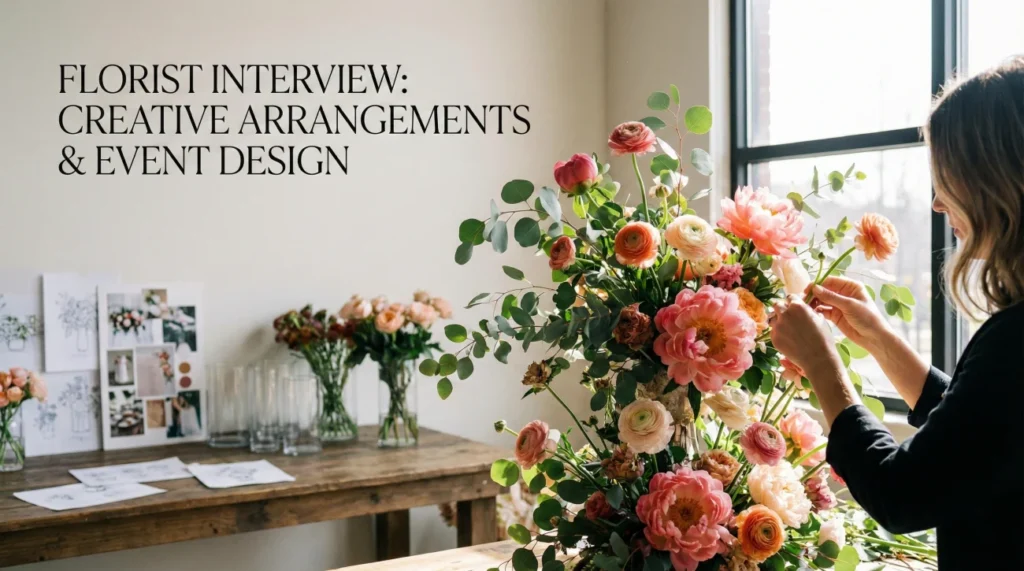
Floristry is beautiful because it is temporary. The stems arrive full of promise, and the clock starts the second you open the box. That is why florist interview questions are not only about taste and color. They are about whether you can protect fragile inventory, design under pressure, and still deliver something that feels effortless to the customer.
A hiring manager is listening for real shop instincts: how you condition fast without cutting corners, how you keep a cooler organized so product does not disappear in the back, and how you stay calm when an order changes late. They also want to know how you handle modern expectations like foam-free mechanics, local sourcing when possible, and smart substitutions when a requested bloom is out of season.
This guide helps you speak like a florist who understands both sides of the counter. You will practice answers about design mechanics, flower care, event execution, and customer conversations that can make or break a reputation in one delivery.
Floral Design & Mechanics
Q: Describe your design style. Are you more traditional or garden-style?
I am versatile, but my personal strength is “Garden-Style” or “Organic.” I love using negative space and asymmetrical lines to let the flowers breathe, mimicking how they grow in nature. However, I understand that in a retail shop, I must adapt to the customer’s vision.
If a client wants a tight, traditional pave of roses, I can execute that with precision. I stay updated on current trends (like dried florals or color-blocking) so I can offer modern options, but I respect the timeless techniques of classical design.
Q: What mechanics do you use for a large arch or installation?
I prioritize sustainability and stability. I am moving away from floral foam (Oasis) due to its environmental impact. Instead, I use “Chicken Wire” (poultry netting) or “Agra-Wool” for structure and water retention.
For a large arch, I would use water tubes for thirsty blooms and moss to hide the mechanics. I ensure everything is double-secured with zip ties because safety is paramount – an installation cannot fall on a guest. I build the mechanics first, knowing that a strong foundation creates a beautiful result.
Q: How do you calculate the stem count for an arrangement?
I use a “Recipe” approach. I start with the budget and the retail price of the stems. I allocate 20% for foliage, 30% for focal flowers, and 50% for fillers and secondary blooms.
I visualize the shape (round, oblong) and calculate the surface area. I always factor in a 10% “waste/breakage” buffer. Being mathematically precise ensures the shop makes a profit on every arrangement, rather than guessing and over-stuffing.
Q: How do you create depth in an arrangement?
I work in layers. I start with the greenery to establish the shape. Then I place the focal flowers at varying heights – “burying” some deeper into the arrangement and letting others float above.
I use “line flowers” (like snapdragons) to draw the eye out and “face flowers” (like dahlias) to hold attention. Contrast in texture (smooth lily vs. rough thistle) also creates visual depth. I constantly spin the vase (lazy susan) to ensure it looks good from 360 degrees.
Flower Care & Conditioning
Q: How do you process flowers when they arrive from the wholesaler?
Speed is key. I unbox immediately to prevent overheating. I remove all foliage that would sit below the water line to prevent bacterial growth.
I give every stem a fresh cut at a 45-degree angle to maximize water uptake. I place them in clean buckets with the appropriate flower food solution. I let them hydrate (“drink”) at room temperature for an hour before putting them in the cooler to harden off.
Q: What is your trick for reviving wilted hydrangeas?
Hydrangeas drink through their petals and stems. If they wilt, I submerge the entire head in room-temperature water for 30 minutes.
I also re-cut the stem and dip it in boiling water (or use Alum powder) for 30 seconds to clear the sap blockage, then place it back in fresh cool water. This usually perks them up within an hour. Knowing these rescue tricks saves inventory and profit.
Q: Which flowers should not be stored together?
Ethylene sensitivity is the main issue. I keep ethylene producers (like aging carnations or fruits) away from ethylene-sensitive flowers (like orchids or delphinium).
Also, daffodils (narcissus) secrete a sap that clogs other stems. They must be conditioned separately in their own bucket for 24 hours before being mixed into an arrangement with other flowers.
Q: How do you manage inventory to minimize waste (shrinkage)?
I use the FIFO method: First In, First Out. I date the buckets when they arrive. I use older (but still healthy) blooms for daily orders and save the freshest for later in the week.
I create “Designer’s Choice” specials to move product that is opening up quickly. If flowers are past their retail prime but still pretty, I dry them for future use or donate them, ensuring we get value from every stem.
Q: How do you handle lilies in a shop with cats or hospitals?
I am hyper-aware of safety. Lilies are toxic to cats. If I know a recipient has a cat, I substitute the lily or warn the sender explicitly.
For hospitals, I avoid highly fragrant flowers (like Stargazer lilies) as they can trigger allergies or nausea. I also remove the pollen anthers from lilies immediately as they open to prevent staining clothes or tablecloths.
Q: How do you force blooms open for an event?
If I need peonies or roses to be fully blown for a Saturday wedding, I manage the temperature. I keep them out of the cooler in a warm, bright room (but not direct sun).
I use warm water in the bucket. For roses, I might gently “reflex” the petals manually. Timing is everything; I monitor them hourly so they don’t blow open too early and shatter.
Weddings & Customer Consultation
A bride wants blue roses and out-of-season flowers on a small budget.
I manage expectations gently. I explain, “True blue roses don’t exist in nature; they are dyed and can look artificial/stain the dress. Peonies in December are imported and cost 3x the normal price.”
I offer alternatives: “To stay in budget and get that lush look, let’s use garden roses which mimic peonies, and introduce blue through thistle, delphinium, or the ribbon.” I focus on the feeling and color palette rather than specific expensive stems.
A customer complains that their arrangement died after 2 days.
I apologize and investigate without blaming. “I’m so sorry to hear that. Our flowers usually last 5-7 days. Can you tell me where they were displayed (e.g., near a heater/window)?”
Regardless of the cause, I offer a replacement. “I want you to enjoy your flowers. I’ll send a fresh wrap today.” I use it as a chance to re-educate on care (changing water), turning a negative into a loyal customer. The cost of a replacement is cheaper than a bad review.
It is Valentine’s Day week. The shop is chaos. How do you cope?
I thrive on the adrenaline. I prep in advance (“greening” vases early). I focus on mass production (assembly line style) for the standard “Dozen Red Roses” orders.
I maintain a clean station to prevent mistakes. I help customers who walk in by offering “Grab and Go” bouquets so they don’t have to wait for a custom design. I keep my attitude positive because the team energy depends on it.
Business & Retail Operations
Q: How do you handle delivery logistics?
I double-check addresses and phone numbers before the driver leaves. I group deliveries by zip code (“Routing”) to save gas and time. I call ahead if the weather is extreme (freezing/heat) to ensure someone is home, as leaving flowers on a porch can ruin them in minutes.
If a recipient isn’t home, I tag the door, leave a voicemail, and bring the flowers back to the shop cooler rather than risking them. Communication with the sender is vital.
Q: How do you up-sell a customer ordering over the phone?
I paint a picture. If they ask for the $50 bouquet, I say, “That is a lovely size for a desk. If you bump it to the $75 ‘Premium’ size, we can add premium blooms like orchids and roses that really make a statement.”
I suggest add-ons like chocolates, a luxury card, or a keepsake vase. I focus on the reaction of the recipient: “Make it a moment they won’t forget.”
Q: How do you maintain the shop’s appearance?
A flower shop is a sensory experience. I sweep the floor constantly to remove leaves and thorns (slip hazard). I change the water in the display cooler buckets every other day so it is crystal clear, not cloudy.
I arrange the cooler by color (rainbow effect) to make it visually appealing and easy for customers to shop. A clean, fresh-smelling shop sells more flowers.
Q: Why do you want to work as a Florist?
I want to be a florist because I love the intersection of nature and emotion. Flowers are present for life’s biggest moments – birth, marriage, love, and loss. I take pride in translating a customer’s feelings into a tangible, beautiful arrangement. I enjoy the fast pace and the physical work, and I find deep satisfaction in creating something temporary but impactful.
Floral Design Competency Quiz
Take the 20-Question Challenge
1. “Conditioning” flowers means:
- Exercise for the florist
- Preparing stems (cutting, hydrating) to prolong vase life
- Painting them
- Drying them out
2. The “Focal Point” of an arrangement is:
- The vase
- The area of greatest visual impact or weight
- The price tag
- The greenery
3. Ethylene gas causes flowers to:
- Grow faster
- Age prematurely (wilt, drop petals)
- Change color
- Smell better
4. A “Boutonniere” is worn by:
- The bride
- The groom/men on the lapel
- The flower girl
- The table
5. To keep water clear, you should remove:
- The thorns
- All foliage below the water line
- The flower food
- The petals
6. “Mechanics” in floristry refers to:
- Fixing the delivery van
- The supplies (tape, wire, foam) used to hold flowers in place
- The robotic flowers
- The cash register
7. A “Corsage” is typically worn:
- On the head
- On the wrist or pinned to the dress shoulder
- On the shoe
- In the vase
8. “Deadheading” means:
- Killing the plant
- Removing spent/dead blooms to encourage new growth or aesthetics
- Cutting the roots
- Painting the flower black
9. The “Line Flower” establishes:
- The price
- The height, width, and shape of the design (skeleton)
- The color only
- The smell
10. “Floral Foam” (Oasis) must be soaked by:
- Forcing it down under water
- Letting it float and absorb water naturally (free float)
- Spraying it with a hose
- Leaving it in the rain
11. A “Hand-Tied Bouquet” is constructed:
- In a vase
- In the hand, spiraling the stems
- With glue
- By a machine
12. Which flower is known for a hollow stem that crushes easily?
- Rose
- Amaryllis (or sometimes Dahlia/Delphinium)
- Carnation
- Chrysanthemum
13. “Reflexing” a rose means:
- Throwing it away
- Gently folding back the petals to make it look larger/open
- Painting it
- Freezing it
14. “Filler Flowers” are used to:
- Fill the trash can
- Fill gaps between focal flowers (e.g., Baby’s Breath, Waxflower)
- Make the bouquet heavy
- Hide the vase
15. To cut a thick woody stem (like Hydrangea/Lilac), you should:
- Break it by hand
- Use sharp shears (and possibly split the stem vertically)
- Use scissors
- Burn it
16. “Monochromatic” color scheme uses:
- Every color in the rainbow
- Tints and shades of a single color
- Black and white only
- Red and Green
17. “Wiring” a stem is done to:
- Electrocute it
- Provide support, lengthen, or manipulate the curve of the flower
- Make it magnetic
- Dry it out
18. A “Nosegay” is:
- A tissue
- A small, tight cluster of flowers (posy)
- A large funeral spray
- A flower crown
19. The “Vase Life” is:
- How long the vase lasts
- How long the flowers remain fresh after arrangement
- The price of the vase
- The history of the vase
20. “Pave” style involves:
- Throwing flowers
- Placing flowers very close together, creating a carpet-like surface
- Using tall branches
- Using only leaves
❓ FAQ
📷 What is the best way to present my work if I am not “Instagram famous”?
Bring a small, clean set of photos that show range and finish. Include one everyday arrangement, one sympathy piece, and one event-style design. Hiring managers care more about mechanics, proportion, and consistency than follower count.
🧰 What will a bench test usually measure?
Speed, mechanics, and how you work. They watch stem prep, tape and wiring, balance, and cleanliness. If you narrate your choices briefly and keep your station controlled, you score points even before the piece is finished.
🧠 How should I handle a client who wants an expensive look on a tight budget?
Ask what they want the arrangement to feel like, then build that feeling with smart substitutions. Use fewer premium focal blooms, more texture from foliage, and a shape that looks intentional. Budget work is where your design judgment shows.
🧊 What is a common mistake new florists make with the cooler?
Mixing everything together and losing track of age. A simple system, dated buckets, grouped varieties, and daily checks prevents waste. Organization is not optional when the product is perishable.
🚚 How do I answer questions about delivery problems?
Own the moment and protect the relationship. Explain how you confirm details, communicate early if something is off, and offer a fast fix when needed. A calm replacement plan is cheaper than a damaged reputation.
Final Thoughts
Great florists are creative, but the ones who get hired are also dependable. Your answers to florist interview questions should show you can design with intention, keep product healthy, and execute orders cleanly when the shop is busy.
If you can explain your conditioning routine, your mechanics for stable designs, and how you communicate substitutions without stress, you will sound like someone who can protect quality and keep customers coming back.
⚠️ Disclaimer: The interview strategies, sample answers, and negotiation tips provided in this guide are for educational purposes only. Hiring decisions are subjective and vary by company and industry. While these strategies are based on professional HR standards, they do not guarantee a specific job offer or result.