Protecting the Bottom Line
Loss prevention officer interview questions (or Asset Protection) are designed to find a candidate who is observant, disciplined, and legally savvy. Unlike a standard security guard who observes and reports, a Loss Prevention (LP) Officer often has the authority to detain shoplifters, conduct internal audits, and investigate employee fraud. Hiring managers are looking for someone who can balance the aggression required to stop a thief with the customer service mindset required to work in a retail environment.
The rise of “Organized Retail Crime” (ORC) has made this role more dangerous and more critical. Interviewers will ask: Can you recite the “Five Steps of Apprehension” without hesitation? How do you handle a physical confrontation without getting the company sued? Do you have experience investigating internal theft, which often causes more loss than shoplifting? Your answers must prove that you can protect the store’s assets while strictly adhering to the laws and policies that protect the store’s liability.
This comprehensive guide helps you secure your badge. We explore the legal nuances of probable cause, the psychology of interviewing a dishonest employee, and the operational skills of auditing inventory. Whether you are applying to a big-box retailer like Target or a luxury boutique, these strategies will help you demonstrate that you are the ultimate protector of profit.
The 5 Steps of Apprehension & Legal
Q: What are the “Five Steps of Apprehension” (or Elements of Proof)?
I know these by heart because missing one means a bad stop and a lawsuit.
1. Selection: Seeing the subject pick up the merchandise.
2. Concealment: Seeing them hide it (or bypass payment).
3. Observation: Maintaining 100% continuous surveillance (no broken eye contact) to ensure they didn’t dump it.
4. Intent: Seeing them pass the last point of sale without paying.
5. Exit: Approaching them usually outside the vestibule.
If I miss even one step (e.g., I lost sight of them for 10 seconds), I do not make the stop. It is better to let the product go than to risk a false arrest claim.
Q: How do you approach a suspect to detain them?
I approach from the side or front (never behind, which is startling) with a calm, professional demeanor. I identify myself immediately: “Security, I need to talk to you about the merchandise in your bag.”
I do not touch them unless necessary for self-defense. I ask them to come back to the office voluntarily. I keep my hands visible and my distance safe. My goal is compliance, not a fight.
Q: A suspect runs. Do you chase them?
Absolutely not. Most major retailers have a strict “No Chase” policy to prevent injury to staff, customers, and the suspect. Chasing escalates the situation and can lead to a fatal accident in the parking lot.
Instead, I observe their direction of travel, get a description of the vehicle/license plate, and log the incident. The merchandise is replaceable; a human life is not.
Q: What is “Probable Cause” in a retail setting?
It is the reasonable belief, based on facts (the 5 steps), that a crime has been committed. I don’t stop someone based on a “hunch” or profiling (race/age/dress). I stop them based on behavior.
If I didn’t see the concealment myself, I don’t stop them, no matter what a sales associate tells me. I rely only on what I have personally witnessed or verified on CCTV.
Surveillance & Technology
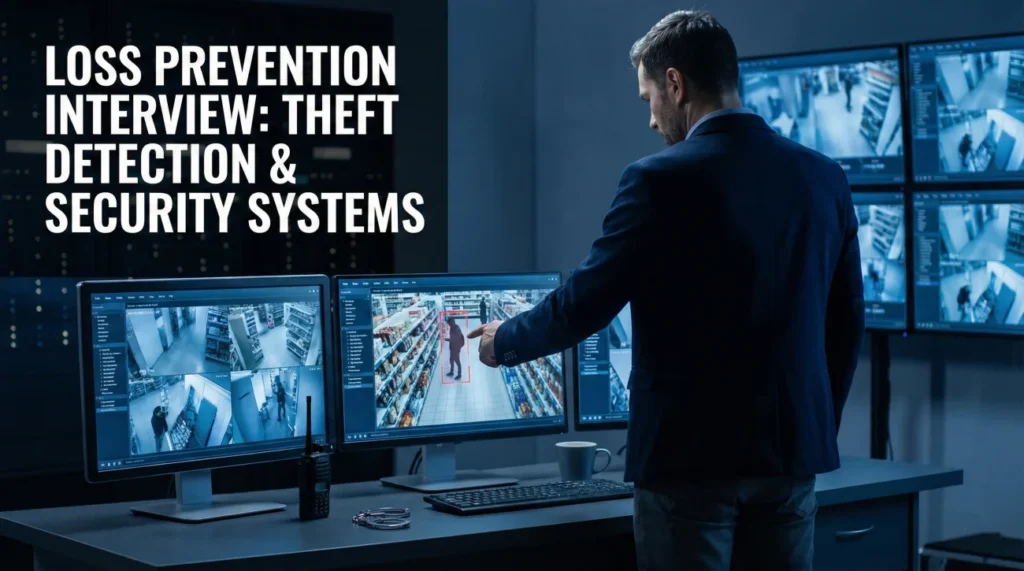
Q: How do you effectively monitor a store with 50+ cameras?
I don’t watch random screens. I focus on “High Shrink” areas (electronics, cosmetics) and “Choke Points” (entrances/exits).
I use “PTZ” (Pan-Tilt-Zoom) cameras to actively track suspicious behavior rather than just recording static views. I look for clusters of activity. I also use data analytics (register alerts) to tell me when to look at a specific camera.
Q: What behaviors signal a potential shoplifter?
I look for “scanning” (looking at employees/cameras rather than products). I look for “staging” (gathering items in a cart to grab later).
I watch for inappropriate clothing (heavy coats in summer) or large empty bags. Quick movements, selecting expensive items without looking at the price, and refusing customer service are all red flags I watch for.
Q: How do you use EAS (Electronic Article Surveillance) tags?
EAS tags are a deterrent. I ensure high-value items are tagged properly (not interfering with the product info). I audit the tagging compliance of the sales floor staff.
If the alarm goes off, I use it as a customer service opportunity: “Excuse me, I think the cashier forgot to remove a tag.” I don’t assume theft immediately; I verify the receipt first. False alarms kill credibility.
Q: How do you document a theft incident?
I write a detailed narrative report immediately. I burn the video footage to a disc/drive as evidence. I photograph the stolen merchandise.
I collect witness statements. I catalog the value of the items for restitution. My paperwork must be flawless because it is the primary evidence if the case goes to court. Sloppy paperwork lets criminals go free.
Q: How do you deal with “Organized Retail Crime” (ORC)?
ORC involves groups stealing for resale. They are dangerous. I don’t engage alone. I call police immediately.
I gather intelligence: license plates, descriptions, and patterns. I share this info with other local LP managers and law enforcement. We build a case over time rather than trying to stop a “blitz” robbery in the moment, which is unsafe.
Q: What is your experience with Exception Based Reporting (EBR)?
I use EBR software to analyze POS data. I look for cashier outliers: high voids, excessive returns, post-voids, or cash transactions with no receipt.
If Cashier A has $500 in refunds and the store average is $50, I investigate. EBR tells me where to look for internal theft so I’m not searching a needle in a haystack.
Internal Theft & Investigations
You suspect an employee is stealing cash from the register.
I do not confront them immediately. I build the case. I use CCTV to watch their hand movements during transactions. I correlate the video with the transaction log (EBR).
I look for “sweethearting” (not scanning items for friends) or pocketing cash. Once I have irrefutable video evidence and data, I conduct a formal interview (Wicklander-Zulawski method) to obtain a confession/admission before termination.
An associate tells you their manager is stealing.
I take the tip seriously but discreetly. I protect the whistleblower’s identity. I do not tell the manager.
I start an investigation, auditing the manager’s cycle counts, trash logs, or refund overrides. I might install a covert camera if authorized by legal/HR. Investigating a superior requires extreme caution and usually involves looping in the District LP Manager.
During an interview, the employee admits to stealing $20, but you know it’s $500.
I use the admission to pivot. “Thank you for being honest about the $20. I appreciate that. But my investigation shows this has been happening for a few weeks. I need you to be honest about the rest so we can resolve this fully.”
I show empathy (“I know you were under pressure”), but I stay firm on the facts. I usually have the evidence ready to show them if they deny it. The goal is a full written admission for restitution purposes.
Auditing & Safety Culture
Q: How do you conduct a physical security audit?
I check the perimeter: Are back doors alarmed and locked? Is the receiving dock secure? I check the merchandise protection: Are spider wraps on the TVs? Are the high-value cages locked?
I check safety: Are fire extinguishers charged? Are aisles clear? I score the store on compliance. I then walk the store manager through the findings, not to punish them, but to help them fix the gaps before a loss occurs.
Q: How do you train store staff on loss prevention?
I attend morning huddles. I teach “aggressive hospitality” – greeting every customer is the #1 theft deterrent. I teach them what to look for without profiling.
I explain the “Bob and Lisa” (Bottom of Basket, Look Inside Always) for cashiers. I make LP part of their daily routine, not a scary separate department. If the sales floor is vigilant, my job is easier.
Q: How do you handle a “Grab and Run” where you can’t stop them?
I observe and report. I note the time, the merchandise taken, and the direction of flight. I call the police to file a report.
I then analyze how it happened. Was the product too close to the door? Was the spider wrap loose? I use the incident to improve our physical security (e.g., moving the display) to prevent a repeat. I accept the loss but learn the lesson.
Q: Why do you want to work in Loss Prevention?
I want to work in LP because I enjoy the investigative process and the challenge of outsmarting criminal activity. I have a strong moral compass and attention to detail. I like that every day is different – one minute I’m auditing paperwork, the next I’m recovering $500 in merchandise. I want to protect the profitability of the store so that the honest employees can keep their jobs and bonuses.
Loss Prevention Competency Quiz
Take the 20-Question Challenge
1. The first of the 5 Steps of Apprehension is:
- Concealment
- Selection (You must see them pick it up)
- Intent
- Exit
2. “Shrink” refers to:
- Clothing getting smaller
- The difference between recorded inventory and actual physical inventory (Loss)
- A psychologist
- Closing the store early
3. “Sweethearting” is:
- Dating a coworker
- A cashier giving free or discounted merchandise to a friend/family member
- Being nice to customers
- Buying candy
4. A “Bad Stop” (stopping someone who didn’t steal) can lead to:
- A promotion
- A lawsuit for false imprisonment and termination of the LP officer
- A warning only
- Nothing
5. “ORC” stands for:
- Official Retail Council
- Organized Retail Crime
- Optional Return Center
- Overnight Receiving Crew
6. “EAS” stands for:
- Employee Assistance Service
- Electronic Article Surveillance (security tags/towers)
- Early Arrival Shift
- Emergency Alarm System
7. If you lose visual contact with a suspect (“Broken Surveillance”), you should:
- Stop them anyway
- Let them go (You cannot prove they didn’t dump the item)
- Guess they still have it
- Ask a customer
8. “Internal Theft” is committed by:
- Customers
- Employees
- Vendors
- Burglars
9. A “Booster” is:
- A child seat
- A professional shoplifter who steals for resale
- A manager
- A security guard
10. “Exception Reporting” analyzes:
- Exceptional employees
- Point of Sale (POS) data to identify irregular transactions (voids/refunds)
- Customer complaints
- Inventory counts
11. The safest place to apprehend a suspect is:
- In the middle of the store
- Just past the last point of sale or in the vestibule (Exit)
- In the parking lot
- In the bathroom
12. “Spider Wraps” are used to secure:
- Spiders
- Boxed merchandise (like electronics)
- Clothing
- Doors
13. If a suspect brandishes a weapon, you:
- Fight them
- Disengage immediately and call the police (Safety First)
- Follow them
- Yell louder
14. “Probable Cause” means:
- A gut feeling
- Reasonable grounds (facts/evidence) for making a stop/search
- Profiling
- Guessing
15. “Operational Shrink” involves:
- Theft
- Paperwork errors, missed markdowns, or vendor errors (non-theft loss)
- Washing clothes
- Cold weather
16. A “Grab and Run” is:
- A game
- Snatching items and fleeing quickly without concealment
- Shopping fast
- A sale event
17. “Bob” (in cashier training) stands for:
- A person’s name
- Bottom of Basket
- Back of Box
- Bring our Bags
18. The “Wicklander-Zulawski” method is for:
- Inventory counting
- Interviewing and Interrogation (non-confrontational)
- Stacking shelves
- Driving a forklift
19. If you did not see “Selection,” can you make a stop based on “Concealment” alone?
- Yes, always
- Usually No (You don’t know if they brought the item in with them)
- Maybe on Tuesdays
- Only if they look suspicious
20. The primary goal of Loss Prevention is:
- To arrest people
- To protect assets and ensure profitability (Preventing loss before it happens)
- To carry a badge
- To fight
❓ FAQ
📜 Do I need a criminal justice degree?
No, but it helps for management roles. For store-level LP, a High School Diploma and a clean background check are standard. Experience in security or retail is often more valuable than a degree.
🖐️ Are LP officers allowed to touch shoplifters?
It depends on company policy (and state law). Many retailers have moved to “Hands-Off” policies to reduce liability and injury lawsuits. Others allow “reasonable force” to handcuff. Know the specific policy of the employer.
🛑 Is it dangerous?
Yes. Confronting criminals always carries risk. You may face weapons, needles, or physical aggression. Situational awareness and de-escalation training are your best defenses.
🕵️♀️ Do I wear a uniform or plain clothes?
It varies. “Store Detectives” (undercover) wear plain clothes to blend in and catch shoplifters. “Uniformed Security” (deterrence) wear uniforms to prevent theft by presence. Many roles are a mix.
💰 Do I get a commission on recoveries?
No. That would create a perverse incentive to make false arrests. You are paid an hourly wage or salary. Your performance is judged on stats (stops, recoveries, internal cases), but never on a “bounty” system.
Final Thoughts
To secure a position, your answers to loss prevention officer interview questions must show that you are a disciplined professional, not a cowboy. Retailers need LP officers who protect the brand’s reputation as fiercely as they protect the merchandise. By highlighting your knowledge of the 5 steps, your adherence to safety protocols, and your ability to conduct fair investigations, you prove that you are the asset they need to protect their assets.
⚠️ Disclaimer: The interview strategies, sample answers, and negotiation tips provided in this guide are for educational purposes only. Hiring decisions are subjective and vary by company and industry. While these strategies are based on professional HR standards, they do not guarantee a specific job offer or result.