Where the Prescription Becomes Real Life
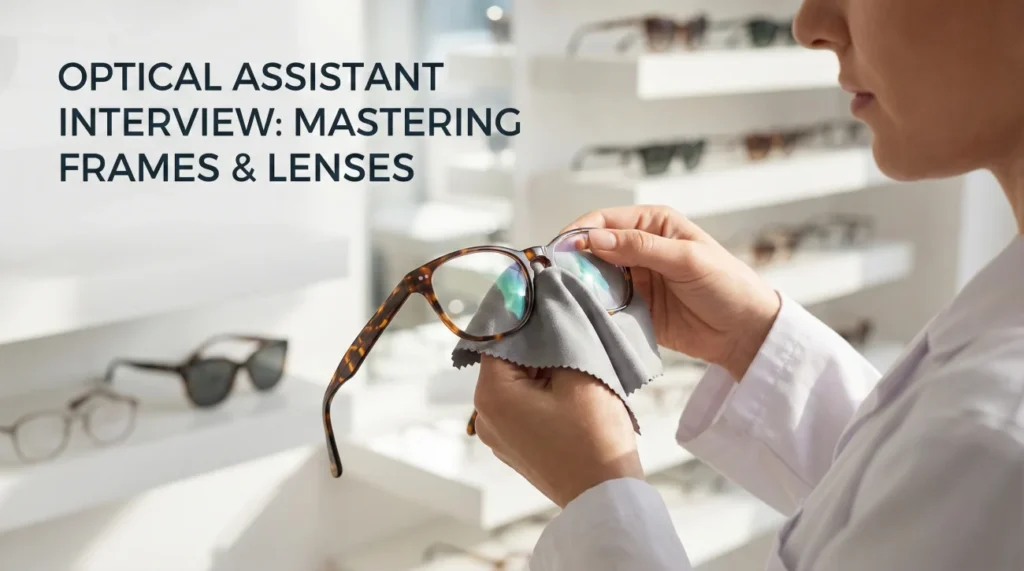
After the eye exam, most patients still have one big question: “What will actually work for me?” That is where an optical assistant steps in. Optical assistant interview questions are designed to see whether you can translate a prescription into eyewear that fits, looks right, and feels comfortable day after day.
This role lives at the intersection of care and commerce. You are measuring, verifying, and troubleshooting like a technician, while also guiding frame choices like a stylist and explaining pricing like a retail pro. Interviewers pay attention to how you speak: can you simplify options without overselling, protect accuracy without sounding rigid, and keep the patient confident instead of overwhelmed?
Use this guide to practice answers that sound grounded in real dispensary work. The strongest candidates show calm process, clean measurements, and a patient-first tone that still supports sales goals.
Optical Knowledge & Lens Technology
Q: How do you explain Progressive Lenses (PALs) to a first-time wearer?
I avoid technical jargon like “corridor” or “add power” initially. I explain it as “natural vision.” I say, “Unlike bifocals with a visible line, these lenses mimic how your eye naturally sees. The top is for distance (driving), the middle is for the computer, and the bottom is for reading, all blended seamlessly.”
I actively manage expectations. I warn them about the “soft focus” at the edges and the need to point their nose at what they want to see. Teaching them how to use the lens before they buy it reduces non-adapts and returns significantly.
Q: A patient has a high prescription (-6.00). What lens material do you recommend?
I immediately recommend High-Index material (1.67 or 1.74). I explain, “With your prescription, standard plastic lenses will be thick and heavy, which can slide down your nose and distort the look of your eyes.”
I focus on the benefit: “High-index lenses bend light more efficiently, so they can be much thinner and lighter. This means your glasses will look sleek and feel comfortable all day.” I frames it as an investment in comfort and aesthetics, not just an upsell.
Q: Explain the benefits of Anti-Reflective (AR) coating.
I describe AR coating as “invisible glass.” I explain that without it, lenses reflect about 8-10% of light, which creates glare for the wearer and reflections that hide their eyes from others.
I use real-world examples: “AR coating reduces the starbursts you see around headlights when driving at night, and it lets people see your eyes in photos instead of the glare from the flash.” I present it as a standard necessity for clear vision, not an optional extra.
Q: What is the most critical measurement when dispensing glasses?
The Pupillary Distance (PD) and, for progressives, the Segment Height. If the optical center of the lens does not align with the patient’s pupil, they will experience induced prism, causing eye strain or double vision.
I take these measurements multiple times to ensure accuracy. I also check the “vertex distance” and “pantoscopic tilt” for higher prescriptions, knowing that even a millimeter of error can ruin the visual experience for the patient.
Consultative Selling & Patient Experience
A patient loves a frame that fits them poorly (e.g., bridge is too wide). What do you do?
I use the “Compliment and Redirect” strategy. I validate their taste: “I love that color on you!” Then I gently point out the fit issue as a functional concern: “I’m worried that because the bridge is wider than your nose, these will slide down constantly, which will be annoying.”
I immediately offer a solution: “Let me find a similar shape/color from a brand that offers a ‘universal fit’ or a narrower bridge.” I frame it as ensuring their comfort, so I am helping them, not criticizing their choice.
A patient complains about the price: “Why are these $500 when I can buy online for $50?”
I validate the cost but differentiate the value. “Online glasses can be great for a backup pair, but here you are paying for precision and guarantee. We take 3D measurements to align the lens perfectly to your eye, which online algorithms can’t do.”
I also highlight the quality of materials (e.g., titanium vs. nickel alloy) and the service warranty. “If a screw falls out or they need adjustment, we are here to fix it for free for the life of the frame.” I sell the service and the medical accuracy, not just the plastic.
How do you handle a “non-adapt” patient who says they can’t see out of their new progressives?
I listen and empathize first. “I know it feels ‘swimmy’ right now; that is very common.” I check the fitting cross alignment on their face to ensure the measurements were correct.
If the fit is correct, I re-educate them on head movement vs. eye movement. I ask them to try it for 1-2 weeks consistently. If they still struggle, I honor our satisfaction guarantee and switch them to a bifocal or single vision, ensuring they feel supported rather than blamed.
Frame Styling & Aesthetics
Q: How do you select frames for a round face shape?
The rule of thumb is contrast. For a round face (soft curves), I recommend angular frames like rectangular or geometric shapes to add definition and structure. I avoid round frames which can emphasize the fullness of the face.
I also look for frames that are slightly wider than the cheekbones to balance the proportions. However, confidence is key – if a patient loves a round frame and feels great in it, I support that choice because attitude trumps rules.
Q: How do you assist a patient with a high minus prescription (-8.00) in frame selection?
I steer them toward smaller, rounder frames. A rectangular frame keeps the thickest part of the lens (the edge), whereas a rounder shape cuts off that thick edge.
I advise against rimless or semi-rimless frames because the lens thickness will be very visible. I recommend a full plastic (acetate) frame which helps hide the edge thickness, ensuring the glasses look as good as the vision they provide.
Q: What is your strategy for selling a “second pair”?
I don’t sell it as a “spare”; I sell it as a “function-specific” tool. I ask about their lifestyle. If they work on computers, I suggest “Office Lenses.” If they are outdoors, I suggest prescription sunglasses.
I use the “shoe analogy”: “You wouldn’t wear high heels to the gym or running shoes to a wedding. One pair of glasses can’t do everything perfectly.” By identifying a specific visual need, the second pair becomes a solution, not a luxury.
Q: How do you keep the dispensary organized and appealing?
I practice “Visual Merchandising.” I group frames by brand or style (e.g., “The Minimalist Collection”). I ensure every frame is clean (no fingerprints!) and aligned on the shelf.
I rotate inventory to keep the board looking fresh. If a frame hasn’t sold in 6 months, I move it to a prime eye-level spot to give it a chance. An organized board tells the patient we are meticulous professionals who will be meticulous with their prescription.
Operations & Troubleshooting
Q: A patient comes in with a broken frame they bought elsewhere. Do you fix it?
I assess the risk first. I explain, “I am happy to try to adjust/fix this, but since it is not our frame, I cannot guarantee it won’t break further, and I can’t replace it if it does.”
I have them sign a waiver if the repair is risky (e.g., heating an old plastic frame). I try to be the hero who fixes it, as that builds immense goodwill and often converts them into a future customer for their next exam.
Q: How do you handle a busy Saturday with multiple patients waiting?
I acknowledge everyone immediately. “Welcome! I’ll be with you in about 10 minutes. Feel free to browse the frames while you wait.”
I triage. If someone just needs a quick adjustment, I might do it while the current patient is dilating or deciding. I prioritize comprehensive sales/dispenses but keep the flow moving. I never rush the patient in the chair, but I communicate clearly to those waiting.
Q: How do you ensure accuracy when ordering lenses from the lab?
I double-check everything. I compare the doctor’s Rx to the order form. I re-measure the PD and Segment Height.
I verify frame model numbers and color codes. When the glasses arrive from the lab, I “neutralize” them (check the prescription) using the lensometer before calling the patient. Catching a lab error before the patient arrives prevents a negative experience and a wasted trip.
Q: Describe your experience with Vision Insurance.
I am familiar with major plans like VSP and EyeMed. I know how to pull authorizations and explain benefits clearly to patients (“You have a $150 frame allowance, and 20% off the overage”).
I calculate the out-of-pocket cost upfront so there are no surprises at the register. Understanding the complexity of managed care is essential to avoiding billing disputes.
Q: How do you troubleshoot a patient seeing “rainbows” in their lenses?
This is often due to “chromatic aberration” in polycarbonate lenses, especially with high prescriptions. I would check the material.
If they are in poly, I might recommend switching to Trivex or 1.60 High Index, which have better optical clarity (Abbe value). I explain it as a material sensitivity, not a defect, and work to find a material that provides clearer optics for them.
Q: How do you handle patient data privacy (HIPAA)?
Even in the retail area, we are a medical facility. I never discuss a patient’s prescription or medical conditions loudly where others can hear.
I keep computer screens turned away from the public. I shred documents with personal info. I treat every file with the same confidentiality I would want for my own medical records.
Optical Assistant Knowledge Check
Take the 20-Question Challenge
1. “PD” stands for:
- Peripheral Design
- Pupillary Distance (distance between pupils)
- Prism Diopter
- Patient Diagnosis
2. A “Progressive Lens” is also known as:
- A lined bifocal
- A No-Line Bifocal or PAL (Progressive Addition Lens)
- A single vision lens
- A contact lens
3. Which material is the most impact-resistant (safest for kids/safety glasses)?
- CR-39 (Standard Plastic)
- Polycarbonate or Trivex
- High Index 1.74
- Glass
4. “Photochromic” lenses (e.g., Transitions):
- Are always dark
- Darken when exposed to UV light (outdoors) and clear indoors
- Are only for cameras
- Change color based on mood
5. “Pantoscopic Tilt” refers to:
- The curve of the frame front
- The angle of the frame front relative to the face (tilted toward cheeks)
- The width of the bridge
- A broken hinge
6. An “OD” prescription refers to the:
- Left Eye (Oculus Sinister)
- Right Eye (Oculus Dexter)
- Both Eyes (Oculus Uterque)
- Optical Doctor
7. “High Index” lenses are beneficial because they are:
- Cheaper
- Thinner and lighter for high prescriptions
- Scratch-proof
- Unbreakable
8. “Anti-Reflective” (AR) coating helps to:
- Make the lens darker
- Reduce glare, allow more light to pass through, and improve aesthetics
- Prevent scratches entirely
- Make the lens thicker
9. A “Segment Height” measurement is required for:
- Single vision reading glasses
- Progressives and Bifocals
- Sunglasses only
- Contact lenses
10. “Presbyopia” is the condition where:
- You cannot see far away
- The eye loses ability to focus on near objects (happens around age 40+)
- You are color blind
- You have high pressure
11. A “Temple” on a pair of glasses is:
- The part that holds the lenses
- The arm that goes over the ear
- The nose pad
- The screw
12. “Blue Light” lenses filter light primarily from:
- The sun only
- Digital screens (computers, phones) and LED lighting
- The ocean
- Blue paper
13. The “Sphere” (SPH) part of a prescription indicates:
- The amount of astigmatism
- The overall power correction for nearsightedness (-) or farsightedness (+)
- The reading add
- The axis of rotation
14. “Astigmatism” (CYL) means the cornea is shaped like a:
- Basketball (perfectly round)
- Football (oval/irregular curve)
- Cube
- Pyramid
15. “Frame Warming” is done to:
- Sanitize the frame
- Make plastic frames pliable for lens insertion or adjustment
- Change the color
- Melt the frame down
16. If a frame sits too high on the nose, you should:
- Tighten the nose pads (bring them closer)
- Widen the nose pads (move them apart) to let it sit lower
- Bend the temples down
- Give up
17. “Vertex Distance” is the distance between:
- The two pupils
- The back surface of the lens and the front of the cornea (eye)
- The ears
- The floor and the eye
18. A “Lensometer” is used to:
- Measure the patient’s head
- Verify the prescription power of a lens
- Clean the lens
- Take a photo of the eye
19. “Asian Fit” or “Low Bridge Fit” frames have:
- No nose pads
- Larger/built-up nose pads to prevent sliding on flatter nose bridges
- Smaller lenses
- Wider temples
20. The most important factor in frame selection is:
- The brand name
- Ensuring the pupil is centered in the lens for optical performance
- The color
- The price tag
❓ FAQ
🧾 Do I need certification to work as an optical assistant?
It depends on where you work. Some locations hire and train from scratch, while others prefer candidates with credentials like ABO certification. In interviews, focus on accuracy, customer handling, and your willingness to learn standards quickly.
🏥 Is an optical assistant more medical or more retail?
It is both. You handle medical-adjacent tasks like measurements, lens verification, and privacy, but you also guide product selection and pricing conversations. The best answer shows you can keep ethics and service quality high while still meeting business goals.
👓 What should I wear to the interview?
Professional and neat is the baseline. If you wear glasses that fit well, it subtly signals you care about the product and know how eyewear should sit. If you wear contacts, that is fine too, just be ready to speak confidently about frames and lens options.
💬 How do I answer questions about upselling without sounding pushy?
Position it as education and fit-for-purpose recommendations. Explain benefits in plain language, confirm lifestyle needs, and offer choices. When patients understand why a coating or a second pair helps, the decision feels like care, not pressure.
🛠️ Will I be expected to adjust and repair glasses?
Yes, in many settings. Mention basic adjustments, nose pad changes, screw tightening, and safe frame heating practices. Employers want steady hands, patience, and the habit of explaining risk before attempting fragile repairs.
Final Thoughts
Strong answers to optical assistant interview questions sound like a person who can guide, measure, and troubleshoot without creating stress for the patient. You are proving you can be accurate with details while staying warm and practical in conversation.
If you highlight your measurement discipline, your ability to explain lens options clearly, and your calm handling of non-adapts and repairs, you will come across as the teammate an optometrist trusts and a patient wants to come back to.
⚠️ Disclaimer: The interview strategies, sample answers, and negotiation tips provided in this guide are for educational purposes only. Hiring decisions are subjective and vary by company and industry. While these strategies are based on professional HR standards, they do not guarantee a specific job offer or result.