The First Line of Defense
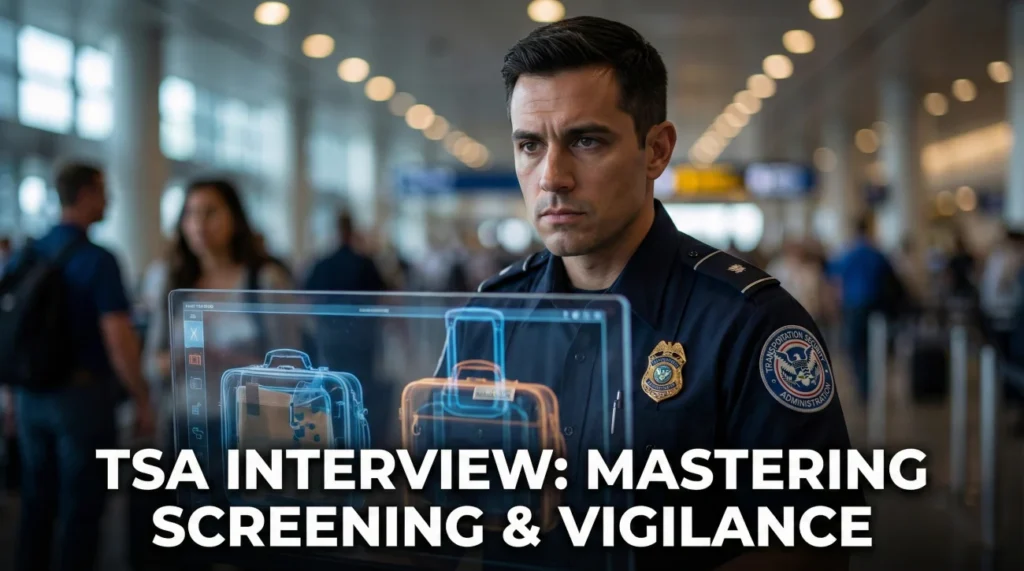
The Transportation Security Administration (TSA) Officer stands as the critical barrier between the traveling public and potential threats to aviation security. This is not merely a job of checking bags; it is a role that demands constant vigilance, rigorous adherence to Standard Operating Procedures (SOPs), and the ability to maintain composure in a high-stress, high-volume environment. Hiring managers are looking for candidates who can demonstrate unwavering integrity, attention to detail, and the customer service skills necessary to manage thousands of stressed passengers daily. To join the ranks of the Department of Homeland Security, you must be prepared to answer TSA officer interview questions that test your situational judgment, your ability to spot anomalies, and your commitment to the mission of protecting the nation’s transportation systems.
Screening Procedures and Threat Detection
Q: Describe your attention to detail in a repetitive task.
I understand that in security screening, complacency is dangerous. To maintain focus during repetitive tasks like X-ray monitoring, I use a systematic scanning method. I divide the image into quadrants and scan them in a specific order every time, rather than just looking at the center.
I actively look for “threat indicators” like density, shape, and opacity. I mentally name the objects I see to keep my brain engaged. If I feel fatigue setting in, I use the allowed rotation schedule to switch positions (e.g., from X-ray to walk-through metal detector) to refresh my focus. I treat every bag as if it could contain a threat, never assuming it is “just another suitcase.”
Q: How do you handle a bag that triggers an alarm during screening?
I follow the SOP strictly. I do not panic, but I do not ignore it. I take control of the bag immediately so the passenger cannot access it. I call for a “bag check” using the proper code.
I communicate clearly to the passenger: “I need to look inside your bag.” I ask them not to touch the bag. I use specific search techniques, looking for the item identified on the X-ray. If I find a prohibited item (like a large bottle of liquid), I give them their options (surrender, check it, or abandon). If I find a weapon or potential explosive, I stop, secure the area, and notify a supervisor and Law Enforcement Officer (LEO) covertly, keeping the passenger calm and separated from the item.
Q: What is the “Resolution” process for an anomaly?
Resolution means identifying exactly what caused the alarm and determining if it is a threat. I cannot let a passenger or bag pass until the alarm is resolved. If a body scanner alarms on a leg, I must conduct a targeted pat-down of that area.
If an X-ray shows a dark mass, I must physically inspect it or use Explosive Trace Detection (ETD) swabs. I do not guess. If I cannot resolve the alarm myself, I escalate to a supervisor. The rule is: “When in doubt, check it out.” I never clear an alarm based on an assumption or because the line is long.
Q: How do you balance security speed with security effectiveness?
Security effectiveness always comes first. A fast line that lets a weapon through is a failure. However, efficiency is important. I balance this by being prepared and communicative.
I give clear, loud instructions to passengers before they reach the belt (“Laptops out, shoes off”) so they are ready. I keep the bins moving. I work as a team; if my partner gets backed up at the bag check, I slow the X-ray belt slightly or call for a “bin runner.” I focus on smooth, steady flow rather than rushing, because rushing leads to mistakes.
Passenger Interaction and Conflict
Q: A passenger becomes aggressive because you confiscated their water bottle. How do you react?
I remain calm and professional. I do not take their anger personally. I explain the rule briefly: “I understand it’s frustrating, but federal regulations prohibit liquids over 3.4 ounces.”
I give them choices to restore their sense of control: “You can step out and drink it, check the bag, or surrender it here.” I do not argue. If they escalate to shouting or threats, I signal a supervisor or LEO. I maintain my position and do not return the item just to quiet them down, as that compromises security.
Q: How do you screen a passenger with a disability or medical device?
I treat them with dignity and follow the specific SOPs for persons with disabilities. I ask, “What is the best way for me to screen you?” listening to their needs regarding pain or mobility.
I explain every step before I do it: “I need to pat down your arm now.” I allow them to stay in their wheelchair if needed, using ETD swabs and a pat-down instead of the body scanner. I am patient and ensure they are not separated from their medical equipment or support person. Respect is compatible with security.
Q: A passenger claims they are late for a flight and tries to push past you. What do you do?
I physically block their path if necessary but use verbal redirection first. “Sir, you cannot pass this point until screening is complete.”
I explain that rushing compromises safety. I check their boarding pass; if the flight is truly closing, I might alert a supervisor to see if they can be expedited, but I do not break protocol myself. I remain firm. “I can get you through quickly if you follow my instructions right now.” I control the pace of the screening, not the passenger.
Q: How do you handle a passenger who refuses to be screened by the AIT (body scanner)?
Passengers have the right to opt-out of AIT. I explain the alternative clearly: “You have opted out. The alternative is a thorough pat-down.”
I explain that the pat-down is invasive and covers sensitive areas using the back of the hand. I offer a private screening room. I ensure a same-gender officer conducts the pat-down. I remain neutral and do not punish them for opting out, but I ensure the alternative screening is conducted meticulously according to SOP.
Q: You suspect a passenger is engaging in human trafficking. What are the signs?
I look for behavioral indicators: a passenger who is not in control of their own documents, who looks fearful or malnourished, or is dressed inappropriately for the weather/route.
I notice if a companion is answering all questions for them or watching them aggressively. I do not confront the trafficker directly. I flag the situation to a supervisor and LEO immediately, providing a description. I might separate them for a “random” additional screening to give the victim a chance to speak safely if possible.
Q: How do you handle a language barrier during screening?
I use non-verbal communication. I demonstrate what I want them to do (e.g., taking off my own shoes, miming emptying pockets). I point to signage that has visual icons.
I use the “Language Line” translation service or a translation app if available on agency devices. I remain patient and smile to reduce their anxiety. I check if a colleague speaks the language. I ensure they understand the instruction before proceeding to avoid a misunderstanding that looks like non-compliance.
Ethical and Team Scenarios
You see a coworker let a friend pass through without checking their bag. What do you do?
This is a major security breach. I must intervene. If the person is still there, I stop them: “Sir, we need to check your bag.”
I report the incident to my supervisor immediately. There are no “professional courtesies” in aviation security. A friend could be coerced into carrying a threat, or it could be a “Red Team” test. Allowing an unscreened bag endangers the entire airport. I prioritize the mission over my relationship with the coworker.
You find a large amount of cash in a bag ($50,000). Is it prohibited?
Cash itself is not a prohibited item. TSA searches for threats to aviation safety (explosives, weapons), not drugs or cash. However, large bulk cash can be indicative of criminal activity.
I would screen the bag for explosives as per SOP. If it clears security protocols, I generally return it. However, per agency policy, I might notify a supervisor or LEO so they can determine if further investigation (like a currency seizure) is warranted under their authority. I do not confiscate it myself.
You are exhausted at the end of a shift and the line is long. How do you stay vigilant?
I remind myself of the “why.” One mistake could bring down a plane. I focus on the immediate task – the one bag in front of me.
I use the team rotation system to switch positions to stay fresh. I drink water and stretch during breaks. I engage with my teammates to keep morale up. I do not cut corners. If I feel my performance slipping dangerously, I notify a supervisor to request a brief break or a position change away from critical X-ray duties.
A celebrity comes through your line. How do you treat them?
I treat them exactly like every other passenger. I screen them with the same rigor. I do not ask for an autograph, a photo, or special favors.
I maintain professionalism and privacy. I do not alert other passengers or cause a scene. If they request private screening to avoid paparazzi or crowds, I facilitate that request according to SOP, just as I would for any passenger requesting privacy. Security is the equalizer; fame does not exempt anyone from screening.
SOP and Agency Knowledge
Q: What is the “SSI” (Sensitive Security Information) rule?
SSI is information that, if publicly released, would compromise security. This includes specific details about screening percentages, machine capabilities, or shift schedules. I am trained to protect SSI. I do not discuss it with family, friends, or passengers. I do not post about it on social media. I only share it with those who have a “need to know.” Protecting SSI prevents bad actors from finding loopholes in our defense.
Q: Explain the “3-1-1” rule for liquids.
This is the standard for carry-on liquids. 3: Liquids, gels, and aerosols must be in containers of 3.4 ounces (100ml) or less. 1: All containers must fit inside 1 clear, quart-sized plastic bag. 1: Only 1 bag is allowed per passenger. Exceptions are made for medications, breast milk, and formula, which must be declared and screened separately (often with a bottle scanner or test strip).
Q: What is a “Red Team” test?
Red Teams are undercover testers from DHS who attempt to smuggle mock improvised explosive devices (IEDs) or weapons through checkpoints to test our effectiveness. I treat every passenger as if they could be a Red Team tester. If I catch a test object, I follow the reporting procedure. If I miss one, I accept the remedial training immediately. These tests are vital for identifying weaknesses in the system and improving our skills.
Q: What does “TDC” stand for and what happens there?
TDC is the Travel Document Checker. It is the first point of contact. I check the validity of the ID (looking for holograms, UV features, expiration) and verify the boarding pass (date, name match). I also conduct “behavioral detection” here, observing the passenger for signs of unusual stress, sweating, or deception before they even enter the physical screening lanes.
TSA Officer Knowledge Quiz
20 Practice Questions
1. What department does TSA belong to?
- Department of Transportation
- Department of Homeland Security
- Department of Defense
- Department of Justice
2. The 3-1-1 rule applies to:
- Checked baggage
- Carry-on liquids
- Food items
- Electronics
3. “ETD” stands for:
- Electronic Time Device
- Explosive Trace Detection
- Emergency Travel Document
- Enhanced Threat Drill
4. “AIT” is the acronym for:
- Automated ID Tracker
- Advanced Imaging Technology (Body Scanner)
- Airport Internal Transit
- All Item Test
5. Can a passenger opt out of AIT?
- No, it is mandatory
- Yes, but they must receive a pat-down
- Yes, they can just walk through the metal detector
- Only with a doctor’s note
6. “SOP” stands for:
- Security Of People
- Standard Operating Procedure
- System Of Protection
- Screening Officer Protocol
7. “LEO” refers to:
- Lead Executive Officer
- Law Enforcement Officer
- Luggage Entry Operator
- Late Entry Option
8. Which item is prohibited in carry-on?
- Disposable razor
- Baseball bat
- Knitting needles
- Empty water bottle
9. “SSI” means:
- Secret Security Intel
- Sensitive Security Information
- Screening Standard Index
- Safe Secure International
10. “Divestiture” involves:
- Investing money
- Removing items (shoes, belt) for screening
- Arresting a passenger
- Cleaning the bin
11. A “Resolution” is:
- A New Year’s promise
- Clearing an alarm/anomaly
- Denying entry
- Scanning a boarding pass
12. “PreCheck” passengers can keep on:
- Nothing
- Shoes, belt, and light jacket
- Heavy coats
- Headphones
13. “IED” stands for:
- Internal Explosive Device
- Improvised Explosive Device
- International Entry Document
- Immediate Emergency Drill
14. When can you stop screening?
- When the line is empty
- Never, until the checkpoint closes
- When you are tired
- When a supervisor isn’t looking
15. “TDC” stands for:
- Terminal Data Center
- Travel Document Checker
- Transportation Department Chief
- Time Delay Control
16. What color gloves are standard for TSA (usually)?
- Red
- Blue (Nitrile)
- White
- Black
17. “TIP” (Threat Image Projection) is:
- A tip from a passenger
- Fake threat images on X-ray to test officers
- A small payment
- Touching the screen
18. Who handles unruly passengers?
- The TSO physically
- Law Enforcement (LEO)
- The pilot
- Other passengers
19. “Accessible Property” is:
- Checked bags
- Items the passenger can reach (Carry-on)
- Duty-free items only
- Lost and found items
20. Which agency manages Customs?
- TSA
- CBP (Customs and Border Protection)
- FBI
- FAA
❓ Frequently Asked Questions
👮 Is this a law enforcement job?
No. TSOs are not law enforcement officers. You do not carry a gun, handcuffs, or have arrest powers. Your role is screening and detection. If an arrest is needed (for weapons or aggression), you call the Airport Police (LEOs).
⏰ What are the shifts like?
Airports operate early morning to late night. Shifts often start at 3:00 AM or 4:00 AM for the morning rush. Split shifts (working morning, break, then evening) and weekend/holiday work are common for new hires. Seniority determines shift bidding.
🏋️♀️ Is the job physically demanding?
Yes. You are on your feet for almost the entire shift. You must be able to lift heavy bags (up to 50-70 lbs) onto inspection tables, bend, reach, and squat repeatedly. Physical stamina is a requirement.
🎓 Do I need a degree?
No. A high school diploma or GED is the minimum requirement. However, you must pass a background check, a drug test, a medical evaluation, and a structured interview. Proficiency in English (reading, writing, speaking) is required.
🚀 Is there a career path?
Yes. You can advance to Lead TSO, Supervisor, Training Instructor, or Manager. Many TSOs also use the experience as a stepping stone to other federal agencies like Customs (CBP), ICE, or the Federal Air Marshal Service.
The Shield of the Skies
Being a TSA Officer is a role of immense responsibility often hidden behind routine. You are the shield that ensures millions of people arrive safely at their destinations. When you interview, show them your discipline. Show them that you can do the same task 1,000 times with the same focus as the first time because you know the stakes. By mastering these TSA officer interview questions, you demonstrate that you are ready to stand the watch and protect the skies.
⚠️ Disclaimer: The interview strategies, sample answers, and negotiation tips provided in this guide are for educational purposes only. Hiring decisions are subjective and vary by company and industry. While these strategies are based on professional HR standards, they do not guarantee a specific job offer or result.