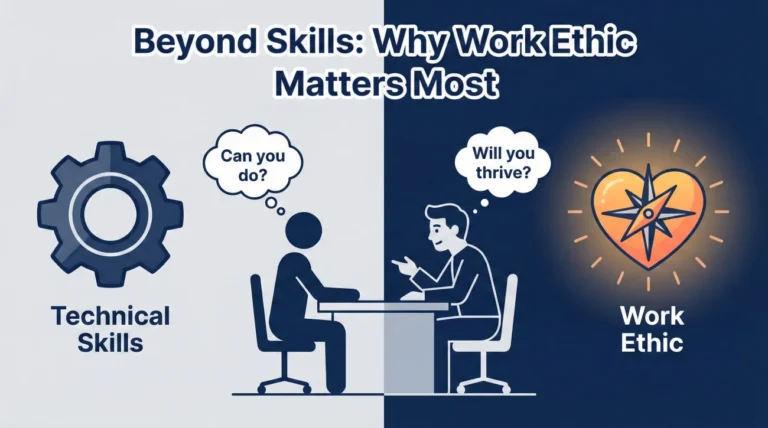
- What work ethic really means: Internal standards for quality, reliability, and conduct that stay consistent even when nobody is watching.
- Key components: Reliability, high quality standards, initiative, integrity, persistence, and professionalism together determine how dependable you are.
- Why it beats raw talent: Predictable delivery lets teams plan and trust you, and strong work ethic raises the whole team’s bar through example.
- How to prove it in interviews: Use specific stories that show what you did, why you chose the harder right option, and what changed because of it.
- How to build it over time: Define your own benchmarks, set accountability systems, seek feedback, and review where you slipped so you can fix the pattern.
Beyond the Cliché: Understanding Work Ethic
Everyone claims strong work ethic on resumes and during interviews, reducing the term to meaningless self-promotion that signals nothing about actual workplace behavior. Understanding what is work ethic requires moving past vague platitudes about “working hard” toward specific behavioral patterns that distinguish genuinely committed professionals from those who merely talk about commitment. Work ethic encompasses your internal standards for quality, reliability, and professional conduct – standards you maintain regardless of external monitoring or immediate consequences.
True work ethic manifests through consistent actions when shortcuts tempt, when deliverables fall below quality standards but meet minimum requirements, when colleagues won’t notice the difference between adequate and excellent. These moments reveal whether work ethic represents genuine values or convenient performance theater you abandon when circumstances don’t demand excellence. Organizations seek employees whose internal standards exceed external requirements because these individuals drive quality improvements, maintain performance during difficult periods, and inspire higher team standards through modeling rather than mandating.
Essential Components of Work Ethic
The work ethic definition extends beyond simple effort investment to encompass multiple dimensions that collectively determine your professional reliability and contribution quality.
Reliability and Consistency
The foundation of work ethic lies in predictable delivery – stakeholders can count on you meeting commitments regardless of circumstances. This reliability doesn’t mean perfect execution every time but rather consistent effort, proactive communication when obstacles emerge, and ownership of outcomes rather than excuse generation. Organizations value reliability more than occasional brilliance because business operations depend on predictable contributions that teammates can build upon.
| Work Ethic Component | How It Manifests | Why Employers Value It |
|---|---|---|
| Reliability | Consistent delivery, proactive communication, ownership | Predictable outcomes enable planning and team coordination |
| Quality Standards | Internal benchmarks exceeding minimums, attention to detail | Reduces errors, enhances reputation, minimizes rework |
| Initiative | Self-directed problem-solving, improvement pursuit | Drives innovation without constant supervision |
| Integrity | Honest reporting, ethical decisions under pressure | Builds trust, prevents costly mistakes from hidden problems |
| Persistence | Maintains effort through obstacles, seeks solutions | Completes difficult work others abandon |
| Professionalism | Respectful conduct, constructive communication | Creates collaborative environment, reduces conflict |
Internal Quality Standards
People with strong work ethic maintain quality benchmarks that exceed minimum requirements because their self-respect demands excellence regardless of external validation. This doesn’t mean perfectionism that prevents completion but rather consistent attention to detail, thoroughness in execution, and pride in work that represents their capabilities. These internal standards persist when supervisors aren’t watching, when clients wouldn’t notice shortcuts, when deadlines tempt corner-cutting.
Initiative and Ownership
Work ethic includes proactive problem identification and solution generation rather than waiting for explicit direction on every task. You identify improvement opportunities, address emerging issues before they escalate, and take responsibility for outcomes whether favorable or disappointing. This ownership mindset prevents excuse-making and finger-pointing while driving continuous enhancement of processes and results.
Expert advice: The clearest work ethic demonstration occurs when you maintain high standards during situations where no one would notice or penalize lower performance – this reveals genuine commitment versus compliance theater.
Why Work Ethic Matters More Than Talent
Organizations consistently choose candidates with solid skills and exceptional work ethic over brilliant individuals lacking reliability or initiative because long-term success depends more on consistent contribution than intermittent genius.
Predictability Creates Value
Managers can plan around reliable employees, assign critical projects with confidence, and build effective teams when work ethic ensures predictable outcomes. Talented but unreliable individuals create chaos requiring constant supervision, backup planning, and crisis management that undermines their technical contributions. The overhead of managing inconsistency often exceeds the value delivered during productive periods.
Work Ethic Amplifies Culture
Employees with strong work ethic elevate team standards through modeling rather than mandating behavior. When colleagues observe your consistent quality focus, proactive problem-solving, and ownership mindset, they adjust their own standards upward to match peer expectations. Conversely, poor work ethic contaminates culture as teammates rationalize similar shortcuts, reduced effort, and excuse-making once these behaviors become normalized.
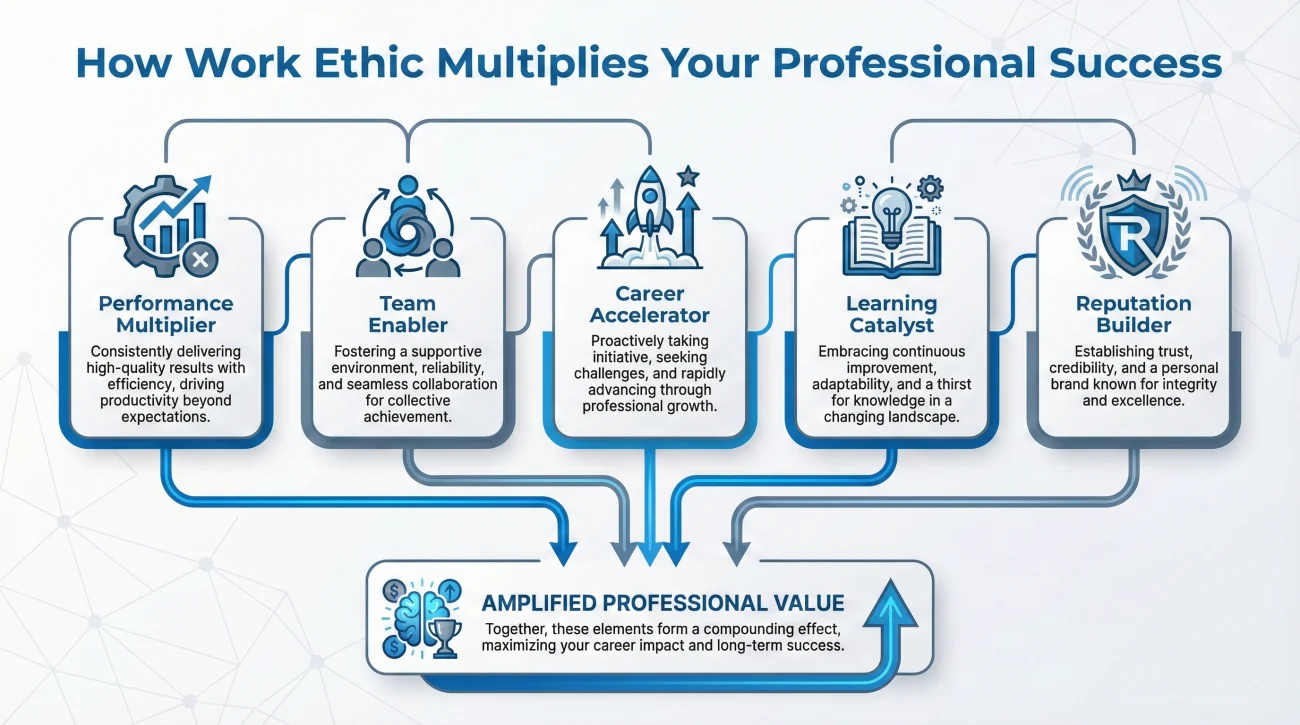
- 📈 Performance multiplier: Work ethic maximizes skill utilization while poor ethic wastes talent
- 🤝 Team enabler: Reliability allows colleagues to build on your contributions confidently
- 🎯 Career accelerator: Consistent delivery earns trust that expands opportunities
- 💡 Learning catalyst: Initiative and persistence develop expertise faster than passive participation
- 🛡️ Reputation builder: Track record of quality and reliability creates professional brand
💡 Pro tip: Work ethic becomes your competitive advantage when technical skills among candidates prove similar – it’s the differentiator employers can’t train but must hire.
Demonstrating Work Ethic Authentically
Understanding the work ethic meaning proves worthless without ability to communicate your patterns through specific behavioral evidence that goes beyond self-serving declarations.
Examples Over Assertions
Claiming “I have strong work ethic” carries zero credibility because every candidate makes identical assertions. Credibility comes from describing specific situations where your work ethic manifested through actions: maintaining quality standards when shortcuts would go unnoticed, taking initiative to solve problems beyond your role, delivering consistently despite challenging circumstances, owning mistakes rather than deflecting blame. These concrete stories demonstrate patterns that abstract claims cannot establish.
| Weak Demonstration | Strong Demonstration |
|---|---|
| “I’m very hardworking” | Example of specific project requiring sustained effort with measurable outcome |
| “I always deliver quality work” | Situation where you identified and corrected issues others missed |
| “I take initiative” | Problem you proactively solved without being asked or assigned |
| “I’m reliable” | Track record of consistent delivery across multiple projects or timeframe |
| “I have integrity” | Difficult decision prioritizing honesty despite personal cost |
Showing Patterns, Not Isolated Incidents
Single examples can represent atypical behavior rather than genuine work ethic patterns. Stronger demonstration comes from multiple examples across different contexts showing consistent approach: how you handled various projects, adapted to different team dynamics, maintained standards across favorable and difficult circumstances. This pattern evidence proves work ethic represents core values rather than situational performance you summoned for one important project.
Including Challenges and Adaptation
Perfect execution claims appear fabricated rather than authentic. Honest work ethic demonstration acknowledges situations that tested your standards, how you maintained effort when motivation declined, what adjustments you made when initial approaches proved insufficient. This realistic portrayal creates credibility that airbrushed narratives cannot achieve while showing resilience and learning orientation that employers value.
Developing Stronger Work Ethic
Work ethic isn’t fixed personality trait but rather developed capability that improves through conscious practice and values alignment.
Establishing Internal Standards
Strong work ethic begins with defining quality benchmarks independent of external requirements. What does excellent work look like in your role? What shortcuts compromise integrity even when undetectable? What minimum effort disappoints you regardless of whether deliverables meet formal standards? These internal standards become references guiding decisions when external pressure tempts compromise or when supervision gaps create opportunities for reduced effort.
Creating Accountability Systems
Even strong work ethic benefits from structures supporting consistent execution. Regular progress reviews, peer accountability partnerships, visible commitment tracking, and reflection practices maintain standards when motivation fluctuates or challenges accumulate. These systems don’t replace genuine work ethic but reinforce it through consistent feedback and course correction before drift becomes significant.
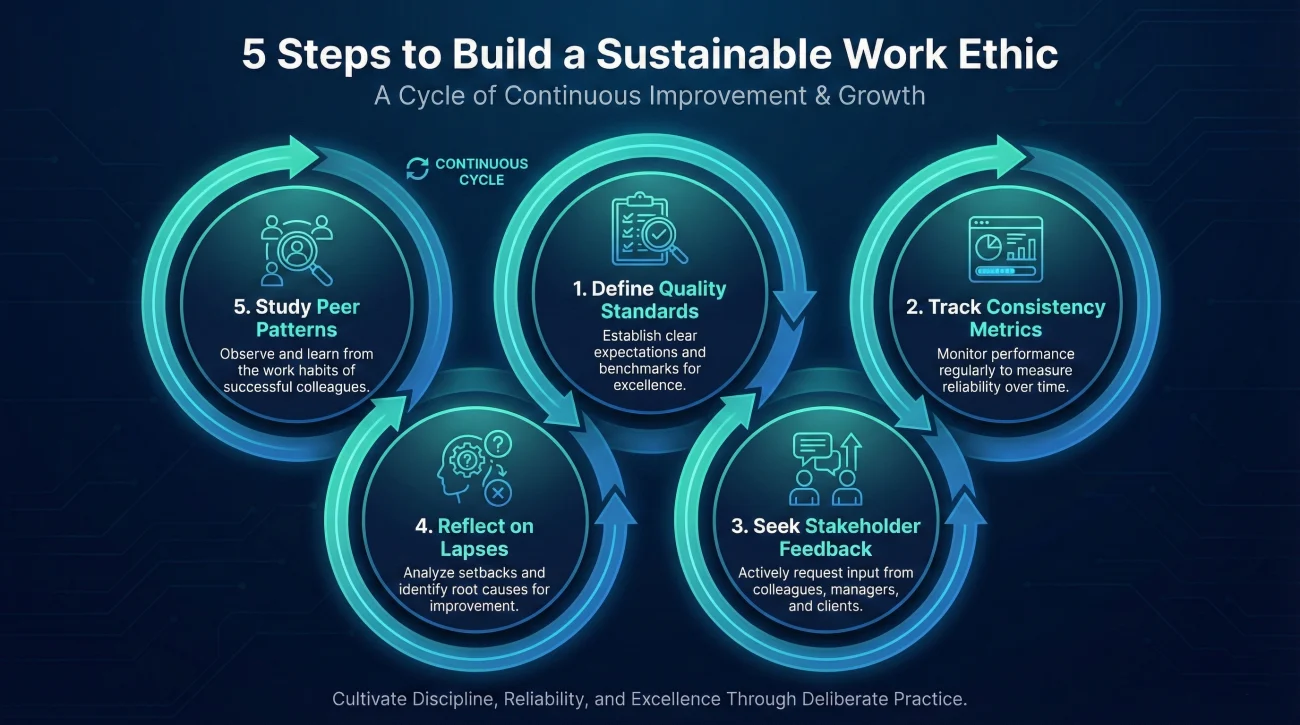
- Define explicit quality standards for your work that exceed formal requirements
- Track consistency metrics revealing whether standards persist across situations
- Seek feedback on reliability, initiative, and quality from diverse stakeholders
- Reflect on situations where you compromised standards and what triggered lapses
- Study colleagues demonstrating exceptional work ethic to identify transferable patterns
Work ethic development requires honest self-assessment – inflating your current capabilities prevents identifying areas genuinely needing improvement.
❓ FAQ
🎯 Is work ethic the same as working long hours?
No, work ethic focuses on quality, reliability, and integrity rather than mere time investment. You can work long hours with poor work ethic through low standards and inefficiency, or maintain strong work ethic through efficient execution within reasonable hours.
💼 Can work ethic compensate for skill gaps?
Partially, strong work ethic accelerates learning and maximizes existing capabilities, but can’t completely replace critical technical skills. The combination of solid skills and exceptional work ethic proves more valuable than brilliant skills with poor ethic.
⏰ How do I demonstrate work ethic in interviews?
Provide specific examples showing reliability patterns, quality focus beyond requirements, proactive initiative, and integrity under pressure. Include measurable outcomes and explain what these examples reveal about your standards and values.
📋 What’s the difference between work ethic and perfectionism?
Work ethic maintains high standards while accepting reasonable completion. Perfectionism prevents delivery through impossible standards. Strong work ethic includes knowing when good enough truly suffices versus when excellence matters, whereas perfectionism applies maximum standards universally.
✨ Is work ethic innate or learned?
Primarily learned – while personality influences initial tendencies, work ethic develops through conscious values development, feedback incorporation, and deliberate practice maintaining standards across varying circumstances. Anyone can strengthen work ethic through commitment and structured effort.
Final Thoughts
Work ethic represents the behavioral manifestation of your professional values – how you actually conduct yourself when external monitoring disappears and when circumstances make shortcuts tempting. Organizations increasingly prioritize work ethic during hiring because they recognize that skills without commitment, talent without reliability, and knowledge without integrity create more problems than they solve. The candidates who advance consistently demonstrate strong work ethic through specific examples revealing patterns of quality focus, proactive initiative, and dependable execution.
Truly understanding what is work ethic moves you beyond superficial claims toward authentic self-assessment of your standards, consistency, and professional conduct. This honest evaluation identifies both strengths to emphasize and gaps to address through conscious development. Work ethic isn’t mysterious or complex – it’s simply doing what you commit to doing, maintaining quality standards you define for yourself, taking ownership of outcomes, and conducting yourself with integrity regardless of who’s watching or what consequences loom.
During interviews and throughout your career, let your work ethic speak through demonstrated patterns rather than self-serving declarations. Build track record of reliable delivery, quality focus, and proactive contribution that creates reputation preceding you into new opportunities. Remember that work ethic becomes your sustainable competitive advantage because while others can learn skills you possess, they can’t easily replicate the consistent standards, initiative, and integrity that genuine work ethic represents.
⚠️ Disclaimer: The interview strategies, sample answers, and negotiation tips provided in this guide are for educational purposes only. Hiring decisions are subjective and vary by company and industry. While these strategies are based on professional HR standards, they do not guarantee a specific job offer or result.