
- Core distinction: Intrinsic vs extrinsic motivation determines whether performance holds up when rewards fade or recognition disappears.
- Intrinsic drivers: Mastery, autonomy, purpose, creation, and problem-solving can sustain effort through hard phases, but each has limits if the role becomes routine or controlled.
- Extrinsic drivers: Compensation, recognition, advancement, competition, consequence avoidance, and social approval can boost effort fast, but they are structurally hard to maintain long term.
- Best model: A balanced mix is most resilient, so when one driver weakens, others keep you engaged instead of crashing motivation.
- Interview framing: Admit both types matter, connect your real drivers to the role’s reality, and avoid claiming you are “purely” intrinsically motivated.
Understanding What Actually Drives Performance
The distinction between intrinsic vs extrinsic motivation determines whether your performance sustains through challenges or collapses when external rewards disappoint or recognition disappears. Intrinsic motivation comes from internal satisfaction – the work itself provides fulfillment through learning, mastery, contribution, or alignment with personal values. Extrinsic motivation depends on external factors like compensation, recognition, advancement, or avoiding negative consequences. Neither proves universally superior, but understanding your actual drivers prevents accepting roles where motivation sources don’t align with organizational realities.
Most people operate from mixed motivation – both internal satisfaction and external rewards matter, though proportions vary significantly across individuals and situations. Problems emerge when you rely exclusively on extrinsic motivation that employers can’t sustain indefinitely, or when you claim pure intrinsic motivation that sounds impressive but doesn’t reflect genuine drivers. During interviews and throughout careers, honest motivation assessment helps identify roles where you’ll maintain performance through difficult periods rather than only during favorable circumstances when rewards flow freely.
Intrinsic Motivation Sources and Sustainability
Understanding internal vs external motivation requires examining what creates genuine satisfaction from work itself rather than what work produces in terms of rewards or recognition.
Mastery and Continuous Learning
Some professionals gain primary satisfaction from skill development, problem-solving complexity, and intellectual challenge. The work itself provides reward through capability expansion regardless of external recognition. This intrinsic driver sustains motivation through difficult projects where external rewards lag because the learning process itself creates fulfillment. However, pure mastery motivation can lead to job-hopping once learning plateaus if not balanced with other drivers.
| Intrinsic Driver | What Provides Fulfillment | Sustainability Pattern |
|---|---|---|
| Mastery/Learning | Skill development, complex challenges, capability growth | High during growth phases, declines with routine work |
| Autonomy | Independent decision-making, creative freedom, control | Consistent when environment allows, frustrating when micromanaged |
| Purpose/Impact | Meaningful contribution, helping others, mission alignment | Sustains through challenges if impact remains visible |
| Creation | Building something new, innovation, tangible outputs | Strong during projects, weaker in maintenance roles |
| Problem-Solving | Overcoming obstacles, analytical challenges, solutions | Energizing with variety, diminishes with repetitive issues |
Autonomy and Self-Direction
Intrinsic motivation for many comes from exercising judgment, making independent decisions, and controlling their approach to work. This driver thrives in environments trusting employee expertise while suffering in micromanaged settings requiring constant approval. Organizations offering autonomy can sustain this motivation source even when compensation proves average because the work freedom itself provides significant fulfillment.
Purpose and Meaningful Impact
Purpose-driven professionals derive primary satisfaction from contributing to missions they value, helping others succeed, or creating positive impact beyond immediate tasks. This powerful intrinsic motivator sustains effort through challenges when connection between daily work and meaningful outcomes remains visible. However, abstract purpose without tangible impact evidence eventually weakens as motivation source requiring organizations demonstrate actual mission advancement rather than just stating worthy goals.
Expert advice: The most sustainable intrinsic motivation combines multiple sources – mastery, autonomy, and purpose together create resilience when individual drivers temporarily weaken during difficult periods.
Extrinsic Motivation Types and Limits
While intrinsic motivation examples come from work satisfaction itself, extrinsic drivers depend on rewards, recognition, and consequences organizations control – making them less stable but often more immediately powerful.
Compensation and Financial Rewards
Money motivates powerfully but research shows compensation effectiveness diminishes once basic needs are met. Initial salary increases drive significant effort but subsequent raises generate smaller motivation boosts. Relying exclusively on compensation motivation creates vulnerability because organizations cannot increase pay indefinitely, and adaptation to higher income levels reduces motivational impact over time. Smart professionals use compensation as important factor within broader motivation mix rather than primary driver.
Recognition and Status
Many derive strong motivation from public acknowledgment, titles, awards, and visibility within organizations. This driver creates powerful short-term surges when recognition arrives but proves difficult to sustain because organizations cannot provide constant recognition without diluting its value. Additionally, recognition motivation creates dependency on others’ validation rather than internal satisfaction, making performance vulnerable to leadership changes or shifting organizational priorities around acknowledgment.
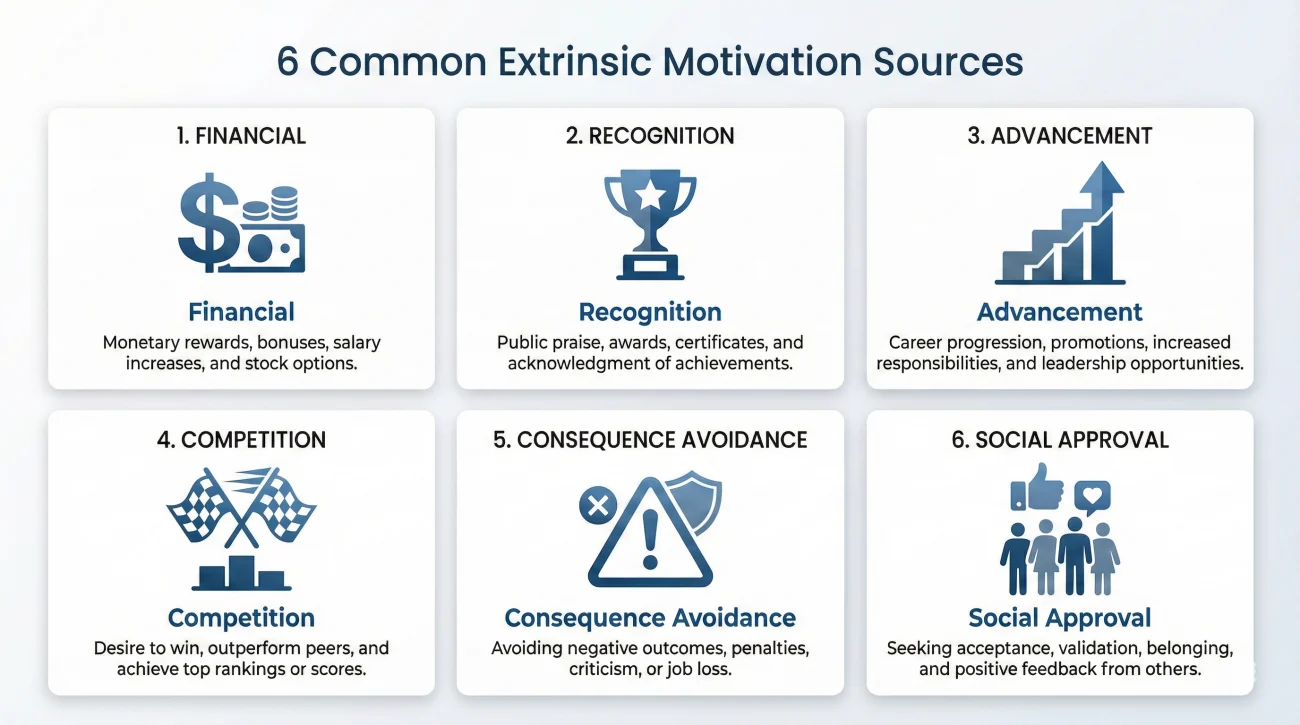
- 💰 Financial: Salary, bonuses, equity, benefits, perks
- 🏆 Recognition: Awards, public praise, titles, visibility
- 📈 Advancement: Promotions, expanded responsibility, career trajectory
- 🎯 Competition: Outperforming peers, rankings, relative success
- ⚠️ Consequence avoidance: Meeting expectations, avoiding criticism or job loss
- 👥 Social approval: Peer respect, manager satisfaction, team acceptance
Career Advancement
Promotion potential and expanded responsibility motivate many professionals effectively, particularly early in careers when advancement happens frequently. However, advancement motivation faces structural limits – organizations have finite senior positions, and promotions slow as you ascend. Professionals relying primarily on advancement motivation struggle when reaching plateau levels where further promotion becomes rare, requiring development of alternative drivers to maintain long-term engagement.
💡 Pro tip: During interviews, acknowledge both intrinsic and extrinsic drivers rather than claiming pure intrinsic motivation – authentic balance demonstrates self-awareness that pure idealism cannot match.
Creating Sustainable Motivation Balance
Understanding extrinsic motivation types alongside intrinsic drivers helps build resilient motivation that sustains performance through varying circumstances rather than depending on constantly favorable conditions.
Complementary Driver Strategy
The most sustainable motivation combines intrinsic satisfaction with appropriate extrinsic rewards – mastery pursuit supported by fair compensation, purpose-driven work complemented by recognition, autonomy balanced with advancement opportunity. This combination creates resilience because when one motivation source temporarily weakens, others maintain engagement. Pure intrinsic motivation sounds noble but proves fragile when work challenges accumulate without external validation or reward. Pure extrinsic motivation generates strong initial effort but collapses when organizations can’t sustain escalating rewards.
| Scenario | Intrinsic Only | Extrinsic Only | Balanced Approach |
|---|---|---|---|
| Difficult project phase | Learning sustains effort | Motivation drops without rewards | Purpose drives work, bonus provides extra push |
| Promotion unavailable | Unaffected by external limits | Severe motivation decline | Mastery continues, acknowledges disappointment |
| Routine work period | Motivation may decline without challenge | Steady compensation maintains effort | Purpose provides meaning, stability appreciated |
| Recognition gaps | Internal satisfaction sufficient | Motivation collapse without acknowledgment | Autonomy valued, would appreciate recognition |
Situational Motivation Adaptation
Different career phases and organizational contexts benefit from different motivation emphases. Early career often relies more heavily on learning and advancement while mid-career may emphasize purpose and autonomy as mastery opportunities decline and promotion pace slows. Recognize these natural shifts rather than rigidly maintaining identical motivation profile throughout changing circumstances. Flexibility in motivation sources prevents disengagement when specific drivers become less available.
Organizational Motivation Alignment
Assess whether organizations can sustain your primary motivation sources before accepting offers. If learning drives you but role offers minimal growth opportunity, motivation will suffer regardless of compensation. If recognition matters significantly but culture emphasizes quiet contribution without public acknowledgment, you’ll struggle despite interesting work. This honest alignment assessment prevents accepting mismatched positions then blaming organizations for not providing motivation sources they never promised or prioritized.
Claiming you’re “purely intrinsically motivated” during interviews often signals either poor self-awareness or dishonesty – employers know everyone values appropriate compensation and recognition alongside work satisfaction.
Articulating Motivation in Interviews
Discussing your sustainable motivation sources during interviews requires balancing honesty about drivers with strategic framing that demonstrates both idealism and realism.
Demonstrating Authentic Balance
Strong responses acknowledge both intrinsic and extrinsic motivation without overemphasizing either extreme. Explain what provides daily work satisfaction (learning, impact, problem-solving) while honestly noting that appropriate compensation, recognition, and advancement opportunity matter. This balanced approach signals maturity that pure intrinsic or extrinsic claims cannot convey. Use specific examples showing when intrinsic drivers sustained you through challenges and when extrinsic rewards provided valuable validation or security.
Connecting Drivers to Role Specifics
Generic motivation discussions carry little weight – connect your drivers to specific aspects of the role you’re pursuing. If mastery motivates you, explain which skills this role develops. If purpose matters, articulate how the organization’s mission aligns with your values. If advancement drives you, discuss the career trajectory the position enables. This specific connection demonstrates you’ve thought seriously about fit rather than providing rehearsed motivation platitudes applicable to any job.
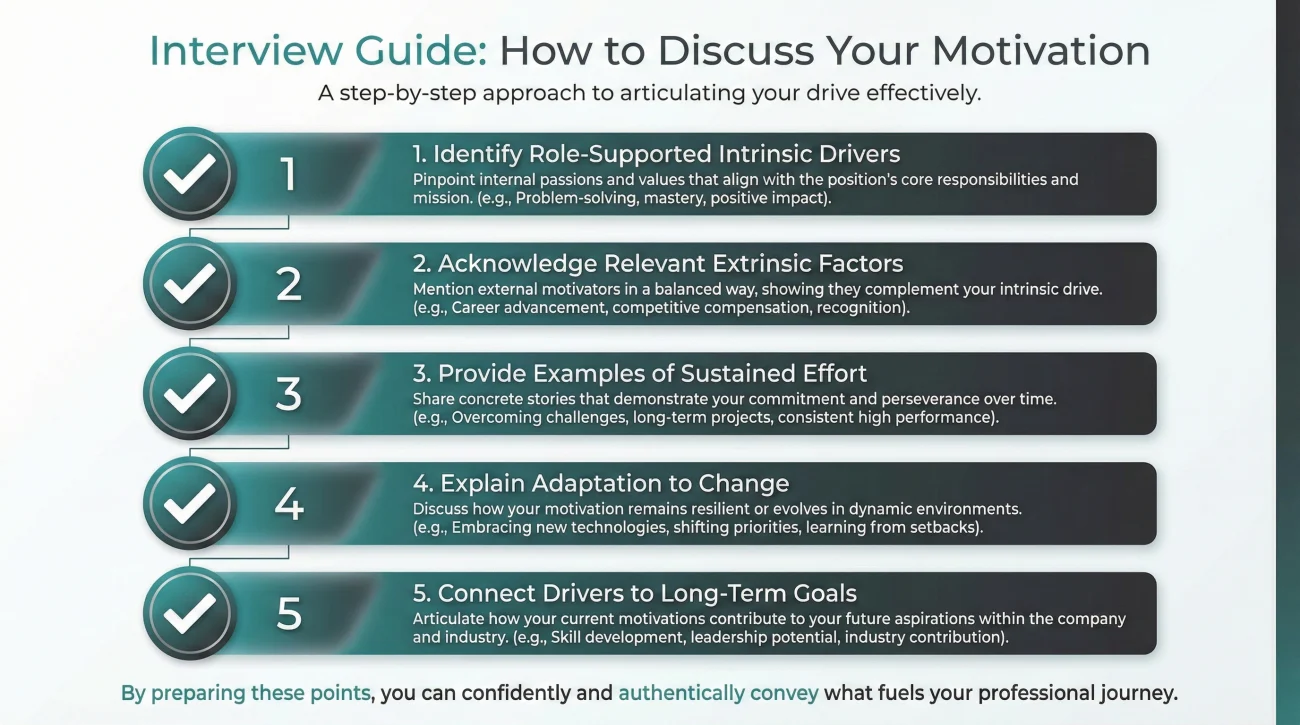
- Identify which intrinsic drivers the role genuinely supports with evidence
- Acknowledge extrinsic factors that matter without overemphasizing compensation
- Provide examples of sustaining motivation through previous challenges
- Explain how you’ve adapted motivation when circumstances changed
- Connect drivers to long-term career goals, not just immediate position
❓ FAQ
🎯 Is intrinsic motivation always better than extrinsic?
No, both serve important functions. Intrinsic motivation sustains effort through challenges while extrinsic rewards provide tangible validation and security. The most resilient professionals balance both rather than relying exclusively on either type.
💼 Should I emphasize money as motivator during interviews?
Acknowledge compensation matters as important factor within broader motivation mix, but don’t position it as primary driver. Frame it as “fair compensation allows me to focus on the work I find meaningful” rather than money as sole motivator.
⏰ What if my motivation is purely extrinsic?
Consider developing intrinsic drivers for sustainability because organizations cannot indefinitely increase extrinsic rewards. Find aspects of work providing satisfaction beyond compensation – learning, relationships, impact – to create resilient motivation that survives reward plateaus.
📋 How do I identify my actual motivation sources?
Review when you’ve maintained effort despite obstacles versus when motivation disappeared. What sustained you through difficult periods? What led to disengagement in previous roles? These patterns reveal genuine drivers versus aspirational claims about what should motivate you.
✨ Can motivation types change over time?
Yes – career phases, life circumstances, and experience naturally shift motivation emphasis. Early career often emphasizes learning and advancement while later stages may prioritize purpose and autonomy. Recognize these natural evolutions rather than rigidly maintaining static motivation profile.
Final Thoughts
Understanding your actual motivation sources prevents accepting roles where drivers don’t align with organizational realities, avoiding years of frustration in positions that cannot sustain your engagement. The professionals who build satisfying careers recognize their genuine motivation mix – acknowledging both intrinsic satisfaction and extrinsic rewards matter in proportions varying by individual and situation. This honest self-assessment enables better role selection than claiming pure intrinsic motivation that sounds impressive but doesn’t reflect actual drivers.
The distinction between intrinsic vs extrinsic motivation matters because sustainable performance requires resilient drivers that persist through varying circumstances rather than depending on constantly favorable conditions. Pure intrinsic motivation proves fragile when work challenges accumulate without external validation. Pure extrinsic motivation collapses when organizations reach natural limits on rewards escalation. The balanced approach combining work satisfaction with appropriate recognition and compensation creates motivation sustainability that neither extreme achieves alone.
During interviews and throughout your career, articulate authentic motivation balance demonstrating both idealism about meaningful work and realism about valuing appropriate rewards. Connect drivers to specific role characteristics rather than providing generic motivation platitudes. Remember that employers seek candidates whose motivation sources align with what organizations can sustainably provide – intrinsic satisfaction from work itself complemented by fair extrinsic rewards rather than exclusive dependence on either type creating vulnerability to inevitable circumstance changes.
⚠️ Disclaimer: The interview strategies, sample answers, and negotiation tips provided in this guide are for educational purposes only. Hiring decisions are subjective and vary by company and industry. While these strategies are based on professional HR standards, they do not guarantee a specific job offer or result.