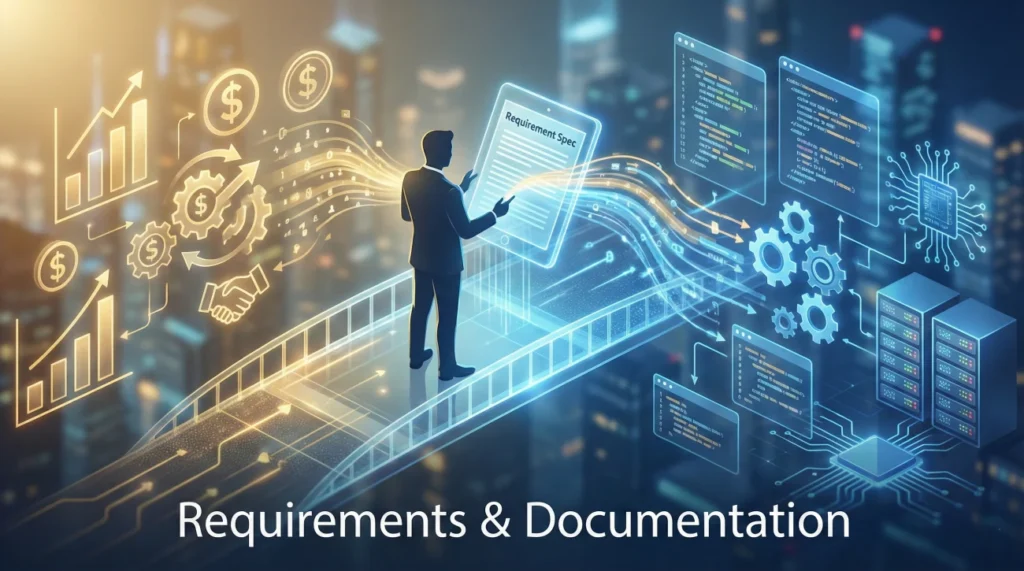
What Business Analyst Interviews Test
Business analyst interviews test bridging skills between business and technology over technical depth. Companies probe how you gather requirements uncovering real needs, facilitate stakeholder workshops aligning perspectives, document specifications developers understand, coordinate UAT ensuring business acceptance, and communicate complex concepts across audiences. This article covers fundamentals tested in business analyst interview questions: requirements elicitation techniques, documentation standards, UAT process management, stakeholder engagement strategies, and business-technical translation.
You’ll learn structured approaches to requirements gathering, facilitation methods for productive workshops, UAT planning and execution, clear documentation practices, and effective stakeholder communication. Understanding technical interview fundamentals helps, but this focuses on business analysis skills bridging organizational silos applicable across industries and project types.
Requirements Gathering Techniques
Mastering requirements gathering techniques involves knowing when to apply specific elicitation methods effectively.
Elicitation Methods
Q: What requirements elicitation techniques do you use?
Multiple techniques suit different situations. Interviews: one-on-one conversations with stakeholders, structured (preset questions) or unstructured (exploratory), establish rapport and get detailed insights. Workshops: facilitated group sessions bringing stakeholders together, JAD (Joint Application Development) for IT projects, resolve conflicts and build consensus. Document Analysis: review existing documentation (business processes, manuals, specifications), understand current state, identify gaps. Observation: watch users performing tasks, passive (don’t interact) or active (ask questions), uncover unstated needs. Surveys/Questionnaires: collect quantitative data from large groups, cost-effective for distributed stakeholders. Choose based on: stakeholder availability, project complexity, information needed, time constraints.
Q: How do you prepare for a requirements workshop?
Preparation critical for workshop success. Define objectives: what decisions need making, what requirements to gather, what conflicts to resolve. Identify participants: right stakeholders (decision makers, subject matter experts, end users), typically 6-8 people (more difficult to manage). Create agenda: topics to cover, time allocation, activities planned. Prepare materials: templates, process diagrams, sample requirements, relevant documentation. Set logistics: room with whiteboard, post-its, comfortable space, schedule when all can attend. During workshop: facilitate don’t dominate, keep focused on objectives, document decisions visibly, manage time strictly, handle conflicts constructively. Follow-up: distribute notes promptly, confirm decisions, track action items.
Q: How do you handle conflicting requirements from stakeholders?
Conflicts common when stakeholders have different priorities. Understand root causes: different business goals, competing priorities, miscommunication, technical constraints. Techniques: facilitated discussion (bring stakeholders together, explore underlying needs), prioritization frameworks (MoSCoW: Must have, Should have, Could have, Won’t have), trade-off analysis (show costs and benefits of each option), escalation (senior stakeholder makes final decision when consensus impossible). Example: Sales wants feature immediately, Development says impossible in timeframe – facilitate discussion revealing Sales has client commitment, propose phased approach delivering core functionality on time, additional features next release. Document decisions and rationale. Avoid taking sides – remain neutral facilitator.
Q: What questions do you ask to elicit requirements effectively?
Open-ended questions uncover deeper needs. Current state: “Walk me through your current process,” “What challenges do you face?” Future state: “What would ideal solution look like?” “How would this improve your work?” Clarification: “Can you give me an example?” “What do you mean by [term]?” Constraints: “What limitations exist?” “What must we avoid?” Success criteria: “How will we know this succeeded?” “What metrics matter?” Avoid: leading questions (suggesting answer), yes/no questions (limit information), jargon (confuse stakeholders), multiple questions at once (overwhelm). Practice active listening: stakeholders reveal more when truly heard. Follow-up questions dig deeper into interesting points.
Requirements Documentation
Effective elicitation methods business analyst must connect to clear documentation developers and stakeholders understand.
Documentation Practices
Q: What documents do business analysts create?
Common deliverables: Business Requirements Document (BRD) – high-level business needs, objectives, scope, stakeholder requirements. Functional Requirements Specification (FRS) – detailed system functionality, user interactions, acceptance criteria. Use Cases – specific scenarios showing how users interact with system. User Stories – Agile format: “As a [role], I want [feature], so that [benefit].”
Process Flow Diagrams – visual representation of workflows (as-is and to-be). Data Models – entity relationships, data requirements. Acceptance Criteria – conditions for requirement satisfaction, testable statements. Requirements Traceability Matrix – links requirements to business objectives, design, test cases. Choose format based on: project methodology (Agile vs Waterfall), stakeholder preferences, organizational standards, complexity of requirements.
Q: How do you write clear, testable requirements?
Good requirements characteristics: Clear (unambiguous language), Testable (can verify implementation), Feasible (technically possible), Necessary (supports business objective), Prioritized (relative importance). Use active voice and specific verbs. Bad: “System should be user-friendly.” Good: “Users shall complete order checkout in maximum 3 steps.”
Include acceptance criteria: “Given [context], When [action], Then [result].” Avoid: ambiguous terms (user-friendly, fast, efficient), implementation details (unless necessary), compound requirements (break into atomic requirements). Number requirements for traceability. Example: REQ-001 System shall validate email format before account creation. Review with stakeholders confirming understanding. Developers should be able to estimate effort from requirement alone.
Q: How do you ensure requirements traceability?
Traceability links requirements throughout lifecycle: backward (business need to requirement), forward (requirement to design, code, test). Create Requirements Traceability Matrix (RTM): columns for requirement ID, description, business objective, design reference, test case ID, status. Benefits: verify all requirements addressed, assess change impact, ensure test coverage.
Maintain through tools: JIRA, Azure DevOps, dedicated requirements management tools. Update when requirements change. Example: business objective “reduce checkout abandonment” traces to requirements REQ-001 through REQ-005, which trace to design documents and test cases TC-101 through TC-125. Helps answer: “If we change this requirement, what’s affected?” “Does this test case cover any requirement?”
Q: How do you manage changing requirements?
Requirements change inevitable. Establish change control process: request form capturing proposed change, rationale, impact. Impact analysis: affected requirements, design, code, tests, schedule, budget. Prioritization: urgent vs important, cost vs benefit. Approval: Change Control Board or designated authority makes decision. Communication: notify all stakeholders of approved changes, update documentation, adjust plans. Version control: track requirement versions, maintain history. Agile approach: Product Backlog continuously refined, prioritized items change between sprints. Waterfall: formal change request process with sign-offs. Key: balance flexibility with stability – too rigid misses opportunities, too flexible chaos.
User Acceptance Testing (UAT)
Coordinating UAT testing process validates solutions meet business needs before production deployment.
UAT Planning and Execution
Q: What is UAT and why is it important?
User Acceptance Testing final validation phase where actual end users test system ensuring it meets business requirements and works in real scenarios. Differs from system testing: System Testing – technical team verifies technical specifications, controlled test data, finds bugs. UAT – business users validate business requirements, realistic data, confirms usability and business value. Purpose: verify solution solves business problems, validate requirements gathered correctly, identify usability issues, build user confidence, obtain formal approval for production. UAT catches: gaps between requirements and implementation, usability problems, workflow issues, scenarios missed in earlier testing. Critical because: last chance before go-live, business owns sign-off, reduces production issues.
Q: How do you plan and coordinate UAT?
UAT planning involves: Define scope (what to test based on business-critical processes, user roles), Identify testers (diverse users: different roles, experience levels, departments), Create test cases (scenarios mirroring real workflows, not just technical test cases), Prepare test data (realistic data reflecting production), Set up environment (mirrors production closely), Define entry/exit criteria (when start UAT, when consider complete). Entry criteria: all critical defects from system testing resolved, test environment ready, testers trained, test cases reviewed. Exit criteria: all test cases executed, critical defects fixed, stakeholder sign-off obtained. Schedule: allow sufficient time, consider user availability, plan for defect resolution cycles.
Q: What is your role as BA during UAT?
BA facilitates UAT but business owns testing. Preparation: create test scripts based on requirements and use cases, coordinate with testers identifying participants, conduct training on system and testing process. During execution: answer questions about requirements and expected behavior, log defects testers identify, coordinate with development on fixes, track testing progress and coverage, facilitate communication between testers and developers. Defect triage: prioritize issues (critical blocks go-live, minor can wait), clarify whether defect or misunderstood requirement, verify fixes before retesting. Documentation: maintain test results, defect logs, sign-off documents. Post-UAT: facilitate lessons learned, update requirements based on findings, support transition to production.
Q: How do you handle when UAT reveals solution doesn’t meet requirements?
Serious situation requiring root cause analysis. Investigate: requirements misunderstood (clarify with stakeholders), requirements changed (not communicated), requirements incomplete (gap in elicitation), implementation deviated from requirements (development error). Options: fix immediately (if critical and time allows), workaround temporarily (document as technical debt), defer non-critical items (next release), renegotiate requirements (if original requirement wrong). Critical decisions: delay go-live (fix issues vs accept risk), partial deployment (which features ready), rollback plan (if production issues). Facilitate discussion with stakeholders weighing: business impact of issues, cost of delay, risk of proceeding. Document decisions and rationale. Learn: what went wrong in requirements process, how prevent future occurrences.
Stakeholder Communication
Developing stakeholder communication strategies enables effective collaboration across business and technical teams.
Communication Approaches
How do you communicate technical concepts to non-technical stakeholders?
Avoid jargon and use business language. Translate technical terms: instead of “API integration,” say “systems will automatically share data.” Use analogies: “database like filing cabinet organizing information for quick retrieval.” Visual aids: diagrams show system flow better than words, before/after screenshots demonstrate changes, process maps illustrate workflows. Focus on business value: “This reduces manual data entry saving 10 hours weekly” rather than “We’ll implement automated synchronization.”
Check understanding: ask stakeholders to explain back in their words, watch for confusion signals (blank stares, frowns), encourage questions creating safe environment. Example: explaining cloud migration to executives – focus on cost savings, flexibility, security rather than infrastructure details. Tailor communication: executives want high-level benefits, end users want workflow impact, technical teams need implementation details. Practice explaining complex concepts simply.
How do you handle difficult or unresponsive stakeholders?
Understand root causes: too busy (schedule short, focused meetings), don’t see value (explain how their input critical), previous bad experiences (rebuild trust), conflicting priorities (escalate to sponsors). Build relationships: meet informally before formal sessions, understand their concerns and constraints, show how you’ve addressed their feedback, deliver on commitments consistently.
Adapt approach: stakeholder prefers email over meetings – document questions, send ahead. Won’t attend workshops – schedule brief one-on-one. Delegates junior staff – ensure they have authority to decide. Engage sponsors: if stakeholder truly unresponsive, escalate to project sponsor highlighting risks of no input. Example: busy executive rarely available – send concise email with 3 specific questions requiring yes/no answers, schedule 15-minute call to discuss, respect their time. Persistence without pestering: follow up regularly but professionally.
How do you facilitate disagreements between stakeholders?
Remain neutral facilitator, not decision maker. Understand positions: ask each stakeholder to explain their perspective, ensure both sides feel heard, identify common ground and differences. Explore underlying interests: stated position often symptom of deeper concern, ask “why is this important to you?” Example: Sales wants feature, Operations resists – underlying issue is operational complexity. Propose solutions addressing both concerns.
Facilitate decision: objective criteria (cost, user impact, strategic alignment), data-driven analysis (usage statistics, customer feedback), escalation path (who decides if no consensus). Document: decisions made, rationale, dissenting opinions (for future reference). Follow-up: ensure losing party understands decision and commits to supporting it. Techniques: focus on interests not positions, brainstorm options together, use “Yes, and…” instead of “No, but…” Successful facilitation builds collaboration despite disagreement.
Business Analysis Quiz
20 Practice Questions
1. Which elicitation technique brings multiple stakeholders together?
- Interview
- Workshop
- Document analysis
- Survey
2. What does UAT stand for?
- Unit Acceptance Testing
- User Acceptance Testing
- Universal Application Testing
- Unified Acceptance Test
3. Who should execute UAT?
- Developers
- Business Analysts
- Actual end users
- QA team
4. What makes a good requirement?
- Long and detailed
- Clear, testable, and necessary
- Technical and complex
- Flexible and vague
5. What is MoSCoW prioritization?
- A Russian framework
- Must have, Should have, Could have, Won’t have
- A documentation standard
- A testing methodology
6. What is JAD?
- Just Add Documentation
- Joint Application Development
- Java Application Design
- Job Analysis Document
7. Purpose of Requirements Traceability Matrix?
- Track project budget
- Link requirements throughout lifecycle
- Assign team tasks
- Schedule meetings
8. When should document analysis be used?
- Never
- To understand existing processes and context
- Only for legacy systems
- After project completion
9. What is a user story format?
- “System shall…”
- “As a [role], I want [feature], so that [benefit]”
- “The user needs…”
- “Feature X must…”
10. UAT differs from system testing how?
- Same thing, different name
- UAT validates business value, system testing verifies technical specs
- UAT is automated
- System testing happens first always
11. Best practice for workshop facilitation?
- Dominate discussion
- Keep focused on objectives, manage time, document visibly
- Avoid conflict at all costs
- Let discussion go wherever
12. How to handle conflicting requirements?
- Choose one randomly
- Facilitate discussion, use prioritization framework, escalate if needed
- Ignore the conflict
- Implement both
13. What is BRD?
- Bug Report Document
- Business Requirements Document
- Backend Resource Definition
- Build Release Directive
14. When should BA get involved in UAT?
- Never, business owns it
- Planning, facilitating, clarifying requirements, not executing tests
- Only if UAT fails
- Execute all tests personally
15. What is active observation?
- Watching without interaction
- Observing while asking questions and participating
- Remote video surveillance
- Reading user feedback
16. Purpose of acceptance criteria?
- Estimate project cost
- Define conditions for requirement satisfaction, testable statements
- Assign developer tasks
- Schedule milestones
17. What happens during UAT entry?
- System development starts
- Verify critical defects fixed, environment ready, testers trained
- Deploy to production
- Begin requirements gathering
18. Best type of questions for elicitation?
- Yes/no questions
- Open-ended questions
- Leading questions
- Multiple questions at once
19. What is FRS?
- Final Release Schedule
- Functional Requirements Specification
- Feature Request System
- Failure Recovery Strategy
20. When managing requirement changes, what’s essential?
- Accept all changes immediately
- Impact analysis, approval process, communication, version control
- Reject all changes
- Only document verbally
❓ FAQ
🎯 Do I need technical background for BA roles?
Technical understanding helps but not required for all BA roles. More important: communication skills, analytical thinking, stakeholder management, requirements elicitation ability. Domain knowledge (finance, healthcare, retail) often more valuable than programming skills. Can learn technical concepts on job. Focus on bridging business-IT gap regardless of technical depth.
💼 How do I demonstrate BA skills without BA title experience?
Highlight transferable experiences: gathering requirements from customers, documenting processes, facilitating meetings, managing stakeholders, analyzing data. Project coordinator, product manager, QA roles involve BA activities. Describe specific situations using STAR method (Situation, Task, Action, Result). Emphasize outcomes: “Gathered requirements from 5 departments, created process documentation reducing onboarding time 30%.”
⏰ What certifications matter for business analysts?
IIBA certifications (ECBA, CCBA, CBAP) most recognized. PMI-PBA for project-focused roles. Agile certifications (PMI-ACP, CSPO) for Agile environments. Certifications validate knowledge but experience matters more. Study BABOK (Business Analysis Body of Knowledge) understanding elicitation, documentation, stakeholder management. Practical skills trump certificates but both together strongest.
📋 How important is knowing specific tools?
Tools secondary to core BA skills. Common tools: JIRA (Agile requirements), Confluence (documentation), Visio/Lucidchart (diagrams), Excel (data analysis). Learn tools quickly if you understand requirements fundamentals. Interviews focus more on methodology than tool proficiency. Mention tool experience but emphasize elicitation techniques, stakeholder management, documentation clarity.
✨ How do I prepare for BA behavioral questions?
Prepare STAR stories for: gathering requirements in ambiguous situation, handling difficult stakeholder, managing requirement changes, facilitating workshops, coordinating UAT, resolving conflicts, communicating technical concepts to non-technical audiences. Focus on your specific actions and measurable results. Practice explaining situations concisely. Have 5-6 detailed examples covering different BA competencies ready.
Final Thoughts
Modern business analyst interview questions test bridging skills over technical depth. Master requirements elicitation techniques choosing appropriate methods for situations, documentation standards creating clear testable requirements, UAT coordination facilitating business validation, stakeholder communication translating between business and technical teams, and facilitation skills managing workshops and conflicts. Success requires practicing business analysis where you gather requirements uncovering real needs, document specifications developers understand, coordinate UAT ensuring business acceptance, and communicate effectively across organizational boundaries demonstrating BA capabilities applicable across industries and methodologies.
⚠️ Disclaimer: The interview strategies, sample answers, and negotiation tips provided in this guide are for educational purposes only. Hiring decisions are subjective and vary by company and industry. While these strategies are based on professional HR standards, they do not guarantee a specific job offer or result.