- Main point: Talk while you solve, because interviews score visible reasoning and collaboration, not silent code.
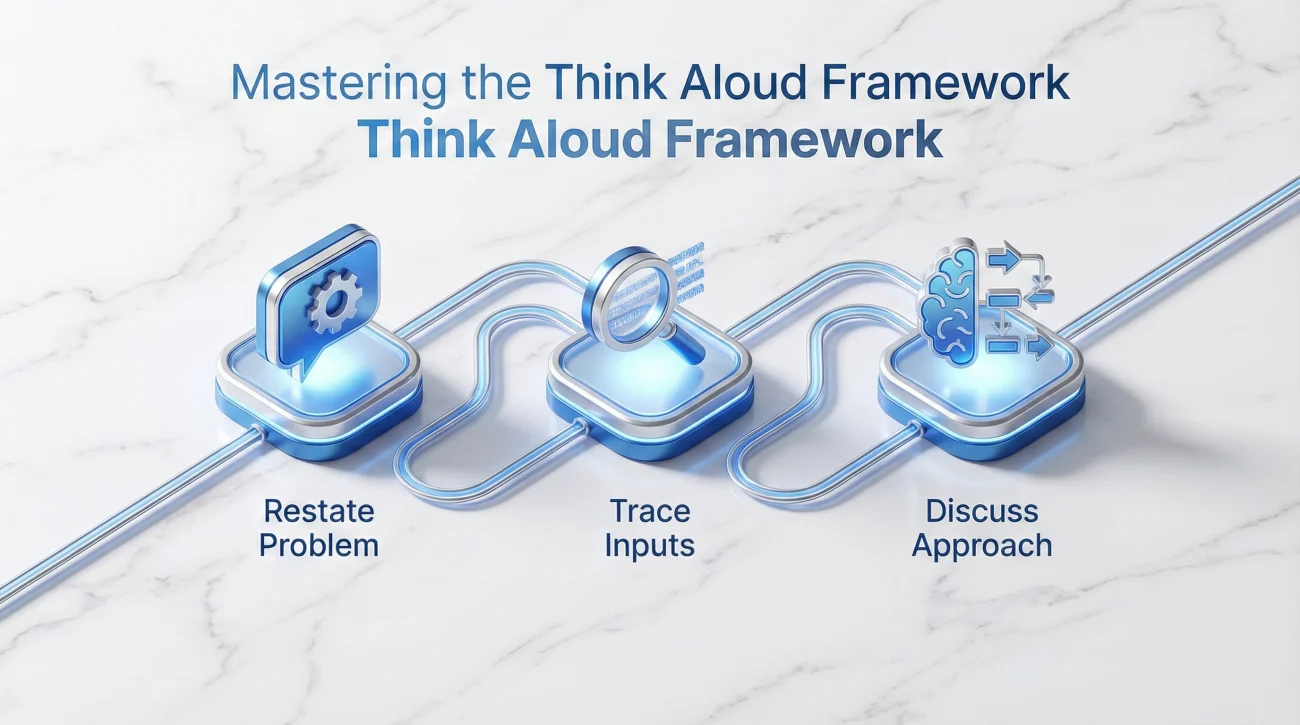
- Think-aloud basics: Restate the problem, walk a tiny example, then explain your plan and trade-offs before you write.
- Keep it natural: Narrate in chunks (what this loop does, what this check protects), and call out key edge cases as you go.
- Whiteboard rules: Plan space first, write big and clean, use pseudocode if needed, prioritize clarity over clever one-liners.
- When you get stuck: Say it, reset with an example, simplify, check edge cases, ask clarifying questions, and use hints to pivot calmly.
Coding Interview Tips (Thinking Aloud & Whiteboarding)
Solving problems silently in your head works great at your desk. In interviews, it guarantees failure. Interviewers can’t evaluate invisible thought processes. They need to hear your reasoning, understand your approach, and assess how you handle obstacles. The difference between passing and failing often comes down to communication, not code quality.
Effective coding interview tips center on verbalizing your thinking while working through problems. Interviewers evaluate collaboration potential as much as technical skill. Can you explain trade-offs? Do you clarify requirements before diving in? How do you respond when your first approach hits a wall? These meta-skills separate candidates who interview well from those who simply code well.
Whiteboard coding adds another layer of challenge – no syntax highlighting, no autocomplete, no compiler feedback. Mastering this constrained environment requires different techniques than everyday development. Let’s break down the specific skills that transform nervous whiteboard sessions into confident technical conversations.
Think Aloud Fundamentals
Think aloud coding feels unnatural initially because developers rarely narrate their work. But interviews aren’t normal coding – they’re performance evaluations where silence reads as confusion or lack of depth.
What to Verbalize
Start by restating the problem in your own words. This confirms understanding and catches misinterpretations early. “So we’re building a function that takes a sorted array and finds two numbers that sum to a target value, right?” Simple clarification prevents wasted time solving the wrong problem.
Walk through example inputs before touching code. Trace what should happen with a small test case, explaining expected outputs. “If we have [2, 7, 11, 15] and target 9, we’d return indices 0 and 1 because 2 + 7 equals 9.” This demonstrates you understand requirements beyond just the problem description.
Discuss your approach before implementing. “I’m thinking we could use a hash map here – iterate through the array once, and for each number, check if we’ve seen its complement. That gives us O(n) time complexity instead of O(n²) with nested loops.” Verbalizing the plan lets interviewers guide you if you’re heading down an inefficient path.
Maintaining Conversational Flow
Don’t narrate every line of code – that’s tedious and slow. Instead, explain what each section accomplishes. “I’m initializing a hash map to store values we’ve seen. Then in the loop, I’ll check for the complement before adding the current number.” Summary-level commentary keeps interviewers engaged without drowning them in details.
Expert advice: Practice thinking aloud with easy problems first. The skill feels awkward initially, but verbalizing becomes natural with repetition. Record yourself or practice with friends to build comfort.
When you hit a tricky section, pause and explain your reasoning. “I need to handle the edge case where the array is empty. Let me add a check at the beginning.” Showing awareness of edge cases signals thoroughness even if you don’t catch every possibility.
Whiteboard Coding Techniques
Whiteboard coding techniques differ fundamentally from typing code in an IDE. Limited space, no delete key, and permanent marker visibility demand different strategies.
Managing Limited Space
Start in the top-left corner but leave room above for function signatures and imports you might add later. Write larger than feels natural – interviewers need to read your work from several feet away. Small, cramped writing wastes time when you need to erase and rewrite.
Plan your layout before writing. Estimate how much vertical space your solution needs. If you’re implementing multiple functions, sketch quick boxes showing where each goes. Running out of room halfway through forces awkward cramming or complete rewrites.
| Whiteboard Challenge | Strategy |
|---|---|
| No syntax highlighting | Use clear variable names that convey purpose without color cues |
| Can’t easily delete | Write pseudocode first, then convert to actual code |
| Limited space | Estimate layout before starting, leave margins for additions |
| No autocomplete | Use simplified syntax; focus on logic over perfect method names |
| Permanent visibility | Write neatly from the start; messy code is harder to debug |
| No compiler feedback | Test code mentally with examples as you write |
Writing Readable Code
Optimize for clarity over brevity. Dense one-liners that save typing become impossible to debug on a whiteboard. Break complex expressions into multiple lines with descriptive variable names. “Let leftSum = array.slice(0, i).reduce(…)” beats “ls = a.slice(0,i).reduce(…)”.
💡 Pro tip: Use consistent indentation and spacing. Visual structure helps both you and the interviewer follow logic flow, especially in nested conditions or loops.
Don’t worry about perfect syntax for library methods. If you can’t remember the exact parameters for a hash map method, use pseudocode or explain verbally. “I’d use the built-in method to check if the key exists, something like map.has(key).” Interviewers care about problem-solving approach, not memorizing API documentation.
Handling Stuck Moments
Every candidate gets stuck during interviews. How you respond separates strong performers from those who panic. Silence and visible frustration signal poor collaboration skills. Structured recovery demonstrates resilience.

Acknowledge and Verbalize
Handling stuck moments starts with honest communication. “I’m not immediately seeing the optimal approach here. Let me think through a brute force solution first.” This keeps the interviewer engaged and shows you’re thinking systematically rather than randomly guessing.
Walk through your current thinking, even if incomplete. “I know I need to track elements I’ve seen, and a hash map feels right for O(1) lookups. But I’m stuck on how to handle duplicates.” Verbalizing partial progress often triggers insights or prompts helpful hints from interviewers.
Structured Recovery Steps
- 🔄 Revisit examples: Work through your test case again slowly. Sometimes bugs become obvious when you trace execution step-by-step.
- 🎯 Simplify the problem: “What if we only had 3 elements instead of n?” Solving a simpler version often reveals the pattern for the general case.
- 💭 Think about similar problems: “This reminds me of the two-pointer technique we’d use for a different array problem.” Drawing connections helps adapt known patterns to new situations.
- 🔍 Check edge cases: Missing boundary conditions often causes bugs. Verify empty inputs, single elements, duplicates, negative numbers – whatever applies to your problem.
- 🤝 Ask clarifying questions: “Can the array contain duplicates?” or “Should I optimize for time or space?” Sometimes additional constraints unlock the solution.
Don’t sit in silent panic. Interviewers can’t help if they don’t know where you’re stuck. Articulate your obstacle clearly.
Working With Hints
Interviewers offer hints when they see you’re stuck productively – thinking systematically but missing a key insight. Accept hints gracefully. “Oh, I should consider a different data structure for lookups?” shows you’re listening and adapting.
After receiving a hint, verbalize how it changes your approach. “Right, if I use a set instead of an array for storage, membership checks become O(1). Let me refactor this section.” Demonstrating you understand the hint’s impact matters as much as implementing it.
Interview Communication Skills
Interview communication skills extend beyond explaining code. Strong candidates manage the conversation, ask smart questions, and demonstrate collaborative problem-solving throughout the session.
Asking Strategic Questions
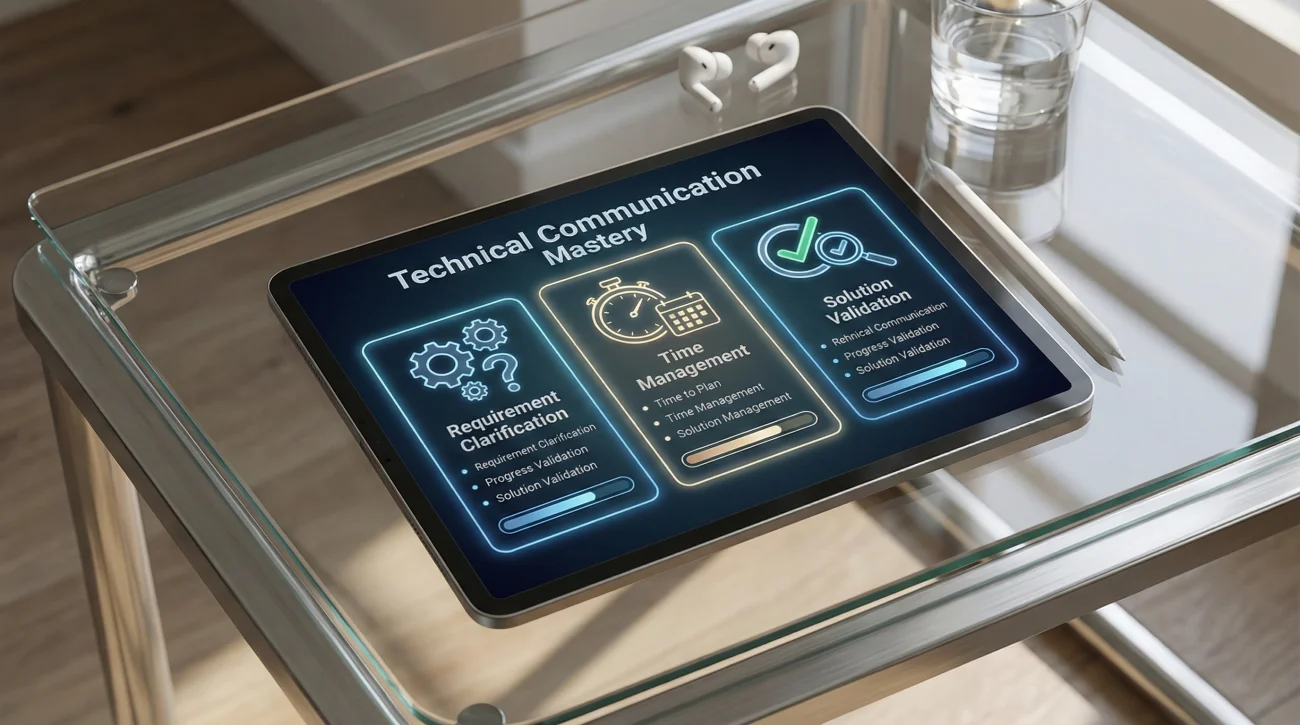
Clarify requirements before coding. “Should I handle negative numbers?” or “What should the function return if no solution exists?” prevents building the wrong solution. Smart questions demonstrate thoughtfulness and attention to detail.
Don’t ask yes/no questions about your approach. Instead of “Is this the right way?” try “I’m considering two approaches – a hash map for O(n) time or sorting for O(n log n). Which would you prefer I focus on?” This shows you understand trade-offs and invites collaborative discussion.
Expert advice: Frame uncertainty as trade-off analysis. “I could optimize for time complexity here, but it would increase space usage to O(n). Is that acceptable?” turns weakness into strength by demonstrating systems thinking.
Managing Interview Time
Track time loosely without obsessing. If 20 minutes pass and you’re still planning, start coding something. Interviewers prefer seeing partial working code over perfect planning with no implementation. You can refactor as you go.
Signal when you’re moving between phases. “I’ve got the core logic working. Should I spend time on edge cases or walk through testing?” Gives interviewers opportunity to redirect if time is tight. They might say “The edge cases are fine, let’s discuss complexity analysis instead.”
Testing Your Solution
After implementing, don’t immediately declare victory. Walk through your code with a test case, tracing variable values line by line. “Let me verify with the example input [2, 7, 11, 15] and target 9. In the first iteration, number is 2, complement is 7, map is empty so we add 2…” Catching bugs yourself impresses interviewers more than them finding issues.
Consider edge cases explicitly. “I should test empty array, single element, no solution exists, and duplicate values.” You don’t need to code all edge case handlers if time is limited, but acknowledging them shows thoroughness.
Developing a Problem-Solving Approach
Strong candidates follow consistent problem solving approach frameworks that organize their thinking and demonstrate systematic reasoning.
The UMPIRE Framework
This mnemonic guides you through technical problems methodically:
| Step | Action | Example |
|---|---|---|
| Understand | Restate problem, clarify requirements | “So we’re finding the longest substring without repeating characters?” |
| Match | Connect to known patterns/algorithms | “This feels like a sliding window problem” |
| Plan | Outline approach before coding | “I’ll use two pointers and a set to track characters” |
| Implement | Write code with clear explanations | Code while narrating logic |
| Review | Test with examples, check edge cases | “Let me trace through with input ‘abcabcbb'” |
| Evaluate | Analyze complexity, discuss optimizations | “This runs in O(n) time and O(min(n,m)) space” |
Following a framework prevents skipping critical steps like clarifying requirements or testing your solution. It also provides structure when you’re nervous and struggling to think clearly.
Discussing Time and Space Complexity
Always analyze complexity even if not explicitly asked. “This solution runs in O(n) time because we iterate through the array once. Space complexity is O(n) in the worst case for the hash map.” Demonstrates you think about performance beyond just getting code working.
💡 Pro tip: If you spot optimizations but time is limited, mention them verbally. “We could reduce space to O(1) if we sorted the array first, though that would increase time complexity to O(n log n).”
Compare your solution to alternatives. “The brute force approach would be O(n²), but using a hash map improves that to O(n) with additional space trade-off.” Shows you understand the solution landscape, not just one path.
Practice Strategies That Actually Work
Grinding LeetCode silently doesn’t prepare you for verbal communication demands. Effective practice simulates real interview conditions.

Mock Interview Practice
Schedule mock interviews with peers, mentors, or platforms like Pramp. The pressure of explaining to another person reveals communication gaps invisible when coding alone. Record sessions to identify verbal tics, long silences, or unclear explanations.
Alternate roles between interviewer and candidate. Conducting interviews teaches you what makes answers clear or confusing. You’ll naturally adopt better communication habits after experiencing the interviewer perspective.
Solo Practice Drills
Practice thinking aloud even when alone. Set a timer and solve problems while verbalizing every thought to an imaginary interviewer. Feels silly initially but builds the skill effectively. Record yourself to catch moments where you go silent or explanation becomes unclear.
Use actual whiteboards or paper instead of always typing. The physical medium matters – writing code by hand forces you to plan more carefully and accept that mistakes require full rewrites rather than quick edits.
Browse our complete collection of preparation guides for role-specific practice strategies. Different positions emphasize different problem types, so match your practice to the interview you’re preparing for.
❓ FAQ
🎯 How much should I verbalize during coding?
Explain your overall approach before coding, then provide running commentary at a summary level. Don’t narrate every line like “now I’m declaring a variable called count” but do explain sections: “This loop iterates through the array to count matching elements.” Find the balance between helpful narration and tedious play-by-play.
💼 What if I realize my approach is wrong halfway through?
Acknowledge it directly. “Actually, this approach won’t handle duplicates correctly. Let me switch to using a set instead of an array.” Pivoting gracefully demonstrates adaptability. Interviewers respect candidates who recognize issues and correct course over those who stubbornly implement flawed solutions.
⏰ Should I write syntactically perfect code on the whiteboard?
No. Focus on logical correctness and clear structure over perfect syntax. If you can’t remember exact method names, use descriptive pseudocode. Saying “I’d use the standard library’s sort method here” works fine. Interviewers evaluate problem-solving, not API memorization.
📋 How do I practice thinking aloud effectively?
Start with easy problems and verbalize every thought to an imaginary interviewer. Record yourself to identify long silences or unclear explanations. Progress to mock interviews with real people once comfortable. The skill feels unnatural initially but becomes automatic with repetition.
✨ What if the interviewer stays completely silent?
Keep communicating anyway. Silence might be intentional – they’re evaluating how you handle minimal feedback. Continue explaining your thinking, ask clarifying questions, and test your solution aloud. Don’t interpret silence as disapproval; stay confident in your process.
Final Thoughts
Technical interviews test collaboration as much as coding ability. The best solution delivered silently scores lower than a good solution explained clearly. Interviewers need to understand not just what you built, but how you think, how you handle obstacles, and whether you can communicate technical concepts effectively.
Master the fundamentals – think aloud narration, whiteboard space management, structured problem-solving frameworks. Practice until verbalizing becomes natural rather than forced. Build comfort with getting stuck and recovering gracefully. These skills compound over time and transfer across all technical interviews.
Remember that coding interview tips aren’t tricks to game the system – they’re communication skills that make you a better collaborator. The same techniques that help you explain solutions to interviewers will help you code review with teammates, explain technical decisions to stakeholders, and mentor junior engineers. Invest in these skills not just to pass interviews, but to build a foundation for effective technical communication throughout your career.
⚠️ Disclaimer: The interview strategies, sample answers, and negotiation tips provided in this guide are for educational purposes only. Hiring decisions are subjective and vary by company and industry. While these strategies are based on professional HR standards, they do not guarantee a specific job offer or result.