What Product Management Interviews Test
Product management interviews test strategic thinking and prioritization skills over domain knowledge. Companies probe how you identify user problems driving value, prioritize features balancing impact and effort, define metrics measuring success, make trade-off decisions with limited resources, and communicate product vision to stakeholders. This article covers fundamentals tested in product manager interview questions: product sense frameworks, RICE and MoSCoW prioritization methods, metrics selection, user research interpretation, and stakeholder alignment.
You’ll learn structured approaches to product design questions, quantitative prioritization using RICE scores, qualitative categorization with MoSCoW, choosing north star metrics, and demonstrating user empathy. Understanding technical interview fundamentals helps, but this focuses on product thinking and strategic decision-making applicable across industries and product types.
Product Sense and Design Thinking
Developing strong product sense interview skills requires structured frameworks for approaching ambiguous problems.
Product Design Framework
Q: How do you approach product design questions?
Use structured framework avoiding random feature lists. BUS Framework: Business objectives (clarify goals, ask assumptions), User problems (identify segments, prioritize pain points), Solutions (brainstorm features, prioritize). Start by clarifying: who are users, what’s the goal, what constraints exist. Define success metrics upfront. Example: “Design a fitness app” – clarify target users (beginners vs athletes), business goal (engagement vs monetization), constraints (resources, timeline). Identify user segments, select focus based on market size and pain severity. List problems each segment faces, prioritize by impact. Generate solutions addressing top problems, prioritize features supporting product vision.
Q: What makes strong product sense?
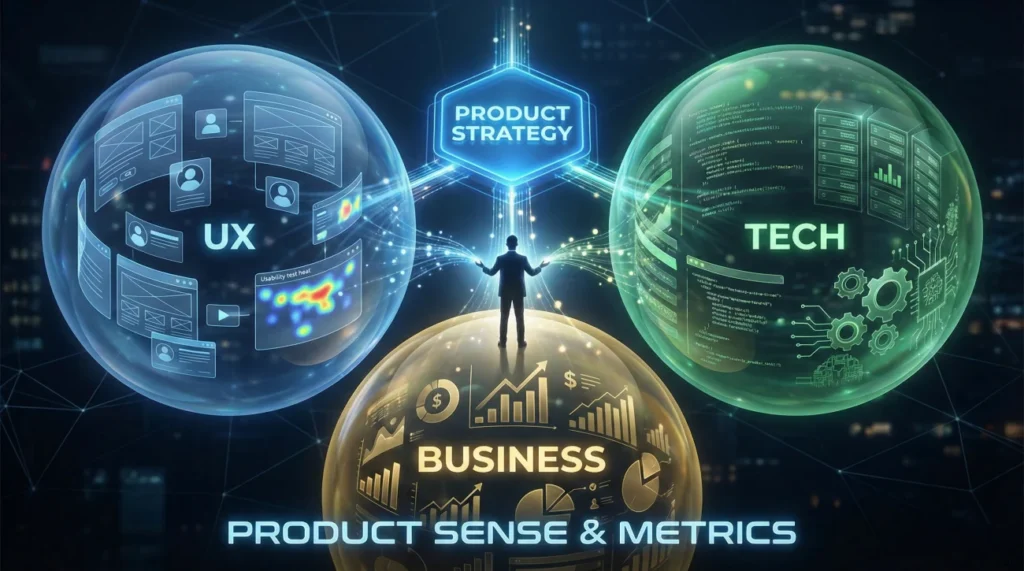
Product sense combines user empathy, business acumen, technical feasibility understanding. Strong PMs identify real user problems beyond surface requests. They distinguish “nice to have” from “must have.” Understand how features connect to business metrics. Consider implementation complexity and trade-offs. Example: users request “dark mode” – strong product sense asks why: accessibility needs, battery saving, aesthetic preference. Prioritize based on user impact and effort. Weak product sense builds requested features without questioning underlying needs. Product sense developed through: using many products critically, conducting user research, analyzing competitors, building products.
Q: How do you identify user pain points?
Multiple research methods reveal problems. User interviews: open-ended questions, observe behavior not just listen to requests. Users say what they want but often misidentify root causes. Surveys: quantitative validation of hypotheses. Analytics: identify where users struggle (high drop-off, low engagement). Support tickets: recurring complaints signal pain points. Competitor analysis: what problems do they solve, what gaps exist. Create user journey maps showing steps, emotions, pain points at each stage. Prioritize pain points by: frequency (how many users affected), severity (how painful), willingness to pay (monetization potential).
Q: Walk me through designing a product for a specific use case.
Example: “Design a feature for restaurant discovery.” Step 1 – Clarify: target users (tourists, locals, food enthusiasts), goal (discovery, reservations, reviews), platform (mobile app). Assume mobile-first, focus on tourists. Step 2 – User problems: unfamiliar with local options, dietary restrictions, language barriers, wait times, group dining coordination. Step 3 – Prioritize: tourists struggle most with unfamiliarity and dietary needs. Step 4 – Solutions: curated collections by category, filter by dietary restrictions, photos-heavy interface, real-time wait times, translation. Step 5 – Prioritize features: curated collections (high impact, medium effort), dietary filters (medium impact, low effort). Step 6 – Success metrics: discovery rate, booking conversion, user retention.
RICE Prioritization Framework
The RICE prioritization framework provides quantitative approach to feature ranking based on objective criteria.
RICE Scoring Method
Q: What is the RICE framework and how do you use it?
RICE developed by Intercom for objective prioritization. Acronym: Reach, Impact, Confidence, Effort. Formula: (Reach × Impact × Confidence) / Effort. Higher score = higher priority. Reduces bias toward pet features, provides consistent scoring across disparate ideas.
Reach: number of users affected per time period (month/quarter). Example: 2,000 users per month. Use analytics, not guesses. Impact: effect on each user. Scale 0-3: minimal (0.25), low (0.5), medium (1), high (2), massive (3). Confidence: certainty in estimates. Percentage: high (100%), medium (80%), low (50%). Below 50% = moonshot, deprioritize. Effort: person-months required (product, design, engineering, testing). Example: 3 person-months = effort score 3.
Q: Calculate RICE scores for competing features.
Example features: A (messaging update), B (desktop app), C (onboarding flow). Feature A: Reach 5,000/month, Impact 1 (medium), Confidence 80%, Effort 4 person-months. RICE = (5,000 × 1 × 0.8) / 4 = 1,000. Feature B: Reach 1,000/month, Impact 2 (high), Confidence 100%, Effort 8 person-months. RICE = (1,000 × 2 × 1) / 8 = 250.
Feature C: Reach 10,000/month (all new users), Impact 3 (massive), Confidence 80%, Effort 6 person-months. RICE = (10,000 × 3 × 0.8) / 6 = 4,000. Prioritization: C (4,000), A (1,000), B (250). Feature C highest impact despite medium effort. Consider other factors: dependencies (B prerequisite for A?), strategic importance (B promised to stakeholders?). RICE provides starting point, not absolute rule.
Q: What are limitations of RICE framework?
Estimation uncertainty: Reach, Impact, Confidence subjective. Different team members score differently. Requires historical data for accuracy. Doesn’t capture qualitative factors: strategic alignment, competitive necessity, technical debt, team morale. Effort estimation notoriously difficult: technical complexity, dependencies, unknowns.
Impact scale arbitrary: difference between “medium” (1) and “high” (2) unclear. Confidence percentage masks range: 80% could mean very different things. Mitigation: calibrate scoring through team discussion, revisit estimates with new information, combine with qualitative frameworks, use for comparison not absolute truth. RICE works best for similar-sized initiatives, struggles comparing small features versus large projects.
Q: How do you estimate reach accurately?
Use product analytics as foundation. Active users in relevant segment: feature affects search → search users per month. Conversion funnel data: onboarding improvements affect new signups. Historical patterns: similar features → adoption rates. A/B test results inform future reach. When lacking data: conservative estimates better than optimistic, user research indicates interest, competitor benchmarks provide reference points, iterate estimates as you gather data. Specify time period clearly: monthly active users standard, adjust for product cadence. Document assumptions enabling future refinement.
MoSCoW Prioritization Method
The MoSCoW method product management categorizes requirements qualitatively managing stakeholder expectations.
MoSCoW Categories
Q: Explain the MoSCoW prioritization method.
MoSCoW developed by Dai Clegg at Oracle for Agile projects. Acronym: Must have, Should have, Could have, Won’t have (this time). Qualitative categorization complementing quantitative methods. Must Have: critical requirements, product fails without them, non-negotiable, minimum viable product (MVP). Example: user authentication for SaaS app. Should Have: important but not critical, significant value, can defer if necessary, scheduled for future release. Example: advanced analytics dashboard. Could Have: nice-to-have, minimal impact if excluded, first to cut when resources tight, optional enhancements. Example: customizable themes. Won’t Have: explicitly deferred, manages expectations, prevents scope creep, might include in future. Example: blockchain integration.
Q: How do you apply MoSCoW to a product release?
Mobile app example. Requirements: user login (Must), push notifications (Should), social sharing (Could), AI recommendations (Won’t). Step 1 – Align stakeholders on objectives: user acquisition vs engagement. Step 2 – List all requirements from research, stakeholders, competitive analysis. Step 3 – Categorize collaboratively: engineers estimate effort, designers assess user impact, business defines strategic importance. Must have (60% effort maximum): login, core functionality, payment processing. Should have (20% effort): notifications, basic analytics. Could have (20% effort): sharing, extra themes. Won’t have: defer AI, blockchain. Step 4 – Validate categories: ask “would we cancel launch without this?” for Must haves. Step 5 – Monitor and adjust: reassess after sprints, new information changes priorities.
Q: What are MoSCoW’s advantages and disadvantages?
Advantages: simple to understand and communicate, stakeholder alignment through shared language, manages expectations explicitly (Won’t have prevents surprises), works well with timeboxed Agile sprints, flexible for changing requirements. Disadvantages: subjective categorization (team members disagree), blurry boundaries between categories (Should vs Could?), no objective scoring like RICE, temptation to overload Must have category, doesn’t account for dependencies. Best practices: define clear criteria for each category, limit Must have to 60% total effort, combine with objective frameworks (RICE for Must/Should ranking), regularly review and recategorize, document rationale for decisions.
Q: How do MoSCoW and RICE complement each other?
Use both for comprehensive prioritization. MoSCoW for initial categorization: quickly separate critical from optional. RICE for ranking within categories: score all “Must have” features, prioritize highest RICE scores first. Example workflow: gather 50 feature requests → MoSCoW categorization → 15 Must, 20 Should, 10 Could, 5 Won’t → calculate RICE for 15 Must haves → build top 5 highest RICE scores → reassess remaining 10 based on dependencies, learnings. MoSCoW provides qualitative framework, RICE adds quantitative rigor. MoSCoW better for stakeholder communication, RICE better for team decision-making. Different strengths: MoSCoW handles constraints (time, budget), RICE optimizes value delivery.
Product Metrics and Success Criteria
Selecting appropriate feature prioritization techniques requires defining metrics measuring product success.
Choosing Metrics
How do you define success metrics for a feature?
Align metrics with product goals and user outcomes. AARRR framework: Acquisition (new users), Activation (first value moment), Retention (repeat usage), Referral (viral growth), Revenue (monetization). Choose metrics matching feature purpose. Engagement feature: daily active users, session length, feature adoption rate. Growth feature: signup conversion, referral rate, viral coefficient. Monetization feature: conversion to paid, average revenue per user, customer lifetime value.
Good metrics: actionable (drive decisions), accessible (team understands), auditable (trusted data), specific (clear definition). Avoid vanity metrics: total downloads (better: active users), page views (better: engagement rate), total revenue (better: revenue per user). Define success criteria before launch: “feature succeeds if 30% of active users adopt within month and retention increases 10%.” Track leading indicators (adoption) predicting lagging indicators (retention, revenue).
What are north star metrics and how do you choose one?
North star metric: single metric best capturing value delivered to customers. Aligns entire organization around shared goal. Good north star: measures customer value (not just business value), indicates product health, actionable by teams, leading indicator of revenue. Examples: Spotify (time spent listening), Airbnb (nights booked), Slack (messages sent by teams), Amazon (purchases per month).
Choosing north star: identify core value proposition, find metric measuring that value, verify it drives revenue long-term, ensure teams can impact it. Avoid: multiple north stars (dilutes focus), vanity metrics, short-term optimization harming long-term value. Supporting metrics provide context: acquisition, engagement, retention complement north star. Revisit periodically: product evolution may require new north star.
How do you balance competing metrics?
Product decisions often create trade-offs. Engagement vs monetization: aggressive monetization reduces engagement. Growth vs quality: fast growth strains infrastructure, degrades experience. Short-term vs long-term: quick wins versus sustainable growth. Framework for balancing: define primary objective (growth phase prioritizes acquisition), set guardrail metrics (engagement must not drop below X), test trade-offs with A/B experiments, monitor both sides of trade-off.
Example: subscription app considering ads. Primary: increase revenue. Guardrail: retention rate stays above 70%. Test: small percentage users see ads, measure revenue gain versus retention impact. Result informs decision. Communicate trade-offs to stakeholders: “we can increase revenue 15% but risk losing 5% users – worth it?” Product maturity affects priorities: early stage prioritizes growth, mature products optimize monetization.
Product Management Quiz
20 Practice Questions
1. What does RICE stand for?
- Revenue, Investment, Cost, Effort
- Reach, Impact, Confidence, Effort
- Return, Impact, Complexity, Execution
- Resources, Implementation, Cost, Engagement
2. In RICE, higher scores mean:
- Higher priority
- Lower priority
- More effort required
- Less user impact
3. What does “Must have” mean in MoSCoW?
- Highest revenue potential
- Critical requirement, product fails without it
- Requested by executives
- Easy to implement
4. Recommended maximum percentage for “Must have” in MoSCoW?
- 40%
- 80%
- 60%
- 100%
5. What is a north star metric?
- Revenue target
- Single metric best capturing customer value
- Monthly active users
- All important metrics combined
6. In RICE impact scoring, what does “3” typically represent?
- Low impact
- Medium impact
- Massive impact
- Three times baseline
7. What does BUS framework stand for?
- Business objectives, User problems, Solutions
- Build, Update, Ship
- Budget, Users, Strategy
- Beta, User testing, Scale
8. Which is a vanity metric?
- Daily active users
- Retention rate
- Total downloads (without engagement context)
- Conversion rate
9. AARRR framework includes all except:
- Acquisition
- Retention
- Referral
- Research
10. In RICE, confidence below 50% indicates:
- High priority
- Moonshot project, should deprioritize
- Needs more resources
- Ready to build
11. What’s the RICE formula?
- Reach + Impact + Confidence – Effort
- (Reach × Impact × Confidence) / Effort
- Reach × Impact × Effort / Confidence
- (Reach + Impact) / (Confidence + Effort)
12. “Could have” in MoSCoW means:
- Must build eventually
- Nice-to-have, first to cut if resources tight
- Requested by customers
- Low effort
13. What defines good product sense?
- Building all requested features
- User empathy + business acumen + technical understanding
- Following competitor features
- Quick decision-making
14. How do you estimate “Reach” in RICE?
- Total addressable market
- Users affected per time period (e.g., per month)
- Percentage of all users
- Revenue potential
15. MVP consists of which MoSCoW category?
- Must have
- Must have + Should have
- All except Won’t have
- Could have
16. User journey maps help identify:
- Revenue opportunities
- Pain points at each step
- Competitor weaknesses
- Technical requirements
17. What’s a guardrail metric?
- Primary success metric
- Metric that must not decline when optimizing other metrics
- Revenue target
- User acquisition goal
18. When combining RICE and MoSCoW:
- Use only one framework
- MoSCoW categorizes, RICE ranks within categories
- RICE replaces MoSCoW
- Apply to different products
19. In RICE, effort is measured in:
- Dollars
- Person-months
- Story points
- Calendar time
20. Which best describes product sense?
- Knowing all product features
- Understanding user needs and connecting them to business value
- Technical expertise
- Market research skills
❓ FAQ
🎯 Do I need technical background for PM roles?
Technical understanding helps but deep coding skills usually unnecessary. PMs need sufficient technical knowledge to: evaluate feasibility, communicate with engineers, make architecture trade-offs, understand constraints. Focus on product thinking, user empathy, business acumen, stakeholder management. Technical roles transition easily but non-technical candidates succeed through product sense development.
💼 How do I demonstrate product sense without PM experience?
Build personal projects applying frameworks: identify problem, research users, design solution, measure metrics. Analyze existing products critically: what problems they solve, how features connect to metrics, what you’d improve. Practice case studies using BUS framework. Conduct user research even informally. Document thought process showing structured thinking over perfect solutions.
⏰ Should I memorize RICE and MoSCoW frameworks?
Understand principles over memorizing formulas. Know when to apply each framework: RICE for quantitative comparison, MoSCoW for stakeholder alignment. Practice applying to real scenarios. Interviewers value structured thinking demonstrating trade-off considerations. Explain framework choice rationale: “I’m using RICE because we need objective comparison across disparate features.”
📋 How important are metrics in PM interviews?
Critical. Every product decision needs success measurement. Practice defining metrics for features: identify primary objective, choose metric measuring that objective, set success criteria, define guardrails. Understand metric trade-offs: engagement versus monetization. Know common metrics: DAU/MAU, retention curves, conversion funnels, LTV/CAC. Demonstrate data-driven decision making.
✨ What if I disagree with interviewer during case study?
Healthy disagreement shows conviction and reasoning skills. Present alternative viewpoint respectfully: “I see that perspective. Another consideration is…” Explain reasoning with data or user insight. Acknowledge trade-offs in both approaches. Interviewers test collaboration and communication, not looking for single “right” answer. Strong PMs defend decisions while remaining open to feedback.
Final Thoughts
Modern product manager interview questions test strategic thinking and prioritization over feature knowledge. Master product sense frameworks structuring ambiguous problems, RICE prioritization scoring features objectively, MoSCoW method categorizing requirements qualitatively, metrics selection measuring product success, user research methods identifying real problems, and stakeholder communication aligning teams around decisions. Success requires practicing frameworks on real products where you identify user pain points, prioritize competing features with limited resources, define success metrics connecting features to business value, and explain trade-offs demonstrating thoughtful product thinking applicable across industries and product types.
⚠️ Disclaimer: The interview strategies, sample answers, and negotiation tips provided in this guide are for educational purposes only. Hiring decisions are subjective and vary by company and industry. While these strategies are based on professional HR standards, they do not guarantee a specific job offer or result.