What ML Engineering Interviews Test
Machine learning engineering interviews test production deployment skills over research abilities. Companies probe how you build ML pipelines automating training through deployment, deploy models handling real production traffic, monitor model performance detecting drift, version models and data ensuring reproducibility, and collaborate between data science and operations teams. This article covers fundamentals tested in machine learning engineer interview questions: MLOps lifecycle stages, deployment architectures, continuous integration for ML, monitoring strategies, and infrastructure management.
You’ll learn how ML engineering differs from data science, automate model training and deployment pipelines, serve models at scale, detect and handle data drift, and implement versioning for models and data. Understanding technical interview fundamentals helps, but this focuses on MLOps pipeline design and production engineering, not algorithm development or research covered elsewhere.
MLOps Fundamentals and Lifecycle
Understanding MLOps means knowing how to operationalize machine learning at scale beyond notebook experiments.
MLOps Lifecycle Stages
Q: What is MLOps and why does it matter?
MLOps (Machine Learning Operations) applies DevOps principles to ML workflows. Automates ML lifecycle: data preparation, model training, validation, deployment, monitoring, retraining. Bridges gap between data scientists (build models) and operations (run systems). Enables continuous delivery of ML models to production. Benefits: faster time-to-market, reproducible experiments, reliable production deployments, automated retraining, collaborative workflows. Without MLOps: manual deployments, inconsistent environments, models degrading undetected, difficulty tracking experiments.
Q: How does ML engineering differ from data science?
Data scientists focus on research: exploring data, experimenting with algorithms, optimizing model accuracy, proving concepts work. ML engineers focus on production: building scalable pipelines, deploying models reliably, monitoring performance, automating workflows. Data scientists work in notebooks, ML engineers build production systems. Data scientists optimize metrics, ML engineers optimize latency and throughput. Both roles overlap but emphasize different skills. ML engineers need software engineering practices: version control, testing, CI/CD, infrastructure management.
Q: Explain the key stages of the MLOps lifecycle.
Data preparation: collect, clean, validate, version data. Feature engineering: transform raw data into model inputs. Model training: train models using versioned data and code. Model validation: evaluate performance, ensure quality metrics met. Deployment: package model, deploy to production environment. Monitoring: track model performance, detect drift, alert on issues. Retraining: update models with new data, redeploy automatically. Each stage requires automation for continuous delivery. Pipeline orchestration tools coordinate stages.
Q: What tools and frameworks are commonly used in MLOps?
Pipeline orchestration: Airflow, Kubeflow, MLflow orchestrate workflows. Experiment tracking: MLflow, Weights & Biases track experiments, hyperparameters, metrics. Model versioning: DVC (Data Version Control), MLflow version models and datasets. Deployment: Docker containerizes models, Kubernetes orchestrates containers. Serving: TensorFlow Serving, TorchServe, Seldon serve model predictions. Monitoring: Prometheus collects metrics, Grafana visualizes dashboards. Cloud platforms: AWS SageMaker, Azure ML, GCP AI Platform provide end-to-end MLOps.
Model Deployment Strategies
Choosing appropriate model deployment strategies requires understanding trade-offs between latency, scalability, and complexity.
Deployment Architectures
Q: What are different approaches to deploying ML models?
REST API: model serves predictions via HTTP endpoints. Simple, language-agnostic, scales horizontally. Tools: Flask, FastAPI. Batch processing: process large datasets offline, schedule with cron or Airflow. Lower latency requirements. Edge deployment: models run on devices (phones, IoT). Reduces latency, works offline, privacy benefits.
Embedded models: integrate directly into applications. Real-time predictions without network calls. Streaming: process data streams in real-time (Kafka, Spark Streaming). Model as microservice: containerized, independently scalable. Serverless: functions triggered by events (AWS Lambda). Auto-scales, pay per request. Choose based on latency needs, scale, infrastructure.
Q: How do you implement A/B testing for ML models?
A/B testing compares model versions in production. Split traffic: route percentage to each model (50/50 or 90/10 for cautious rollout). Control (A): current production model. Treatment (B): new model candidate. Define success metrics: accuracy, latency, business KPIs. Monitor both versions simultaneously.
Collect sufficient data for statistical significance. Analyze results: compare metrics, check for improvement. Deploy winner if statistically significant gains. Progressive rollout: gradually increase traffic to new model (5% → 25% → 50% → 100%). Rollback capability if new model underperforms. Tools: feature flags, traffic routing, monitoring dashboards.
Q: What is containerization and why use it for ML models?
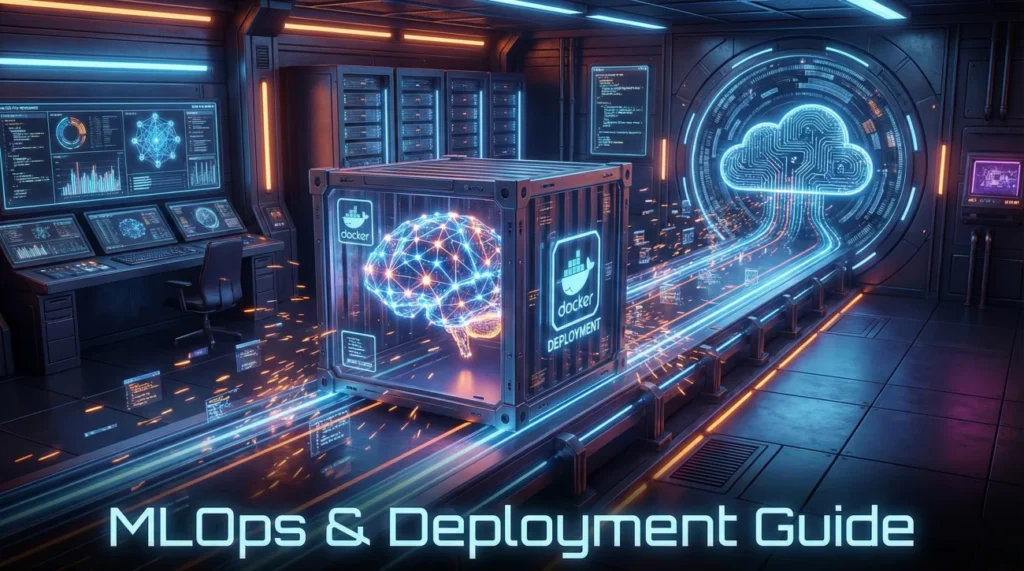
Docker packages model with dependencies (libraries, Python version, system packages) into containers. Ensures consistency across environments: development, staging, production run identically. Solves “works on my machine” problem. Container images are portable, reproducible, isolated from host system.
Kubernetes orchestrates containers at scale: manages deployments, handles failures, auto-scales based on load, load balances traffic. ML workflow: train model, export weights, create Docker image with model and serving code, push to registry, deploy to Kubernetes cluster. Version images with tags. Rollback by deploying previous image version.
Q: How do you optimize ML models for production inference?
Model quantization: reduce precision (float32 to int8) for smaller size and faster inference. Pruning: remove unnecessary weights. Distillation: train smaller model mimicking larger one. Batch predictions: process multiple inputs together improving throughput. Caching: store frequent predictions. GPU acceleration for compute-intensive models. Model optimization frameworks: ONNX Runtime, TensorRT optimize for specific hardware. Profile inference: identify bottlenecks, optimize critical paths. Balance accuracy versus latency based on requirements.
CI/CD and Versioning
Implementing ML model versioning and automated pipelines ensures reproducibility and reliable deployments.
Continuous Integration for ML
Q: How does CI/CD apply to machine learning?
Continuous Integration: automated testing on code commits. Run unit tests for data processing, model training code. Validate data quality, schema consistency. Test model performance on validation set. Continuous Deployment: automatically deploy models passing tests. Build Docker images, push to registry. Deploy to staging, run integration tests. Deploy to production on approval. Differs from software CI/CD: includes data validation, model performance tests, retraining triggers. Tools: Jenkins, GitLab CI, GitHub Actions orchestrate pipelines.
Q: Why is versioning important in MLOps?
Track which model version serves production. Reproduce results: same code + data + hyperparameters = same model. Debug issues: compare current versus previous versions. Rollback when new model underperforms. Audit trail for compliance. Version control needs: code (Git), data (DVC), models (MLflow Model Registry), environment (Docker images). Link versions together: model v3 trained with data v2.1 using code commit abc123. Metadata tracking: training duration, accuracy, who trained, when deployed.
Q: How do you handle data versioning in ML pipelines?
Data Version Control (DVC) tracks dataset versions like Git tracks code. Store data hashes, metadata in Git. Actual data in cloud storage (S3, GCS). Track transformations: raw data v1.0, cleaned data v1.1, features v1.2. Reproducibility: checkout code commit pulls corresponding data version. Handle large datasets Git can’t manage. Integration with CI/CD: pipelines fetch correct data version. Alternative: cloud-native versioning (S3 versioning), lakehouse platforms (Delta Lake) with time travel.
Q: What is model registry and why use it?
Centralized repository storing model artifacts, metadata, versions. MLflow Model Registry common choice. Features: register models with versions, stage models (staging, production, archived), track lineage (training data, code, metrics), manage deployments, enforce approval workflows. Benefits: single source of truth, prevents deploying wrong model, enables collaboration, audit compliance. Integration with deployment: fetch production model from registry, deploy automatically on promotion to production stage.
Production Monitoring and Drift Detection
Effective production model monitoring detects performance degradation before business impact occurs.
Monitoring Strategies
What is model drift and how do you detect it?
Data drift: input data distribution changes over time. Example: user behavior shifts, seasonal patterns, demographic changes. Concept drift: relationship between features and target changes. Example: fraud patterns evolve, economic conditions shift. Both cause model performance degradation.
Detection methods: statistical tests compare current versus training distributions (KS test, Chi-square). Monitor prediction distributions: sudden changes indicate drift. Track model performance metrics over time. Alert when metrics degrade beyond thresholds. Tools: Evidently AI, WhyLabs detect drift automatically. Response: retrain model with recent data, update features, investigate root causes.
What metrics do you monitor for production ML models?
Model performance: accuracy, precision, recall for classification. MAE, RMSE for regression. Track over time, segment by user groups. Business metrics: conversion rate, revenue impact, user engagement tied to model. Infrastructure metrics: latency (p50, p95, p99 percentiles), throughput (requests per second), error rate, resource usage (CPU, memory, GPU).
Data quality: missing values, out-of-range values, schema violations. Prediction distribution: catch anomalies, unexpected outputs. Alert thresholds trigger investigation. Dashboards visualize trends. Prometheus collects metrics, Grafana builds dashboards. Log predictions for debugging, analysis. Balance monitoring cost versus insight value.
How do you implement automated model retraining?
Triggers: scheduled (weekly, monthly), performance-based (accuracy drops below threshold), data-based (sufficient new labeled data accumulated), drift detection (distribution shift detected). Pipeline: fetch latest data, validate quality, train model, evaluate performance, compare against production model.
Deploy if improvement significant. Automated approval for small improvements, manual review for major changes. Orchestration: Airflow schedules pipelines, monitors execution. Kubeflow Pipelines manages ML workflows. Versioning: each retrained model gets new version. Rollback if automated deployment causes issues. Balance retraining frequency versus computational cost and stability needs.
MLOps & Deployment Quiz
20 Practice Questions
1. What does MLOps stand for?
- Machine Learning Optimization
- Machine Learning Operations
- Multi-Layer Operations
- Model Learning Orchestration
2. Which tool is used for ML experiment tracking?
- Docker
- MLflow
- Kubernetes
- Git
3. What is the purpose of Docker in ML deployment?
- Train models faster
- Package model with dependencies for consistent deployment
- Improve model accuracy
- Store training data
4. What is data drift?
- Model accuracy improving over time
- Input data distribution changing over time
- Hardware failure
- Code bugs
5. In A/B testing for ML models, what is the control group?
- New model being tested
- Current production model
- Training dataset
- Validation metrics
6. Which is NOT a stage in the MLOps lifecycle?
- Model training
- Deployment
- Manual data entry
- Monitoring
7. What does DVC (Data Version Control) track?
- Only code changes
- Large datasets and ML model files
- Only hyperparameters
- Only deployment logs
8. What is model quantization?
- Adding more layers to model
- Reducing numerical precision to improve inference speed
- Splitting model across servers
- Versioning models
9. Which metric measures API response time at 95th percentile?
- Mean latency
- p95 latency
- Throughput
- Error rate
10. What does CI/CD stand for in MLOps?
- Code Integration/Code Deployment
- Continuous Integration/Continuous Deployment
- Cloud Infrastructure/Cloud Development
- Container Integration/Container Distribution
11. Which tool orchestrates containerized ML workloads?
- Flask
- Pandas
- Kubernetes
- NumPy
12. What is concept drift?
- Model architecture changes
- Relationship between features and target changes
- Training data grows larger
- Code refactoring
13. Which deployment strategy gradually increases traffic to new model?
- Blue-green deployment
- Progressive rollout (canary deployment)
- Direct deployment
- Batch deployment
14. What is a model registry used for?
- Training models
- Centralized storage and versioning of production models
- Data preprocessing
- Feature engineering
15. Which tool provides ML model serving?
- Git
- TensorFlow Serving
- Jupyter
- Pandas
16. What triggers automated model retraining?
- Code commits only
- Performance degradation or scheduled intervals
- Manual request only
- Server restarts
17. Which is a benefit of MLOps?
- Eliminates need for data scientists
- Faster, more reliable model deployments
- Perfect model accuracy
- No monitoring required
18. What does batch inference mean?
- Real-time predictions
- Processing large datasets offline at scheduled times
- Training multiple models
- Streaming predictions
19. Which tool orchestrates ML workflows?
- Apache Airflow or Kubeflow
- Docker
- Flask
- Scikit-learn
20. What is feature store used for?
- Storing raw data only
- Managing and serving engineered features consistently
- Training models
- Monitoring logs
❓ FAQ
🎯 How much software engineering should ML engineers know?
Strong software engineering fundamentals essential: version control, testing, CI/CD, containerization, API design. Don’t need deep algorithms knowledge like software engineers. Focus on production systems: scalability, reliability, monitoring. Build projects demonstrating end-to-end ML pipelines.
💼 Do ML engineering interviews include coding?
Expect coding for pipeline building, API development, data processing. Python most common. Some companies include system design rounds for ML systems. Take-home projects deploying models to cloud platforms. Less algorithmic coding than software engineering interviews.
⏰ Should I focus more on ML algorithms or MLOps tools?
ML engineer role emphasizes production deployment over research. Understand ML fundamentals but focus on operationalization: Docker, Kubernetes, CI/CD, monitoring. Data scientists deep-dive algorithms. ML engineers build infrastructure running those algorithms at scale.
📋 What cloud platform should I learn for MLOps?
AWS SageMaker most popular. Azure ML, GCP AI Platform also common. Core concepts transfer between platforms. Learn one thoroughly showing end-to-end deployment. Understand platform-agnostic tools: Docker, Kubernetes, MLflow work everywhere.
✨ What if I haven’t deployed models to production?
Build personal projects deploying to cloud platforms (free tiers available). Create REST APIs serving predictions. Implement monitoring dashboards. Set up CI/CD pipelines. GitHub portfolio showing production-ready code matters more than number of models deployed at companies.
Final Thoughts
Modern machine learning engineer interview questions test production deployment skills over algorithm knowledge. Master MLOps lifecycle automation from training through monitoring, deployment architectures balancing latency and scalability, CI/CD pipelines ensuring reliable releases, versioning strategies enabling reproducibility, and monitoring systems detecting drift before business impact. Success requires building end-to-end ML systems where you automate pipelines, deploy to production infrastructure, implement monitoring dashboards, and handle model degradation through automated retraining.
⚠️ Disclaimer: The interview strategies, sample answers, and negotiation tips provided in this guide are for educational purposes only. Hiring decisions are subjective and vary by company and industry. While these strategies are based on professional HR standards, they do not guarantee a specific job offer or result.