What SRE Interviews Assess
Site reliability engineer interviews test reliability engineering principles through SRE SLO interview questions requiring you to define service level objectives balancing user experience with engineering velocity, error budget concepts demonstrating tradeoffs between reliability and feature development, and toil reduction interview scenarios identifying automation opportunities. Companies probe how you respond to production incidents, implement observability revealing system health, and use data-driven approaches choosing which reliability improvements to prioritize. For comprehensive IT interview preparation, explore our complete technical interview resources.
These site reliability engineer interview questions cover SLI/SLO/SLA hierarchy (indicators measuring performance, objectives setting targets, agreements defining consequences), error budget policies guiding feature versus reliability investment, capacity planning preventing resource exhaustion, and observability engineering questions testing monitoring, logging, and tracing integration. Modern SRE roles emphasize blameless postmortems learning from failures, progressive rollout strategies limiting blast radius, and treating operations as software engineering problems solved through code and automation.
SLI, SLO & Error Budgets
Q: Explain the relationship between SLI, SLO, and SLA.
Service Level Indicators (SLIs) are specific metrics measuring service quality like request latency, error rate, or availability percentage. Service Level Objectives (SLOs) set target values for SLIs defining acceptable performance (99.9% availability). Service Level Agreements (SLAs) are contracts with customers including consequences for failing to meet SLOs. The hierarchy flows upward: measure SLIs, set internal SLOs stricter than external SLAs providing buffer for operational mistakes. Example: SLI is percentage of requests served under 200ms, SLO is 99.5% of requests, SLA promises customers 99% with refunds if violated.
Q: What is an error budget and how do you use it?
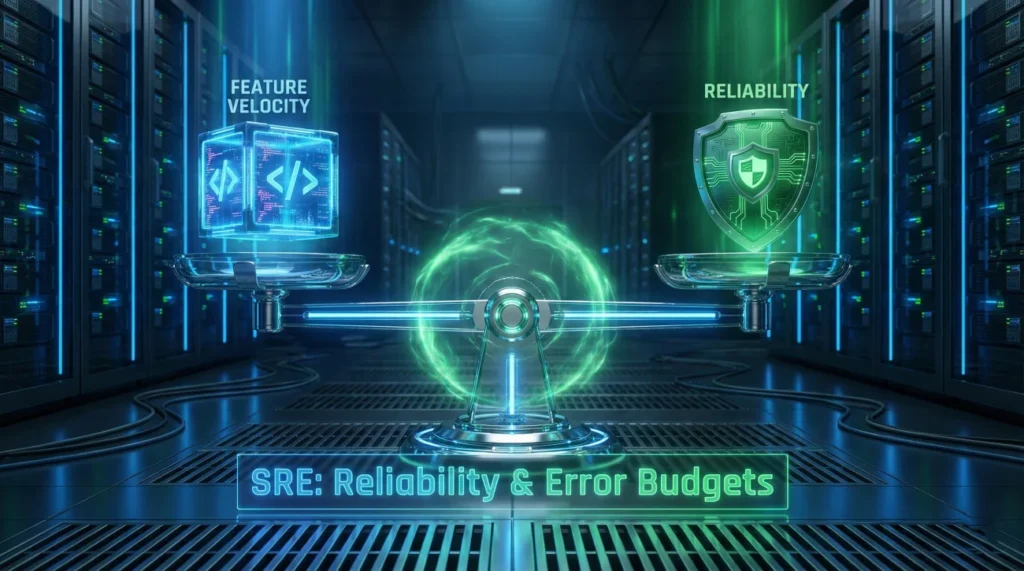
Error budget is the allowed unreliability calculated from SLOs. If SLO is 99.9% uptime, error budget is 0.1% downtime (43 minutes monthly). Teams can “spend” error budget on risky deployments, planned maintenance, or experiments. When error budget exhausts, feature development pauses focusing on reliability improvements until budget replenishes. This quantifies the reliability-velocity tradeoff preventing both reckless deployments and excessive caution blocking innovation. Error budgets align engineering and product on acceptable risk levels.
Q: How do you determine appropriate SLOs for a service?
Start with user experience requirements defining what constitutes “good enough” service. Measure current performance establishing baseline capabilities. Consider dependencies since your SLO can’t exceed weakest dependency. Balance cost since higher SLOs require more resources. Set SLOs slightly below SLA targets providing operational buffer. Make SLOs measurable with clear SLIs avoiding vague targets. Review quarterly adjusting based on business needs and technical capabilities. Involve stakeholders ensuring SLOs match actual user expectations not arbitrary perfection.
Q: What SLIs would you track for a web API service?
Track availability (percentage of successful requests), latency (99th percentile response time), throughput (requests per second), and error rate (percentage of 5xx responses). For user-facing APIs, also monitor perceived availability from multiple geographic regions. Latency percentiles matter more than averages since outliers affect user experience. Set different SLOs for different endpoints if criticality varies. Avoid vanity metrics focusing on measurements correlating with user satisfaction. Track saturation metrics (CPU, memory, connection pool usage) predicting upcoming capacity issues.
💡 Pro tip: SRE interviews test philosophy over tools. Saying “set 99.99% uptime SLO because higher is better” reveals shallow understanding. Explaining tradeoffs between reliability cost and business value, plus how error budgets enable informed risk-taking, demonstrates SRE thinking.
Toil Reduction & Automation
Q: Define toil and explain why reducing it matters.
Toil is manual, repetitive, automatable work lacking enduring value that scales linearly with service growth. Examples include manually deploying releases, resetting passwords, or restarting services. Toil differs from complex troubleshooting requiring human judgment. SRE teams target under 50% time on toil reserving capacity for engineering work improving systems. Excessive toil burns out engineers, slows response to real problems, and indicates poor system design. Eliminate toil through automation, self-service tools, or redesigning systems removing the need for intervention.
Q: How do you prioritize which toil to eliminate first?
Measure frequency and time cost of each toil source calculating total hours monthly. Consider growth rate since toil scaling with traffic becomes unbearable. Evaluate automation complexity balancing effort against savings. Prioritize high-frequency, simple-to-automate tasks generating quick wins and team morale. Address toil blocking other work even if individually small. Involve team identifying toil they find most frustrating. Track toil reduction as key SRE metric demonstrating engineering progress beyond keeping lights on.
Q: Give examples of acceptable versus unacceptable toil.
Unacceptable toil: manually deploying code 20 times daily (automate CI/CD), resetting database connections every hour (fix connection pooling), manually scaling servers during traffic spikes (implement autoscaling). Acceptable work mistaken for toil: incident response requiring human judgment, capacity planning combining data analysis with business context, complex debugging needing expertise. Not all manual work is toil. One-off migrations or rare maintenance are operational work, not toil. The key differentiator is whether work is repetitive and scales with growth.
Q: What’s the difference between SRE and traditional operations regarding automation?
Traditional operations often automates individual tasks creating scripts that still require human orchestration. SRE builds self-healing systems where automation handles entire workflows including detection, diagnosis, and remediation. SREs write production code with testing and version control not quick shell scripts. They design systems eliminating manual intervention needs through proper architecture (stateless services, graceful degradation) rather than just scripting existing manual processes. SRE measures success by reduced operational load not number of scripts written.
Observability & Monitoring
What’s the difference between monitoring and observability?
Monitoring tracks known failure modes through predefined metrics and alerts based on expected problems. Observability enables understanding system behavior by examining outputs (logs, metrics, traces) answering questions you didn’t anticipate. Monitoring asks “is the disk full?” Observability lets you investigate “why is latency high for this specific user cohort?” Monitoring works for known issues. Observability handles novel failures in complex distributed systems. Modern systems need both: monitoring for alerting on established SLIs, observability for diagnosing unexpected behaviors.
Explain the three pillars of observability.
Metrics provide time-series data on system health (CPU usage, request rate, latency percentiles) enabling trend analysis and alerting. Logs capture discrete events with context (request details, errors, state changes) supporting debugging specific incidents. Traces follow individual requests across distributed systems showing which services contributed to latency. Each pillar serves different purposes: metrics for aggregate health, logs for detailed investigation, traces for understanding distributed interactions. Correlation between pillars (associating high latency metric with error logs and slow traces) provides complete incident picture.
How do you reduce alert fatigue while maintaining system awareness?
Alert only on symptoms affecting users (SLO violations) not underlying causes that may self-resolve. Make alerts actionable providing clear next steps not vague warnings. Use alert grouping and deduplication preventing notification storms. Implement progressive escalation starting with self-healing automation before paging humans. Review alert patterns monthly removing alerts that fire frequently without requiring action. Set appropriate thresholds avoiding false positives from normal variation. Build confidence through postmortem analysis proving alerts actually indicate real problems worth waking someone.
Incident Response & Postmortems
Q: Walk through your process for responding to a production incident.
Acknowledge alert immediately signaling you’re responding. Assess severity determining if this requires team escalation. Mitigate user impact before diagnosing root cause using rollbacks, traffic shifting, or feature flags. Establish communication channel keeping stakeholders informed. Assign roles (incident commander coordinates, operators make changes, communicator updates stakeholders). Collect data through logs, metrics, and traces. Implement fix or workaround testing in staging if time permits. Verify resolution monitoring SLIs. Document timeline and actions. Schedule postmortem within 48 hours while details are fresh.
Q: What makes a postmortem effective and blameless?
Effective postmortems identify systemic failures not individual mistakes. Focus on timeline documenting what happened when without judging decisions made under pressure. Ask “why was this possible?” not “who caused this?” Generate action items addressing root causes with clear owners and deadlines. Share postmortems widely spreading lessons. Make postmortems psychologically safe encouraging honesty over covering up mistakes. Track action item completion ensuring learning translates to improvement. Celebrate postmortems as learning opportunities not punishment. Ineffective postmortems blame individuals, generate action items nobody completes, or aren’t shared preventing organizational learning.
Q: How do you prevent incidents from recurring?
Implement comprehensive fixes addressing root causes not just symptoms. Add monitoring and alerting catching problems earlier next time. Improve system design eliminating failure modes through redundancy, graceful degradation, or circuit breakers. Update runbooks and documentation so responses improve. Add automated testing preventing regressions. Share knowledge through postmortems and training. Track mean time between incidents for similar failures measuring prevention effectiveness. Accept that some incidents are learning opportunities balancing prevention investment against error budget philosophy.
Q: Explain chaos engineering and its role in SRE.
Chaos engineering intentionally introduces failures testing system resilience before real incidents occur. Examples include randomly terminating instances, injecting network latency, or simulating dependency failures. This validates assumptions about graceful degradation and redundancy. Run chaos experiments during business hours proving confidence in system reliability. Start small with controlled experiments in non-production before production chaos. Use error budgets deciding acceptable blast radius. Chaos engineering shifts failure discovery from production incidents to controlled tests reducing surprise and improving system understanding.
⚠️ Common mistake: Treating SRE like traditional ops plus automation. SRE fundamentally differs by quantifying reliability through SLOs, using error budgets for tradeoff decisions, and treating operations as software problems requiring engineering solutions not just better scripts.
SRE Concepts Practice
20 Practice Questions
1. What does SLI measure?
- Customer contracts
- Specific service metrics (latency, error rate)
- Team velocity
- Infrastructure cost
2. If SLO is 99.9% uptime, what’s the monthly error budget?
- 1 hour
- ~43 minutes (0.1% of month)
- 10 minutes
- No downtime allowed
3. What defines toil in SRE?
- All manual work
- Manual, repetitive, automatable, scales with growth
- Incident response
- Any operational task
4. What happens when error budget exhausts?
- Nothing changes
- Pause features, focus on reliability
- Increase SLO target
- Deploy faster
5. Three pillars of observability are?
- CPU, memory, disk
- Metrics, logs, traces
- SLI, SLO, SLA
- Dev, test, prod
6. SRE target for toil time is?
- 0% (eliminate all toil)
- 25%
- Under 50%
- 75%
7. Blameless postmortems focus on?
- Who made mistakes
- Systemic failures and prevention
- Performance reviews
- Punishment
8. Which is NOT toil?
- Manually deploying 20x daily
- Restarting services hourly
- Complex incident diagnosis
- Manual password resets
9. SLO should be set?
- Same as SLA
- Stricter than SLA (buffer)
- Looser than SLA
- 100% always
10. Chaos engineering tests what?
- Developer skills
- System resilience through injected failures
- Load capacity
- Security vulnerabilities
11. What SLI is best for user experience?
- CPU usage
- Request latency percentiles
- Code coverage
- Deployment frequency
12. Observability differs from monitoring how?
- They’re the same
- Enables answering unknown questions
- Only uses metrics
- Cheaper to implement
13. Error budget encourages?
- Zero risk deployments only
- Informed risk-taking within limits
- Ignoring reliability
- Manual processes
14. When should alerts fire?
- Any anomaly detected
- SLO violations affecting users
- Every error logged
- Hourly status updates
15. Distributed tracing shows?
- Aggregate metrics
- Request flow across services
- Error logs
- Code coverage
16. SLA includes?
- Internal targets only
- Customer contracts with consequences
- Stretch goals
- Development metrics
17. Progressive rollout limits?
- Development speed
- Blast radius of failures
- Team size
- Infrastructure cost
18. Capacity planning prevents?
- Code bugs
- Resource exhaustion from growth
- Security breaches
- Developer turnover
19. Which latency metric matters most for UX?
- Average
- Median
- 99th percentile (captures outliers)
- Minimum
20. Postmortem action items should be?
- Vague suggestions
- Specific, owned, deadline-tracked
- Optional improvements
- Blame assignments
❓ FAQ
🔧 How does SRE differ from DevOps?
DevOps is cultural philosophy promoting development and operations collaboration. SRE is specific implementation using software engineering for operations, emphasizing reliability through SLOs, error budgets, and toil reduction. SRE prescribes concrete practices where DevOps describes general principles. Many organizations use both: DevOps culture with SRE practices for reliability-critical systems.
📊 Do I need to know specific monitoring tools for SRE roles?
Understand concepts over specific tools. Know metrics collection (Prometheus), visualization (Grafana), log aggregation (ELK stack), and distributed tracing (Jaeger, Zipkin). Focus on observability principles, SLI selection, and alert design transferring across tools. Companies use varied toolchains so adaptability matters more than expertise in one product. Demonstrate tool-agnostic thinking during interviews.
⚡ How much coding do SREs actually do?
SRE roles vary but typically 50%+ involves coding automation, tooling, and infrastructure as code. Languages include Python, Go, or whatever the product team uses. SREs write production code requiring testing, review, and version control not quick scripts. Less application development, more systems programming, automation, and integration. If you prefer pure operations over coding, traditional ops roles may fit better.
🎯 What’s the biggest misconception about SRE?
Thinking SRE just rebrands operations or that higher SLOs are always better. SRE fundamentally changes how reliability is managed through quantifiable targets and error budgets enabling data-driven tradeoffs. Setting 99.99% SLO when 99.9% suffices wastes resources. SRE accepts that 100% reliability is wrong target since it prevents learning from failures and innovation. Error budgets legitimize controlled risk-taking.
📚 How do I prepare for SRE interviews without SRE experience?
Study Google’s SRE book available free online covering core concepts. Practice defining SLIs/SLOs for services you use daily explaining tradeoffs. Build personal projects implementing observability, demonstrating toil automation, or using infrastructure as code. Prepare incident stories using STAR method even from non-SRE roles. Emphasize software engineering skills, systems thinking, and data-driven decision making transferring to SRE work.
Final Thoughts
Mastering site reliability engineer interview questions requires understanding reliability as engineering discipline not just operational practice. The best preparation combines studying SRE principles from foundational texts, practicing SLI/SLO design for real services, and demonstrating software engineering approaches to operations problems. Focus on explaining tradeoffs rather than pursuing perfection since SRE philosophy embraces measured risk through error budgets.
Companies value SREs who quantify reliability decisions through data, automate toil freeing capacity for engineering work, and learn from failures through blameless postmortems. Your preparation should include building projects demonstrating observability implementation, writing postmortems for incidents you’ve experienced, and practicing articulation of how error budgets enable informed velocity versus reliability tradeoffs. Demonstrate both technical depth in systems and philosophical alignment with SRE’s data-driven, engineering-centric approach to reliability.
⚠️ Disclaimer: The interview strategies, sample answers, and negotiation tips provided in this guide are for educational purposes only. Hiring decisions are subjective and vary by company and industry. While these strategies are based on professional HR standards, they do not guarantee a specific job offer or result.