What Python Developer Interviews Test
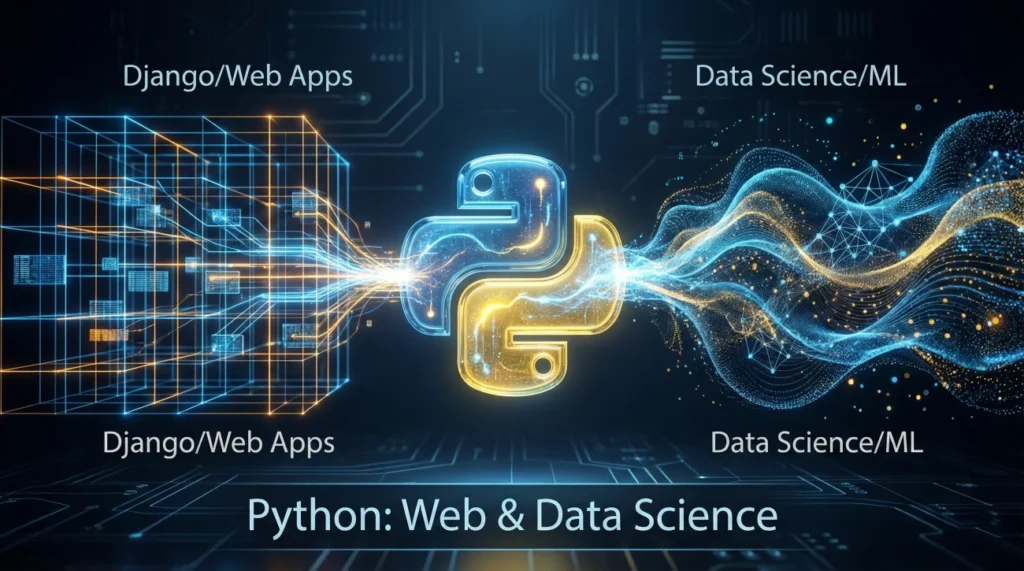
Python developer interviews test your grasp of python developer interview questions through Django MVT architecture knowledge, decorator usage for code enhancement, generator implementation for memory efficiency, and scripting skills for automation. Interviewers probe Django ORM queries, context managers with with statements, list comprehensions versus generator expressions, and virtual environment management for dependency isolation.
This guide covers Django web framework essentials including models, views, and templates, Python core concepts like decorators and generators, scripting and automation techniques, and advanced features such as async/await and magic methods. Modern Python development emphasizes clean Pythonic code following PEP 8, framework expertise for scalable applications, and practical problem-solving with libraries like Pandas and NumPy. Explore comprehensive technical preparation at our complete interview guide.
Django Framework Essentials
Q: Explain Django’s MVT architecture and how it differs from MVC.
Django uses Model-View-Template (MVT) where:
- Models define data structure mapping to database tables
- Views handle business logic processing HTTP requests
- Templates render dynamic HTML
Unlike MVC (Model-View-Controller), Django’s View acts as controller while Template handles presentation. URL dispatcher routes requests to appropriate view functions, views query models for data, then pass context to templates which generate HTML responses. This separation enables independent development of data layer, business logic, and presentation allowing teams to work simultaneously on different components.
Q: How does Django ORM prevent SQL injection and what are its performance optimization techniques?
Django ORM automatically parameterizes queries preventing SQL injection by escaping user inputs. Define models as Python classes: class User(models.Model): name = models.CharField(max_length=100). Query using User.objects.filter(name='John') generates safe SQL with bound parameters.
Optimize with:
select_related()for ForeignKey relationships using SQL JOIN reducing queriesprefetch_related()for ManyToMany using separate queries with Python joiningonly()to fetch specific fieldsdefer()to exclude heavy fields
These techniques prevent N+1 query problems common in web applications.
Q: What are Django migrations and how do you handle data migrations?
Migrations version-control database schema changes:
- Run
python manage.py makemigrationsafter modifying models to generate migration files describing alterations - Apply with
python manage.py migrateexecuting SQL commands - Django tracks applied migrations in
django_migrationstable preventing re-application
For data transformations, use RunPython operations in migration files executing custom Python code.
Example: migrating data format requires creating migration with migrations.RunPython(forwards_func, backwards_func) where functions transform existing records.
Rollback specific migrations using migrate app_name migration_number.
Q: Describe Django middleware and provide practical use cases.
Middleware processes requests before views and responses before returning to client. Common middleware includes:
AuthenticationMiddlewareassociating users with requestsCsrfViewMiddlewareprotecting against CSRF attacksGZipMiddlewarecompressing responses
Custom middleware handles cross-cutting concerns like logging request duration, adding custom headers, or rate limiting. Middleware executes in order defined in MIDDLEWARE setting processing requests top-to-bottom and responses bottom-to-top. Create custom middleware as class with __init__(self, get_response) and __call__(self, request) methods enabling request/response modification globally across application.
Python Core Language Features
Q: What are decorators and how do you implement them in Python?
Decorators modify function behavior without changing source code. Implemented as functions taking functions as arguments returning wrapper functions. Basic syntax: def decorator(func): def wrapper(*args, **kwargs): # before; result = func(*args, **kwargs); # after; return result; return wrapper. Apply using @decorator syntax above function definition. Common uses include @login_required for authentication checking, @lru_cache for memoization, and timing decorators for performance profiling. Decorators enable aspect-oriented programming separating cross-cutting concerns from business logic.
Q: Explain generators and their advantages over regular functions.
Generators use yield instead of return creating iterators that produce values lazily. Function pauses at yield saving state, resuming when next value requested via next().
Example: def fibonacci(): a, b = 0, 1; while True: yield a; a, b = b, a+b generates infinite sequence without storing entire list.
Advantages include memory efficiency by generating values on-demand, ability to represent infinite sequences, and lazy evaluation computing only when needed. Generator expressions (x**2 for x in range(1000)) provide concise syntax compared to list comprehensions reducing memory usage for large datasets.
Q: What is the Global Interpreter Lock and its implications for concurrency?
GIL is mutex preventing multiple threads from executing Python bytecode simultaneously in CPython implementation. Only one thread holds GIL at any moment even on multi-core processors. This simplifies memory management preventing race conditions in reference counting but limits CPU-bound multithreading parallelism. I/O-bound operations release GIL during system calls allowing concurrent execution. Workarounds include multiprocessing module using separate processes each with own GIL for CPU parallelism, using C extensions that release GIL, or async/await for I/O concurrency. Understanding GIL crucial for choosing appropriate concurrency model based on workload type.
Q: How do list comprehensions differ from traditional loops and when should you use them?
List comprehensions create lists concisely in single line: [expression for item in iterable if condition].
Example: squares = [x**2 for x in range(10)] versus multi-line loop requiring initialization, iteration, and append.
Benefits include cleaner readable code for simple transformations, often faster execution than equivalent loops due to optimized C implementation. Limitations include reduced readability for complex logic with multiple conditions or nested iterations. Use comprehensions for straightforward list creation, traditional loops when needing multiple statements per iteration or complex control flow. Nested comprehensions [[i*j for j in range(3)] for i in range(3)] create matrices but consider readability impact.
Scripting and Automation
How do you handle file operations safely in Python scripts?
Use context managers with with statement ensuring automatic file closure even if exceptions occur: with open('file.txt', 'r') as f: content = f.read(). File modes include ‘r’ for reading, ‘w’ for writing (overwrites), ‘a’ for appending, ‘r+’ for read/write, and ‘b’ suffix for binary mode like ‘rb’ for images. Process large files line-by-line memory efficiently: for line in f: iterates without loading entire file. Use pathlib.Path for cross-platform path handling: Path('folder/file.txt').exists(). Handle exceptions with try-except catching FileNotFoundError or PermissionError providing graceful error messages instead of crashes.
Describe a practical automation task you’ve implemented with Python.
Automated daily sales report aggregation from multiple CSV sources using Pandas. Script reads files with pd.read_csv(), merges dataframes on common keys, calculates statistics with groupby() and agg(), then exports to Excel using to_excel(). Scheduled execution via cron (Linux) or Task Scheduler (Windows) running script automatically each morning. Added email notifications using smtplib sending report attachments to stakeholders. Error handling catches file access issues logging problems while continuing execution. This automation eliminated 2 hours daily manual work improving data freshness and accuracy while reducing human errors in calculations.
How do you manage project dependencies and virtual environments?
Create virtual environments isolating project dependencies using python -m venv env_name. Activate with source env_name/bin/activate on Unix or env_name\Scripts\activate on Windows. Install packages within environment using pip install package_name. Generate requirements file capturing all dependencies with versions: pip freeze > requirements.txt. Team members recreate environment using pip install -r requirements.txt ensuring consistent setups across development, testing, and production. Modern tools like Poetry or Pipenv provide enhanced dependency resolution and lock files. Virtual environments prevent version conflicts between projects using different package versions.
Advanced Python Concepts
Q: What are context managers and how do you implement custom ones?
Context managers manage resources ensuring proper setup and cleanup using with statement. Common example: with open('file.txt') as f: guarantees file closure. Implement using __enter__() returning resource and __exit__() handling cleanup even if exceptions raised. Alternatively use @contextmanager decorator from contextlib: @contextmanager def timer(): start = time.time(); yield; print(f"Elapsed: {time.time()-start}"). Custom context managers handle database transactions, lock acquisition, temporary directory creation, or state changes requiring guaranteed cleanup regardless of success or failure.
Q: Explain *args and **kwargs and their practical applications.
*args accepts variable positional arguments collected as tuple, **kwargs accepts variable keyword arguments collected as dictionary. Function signature: def func(*args, **kwargs): accepts any arguments. Calling func(1, 2, name='Alice', age=30) sets args to (1, 2) and kwargs to {'name': 'Alice', 'age': 30}. Use for flexible APIs, wrapper functions, decorators needing to preserve signatures. Unpacking: func(*[1,2,3]) expands list to positional arguments, func(**{'x': 1, 'y': 2}) expands dict to keyword arguments enabling dynamic function calls.
Q: What’s the difference between shallow copy and deep copy?
Shallow copy creates new object but references original nested objects: import copy; shallow = copy.copy(original) or list.copy(). Modifying nested structures affects both copies.
Deep copy recursively copies all nested objects: deep = copy.deepcopy(original) creating completely independent copy.
Example: original = [[1,2],[3,4]]; shallow = copy.copy(original); shallow[0][0] = 99 changes original[0][0] because inner lists are shared. Deep copy prevents this independence.
Use shallow for flat structures, deep for nested objects. Shallow copying faster but deep copying ensures true isolation.
Q: How does exception handling work with try-except-finally?
Try-except blocks catch errors gracefully: try: risky_operation() except ValueError: handle_value_error() except Exception as e: handle_general_error(e) else: runs_if_no_exception() finally: always_cleanup(). Catch specific exceptions before general ones. Multiple except blocks handle different error types differently. else clause executes only if no exception raised. finally always executes for cleanup like closing files or releasing locks. Raise exceptions using raise ValueError("message"). Create custom exceptions: class CustomError(Exception): pass. Avoid bare except catching all exceptions which masks programming errors.
Python Ecosystem Practice
20 Practice Questions
1. Django MVT stands for?
- Model-View-Technology
- Model-View-Template
- Module-View-Template
- Model-Variable-Template
2. What symbol precedes decorators in Python?
- # hash
- @ at symbol
- ! exclamation
- % percent
3. The yield keyword is used in?
- Regular functions only
- Generators
- Classes
- Modules
4. Django ORM prevents SQL injection through?
- String escaping only
- Parameterized queries
- Input validation only
- Character filtering
5. List comprehension [x**2 for x in range(5)] produces?
- [1, 2, 3, 4, 5]
- [0, 1, 4, 9, 16]
- [2, 4, 6, 8, 10]
- [0, 2, 4, 6, 8]
6. The GIL (Global Interpreter Lock) primarily affects?
- I/O-bound operations
- CPU-bound multithreading
- Single-threaded code
- Memory allocation
7. The with statement ensures?
- Faster execution
- Automatic resource cleanup
- Error prevention
- Type checking
8. In def func(*args, **kwargs), args is?
- A dictionary
- A tuple of positional arguments
- A list
- A set
9. Virtual environments are created using?
- pip install venv
- python -m venv env_name
- virtualenv –create
- python create-env
10. Django migrations are created with?
- python manage.py migrate
- python manage.py makemigrations
- python manage.py create
- django-admin startmigration
11. What does **kwargs provide?
- Positional arguments tuple
- Keyword arguments dictionary
- Fixed parameters
- Default values
12. Deep copy differs from shallow copy by?
- Being faster
- Recursively copying nested objects
- Using less memory
- No difference
13. Django middleware processes requests?
- After views only
- Before views and after in reverse order
- Only on errors
- Randomly
14. Generator advantage over list is?
- Faster iteration
- Memory efficiency through lazy evaluation
- Easier syntax
- Better error handling
15. The command pip freeze outputs?
- Package descriptions
- Installed packages with versions
- Available updates
- Package sizes
16. The finally block in exception handling?
- Only runs if exception occurs
- Always executes for cleanup
- Prevents exceptions
- Catches errors
17. Django ORM select_related() optimizes?
- ManyToMany relationships
- ForeignKey relationships using JOIN
- Reverse relationships
- All relationships equally
18. Lambda function lambda x: x * 2 is equivalent to?
- def f(x): return x * 2
- def f(x): x * 2
- def f(): return x * 2
- x * 2
19. Context managers implement which methods?
- __init__ and __del__
- __enter__ and __exit__
- __start__ and __stop__
- __open__ and __close__
20. Django templates separate?
- Models from views
- Presentation HTML from business logic
- Database from code
- Frontend from backend
❓ FAQ
🐍 Should I focus on Django or Flask for web development interviews?
Django suits full-stack roles with its batteries-included approach providing ORM, admin interface, and authentication out-of-box. Flask works for API-focused positions offering flexibility and minimal overhead. Most Python web developer roles expect Django knowledge since it dominates enterprise applications, but understanding both frameworks demonstrates versatility and deeper web development comprehension.
📊 How important are data science libraries for general Python developer roles?
Web development roles prioritize framework expertise over data science libraries, though basic Pandas knowledge helps with data processing tasks. Data engineer or analyst positions require deep NumPy, Pandas, and Matplotlib proficiency. Check job descriptions carefully: “Python Developer” typically means web development, while “Data Engineer” emphasizes scientific computing libraries and analytical skills.
⚡ What’s the best way to prepare for Python coding challenges?
Practice on LeetCode, HackerRank, or CodeSignal focusing on data structures (lists, dictionaries, sets) and algorithms (sorting, searching, recursion). Master Python idioms like list comprehensions, built-in functions (map, filter, zip), and string methods. Time yourself simulating interview pressure, explain solutions aloud practicing communication, and review Pythonic solutions learning concise elegant approaches rather than memorizing specific answers.
🔧 How do I demonstrate Python expertise beyond basic syntax knowledge?
Build portfolio projects showcasing practical skills: web application with Django, automation script solving real problems, or data analysis with Pandas. Contribute to open source demonstrating collaboration and code review abilities. Write technical blog posts teaching concepts which solidifies understanding. Discuss architectural tradeoffs, testing practices with pytest, and deployment strategies showing mature engineering thinking beyond coding mechanics.
📚 Should I learn Python 2 or focus exclusively on Python 3?
Focus exclusively on Python 3 since Python 2 reached end-of-life in 2020 and companies have migrated. Know major differences if asked: print function versus statement, Unicode string handling, integer division behavior. Legacy maintenance roles might mention Python 2 but new development uses Python 3. Latest stable version knowledge demonstrates staying current with language evolution and modern best practices.
Final Thoughts
Success with python developer interview questions requires combining language fundamentals with practical framework experience and problem-solving ability. Focus on writing clean Pythonic code following PEP 8 guidelines, understanding Django MVT architecture for web development, and mastering decorators and generators demonstrating advanced Python knowledge. Build actual projects using frameworks, practice coding challenges improving algorithmic thinking, and prepare to discuss architectural decisions showing engineering maturity beyond syntax memorization.
Companies value Python developers who leverage the extensive library ecosystem efficiently, understand web framework internals enabling scalable application design, and write maintainable code with proper testing and documentation. Your preparation should include Django ORM query optimization, file handling with context managers, virtual environment management, and async/await for concurrent operations demonstrating both breadth across Python capabilities and depth in areas matching specific role requirements.
⚠️ Disclaimer: The interview strategies, sample answers, and negotiation tips provided in this guide are for educational purposes only. Hiring decisions are subjective and vary by company and industry. While these strategies are based on professional HR standards, they do not guarantee a specific job offer or result.