The Architect of Adoption
Change management interview questions are about people, not slides. Tools go live in a day. Habits take weeks. Your job is to turn anxiety, rumors, and resistance into steady adoption, without pretending the change is painless.
In answers, blend structure with empathy. Explain how you assess impact, build sponsor and manager routines, and measure adoption in real behavior, not just attendance. The best change leaders are calm communicators who can be firm on expectations and human in delivery.
Change Frameworks & Strategy
You need a methodology. Interviewers want to know if you have a structured approach to chaos.
Q: Which Change Management methodology do you prefer (ADKAR, Kotter, Lewin)?
Answer: I am certified in Prosci’s ADKAR model because it focuses on the individual’s journey. Organizational change only happens when individuals change. I start with Awareness (Why are we doing this?), then build Desire (WIIFM – What’s In It For Me?). Only then do I move to Knowledge and Ability training. Finally, I focus on Reinforcement to ensure we don’t slide back to old ways. However, I am flexible; for urgent crises, I might use Kotter’s 8 Steps to create immediate urgency.
Q: How do you create a Change Management Strategy for a new project?
Answer: I start with an “Impact Assessment.” I look at the “Who, What, and How.” Who is impacted? How severe is the change to their daily work? Is it a systems change or a culture change? Based on the risk level, I design a custom plan that includes a Communication Plan, a Sponsor Roadmap (for leaders), a Coaching Plan (for managers), and a Training Plan (for end-users). One size does not fit all.
Q: What is the difference between “Change Management” and “Project Management”?
Answer: Project Management focuses on the “Technical Side” (timeline, budget, scope, go-live date). Change Management focuses on the “People Side” (adoption, utilization, proficiency). A project can be delivered on time and on budget (PM success) but if no one uses the new tool, it has zero ROI (CM failure). I partner with the PM to ensure the “people” are ready when the “system” is ready.
Q: How do you measure the success of a change initiative?
Answer: I look at three levels of metrics. 1. Activity Metrics: Did we send the comms? Did people attend training? 2. Adoption Metrics: Are people logging in? Are they using the new process or the old workaround? 3. Outcome Metrics: Did we achieve the business benefit (e.g., faster processing time, cost savings)? If adoption is high but outcomes are low, the solution itself might be flawed.
Managing Resistance & Stakeholders
Resistance is inevitable. Interviewers want to know how you handle the “No.”
Q: How do you handle a senior leader who is resisting the change?
The Strategy: Peer Influence.
Answer: Senior resistance is deadly. I seek to understand their “What’s In It For Me.” Are they afraid of losing power? I can’t order them to change. I engage the Primary Sponsor (CEO/VP) to have a peer-to-peer conversation. I provide the Sponsor with talking points to address the specific resistance. I also try to involve the resistant leader in the design process so they feel ownership, not imposition.
Q: What is your strategy for “Stakeholder Mapping”?
The Strategy: Influence vs. Impact.
Answer: I map stakeholders on a 2×2 grid: High/Low Influence vs. High/Low Impact. High Influence/High Impact are my Key Players; I manage them closely. High Influence/Low Impact need to be kept satisfied so they don’t become blockers. Low Influence/High Impact (frontline staff) need to be kept informed and supported. This map dictates my communication frequency.
Q: Frontline employees are complaining about “Change Fatigue.” What do you do?
The Strategy: Acknowledge & Prioritize.
Answer: I validate their feelings. “I know we have thrown a lot at you this year.” I audit the “Change Heatmap” to see overlapping initiatives. I advocate to leadership to pause or delay non-critical changes to give the organization breathing room. I also focus on “Quick Wins” to show that the change is actually making their lives easier, not just adding work.
Q: How do you deal with “Passive Resistance” (employees who say yes but do nothing)?
The Strategy: Direct Engagement.
Answer: Passive resistance is harder to spot than active arguing. I look at the data: are they attending training? Are they logging in? When I see non-compliance, I ask open questions: “I noticed you haven’t logged in yet. Is there a technical blocker?” I remove the excuse. If it persists, I engage their direct manager to make adoption a performance expectation.
Q: How do you identify “Change Champions”?
The Strategy: Network Analysis.
Answer: I look for the informal influencers, not just the managers. Who do people go to for help? Who speaks up in meetings? I recruit a diverse network of “Champions” from different departments. I give them early access to the tool and special training. They become the “Super Users” who train and reassure their peers. Peer validation is more powerful than corporate emails.
Q: What is the “J-Curve” of change?
The Strategy: Managing Expectations.
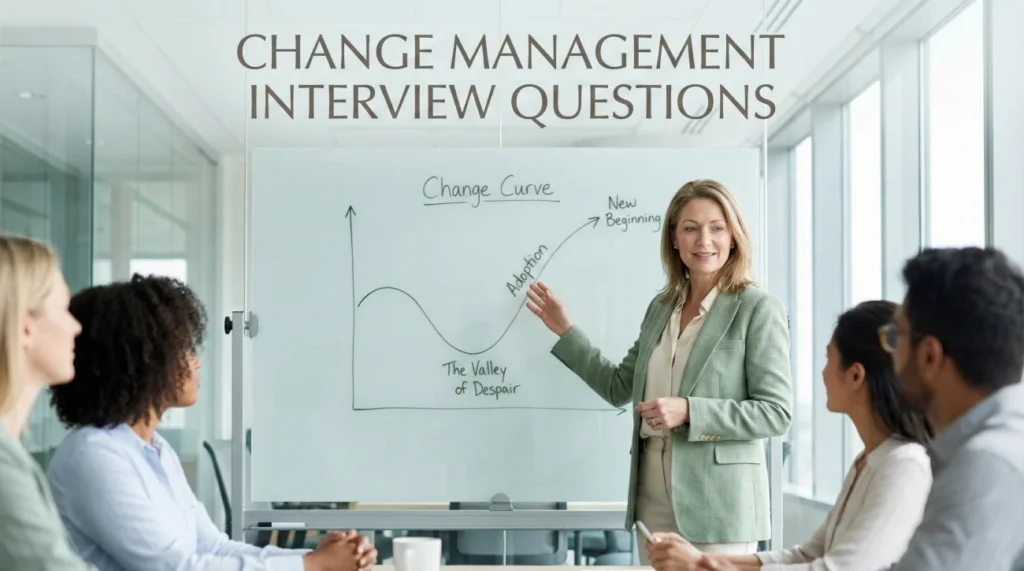
Answer: The J-Curve illustrates that performance usually drops initially after a change is introduced (due to learning curve/confusion) before it improves to a higher level. I show this chart to leadership upfront. “Expect a productivity dip in Week 1. Don’t panic. My job is to make that dip as shallow and short as possible.”
Communication & Engagement
Communication is not just sending emails. It is about ensuring the message is received and understood.
How do you communicate a change that will result in job losses?
The Strategy: Empathy & Clarity.
Answer: I advise leadership to be direct and compassionate. We explain the business context clearly (“Why”). We communicate with impacted employees first, privately. For the remaining employees, we acknowledge the loss and sadness; we don’t try to “spin” it as a positive exciting time immediately. We focus on stabilizing the survivors and clarifying their new roles.
The CEO wants to send one email to announce a major global change. Is that enough?
The Strategy: 7 Times, 7 Ways.
Answer: Absolutely not. People need to hear a message 5-7 times before it sinks in. I propose a campaign: 1. CEO Email (Vision). 2. Town Hall (Q&A). 3. Manager Talking Points (Team level discussion). 4. Intranet FAQ. 5. Digital Signage/Screensavers. 6. Peer Champion endorsement. 7. Follow-up Success Stories. Communication must be multi-channel.
How do you handle rumors and misinformation during a change?
The Strategy: The Truth Vacuum.
Answer: Rumors fill the void of information. I establish a “Single Source of Truth” (e.g., a dedicated Slack channel or Intranet page). I address rumors head-on in FAQs: “You may have heard X; the reality is Y.” I advise leaders to be visible. If we don’t know the answer yet, we say “We don’t know yet, but we will decide by Friday,” rather than silence.
Change Management IQ Quiz
Test Your Change IQ
1. “ADKAR” stands for:
- Always Do Key Action Reports
- Awareness, Desire, Knowledge, Ability, Reinforcement
- Analyze, Design, Keep, Act, Review
- Acknowledge, Decide, Keep, Act, Return
2. “WIIFM” is the key to building Desire. It means:
- What Is It For Management?
- What’s In It For Me?
- Where Is It From Monday?
- Who Is In For Meeting?
3. The “Burning Platform” creates:
- A fire drill
- Urgency for change (the cost of staying the same is higher than changing)
- A new software
- A party
4. “Sponsorship” in change management refers to:
- Paying for lunch
- Active and visible participation by senior leaders to legitimize the change
- Advertising
- Hiring consultants
5. “Change Fatigue” occurs when:
- Employees are sleepy
- Too many changes happen at once or in succession, overwhelming capacity
- The change is too easy
- The AC is broken
6. “Stakeholder Analysis” identifies:
- Who holds the stakes
- Who is affected by the change and their level of influence/support
- The budget
- The timeline
7. The “Valley of Despair” is:
- A place in California
- The dip in productivity and morale during the implementation phase
- A failed project
- A bad meeting
8. “Reinforcement” mechanisms include:
- Building walls
- Audits, rewards, recognition, and celebrations to sustain the change
- More emails
- Firing people
9. “Kotter’s 8 Steps” start with:
- Celebrating wins
- Create a Sense of Urgency
- Form a coalition
- Buy software
10. “Gap Analysis” compares:
- Current state vs. Future state
- Current state vs. Future state
- Clothing brands
- Two employees
11. “Change Champions” are:
- Winners of a game
- Peers who advocate for the change and support their colleagues
- The CEO only
- Consultants
12. “Utilization” metrics measure:
- How many people use the tool
- How many people use the tool
- How fast the tool is
- How much it costs
13. “Proficiency” metrics measure:
- How fast people run
- How well people perform in the new system
- Attendance
- Login count
14. “Resistance Management” focuses on:
- Ignoring complaints
- Identifying root causes of resistance and addressing them
- Firing resistors
- Electrical resistance
15. “Cultural Transformation” takes:
- 1 week
- Years
- 1 month
- 1 email
16. “Soft Side” of change refers to:
- Software
- People, culture, and behavior
- Furniture
- Easy tasks
17. “Hard Side” of change refers to:
- Difficult people
- Systems, structures, and processes
- Furniture
- Walls
18. “Agile Change Management” involves:
- Running fast
- Iterative, incremental change delivery aligned with Agile project sprints
- No planning
- Waterfall methods
19. “Communication Plan” defines:
- Phone numbers
- Audience, Message, Sender, Channel, and Timing
- Internet speed
- Gossip channels
20. The biggest reason for change failure is:
- Bad software
- Lack of effective sponsorship and employee resistance
- Low budget
- Bad luck
❓ FAQ
🧬 What is the fastest way to lose credibility as a Change Manager?
Overpromising. If you pretend there will be no dip, teams stop trusting you the first week productivity drops. Set expectations early, name the J curve, and show the plan to shorten it. Honesty beats hype.
🗣️ How do you handle passive resistance?
I use data and direct support. I look at adoption signals, then ask what is blocking them. Remove friction first. If they still avoid the change, I partner with managers to make the new way the expectation, not an optional experiment.
🧑🤝🧑 Who are “change champions” and why do they matter?
They are the trusted peers people actually listen to. Champions model the new behavior, answer questions, and reduce fear faster than corporate comms. Choose them based on influence, not title, and support them with early training and a feedback loop.
📏 What metrics should I report to executives?
Keep it tight: readiness, adoption, and outcome. Readiness is comms and training completion. Adoption is usage or process compliance. Outcome is the business KPI the change was meant to move. If adoption is high but outcomes are flat, the solution may be the issue.
🧲 How do you communicate change when roles are impacted?
Be direct and compassionate. Tell people what is changing, why, and what support exists. Avoid spin. Give managers clear talking points and a timeline for decisions. People handle hard truths better than silence or vague optimism.
Final Thoughts
Change management interviews are won by realism. Show you can plan, influence, and measure adoption, but also show you can listen and adjust when people struggle. That balance is what turns a “go live” into a lasting shift in behavior.
Close by describing how you work with sponsors: what you need from them, how you keep them visible, and how you escalate resistance early.
⚠️ Disclaimer: The interview strategies, sample answers, and negotiation tips provided in this guide are for educational purposes only. Hiring decisions are subjective and vary by company and industry. While these strategies are based on professional HR standards, they do not guarantee a specific job offer or result.