The Architect of Strategy
Program manager interview questions are a search for someone who can connect dots that other people cannot see. Projects ship outputs. Programs protect outcomes. Your job is to make sure a dozen moving pieces land as one coherent business win, not a pile of “done” tickets.
Instead of selling yourself as a schedule keeper, speak like a strategist. Show how you build a roadmap that survives reality, how you negotiate resource conflicts without burning trust, and how you keep leadership focused on decisions and risk, not noise.
Program Strategy & Roadmaps
You are hired to deliver a vision. Interviewers want to know if you can translate high-level goals into a structured plan.
Q: What is the key difference between a Project Manager and a Program Manager?
Answer: A Project Manager manages outputs (time, scope, budget) of a single initiative. A Program Manager manages outcomes (benefits, ROI, strategic alignment) of a group of related projects. Projects have a definitive end date; Programs are often ongoing or long-term strategic initiatives. As a Program Manager, I don’t just ask “Is it done?” I ask “Did it deliver the intended business value?”
Q: How do you build a Program Roadmap from scratch?
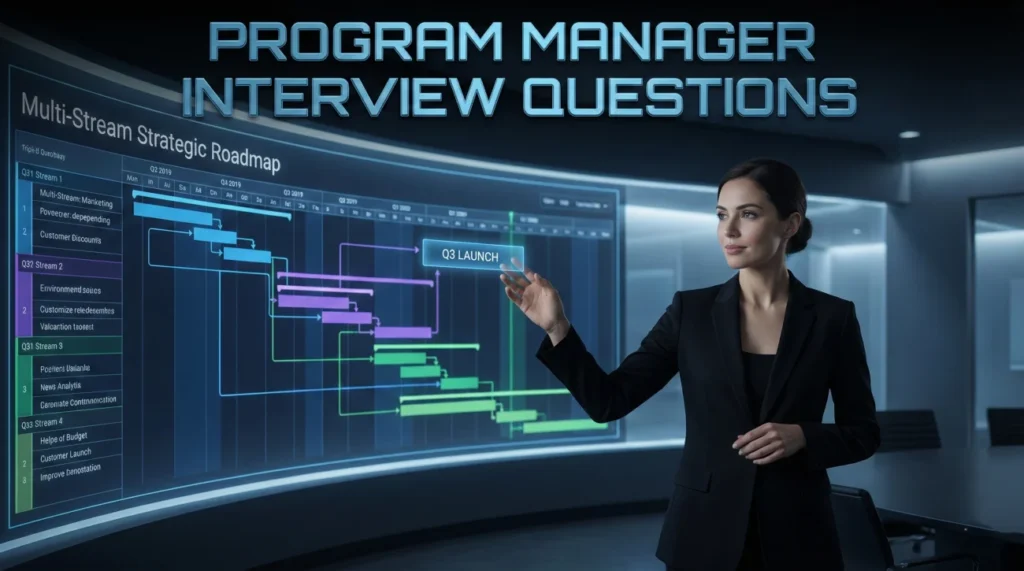
Answer: I start with the “North Star” goal provided by leadership. Then, I conduct a “Discovery Phase” with stakeholders to identify the necessary workstreams (projects). I map these workstreams against a timeline, identifying critical dependencies (Project A must finish before Project B starts). I build in “buffer zones” for risk. Finally, I validate the roadmap with the Steering Committee to ensure resource availability before launching. A roadmap is a living document, not a stone tablet.
Q: How do you prioritize conflicting projects within a program?
Answer: I prioritize based on “Value vs. Effort” and strategic alignment. I use a scoring model (like RICE: Reach, Impact, Confidence, Effort). If two projects compete for the same resources, I look at which one unlocks the most value for the program’s primary KPI. I facilitate a trade-off discussion with stakeholders: “We can do X now, but it will delay Y. Given our Q4 goals, I recommend prioritizing X.” I let data drive the decision.
Q: Describe how you handle “Scope Creep” at the program level.
Answer: I distinguish between “Creep” (uncontrolled growth) and “Change” (controlled growth). If a stakeholder wants to add a new feature, I put it through a “Change Control Process.” I analyze the impact on timeline, budget, and other projects. I present the impact to the Change Control Board (or Sponsor). “We can add this, but it will push the launch date by 2 weeks and cost $50k. Do you want to proceed?” This forces stakeholders to own the cost of their requests.
Stakeholder Management & Governance
You don’t own the resources; you influence them. Managing stakeholders is 50% of the job.
Q: How do you manage a difficult stakeholder who opposes your program?
The Strategy: Empathy & Alignment.
Answer: I seek to understand their resistance. Are they afraid of losing resources? Do they doubt the strategy? I schedule a 1:1 to listen. I try to find the “WIIFM” (What’s In It For Them). “I know this change is disruptive to your team, but here is how the new system will eventually save you 10 hours a week.” If I can’t win them over, I ensure their concerns are documented and mitigated, but I rely on the Executive Sponsor to enforce alignment if necessary.
Q: What is the role of a “Steering Committee” and how do you run it?
The Strategy: Decision-Making Forum.
Answer: The SteerCo provides governance, strategic direction, and clears roadblocks I can’t clear myself. I run the meeting efficiently. I provide a “Pre-Read” deck 24 hours prior. During the meeting, I focus on “Decisions Needed” and “Risks,” not just status updates. I respect their time by being concise. I leave with clear action items and documented approvals.
Q: How do you communicate program status to different audiences?
The Strategy: Tailored Communication.
Answer: I tailor the message. For the Executive Team, I use a “Stoplight Chart” (Red/Yellow/Green) focusing on high-level risks, budget, and timeline. For the Project Teams, I get into the weeds of dependencies and daily blockers. For the Company, I communicate the vision and milestones achieved (“The Why”). One size does not fit all.
Q: How do you handle a “Red” status report?
The Strategy: Transparency.
Answer: I never hide a Red status. “Bad news does not get better with age.” I report it immediately, but always with a “Path to Green.” I say: “We are Red on the timeline due to the vendor delay. Here are three options to recover: A, B, and C. My recommendation is B.” This shows I am in control of the chaos, not a victim of it.
Q: How do you influence teams that don’t report to you?
The Strategy: Influence without Authority.
Answer: I build relationships before I need favors. I demonstrate value by helping them solve their problems first. I connect their work to the larger mission so they feel purpose. I acknowledge their contributions publicly. People work harder for a leader who respects them and makes them look good, even if that leader isn’t their direct boss.
Q: Describe your experience with “Benefit Realization.”
The Strategy: ROI Focus.
Answer: Delivering the project isn’t the end. I track the benefits after delivery. Did the new software actually save costs? Did the marketing campaign actually drive leads? I set up a measurement plan at the start (Baseline) and measure at intervals (3, 6, 12 months) post-launch. This closes the loop and proves the ROI of the program to the business.
Risk & Dependency Management
Programs fail because of unmanaged risks and broken links between projects. You must be the radar.
You identify a critical dependency between two projects that is at risk of breaking.
The Strategy: Proactive Integration.
Answer: Project A is delayed, which means Project B can’t start. I bring the two Project Managers together immediately. “We have a dependency break. Can Project B start a different module while waiting? Can we fast-track Project A?” I facilitate the re-planning. I also alert stakeholders that the timeline might shift. I maintain a “Dependency Map” so I can see these domino effects before they topple.
A key resource (Lead Engineer) is pulled onto another priority initiative.
The Strategy: Resource Negotiation.
Answer: I assess the impact. Can we survive without them? If not, I negotiate with the resource manager. “I understand the other priority, but pulling John now will delay our launch by 2 months, costing $X.” I try to secure a “buy-back” of their time (e.g., 50% allocation) or ask for a replacement with a handover period. I fight for my program’s resources with data.
The budget is cut by 20% halfway through the program.
The Strategy: De-scoping.
Answer: I review the “Must Haves” vs. “Nice to Haves.” I propose a “Minimum Viable Program” (MVP) that delivers the core value within the new budget. I cut the peripheral projects or features. I present the revised scope to the Steering Committee for approval. I focus on delivering 80% of the value with 80% of the budget, rather than failing to deliver 100%.
Methodology & Execution
Agile, Waterfall, Hybrid? You need to know when to use which tool.
Q: Do you prefer Agile or Waterfall for program management?
Answer: I am methodology-agnostic; I use the right tool for the job. For software development with unclear requirements, I use Agile/Scrum for flexibility. For construction or hardware with strict dependencies, I use Waterfall. Often, I run a “Hybrid” program where the development teams run Agile sprints, but the overall program reporting follows a Waterfall milestone structure for executive visibility.
Q: How do you ensure quality across multiple project teams?
Answer: I establish a “Center of Excellence” or standardized playbook at the start. Common templates, common reporting tools (Jira/Asana), and common definition of “Done.” I conduct regular “Gate Reviews” where a project cannot move to the next phase until it meets the quality criteria. Consistency in process leads to consistency in quality.
Q: How do you handle a team that is constantly missing sprint goals?
Answer: I attend their Retrospective to listen. Is it scope creep? Technical debt? Lack of clarity? I coach the Project Manager/Scrum Master. I might suggest reducing the “Velocity” (workload) for the next sprint to build confidence and momentum. I focus on predictability over speed. It is better to commit to less and deliver it, than to promise the moon and fail.
Program Management IQ Quiz
Test Your Strategy IQ
1. “ROI” stands for:
- Rate Of Interest
- Return On Investment
- Risk Of Injury
- Real Office Income
2. A “Steering Committee” is responsible for:
- Driving the bus
- Providing strategic oversight, governance, and decision-making for the program
- Writing code
- Planning the party
3. “Scope Creep” refers to:
- A scary project
- Uncontrolled changes or continuous growth in a project’s scope without adjustments to time/budget
- Working slowly
- Hiring new staff
4. “Dependency” in project management means:
- Being needy
- A relationship between tasks where one must be completed before the other can start
- Trusting someone
- A software bug
5. “Benefit Realization” happens:
- Before the project
- When the outcomes of the program actually deliver value to the business (often after closure)
- During the meeting
- Never
6. “RICE” scoring stands for:
- Rice, Ice, Cream, Eggs
- Reach, Impact, Confidence, Effort
- Real, Interesting, Cool, Easy
- Risk, Income, Cost, Energy
7. “Critical Path” is:
- A dangerous road
- The sequence of stages determining the minimum time needed for an operation
- The boss’s opinion
- The budget line
8. “Stakeholder Analysis” maps stakeholders by:
- Height and Weight
- Power (Influence) and Interest
- Age and Tenure
- Friendliness
9. “Agile” methodology values:
- Documentation over software
- Responding to change over following a plan
- Rigid contracts
- Slow processes
10. “RAID” log tracks:
- Bugs only
- Risks, Assumptions, Issues, and Dependencies
- Police raids
- Resource allocations
11. “Change Control Board” (CCB) decides:
- Who gets fired
- Whether to approve or reject proposed changes to the project baseline
- The lunch menu
- The office layout
12. “Milestone” is:
- A heavy rock
- A significant point in time or an event in the project schedule
- A small task
- A delay
13. “MVP” stands for:
- Most Valuable Player
- Minimum Viable Product (simplest version released to test market)
- Maximum Value Plan
- Money Vs Profit
14. “Resource Leveling” aims to:
- Fire people
- Smooth out resource usage over time to avoid over-allocation
- Level the floor
- Hire more people
15. “Burn Rate” in project management tracks:
- Fire safety
- The rate at which the project budget is being spent
- Employee turnover
- Computer speed
16. “Gap Analysis” compares:
- Clothing brands
- Current state vs. Desired future state
- Two employees
- Two budgets
17. “Waterfall” methodology is characterized by:
- Flexibility
- Sequential, linear phases (Requirements -> Design -> Implementation)
- Sprints
- Daily standups
18. “Sponsor” of a program is:
- An advertiser
- The executive who funds and champions the initiative
- The project manager
- The customer
19. “KPI” stands for:
- Key Person Indicator
- Key Performance Indicator
- Keep People Interested
- Key Program Index
20. “Retrospective” meeting is for:
- Planning the future
- Reflecting on the past sprint/project to identify improvements
- Assigning blame
- Signing contracts
❓ FAQ
🗺️ What is the first thing you do when you inherit a messy program?
I start with clarity, not reporting. I confirm the outcome and the success metric, map the workstreams, and expose the top dependencies. Then I create a short “decision list” for sponsors: what needs a yes, what needs a tradeoff, and what needs escalation. That turns chaos into a governed plan quickly.
📌 Do I need a certification like PMP or PgMP?
It can help signal baseline discipline, but it rarely wins the interview by itself. Hiring panels care more about how you’ve delivered value across teams: dependency control, stakeholder alignment, and measurable ROI. Use certifications as support, not as the headline.
🤝 How do you handle stakeholder politics without getting stuck?
I diagnose incentives early. Who wins, who loses, and who is afraid? Then I build a coalition: sponsors for authority, influencers for adoption, and doers for execution. I keep conversations concrete: timeline, risk, and what decision is needed next, so politics does not turn into endless debate.
🧮 What metrics matter at the program level?
Two layers: delivery health and benefit health. Delivery health is milestones, dependency risk, and burn rate. Benefit health is the KPI the program exists to move, plus adoption or behavior change where relevant. A program can be “on time” and still fail if benefits do not materialize.
🚦 Agile or Waterfall, what is the right answer?
The right answer is “fit for purpose”. Many programs run hybrid: Agile execution inside teams, milestone visibility for executives. Explain how you choose the approach, how you protect quality, and how you keep integration points stable.
Final Thoughts
Program managers interviews reward synthesis. When you answer, start with the outcome, then show the structure behind it: workstreams, dependencies, risk, and governance. That proves you are running the program, not reacting to it.
Close with how you drive decisions. Sponsors want fewer surprises and clearer tradeoffs.
⚠️ Disclaimer: The interview strategies, sample answers, and negotiation tips provided in this guide are for educational purposes only. Hiring decisions are subjective and vary by company and industry. While these strategies are based on professional HR standards, they do not guarantee a specific job offer or result.