The Architect of Execution
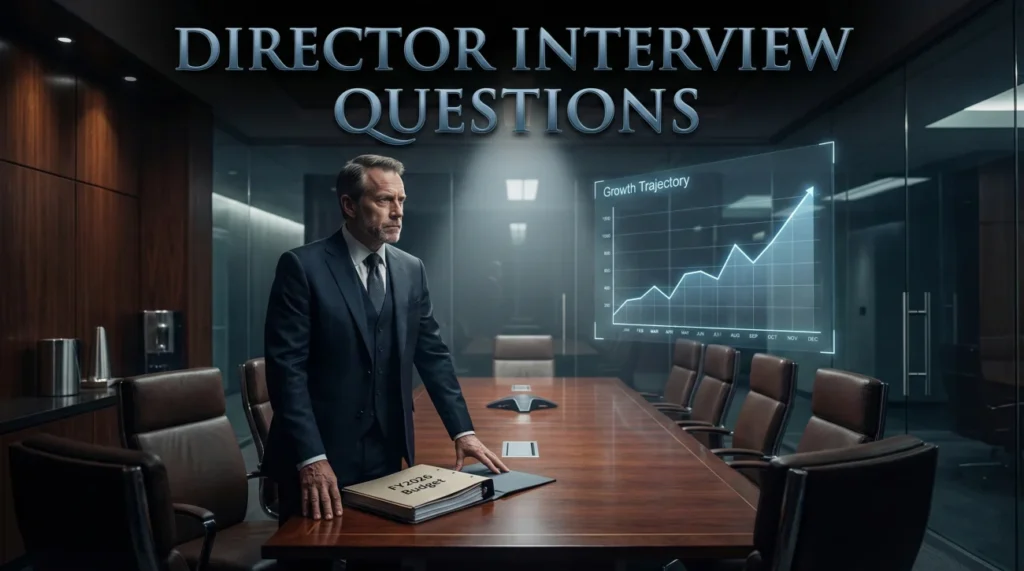
Director interview questions operate at a different altitude than manager interviews. While a Manager is focused on the “How” (tactics and team), a Director is focused on the “What” and the “Why” (strategy and resources). In 2025, organizations need Directors who can translate the CEO’s 5-year vision into a 12-month actionable roadmap, secure the necessary budget, and lead a team of Managers to execute it without micromanagement.
This comprehensive guide helps you prepare for the rigors of director-level scrutiny. We dissect the critical competencies of Strategic Planning (aligning department goals with company mission), Financial Stewardship (managing P&L and CAPEX), and the subtle art of Managing Managers. Whether you are aiming for a Director of Marketing, Operations, or Engineering role, proving you have the vision to see around corners and the discipline to hit the numbers is your competitive advantage.
Strategic Planning & Vision
Directors are paid to look ahead. Interviewers want to know if you can build a roadmap that survives contact with reality.
Q: How do you translate high-level corporate strategy into departmental goals?
Answer: I use the “Cascade” method. I start with the CEO’s OKRs (Objectives and Key Results). If the company goal is “Grow Revenue by 20%,” I ask: “What can my department specifically do to drive that?” For Marketing, it might mean “Increase Lead Gen by 30%.” I then break this down into quarterly milestones for each of my Managers. The key is ensuring every frontline employee knows how their daily task connects to that 20% growth figure. Alignment prevents wasted effort.
Q: Describe a time you had to pivot your strategy mid-year. How did you handle it?
Answer: Last year, a major competitor launched a feature that threatened our market share. We couldn’t wait for the annual planning cycle. I convened a “War Room” with my Managers to assess the impact. We decided to deprioritize two long-term R&D projects to shift resources to an immediate counter-feature. I communicated this pivot transparently to the team: “We are changing course not because we failed, but because the terrain changed.” We delivered the feature in 6 weeks and retained our customer base.
Q: How do you balance long-term innovation with short-term operational targets?
Answer: I use the “70-20-10” resource allocation model. 70% of our budget and time goes to “Run the Business” (hitting quarterly targets). 20% goes to “Grow the Business” (improving existing processes). 10% is protected for “Transform the Business” (high-risk, high-reward innovation). This ensures we hit our numbers today without sacrificing our relevance tomorrow. I protect that 10% fiercely from being cannibalized by daily fires.
Q: How do you evaluate the success of a strategic initiative?
Answer: I define “Success Metrics” before we start. I look at both Lagging Indicators (Revenue, ROI) and Leading Indicators (User Adoption, Pipeline Velocity). I schedule monthly “Steering Committee” reviews to track these metrics. If a strategy isn’t hitting the leading indicators by Q2, I am willing to “fail fast” and kill the project to save resources, rather than dragging it out to Q4 just to save face.
Budgeting & Resource Management
You are the fiduciary of your department. Can you manage a multi-million dollar budget without overspending?
Q: Describe your budgeting process for a new fiscal year.
The Strategy: Zero-Based Budgeting.
Answer: I don’t just take last year’s budget and add 5%. I use Zero-Based Budgeting. I ask my Managers to justify every expense from scratch based on next year’s goals. If a tool or subscription doesn’t directly support our new objectives, we cut it. I build the budget in three tiers: “Must Have” (to keep lights on), “Should Have” (to hit targets), and “Nice to Have” (if we exceed revenue). This gives me flexibility if the CFO asks for cuts later.
Q: You are asked to cut your department budget by 15%. Where do you start?
The Strategy: Protect Talent.
Answer: My priority is to protect headcount (people). I start with “Non-Working Spend” – travel, entertainment, unused software licenses, and vendor renegotiations. I look for efficiencies: can we automate a manual process to save contractor fees? If I must cut deeper, I look at pausing open hiring roles. Layoffs are the absolute last resort because the cost of rehiring and morale loss usually outweighs the short-term savings.
Q: How do you handle a request for unbudgeted headcount?
The Strategy: The Business Case.
Answer: I require a rigorous Business Case. I ask the Manager: “What is the ROI of this role? If we hire them for $100k, will they generate $300k in value or save us 1000 hours?” If the case is strong, I look for trade-offs within my existing budget (can we cut a SaaS tool to pay for the person?). If not, I present the case to the CFO as an investment opportunity, not just an expense request.
Q: Explain the difference between CAPEX and OPEX in your budget.
The Strategy: Financial Literacy.
Answer: OPEX (Operating Expense) is the day-to-day cost like salaries, rent, and cloud subscriptions. It hits the P&L immediately. CAPEX (Capital Expenditure) is investment in long-term assets like servers, office build-outs, or perpetual software licenses. It is depreciated over time. I strategize which bucket to use based on the company’s financial goals (e.g., favoring OPEX to preserve cash flow vs. CAPEX to improve EBITDA).
Q: How do you track “Budget vs. Actuals” throughout the year?
The Strategy: Monthly Hygiene.
Answer: I review the variance report with Finance monthly, not quarterly. If we are under-spending, I ask “Why? Are we delaying critical projects?” If we are over-spending, I freeze discretionary spend immediately to correct the trajectory. I believe in “Forecasting Accuracy” – my goal is to land within +/- 2% of my budget. Surprising the CFO is a failure of management.
Q: How do you ensure your Managers are financially responsible?
The Strategy: Ownership.
Answer: I give them ownership of their line items. I share the P&L data with them (transparency). If they save money in one area (e.g., travel), I allow them to reinvest a portion of it into something they want (e.g., training). This “use it wisely” mindset incentivizes them to treat the company’s money like their own, rather than the “use it or lose it” mentality.
Managing Managers (Meta-Management)
Leading leaders is different from leading doers. You must coach them to lead their own teams, not do their work for them.
Q: How do you coach a new Manager who is struggling to delegate?
Answer: This is the classic “Super-IC” trap. I sit them down and explain: “Your value is no longer in writing the code/closing the deal. Your value is in building a team that can do it.” I ask them to log their time for a week. We review it together: “You spent 10 hours on this report. Could Sarah have done it?” I force them to hand off one “precious” task per week. I reassure them that I am evaluating them on their team’s output, not their personal busyness.
Q: How do you handle a conflict between two of your Managers?
Answer: I refuse to be the judge. I tell them: “You are both leaders. I expect you to resolve this together.” I ask them to schedule a meeting, come up with a joint solution, and present it to me. I provide a framework (focus on business impact, not personality), but I force them to practice conflict resolution. If I solve it for them, I undermine their authority and growth.
Q: How do you assess the “Health” of a team reporting to one of your Managers?
Answer: I use “Skip-Level” meetings. I meet with individual contributors (ICs) once a quarter, not to spy on their Manager, but to ask: “Do you have what you need to succeed? Is the vision clear?” I also look at retention rates and eNPS (Employee Net Promoter Score) scores. If a team has high turnover, I know the Manager needs support or training, regardless of what the Manager tells me.
Change Management & Cross-Functional Impact
Directors drive change. Interviewers want to see how you navigate resistance and organizational politics.
Describe a time you led a major change initiative (e.g., Reorg or New Tech).
The Strategy: The “Why” before the “What.”
Answer: When we implemented a new CRM, the sales team resisted. I didn’t just mandate it. I started with the “Why”: “Our current system is losing us 20% of leads. This new tool will help you close more deals and make more commission.” I identified “Change Champions” – influential ICs – to pilot it first and evangelize it. I over-communicated the timeline and provided ample training. I acknowledged the pain of the transition but kept the focus on the benefit.
How do you handle a peer Director who is blocking your initiative?
The Strategy: Alignment of Interests.
Answer: I seek to understand their objection. Is it a resource constraint? A philosophical disagreement? I schedule a 1:1. “I feel we are misaligned on Project X. Help me understand your concerns.” I try to find the “Win-Win.” If they are blocking because they lack resources, can I lend them some of my budget/headcount to unblock them? I build a coalition. If we are still stuck, I escalate to the VP only as a last resort, presenting the trade-off clearly.
How do you break down “Silos” between departments?
The Strategy: Shared Goals.
Answer: Silos exist because incentives are misaligned. I work with my peer Directors to create “Shared OKRs.” For example, Marketing and Sales should share a “Revenue” goal, not just “Leads” vs “Deals.” I organize cross-functional “Tiger Teams” to solve specific problems, forcing people to work together. I celebrate cross-functional wins publicly to reinforce the behavior.
Director Level Management Quiz
Test Your Executive IQ
1. “Zero-Based Budgeting” means:
- The budget is zero
- Building the budget from scratch every period, justifying every expense
- Using last year’s budget minus 10%
- Spending until the account is zero
2. “CAPEX” stands for:
- Capital Experience
- Capital Expenditure (Long-term assets)
- Capped Expense
- Cash Per Exec
3. A “Skip-Level” meeting is:
- A meeting you skip
- A meeting with employees who report to your direct reports
- A meeting with the CEO only
- A promotion interview
4. “Strategic Alignment” ensures:
- Everyone sits in a straight line
- Departmental goals support the overall organizational mission
- Budgets are equal
- Everyone uses the same software
5. “Change Management” is primarily about:
- Changing the logo
- Managing the people side of transition to ensure adoption
- Firing people
- Changing office furniture
6. “OPEX” includes:
- Building purchase
- Rent, Salaries, Utilities (Operating Expenses)
- Server hardware
- Office renovation
7. A “Silo” in business refers to:
- Grain storage
- Departments that do not share information or collaborate with others
- A tall building
- A quiet room
8. “Succession Planning” is:
- Planning a party
- Identifying and developing future leaders to replace key roles
- Planning success only
- Hiring interns
9. “Stakeholder Management” involves:
- Holding steaks
- Identifying, analyzing, and communicating with people affected by a project
- Managing shareholders only
- Ignoring complaints
10. “Leading Indicators” differ from “Lagging Indicators” because:
- They are faster
- Leading predict future performance; Lagging measure past performance
- Leading are for leaders; Lagging are for staff
- They are less accurate
11. “Span of Control” refers to:
- How long you can control your temper
- The number of direct reports a manager can effectively manage
- The size of the office
- The duration of a project
12. “ROI” stands for:
- Return On Internet
- Return On Investment
- Rate Of Income
- Risk Of Inflation
13. “Matrix Organization” means:
- A sci-fi movie structure
- Employees report to multiple bosses (e.g., Functional Manager and Project Manager)
- No bosses
- Only one boss forever
14. “Headcount” refers to:
- Counting heads in a meeting
- The number of employees in an organization/budget
- A headache
- The boss
15. “Deliverables” are:
- Pizza deliveries
- Tangible or intangible goods/services produced as a result of a project
- Speeches
- Meetings
16. “Variance Analysis” in budgeting helps to:
- Create variety
- Understand the difference between budgeted and actual numbers
- Ignore the budget
- Change the math
17. “Benchmarking” is:
- Sitting on a bench
- Comparing business processes and performance metrics to industry bests
- Marking a bench
- Setting a low standard
18. “SWOT Analysis” evaluates:
- Sales, Work, Order, Time
- Strengths, Weaknesses, Opportunities, Threats
- Simple, Wise, Open, True
- Staff, Wages, Overtime, Taxes
19. “Empowerment” means:
- Giving power to the CEO
- Giving employees authority and tools to make decisions
- Overpowering the competition
- Buying power tools
20. “Vision Statement” describes:
- What we do today
- Where the company wants to be in the future (aspirational)
- The dress code
- The rules
❓ FAQ
👔 How is a Director different from a Manager?
Scope and Strategy. A Manager manages people and execution (Tactical). A Director manages Managers and resources (Strategic). Directors set the destination; Managers drive the car. Directors also have significantly more P&L responsibility and cross-functional interaction.
📈 How do I prepare for a Director-level interview?
Think “Big Picture.” Don’t talk about how you solved a problem; talk about how you built a system or team to solve it. Bring data. Know the company’s 10-K (financial report) if public. Prepare a “30-60-90 Day Plan” that focuses on learning, assessing, and then executing strategy.
💰 Do Directors manage their own budget?
Yes, almost always. You will likely own a departmental budget (OPEX) and possibly a capital budget (CAPEX). You are expected to forecast spend, approve expenses, and explain variances to the CFO. Financial literacy is not optional.
⚖️ How do I handle “Imposter Syndrome” at this level?
It’s common. Remember, you were hired for your judgment, not because you know everything. Rely on your Managers, they are the subject matter experts now. Your job is to clear the path for them, ask the right questions, and synthesize information to make decisions. You don’t need to be the smartest person in the room; you need to be the best leader.
🚀 What comes after Director?
Senior Director, Vice President (VP), or C-Suite (CXO), depending on the company size. The next step involves even less operational detail and more focus on corporate strategy, board relations, and market positioning.
Final Thoughts
To succeed in answering director interview questions, you must demonstrate “Executive Presence.” You need to show you can operate at 30,000 feet (strategy) but can dive down to 3 feet (execution) when necessary to unblock a crisis.
Highlight your ability to build high-performing leadership teams and your financial discipline. If you can prove you are a steward of both the company’s capital and its culture, you will secure the role.
⚠️ Disclaimer: The interview strategies, sample answers, and negotiation tips provided in this guide are for educational purposes only. Hiring decisions are subjective and vary by company and industry. While these strategies are based on professional HR standards, they do not guarantee a specific job offer or result.