The Chief Mission Officer
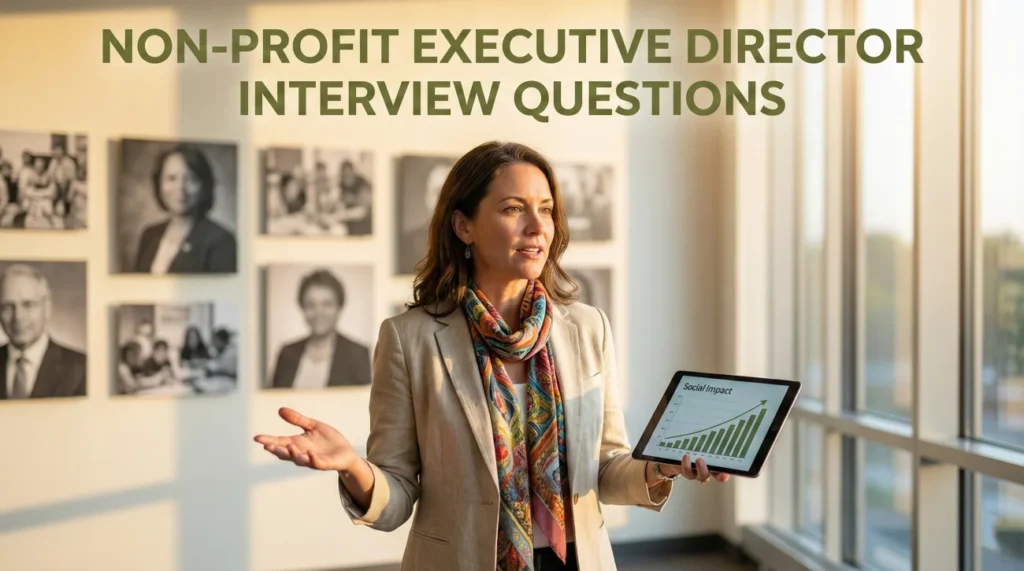
Non-profit executive director interview questions usually test two muscles at once: mission conviction and operational realism. The committee wants proof you can protect the purpose, keep the organization solvent, and stay steady when pressure arrives from donors, staff, and the board on the same day.
Interviews commonly dive into fundraising strategy, board governance, budgeting discipline, and impact measurement. The goal is simple: show you can translate mission into decisions, and translate decisions into results that a board and donor community can trust.
Fundraising & Financial Sustainability
Money fuels the mission. If you cannot raise funds, you cannot lead. Interviewers need to know you are comfortable asking for money.
Q: What is your philosophy on fundraising?
Answer: I do not view fundraising as “begging.” I view it as “enabling.” I enable donors to solve problems they care about but cannot solve alone. My job is to connect their passion with our solution. I focus on building long-term relationships rather than transactional donations. I believe in a diversified funding model: a healthy mix of individual major gifts, corporate partnerships, grants, and earned income to ensure stability if one stream dries up.
Q: Describe a time you secured a Major Gift. How did you do it?
Answer: I identified a donor who had lapsed but had a history of giving to education causes. I didn’t ask for money immediately. I invited them to see our program in action (a site visit). I listened to their legacy goals. Once I understood their motivation, I presented a specific “Investment Opportunity” to fund a new scholarship program for $50,000. Because I aligned the ask with their values, they said yes. I spent the next year stewarding that gift with impact reports, which led to a renewal.
Q: How do you handle “Donor Fatigue”?
Answer: Fatigue happens when we treat donors like ATMs. To prevent it, I practice the “Thank-Ask Ratio” of 3:1. We thank them and show impact three times for every one time we ask for money. I also segment our communication so they aren’t blasted with every single appeal. I focus on storytelling: showing them the specific human face of their impact, which re-energizes their commitment.
Q: What is your experience with Grant Writing and management?
Answer: I view grants as contracts for impact. I have experience identifying alignment with foundation priorities. I ensure we don’t just “chase money” (Mission Creep) by applying for grants that pull us away from our core work. Once won, I implement strict tracking systems to ensure we meet reporting requirements and spend the funds compliantly. Losing a grant due to poor reporting is an unforced error I do not allow.
Board Governance & Volunteer Management
Your boss is a committee of volunteers. Managing this relationship is the #1 reason EDs fail or succeed.
Q: How do you manage a Board of Directors that is disengaged?
The Strategy: Individual Engagement.
Answer: I meet with each member 1:1 to ask: “Why did you join, and are we fulfilling that?” Often, they are bored because we only use them for rubber-stamping. I give them meaningful work aligned with their skills (e.g., asking a lawyer to review bylaws). I also implement a “Give or Get” policy to clarify expectations. I treat Board engagement as part of my job, not a distraction from it.
Q: What is the ideal relationship between the Board Chair and the ED?
The Strategy: Partnership.
Answer: It should be a “Critical Partnership.” We talk weekly. I use the Chair as a sounding board before bringing issues to the full Board. They are my champion and my honest critic. We have a “No Surprises” pact: I never let the Chair walk into a board meeting blind to bad news. In return, they manage the Board’s personalities so I can manage the organization.
Q: How do you handle “Founder’s Syndrome” on the Board?
The Strategy: Honor and Evolve.
Answer: I validate the Founder’s legacy publicly and often. “We are here because of X’s vision.” However, I professionally hold the line on governance. If a Founder tries to micromanage staff, I redirect them: “That is an operational issue; let’s discuss it at the strategic level in the Board meeting.” I slowly professionalize processes so the organization relies on systems, not just the Founder’s intuition.
Q: How do you recruit new Board members?
The Strategy: Skills Matrix.
Answer: I use a “Board Skills Matrix” to identify gaps (e.g., “We have passion but no financial expertise”). I treat it like executive hiring. I draft a job description for the Board seat. I interview candidates to ensure they understand the fiduciary duty and the fundraising expectation. I look for “Work, Wisdom, and Wealth” (the ability to work, give advice, or donate/connect).
Q: How do you motivate unpaid volunteers?
The Strategy: Meaning and Recognition.
Answer: Volunteers are paid in purpose. I ensure they see the direct impact of their work. I invest in a Volunteer Coordinator to ensure they are organized, not standing around wasting time (which is the fastest way to lose them). I celebrate them publicly. I fire toxic volunteers politely but firmly, because they can poison the culture just as much as toxic staff.
Q: Describe your experience with “Governance” vs. “Management”.
The Strategy: Noses In, Fingers Out.
Answer: The Board governs (Strategy, Policy, Hiring ED, Fiduciary Oversight). The ED manages (Operations, Staff, Execution). I educate the Board on this distinction. If a Board member tries to direct a staff member, I intervene: “Please route requests through me so we don’t confuse the team.” Clear lanes prevent chaos.
Financial Stewardship & Operations
Non-profit accounting is complex (Restricted Funds). You must prove you are a responsible steward of public trust.
Q: How do you manage “Restricted” vs. “Unrestricted” funds?
Answer: I treat them as separate buckets. Restricted funds (grants for a specific program) must be spent exactly as promised. I track them meticulously to avoid “commingling” funds, which is illegal/unethical. I work hard to raise Unrestricted funds (General Operating Support) because that is the “electricity bill money” that keeps the organization flexible and alive.
Q: What is your experience with the Form 990?
Answer: The 990 is not just a tax return; it is a marketing document. Donors and Charity Navigator read it. I review it closely with the Audit Committee before filing. I ensure our “Program Expense Ratio” (percentage of money going to the cause vs. admin) is healthy (typically 75%+), but I also advocate for the “overhead myth” to be debunked: we need to spend on admin to have a strong organization.
Q: We are facing a budget deficit. What do you do?
Answer: I communicate early to the Board; I never hide bad news. I present three scenarios: Best, Middle, Worst. I look at cutting variable costs first (travel, events) before touching fixed costs (staff). I rally the development team for an emergency appeal or reach out to our most loyal donors for bridge funding. I act decisively to protect the long-term viability of the mission.
Measuring & Communicating Impact
Donors buy impact. How do you prove you are making a difference?
How do you measure success beyond just “money raised”?
The Strategy: Logic Models.
Answer: I use a “Logic Model” or “Theory of Change.” I track Inputs (resources), Outputs (number of meals served), and Outcomes (reduction in hunger rate). Most orgs stop at Outputs. I strive to measure Outcomes. I collect quantitative data but also qualitative stories (“The Story of One”) because data justifies the donation, but stories open the wallet.
A donor wants us to start a new program that is outside our mission. Do we take the money?
The Strategy: Mission Discipline.
Answer: This is “Mission Creep.” I usually say No. Taking money for a distraction dilutes our impact and strains our staff. I would have an honest conversation: “We are not the best experts for that, but we can partner with Org X who is.” However, if the funding covers 100% of the cost plus overhead and aligns tangentially, I might bring it to the Board for a strategic discussion. But rarely is money “free.”
How do you handle a public PR crisis (e.g., a scandal)?
The Strategy: Radical Transparency.
Answer: Non-profits run on trust. I act fast. I acknowledge the issue, apologize without caveats, and state the corrective action. I communicate with major donors personally before they read it in the press. I focus on protecting the mission and the beneficiaries, not just the brand. I invite external audit/review to restore credibility. Silence is viewed as guilt.
Organizational Culture & Burnout
Non-profit staff often work for lower pay but higher passion. This leads to burnout. How do you lead them?
Q: How do you retain talent when you can’t pay corporate salaries?
Answer: I sell the “Total Rewards.” I focus on flexibility, autonomy, and professional development. I ensure we have good benefits even if salaries are lower. I constantly connect their daily work to the mission impact so they feel the “psychological paycheck.” I also fight to raise salaries over time by educating the Board that “talent is an investment, not overhead.”
Q: How do you address “Compassion Fatigue” in your staff?
Answer: Staff on the frontlines (social workers, animal rescuers) absorb trauma. I normalize talking about mental health. I encourage taking PTO (and model it myself). I bring in external counselors or implement “Trauma-Informed Care” training for the staff, not just the clients. I ensure we celebrate small wins so we aren’t constantly drowning in the heaviness of the problem.
Non-Profit Leadership Quiz
Test Your NPO IQ
1. “Mission Creep” is:
- A scary mission
- Expanding into areas outside the core mission, usually to chase funding
- Moving offices slowly
- Hiring too many people
2. “Restricted Funds” must be used:
- Secretly
- For a specific purpose or time period designated by the donor
- For salaries only
- For parties
3. The “Form 990” is:
- An application form
- The annual federal tax return filed by public charities
- A donation receipt
- A grant proposal
4. “In-Kind” donations are:
- Cash
- Goods or services (computers, legal advice) instead of money
- Kind words
- Foreign currency
5. A “Capital Campaign” is usually for:
- Daily operations
- Large, one-time projects like building a new facility or endowment
- Buying office supplies
- The annual party
6. “Board Fiduciary Duty” implies:
- They pay the bills personally
- Legal obligation to act in the best financial interest of the organization
- They hire the staff
- They do the filing
7. “501(c)(3)” refers to:
- A police code
- The IRS tax code section for tax-exempt charitable organizations
- A fundraising goal
- A grant number
8. “Donor Stewardship” means:
- Asking for money
- Building a relationship and updating donors on impact after the gift
- Cleaning the donor’s house
- Ignoring donors
9. The “Overhead Myth” is the false belief that:
- Overhead is necessary
- Organizations spending less on overhead (admin/fundraising) are always more effective
- Roofs are expensive
- Staff don’t need desks
10. “Earned Income” in a non-profit comes from:
- Donations
- Selling goods or services (e.g., museum tickets, merchandise)
- Interest on bank accounts
- Grants
11. A “Matching Gift” is:
- Two identical gifts
- A donation made by a corporation matching their employee’s donation
- A gift for a couple
- A fake gift
12. “Capacity Building” grants fund:
- More food for clients
- Strengthening internal systems (IT, training, strategy) to scale impact
- Building a bigger room
- Parties
13. “Social Enterprise” is:
- A social club
- An organization that applies commercial strategies to maximize improvements in human/environmental well-being
- A Facebook group
- A government agency
14. “Endowment” is:
- A large donation spent immediately
- A financial asset where the principal is invested and only the interest is spent
- The end of the year
- A debt
15. “Logic Model” maps:
- Logical arguments
- Inputs, Activities, Outputs, and Outcomes of a program
- Donors to dollars
- Staff to desks
16. “Whistleblower Policy” protects:
- Referees
- Employees who report unethical/illegal activity from retaliation
- The CEO
- The donors
17. “Strategic Plan” usually covers:
- 1 week
- 3 to 5 years
- 20 years
- Yesterday
18. “Stakeholders” in a non-profit include:
- Donors only
- Beneficiaries, Donors, Staff, Board, Community, and Government
- Staff only
- Board only
19. “Case for Support” is:
- A lawsuit
- A document explaining why a donor should give (the problem, solution, and impact)
- A box for donations
- A support group
20. The ED reports directly to:
- The Donors
- The Board of Directors
- The Mayor
- The Staff
❓ FAQ
🎓 Do I need a specific degree to become an Executive Director?
Not always. Hiring committees care more about leadership maturity, fundraising ability, and financial stewardship. A relevant degree can help, but a track record of building teams and sustaining programs matters most.
💸 What is the most convincing way to talk about fundraising?
Frame fundraising as relationship building and problem solving. Share how you identify aligned prospects, steward donors, and build a diversified funding mix so the mission does not depend on a single fragile stream.
🧩 How do I manage a board that wants to micromanage staff?
Clarify lanes early. Offer structured reporting and a clear decision calendar, then redirect operational requests back through the ED role. When the board feels informed, it is less tempted to reach into day-to-day work.
📈 How do I prove impact without drowning in metrics?
Use a small set of measures that match the mission. Combine outcomes (what changed) with outputs (what was delivered), and pair data with one real story. The mix keeps reporting credible and human.
🧠 How do I talk about burnout and sustainability as an ED?
Show you build systems, not heroics: clear priorities, reasonable workloads, volunteer structure, and policies that protect staff. Sustainable execution is part of protecting the mission.
Final Thoughts
When you answer non-profit executive director interview questions, the best tone is grounded confidence. Big heart is expected. What separates finalists is the ability to run the operation like a steward of public trust while keeping the mission alive and visible.
Finish by linking your leadership choices to outcomes: money raised, programs delivered, and culture maintained.
⚠️ Disclaimer: The interview strategies, sample answers, and negotiation tips provided in this guide are for educational purposes only. Hiring decisions are subjective and vary by company and industry. While these strategies are based on professional HR standards, they do not guarantee a specific job offer or result.