The Corporate Conscience
Compliance manager interview questions are not about being the “policy police”. They are about proving you can protect the business without slowing it to a crawl. The best compliance leaders translate regulation into simple habits, so teams do the right thing even when nobody is watching.
Treat the interview like a risk conversation. Explain how you assess what could go wrong, build controls that match real workflows, and communicate in plain English. Show that you can say “no” when you must, and still offer a safe path to “yes” when the business is pushing hard.
Regulatory Knowledge & GRC Strategy
You must know the rules of the game. Interviewers want to see how you stay current and apply frameworks.
Q: How do you stay updated on changing regulations in our industry?
Answer: I don’t rely on the news. I use a multi-tiered approach. I subscribe to regulatory feeds directly from the source (e.g., SEC, FDA, or relevant bodies). I am a member of industry associations (like SCCE) for peer insights. I also leverage RegTech tools that alert me to specific legislative changes affecting our jurisdiction. I allocate 2 hours every Friday specifically for regulatory review to ensure I never miss a critical update.
Q: Describe your experience with GRC (Governance, Risk, Compliance) frameworks.
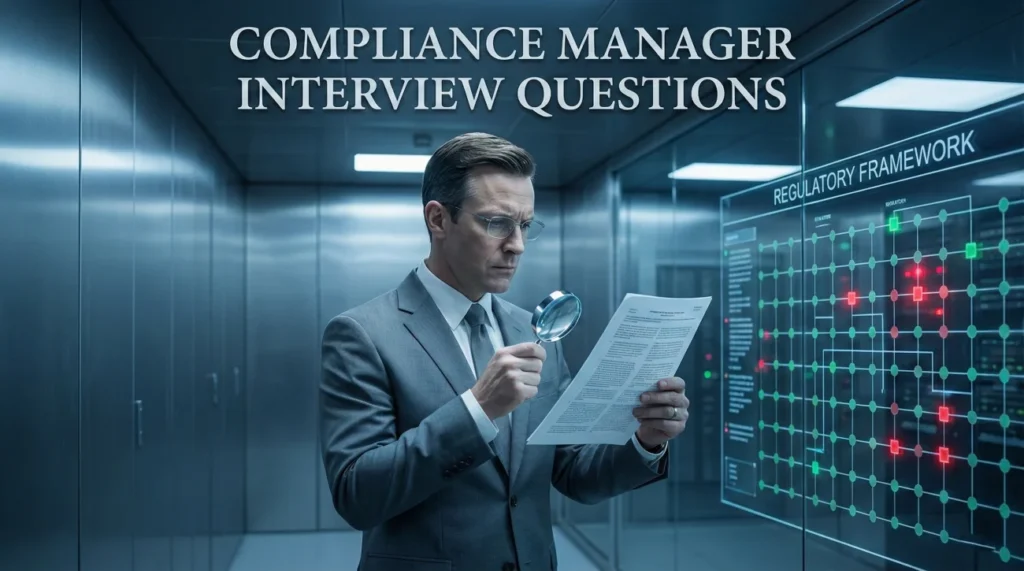
Answer: I view GRC not as software, but as a mindset. I have implemented frameworks like NIST (for cyber/data) or ISO 37301 (for general compliance). My approach is to map every regulation to a specific internal control, and assign an owner to that control. This creates a “Risk Matrix” where we can visualize gaps. I believe in integrated GRC, where compliance data feeds into risk management strategy, rather than operating in silos.
Q: How do you conduct a “Compliance Risk Assessment”?
Answer: I start by mapping the business processes (e.g., “How do we sell? How do we hire?”). I identify the inherent risks in each step (Bribery? Discrimination? Data Leak?). I then evaluate the effectiveness of existing controls. I score risks based on “Likelihood” vs. “Impact.” I prioritize the “Red” risks for immediate remediation. This assessment is not a one-time event; it is a living document I update quarterly.
Q: How do you handle a situation where business goals conflict with compliance requirements?
Answer: I act as a “Solution Architect.” I don’t just say “No, you can’t do that.” I say, “We cannot do it that way because it violates Regulation X. However, if we structure the deal this way, we achieve 90% of the business goal while remaining 100% compliant.” I show them the path to “Yes” within the guardrails. If the risk is non-negotiable (illegal), I hold the line firmly to protect the company.
Policy Development & Implementation
Writing a policy is easy; getting people to follow it is hard. This section tests your change management skills.
Q: How do you ensure employees actually read and understand policies?
The Strategy: Accessibility & Relevance.
Answer: I kill the “Wall of Text.” I create one-page summaries or “Do’s and Don’ts” checklists for complex policies. I use micro-learning videos instead of 50-page PDFs. I track attestation rates, but more importantly, I conduct “knowledge checks” (quizzes) to verify understanding. If a policy is too hard to read, it is too hard to follow.
Q: Describe your process for drafting a new policy from scratch.
The Strategy: Stakeholder Consultation.
Answer: I never write in a vacuum. First, I define the regulatory requirement. Then, I interview the people who actually do the work to understand their workflow. I draft the policy to align with their reality as much as possible. I run a “Pilot Review” with key influencers before publishing. A policy written with the business is adopted; a policy written at the business is ignored.
Q: How do you manage policy exceptions?
The Strategy: Formal Governance.
Answer: Exceptions must be documented, time-bound, and approved by senior leadership. I create an “Exception Request Form” that forces the requester to explain the business justification and the mitigating controls they will put in place. I review the log of exceptions quarterly. If everyone is asking for an exception, the policy is broken and needs to be rewritten.
Q: How do you handle a “Legacy Policy” that is no longer relevant?
The Strategy: Policy Hygiene.
Answer: I conduct an annual “Policy Audit.” I look for rules that stifle innovation without adding safety. I archive obsolete policies to reduce cognitive load on employees. If we have a rule “because we’ve always done it that way,” I challenge it. Simplification is a key part of my compliance strategy.
Q: How do you localize global policies for different regions?
The Strategy: Core vs. Local.
Answer: I establish a “Global Core” of non-negotiable principles (e.g., Code of Conduct, Anti-Bribery). Then, I allow “Local Addendums” to address specific country laws (e.g., GDPR in Europe vs. CCPA in California). I work with local legal counsel to ensure the translation isn’t just linguistic, but cultural.
Q: Describe a time a policy failed. Why?
The Strategy: Root Cause Analysis.
Answer: We implemented a strict Travel Policy that required 3 approvals. It failed because it was too slow for Sales. People started putting flights on personal cards to bypass it. I realized the friction was too high. I rewrote it to allow auto-approval under a certain dollar amount. The lesson was: Compliance must move at the speed of business.
Ethics, Culture & Whistleblowing
Culture is your best control. Can you create an environment where people speak up?
How do you encourage employees to report misconduct (Whistleblowing)?
The Strategy: Safety & Anonymity.
Answer: Fear of retaliation is the biggest blocker. I implement a third-party, anonymous hotline. I market it constantly: “Speak Up, We Listen.” I publish anonymized “sanitized cases” in newsletters to show that when people report, we investigate and take action. This proves the system works. I also train managers on how to receive reports without getting defensive.
A top sales performer is violating policy to hit targets. Leadership wants to ignore it.
The Strategy: No Untouchables.
Answer: This is the “Tone at the Top” test. I present the risk to the Board/CEO: “If we ignore this, we signal that revenue is more important than the law. This creates a toxic culture and legal liability.” I insist on consistent discipline. If we fire a junior admin for stealing $100 but keep a VP for bribing a client, we have no integrity. I hold the line.
How do you measure “Ethical Culture”?
The Strategy: Sentiment Data.
Answer: I add specific questions to the annual engagement survey: “Do you feel safe reporting misconduct?” “Do you believe management acts with integrity?” I track the trends. I also monitor “Hotline Volume.” Ironically, zero reports is a bad sign (it means fear). A healthy volume of minor reports shows the system is trusted.
Audits & Investigations
When you need to verify compliance or investigate a breach, how do you proceed?
Q: Describe your methodology for an Internal Compliance Audit.
Answer: I follow a structured path: Scope (What are we testing?), Fieldwork (Sampling transactions, interviewing staff), Analysis (Comparing actuals to policy), and Reporting. I focus on “Findings” and “Recommendations.” I don’t just point out errors; I collaborate with the auditee to agree on a “Corrective Action Plan” (CAP) with due dates. I follow up to ensure the CAP is executed.
Q: How do you handle an external regulatory audit/inspection?
Answer: I become the single point of contact. I prepare the “Audit Room” and the team beforehand. “Answer the question asked, don’t volunteer extra info.” I maintain a log of every document requested and provided. I build a professional rapport with the auditor. If they find an issue, I acknowledge it and immediately show our remediation plan. Being organized and cooperative builds credibility.
Q: How do you conduct an internal investigation into fraud or harassment?
Answer: Confidentiality is paramount. I secure the data (email logs, files) immediately. I interview the complainant, then witnesses, then the accused. I ask open-ended questions. I document everything. I consult with Legal/HR to ensure we follow labor laws. I produce a factual report with a conclusion based on the “preponderance of evidence.” I ensure the outcome is communicated appropriately to close the loop.
Compliance Manager IQ Quiz
Test Your GRC Knowledge
1. “GRC” stands for:
- Government, Regulations, Companies
- Governance, Risk, and Compliance
- General Rule Code
- Global Risk Committee
2. A “Whistleblower” is:
- A referee
- An insider who reports illegal or unethical activity within the organization
- A compliance officer
- A security guard
3. “Tone at the Top” refers to:
- The CEO’s voice volume
- The ethical atmosphere created by the organization’s leadership
- The roof quality
- The music system
4. “GDPR” is a regulation concerning:
- Gun control
- Data protection and privacy in the EU
- Gas prices
- Global defense
5. A “Conflict of Interest” occurs when:
- Two people fight
- Personal interests interfere with professional duties
- You are bored
- You work two jobs
6. “Due Diligence” means:
- Working hard
- Taking reasonable steps to investigate and satisfy legal requirements before a transaction
- Paying bills
- Hiring staff
7. “SOP” stands for:
- Standard Operating Procedure
- Standard Operating Procedure
- Special Order Process
- System Of Policy
8. “Anti-Bribery” laws (like FCPA) prohibit:
- Gifts to friends
- Offering value to foreign officials to obtain business advantage
- Paying taxes
- Charity donations
9. “Risk Assessment” maps risks by:
- Size and Color
- Likelihood (Probability) and Impact (Severity)
- Alphabetical order
- Department name
10. “Internal Audit” provides:
- External validation
- Independent assurance that an organization’s risk management and controls are operating effectively
- Financial funding
- Legal defense
11. “Compliance” ensures adherence to:
- Laws only
- Laws, regulations, guidelines, and internal specifications
- The CEO’s mood
- Competitor rules
12. “Remediation” is:
- Reading again
- The process of correcting a deficiency or compliance failure
- Firing someone
- A medical cure
13. “Attestation” involves:
- Taking a test
- An employee formally signing off that they have read and understood a policy
- A protest
- Attending a meeting
14. “Three Lines of Defense” model includes:
- Attack, Defend, Goalie
- Operational Management, Risk/Compliance Functions, Internal Audit
- Legal, HR, Finance
- CEO, CFO, COO
15. “Code of Conduct” is:
- A secret password
- A central document outlining the ethical standards and norms of the organization
- A dress code
- A hiring manual
16. “RegTech” helps with:
- Regular Tech support
- Regulatory Technology (using software to manage compliance monitoring)
- Registering technology
- Repairing tech
17. “Materiality” in compliance means:
- Fabric type
- The significance of a risk or error (would it matter to a stakeholder?)
- Spending money
- Printing materials
18. “Sanctions Screening” checks:
- Movie times
- If partners/customers are on government blacklists (e.g., OFAC)
- Employee health
- Product quality
19. “Audit Trail” preserves:
- Hiking paths
- A chronological record of changes/access to data for verification
- Dust footprints
- Old emails
20. The “Chief Compliance Officer” (CCO) reports to:
- Sales
- The CEO and often the Board/Audit Committee (to ensure independence)
- HR
- The customers
❓ FAQ
🛡️ How do you avoid being seen as the team that blocks everything?
I lead with intent and options. I explain the risk in business terms, then propose compliant alternatives that keep momentum. People resist compliance when it feels like a dead end. They cooperate when it feels like a map with guardrails.
📚 Which frameworks should I mention in an interview?
Mention what is relevant to the company. For data and security, NIST style thinking is useful. For broad programs, GRC concepts and control mapping matter. The key is to show you can connect a rule to a control, assign an owner, and test whether it works.
🧪 How do you run a compliance risk assessment without boiling the ocean?
I start with the highest impact processes and the biggest exposure. I score likelihood and impact, then focus on the top risks first. I use sampling and evidence, not opinions, and I update the assessment regularly instead of treating it like a one time report.
📣 What do you do when Sales wants to “move fast” and ignore rules?
I stay calm and make the cost visible. I show the legal, financial, and reputational downside, then offer a compliant structure that still hits most of the goal. If the request crosses into illegality, I document it and escalate. Consistency is the foundation of credibility.
🧯 What does “good” look like after a breach or incident?
Good looks like transparency plus remediation. You contain the issue, preserve evidence, communicate clearly, and fix the root cause. Then you improve controls so the same failure is harder to repeat. A mature program learns fast and proves it with follow up testing.
Final Thoughts
Compliance manager interviews are won by credibility. Show that you understand risk, you can influence without drama, and you build controls that people can actually follow. That is how you protect the company’s license to operate.
End by tying your work to leadership trust: fewer surprises, cleaner audits, and a culture that speaks up early.
⚠️ Disclaimer: The interview strategies, sample answers, and negotiation tips provided in this guide are for educational purposes only. Hiring decisions are subjective and vary by company and industry. While these strategies are based on professional HR standards, they do not guarantee a specific job offer or result.