The Pivot from Doer to Leader
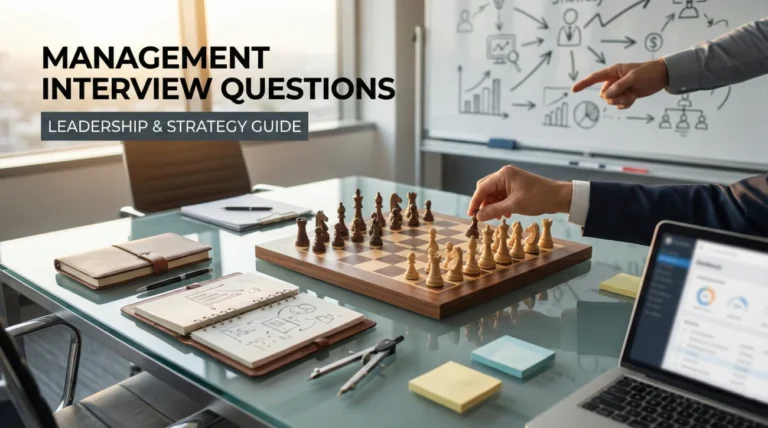
Manager interview questions are designed to test a fundamental shift in mindset. In 2025, the role of a Middle Manager (Department Manager) is no longer about being the best individual contributor in the room. It is about becoming a force multiplier. Hiring managers are looking for candidates who can suppress the urge to “just do it myself” and instead invest the time to teach, guide, and empower a team to do it better.
This comprehensive guide navigates the complex reality of the “Middle Management Squeeze” – the unique pressure of translating executive strategy into frontline action. We dive deep into the art of Effective Delegation (assigning authority, not just tasks), the psychology of Performance Reviews (turning feedback into growth), and the modern challenge of Hybrid Culture Building. Whether you are interviewing for a Sales Manager role or an Engineering Manager position, proving you are a “Coach” rather than a “Boss” is your key to the offer.
Management Philosophy & Transition
Before testing your skills, interviewers want to understand your “Why.” Why do you want to manage people, and how do you view the role?
Q: How do you define the difference between a “Manager” and a “Leader”?
Answer: A Manager focuses on systems, processes, and maintaining order. A Leader focuses on people, vision, and driving change. In my view, you manage things (budgets, schedules) but you lead people. Effective middle management requires toggling between both. I need to manage the P&L to keep the lights on, but I need to lead the team to ensure they want to keep the lights on.
Q: Describe your transition from individual contributor to manager. What was the hardest part?
Answer: The hardest part was letting go of control. As a top performer, I was used to trusting only my own work. When I became a manager, I had to learn to trust others to execute, even if they did it differently than I would. I overcame this by focusing on defining clear “outcomes” rather than dictating “methods.” I realized my success was no longer measured by what I produced, but by what my team produced.
Q: What is your management style?
Answer: I practice “Situational Leadership.” I don’t have one fixed style. For a new hire or a junior employee, I use a “Directing” style with clear instructions and frequent check-ins. For a senior, high-performing veteran, I shift to a “Delegating” style, providing autonomy and support only when asked. I adapt to the needs of the individual to help them succeed.
Q: How do you handle the pressure of being “squeezed” between upper management and your team?
Answer: I view myself as a “Shock Absorber” and a “Translator.” When executives push down aggressive targets, I absorb the stress and translate the goal into actionable, motivating tasks for the team. Conversely, when the team has grievances, I advocate for them to leadership using data and business cases, not just complaints. My job is to maintain alignment without letting the pressure crush morale.
The Art of Delegation
Delegation is the #1 skill for middle managers. Interviewers need to know you won’t become a bottleneck.
Q: How do you decide what to delegate and to whom?
The Strategy: The Eisenhower Matrix.
Answer: I evaluate tasks based on urgency and importance. I keep high-stakes, sensitive tasks (hiring/firing). I delegate tasks that are developmental opportunities for my team. I match the task to the person’s career goals. If someone wants to be a manager, I delegate the project scheduling to them to build that muscle.
Q: A team member fails to deliver a delegated task on time. What do you do?
The Strategy: Autopsy without Blame.
Answer: I look in the mirror first. Did I provide clear instructions? Did I give them the resources? I sit down with them: “We missed this deadline. Let’s walk through what happened.” If it was a skill gap, I train. If it was an obstacle, I remove it. If it was negligence, we discuss accountability. I treat it as a learning moment, not a crime.
Q: How do you ensure quality without micromanaging?
The Strategy: Trust but Verify.
Answer: I set clear “Check-points” at the beginning. “Let’s review the outline on Tuesday and the draft on Thursday.” This gives them freedom in between the checkpoints. Micromanagement is hovering; effective management is setting agreed-upon milestones. I make myself available for questions but wait for the milestone to intervene unless asked.
Q: Describe a time you delegated a task you enjoyed doing yourself.
The Strategy: Letting Go.
Answer: I loved creating the monthly client reports. It was my “zen” time. However, it took 4 hours a week. I realized my Senior Analyst needed visibility with the VP. I handed the report ownership to them. It was hard to let go of the control, but it freed me up for strategy and gave the Analyst a huge win. It wasn’t about dumping work; it was about elevating the team.
Q: How do you delegate to a team member who is already busy?
The Strategy: Priority Trade-offs.
Answer: I don’t just pile it on. I ask: “I need you to take lead on Project X because you’re the best fit. Looking at your current plate, what can we pause, drop, or re-assign to make room for this?” We negotiate the workload together. This shows I respect their time and prevents burnout.
Q: What is the difference between delegating responsibility and delegating accountability?
The Strategy: The Buck Stops Here.
Answer: I can delegate the responsibility (the doing of the task) to my team, but I can never delegate the accountability (the ultimate ownership). If my team fails, I am accountable to my boss. I take the heat publicly, and then we fix the process privately. I never throw a team member under the bus to save myself.
Team Building & Remote Culture
In 2025, teams are often hybrid or remote. Interviewers need to know you can build cohesion without a physical water cooler.
Q: How do you build “Psychological Safety” in your team?
Answer: I lead with vulnerability. I admit when I don’t know an answer or when I’ve made a mistake. When a leader says, “I messed that up,” it gives permission for the team to be honest about their own struggles. I also ensure that in meetings, bad news is met with curiosity (“How can we fix this?”) rather than anger (“Who did this?”). When people aren’t afraid of being punished for honesty, they innovate.
Q: How do you manage a Hybrid team where some are in-office and some are remote?
Answer: I adopt a “Remote-First” communication policy. If one person is on Zoom, everyone is on Zoom (even if sitting at desks). This prevents the “proximity bias” where in-office staff get all the information. I document decisions in public channels (Slack/Teams) rather than hallway chats. I also schedule quarterly in-person “off-sites” focused purely on bonding, not work, to recharge the social batteries.
Q: How do you handle a high-performing employee who destroys team culture (The Brilliant Jerk)?
Answer: I address it immediately. “Your sales numbers are fantastic, but the way you speak to the support team is unacceptable.” I make “culture contribution” a part of their performance review. If they refuse to change, I let them go. The short-term hit to productivity is worth the long-term gain in team retention. Toxic rockstars drive away all the other good people.
Performance Management & Feedback
The hardest part of the job is correcting behavior. You need to show you can have “Tough Conversations” with empathy.
Tell me about a time you had to put an employee on a PIP (Performance Improvement Plan).
The Strategy: Clarity & Support.
Answer: I had an account manager missing quotas for 3 months. I sat them down and presented the data objectively. We co-created a PIP with specific, measurable goals (e.g., “Make 10 calls/day” not just “Try harder”). I set up weekly check-ins to remove blockers. I framed it not as a punishment, but as a structured path to get back on track. Ultimately, they improved, but I was prepared to document the exit if they didn’t.
How do you deliver a negative performance review?
The Strategy: No Surprises.
Answer: A review should never be a surprise. If I am bringing up a major issue for the first time in the annual review, I have failed as a manager. I give feedback in real-time throughout the year. The review should just be a summary of conversations we’ve already had. I use the “SBI” model (Situation, Behavior, Impact) to keep it factual and unemotional.
An employee asks for a raise, but the budget is frozen. What do you say?
The Strategy: Transparency & Advocacy.
Answer: I am honest. “I value your work, and I agree you are performing at a high level. However, the company budget is currently frozen.” I do not make false promises. Instead, I pivot to non-monetary rewards we can control: flexible hours, extra PTO, or funding for a certification course. I also promise to advocate for them the moment the budget unlocks, and I keep that promise.
Conflict Resolution & Crisis
You are the referee. How do you handle disputes without taking sides?
Q: Two of your direct reports are in a conflict that is affecting the team.
Answer: I mediate, I don’t arbitrate. I call them into a room together. I ask each person to state their view of the problem while the other listens without interrupting. I force them to focus on the “Business Problem” (e.g., the missed deadline) rather than the “Personal Attack” (e.g., “he is lazy”). I ask them to propose a solution they can both live with. My goal is to get them to work together professionally, not necessarily to be best friends.
Q: Your team is burnt out and morale is low due to a long project.
Answer: I validate their feelings. “I know this has been a brutal month.” I look for “quick wins” to relieve pressure – maybe canceling non-essential meetings for a week or declaring a “No-Camera Friday.” I also get in the trenches with them. If they are staying late to stuff envelopes or test code, I stay late too and order dinner. Presence shows solidarity.
Q: How do you handle “Managing Up” when your boss gives your team an impossible deadline?
Answer: I push back with data, not emotion. “We can hit that deadline, but we will have to cut feature X or Y to do it. Or, we can keep all features but need 2 more weeks. Which trade-off do you prefer?” I present the “Iron Triangle” (Speed, Scope, Quality). I protect my team from the impossible by forcing leadership to prioritize.
Management Knowledge Quiz
Test Your Leadership IQ
1. The “Eisenhower Matrix” categorizes tasks by:
- Cost and Time
- Urgency and Importance
- Difficulty and Fun
- Person and Team
2. “Micromanagement” is characterized by:
- Setting clear goals
- Obsessive control over details and lack of trust
- Ignoring the team
- Giving frequent raises
3. “PIP” stands for:
- Personal Interest Project
- Performance Improvement Plan
- Paid Incentive Program
- Priority Issue Protocol
4. “Servant Leadership” focuses on:
- Being a servant to the CEO
- Serving the needs of the team first to help them perform
- Making coffee
- Strict hierarchy
5. “Psychological Safety” means:
- The office has good locks
- Team members feel safe to take risks and be vulnerable without fear of punishment
- Everyone is happy all the time
- No one ever argues
6. The “SBI” Feedback model stands for:
- Stop, Breathe, Ignore
- Situation, Behavior, Impact
- See, Believe, Inspire
- System, Business, Income
7. “Manage by Walking Around” (MBWA) involves:
- Tracking steps
- Informal, unstructured check-ins with employees at their stations
- patrolling for mistakes
- Walking away from problems
8. “1:1” (One-on-One) meetings should primarily focus on:
- Status updates only
- The employee’s development, blockers, and wellbeing
- The manager’s complaints
- Planning the holiday party
9. “Managing Up” refers to:
- Getting promoted
- Consciously working with your boss to obtain the best results for you, them, and the company
- Flattering the boss
- Ignoring your team
10. A “Skip-Level” meeting is:
- Skipping a meeting
- A meeting between a manager’s boss and the manager’s direct reports (bypassing the middle layer)
- A meeting on the roof
- A promotion interview
11. “Pareto Principle” (80/20 Rule) in management suggests:
- Work 20 hours a week
- 80% of results come from 20% of causes/effort
- Fire 20% of staff
- Keep 80% of the budget
12. “KPI” stands for:
- Key Person Indicator
- Key Performance Indicator
- Keep People Interested
- Key Profit Index
13. “Onboarding” is:
- Getting on a boat
- The process of integrating a new employee into the organization
- Firing someone
- Interviewing
14. “Attrition” refers to:
- A winning streak
- The reduction of staff/workforce through resignation or retirement
- Attraction to the job
- A team building game
15. “Delegation” fails when:
- The manager explains too much
- The manager assigns the task but keeps the authority/control (Micromanaging)
- The employee succeeds
- The deadline is long
16. “Emotional Intelligence” (EQ) is critical because:
- It helps with math
- It allows managers to recognize and manage their own emotions and those of others
- It replaces IQ
- It is required by law
17. “Situational Leadership” suggests:
- One style fits all
- Adapting leadership style to the competence and commitment level of the employee
- Leading only in crisis
- Changing jobs often
18. “Burnout” is recognized by WHO as:
- Being lazy
- An occupational phenomenon resulting from chronic workplace stress
- A physical injury
- A virus
19. A “SMART” goal is:
- Simple, Money, Action, Real, Time
- Specific, Measurable, Achievable, Relevant, Time-bound
- Smart, Meaningful, Articulate, Real, Tough
- Short, Medium, And, Really, Tall
20. “Succession Planning” involves:
- Planning a party
- Identifying and developing internal people to fill key leadership roles in the future
- Firing the CEO
- Planning the next quarter
❓ FAQ
👔 Do I need an MBA to be a Manager?
No. While an MBA helps with financial strategy, Middle Management is about people. Experience, empathy, and a track record of reliability are more valuable. Many great managers come from non-traditional backgrounds like liberal arts or frontline operations.
😰 How do I manage friends after getting promoted?
Set boundaries early. Have a “Reset Conversation”: “I value our friendship, but in the office, I have to be fair to everyone. I can’t show favoritism.” It will be awkward for a month, but if you are fair, the relationship will adjust. If you play favorites, you lose the whole team.
📉 What if my team is older/more experienced than me?
Respect their expertise. Don’t try to be the “expert”; be the “blocker remover.” Ask them: “You’ve been here 10 years, what usually goes wrong with these projects?” Make them your partners. Your value isn’t knowing more than them technically; it’s facilitating their success.
🕒 How do I avoid burnout as a manager?
Delegate. If you are working 60 hours while your team works 40, you are failing to delegate. Protect your calendar. Block out “Deep Work” time. And model good behavior – if you send emails at midnight, your team thinks they have to respond at midnight. Stop it.
🚀 How do I move from Manager to Director?
Managers execute; Directors strategize. To move up, start solving problems outside your department. Build relationships with other teams. Propose 3-year plans, not just 3-month plans. Show you understand the entire business ecosystem, not just your silo.
Final Thoughts
To succeed in answering manager interview questions, you need to show you have evolved past the “Individual Contributor” mindset. The interviewer isn’t hiring you to code faster or sell more; they are hiring you to build a machine that codes fast and sells more even when you are on vacation.
Focus on your ability to build trust, handle conflict with grace, and develop talent. If you can prove you care about your team’s success more than your own ego, you are ready to lead.
⚠️ Disclaimer: The interview strategies, sample answers, and negotiation tips provided in this guide are for educational purposes only. Hiring decisions are subjective and vary by company and industry. While these strategies are based on professional HR standards, they do not guarantee a specific job offer or result.