The Captain of the Ship (For 8 Hours)
Shift leader interview questions are about trust: keys, cash, people, and decisions made in real time. During your hours, you become the default authority, the problem solver, and the one who keeps the place safe and running.
The conversation usually turns to procedures (opening and closing), cash handling, delegation, and customer escalations. Solid candidates speak in routines and priorities: what must be done, what can wait, and how to keep the team calm when the shift turns chaotic.
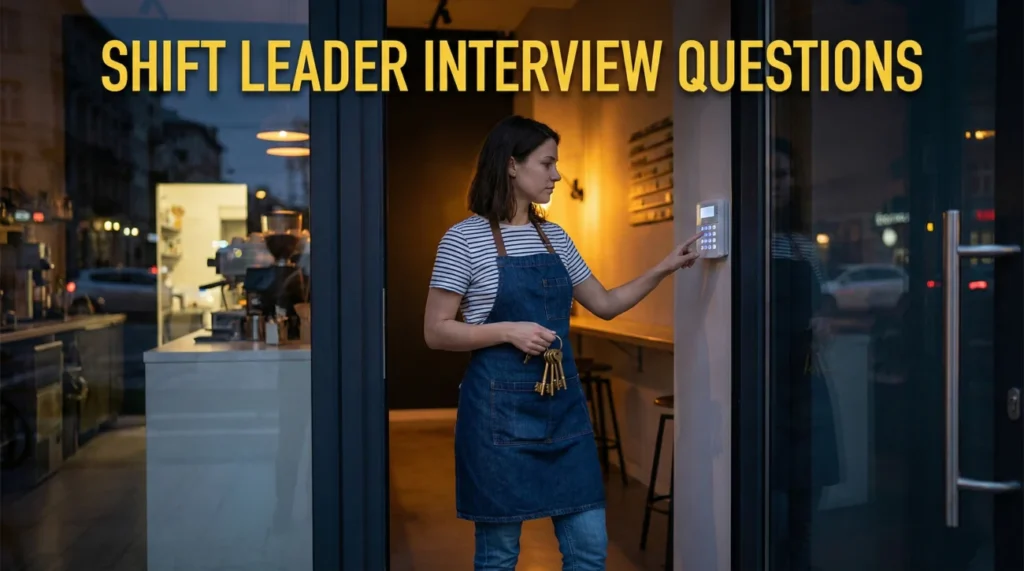
Opening & Closing Procedures (Keyholder)
You are the first one in and the last one out. This section tests your attention to detail and security awareness.
Q: Walk me through your routine for opening the store/facility alone.
Answer: Safety is my first priority. I inspect the exterior for any signs of forced entry before unlocking the door. Once inside, I disarm the alarm immediately and lock the door behind me until other staff arrive (never open alone if possible). I then perform a “Store Walk”: checking for safety hazards, ensuring the previous shift cleaned properly, and verifying the safe count. Only when the facility is 100% safe and ready do I unlock the doors for customers.
Q: What is the most critical part of the closing procedure?
Answer: Securing the assets. This means two things: Cash and Entrances. I personally verify that all cash drawers are balanced, the deposit is dropped in the safe, and the safe is locked. Then, I physically check every entry point (back doors, windows, roof hatches) to ensure they are secured. Setting the alarm is the final step, but the physical check is what actually prevents theft.
Q: How do you handle a discrepancy in the cash count at closing?
Answer: I do not panic or accuse anyone immediately. I recount the drawer myself to rule out human error. I check under the tray for stuck bills. I review the transaction log for large voids or refunds that might explain the variance. If the money is truly missing, I document it on the “Cash Variance Log,” inform the Area Manager immediately via text/email, and leave a note for the opening manager. I follow the company’s variance policy strictly.
Q: You arrive to open and the power is out. What do you do?
Answer: I do not open the doors to the public. I contact the utility company to get an ETA. I inform the Store Manager immediately. If we sell perishable food, I keep the fridge/freezer doors closed to maintain temperature. I keep the staff outside or in a safe area with natural light. I focus on communication and asset protection until power is restored or the decision is made to close for the day.
Task Delegation & Time Management
You can’t do it all yourself. You must deploy your team effectively to get the work done.
Q: How do you assign tasks at the start of a shift?
The Strategy: Aces in Places.
Answer: I use the “Aces in Places” strategy. I put my strongest people in the most critical roles (e.g., peak-hour register or drive-thru) to maximize speed. I assign newer staff to support roles or pair them with a veteran. I use a “Shift Deployment Chart” so everyone knows exactly where they should be and what their secondary tasks are when it gets quiet.
Q: It’s a slow shift. How do you keep the team productive?
The Strategy: “If you have time to lean…”
Answer: I have a “Downtime Checklist” prepared. I assign deep-cleaning tasks (baseboards, high dusting) or restocking duties. I gamify it: “If we finish the deep clean list by 3 PM, I’ll buy everyone a round of sodas.” I also use this time for quick 1-on-1 training sessions to upskill the team. I ensure we stay busy so the closing shift is easier.
Q: The closing team is behind schedule and you are hitting overtime limits.
The Strategy: Prioritization.
Answer: I intervene 1 hour before close. I cut the non-essential tasks (e.g., detailing the windows) and focus purely on the “Must Do” list (Cash, Food Safety, Security). I jump in to help with the bottleneck task myself. I ensure we clock out on time to protect the labor budget, leaving a note for the morning team about the non-essential items we missed, taking responsibility for the decision.
Q: How do you ensure the checklist is actually done, not just pencil-whipped?
The Strategy: Inspect what you Expect.
Answer: I do a physical walk-through. I don’t just look at the checkmark; I look at the floor. If they checked “Clean Restrooms,” I walk into the restroom. If it isn’t clean, I call them back to fix it immediately. I explain: “I can’t sign off on this until it meets the standard.” Consistent verification teaches them that standards matter.
Q: How do you handle a shift handover log?
The Strategy: Detailed Continuity.
Answer: I write for the person coming in next. I include: 1. Sales vs. Target. 2. Any personnel issues (lateness, illness). 3. Maintenance issues (broken equipment). 4. Customer complaints handled. 5. Tasks left unfinished. I make it clear and concise. A good log prevents the next manager from walking into a minefield.
Q: How do you manage a “Rush” when you are understaffed?
The Strategy: Focus on Flow.
Answer: I eliminate bottlenecks. I position myself as the “Floater” or “Expeditor.” I don’t get stuck on a register; I move around to unclog jams (refilling supplies, packing bags, wiping tables). I communicate constantly: “We are doing great, just focus on the customer in front of you.” Keeping the team calm is the only way to survive the rush without mistakes.
Leadership on the Floor
You are the face of management to the staff. How do you lead without a big title?
Q: How do you handle an employee who challenges your authority?
Answer: I stay calm and professional. I do not engage in a shouting match. I pull them off the floor to a private area. I ask: “Is there an issue we need to discuss?” If they continue to be insubordinate, I remind them that during this shift, I am the decision-maker responsible for the store. I document the interaction. If it persists, I send them home for the day to protect the team environment.
Q: A customer demands to speak to the “Manager,” and you are the highest ranking person.
Answer: I introduce myself confidently: “I am the Shift Leader in charge right now. How can I help you?” I listen to their complaint fully. I offer a solution within my authority (refund, replacement). If they insist on speaking to the General Manager, I take their contact info and promise the GM will call them the next day. I never say “I’m just a Shift Leader”; I own the responsibility.
Q: How do you keep morale high during a difficult closing shift?
Answer: I bring energy. I might play upbeat music (if allowed) while we clean. I acknowledge the hard work: “I know it was a crazy night, you guys crushed it.” I help them with the grossest jobs (trash, drains). Shared suffering creates bonding. I ensure we leave together safely, checking that everyone gets to their cars/transport.
Emergency & Safety Scenarios
When the alarm rings or someone gets hurt, you are the MOD (Manager on Duty).
An employee slices their finger deeply while prepping. Action?
The Strategy: First Aid & Protocol.
Answer: I stop them immediately and apply pressure with a clean bandage/towel. I assess if it needs stitches. If yes, I arrange transport to urgent care (taxi or Uber, I don’t drive them myself unless necessary to leave the store). I sanitize the area where the accident happened. I fill out the “Incident Report” for Workers’ Comp immediately while details are fresh.
You suspect a customer is trying to pass a counterfeit bill.
The Strategy: De-escalation.
Answer: I use the counterfeit detector pen or UV light discreetly. If it fails, I hand it back and say: “I’m sorry, I can’t accept this bill as it didn’t pass our security check. Do you have another form of payment?” I do not accuse them of a crime (they might be a victim too). I do not keep the bill. If they get aggressive, I call security/police.
The fire alarm goes off during a busy dinner service.
The Strategy: Evacuation Leader.
Answer: I assume it is real. I cut the music. I shout clearly: “Everyone please move calmly to the nearest exit.” I direct staff to guide customers out. I check the bathrooms to ensure no one is left behind. I take the “Daily Roster” with me to do a headcount outside. I meet the fire department at the entrance. Safety supersedes revenue.
Shift Leader Operations Quiz
Test Your Shift IQ
1. “Keyholder” means:
- Someone who makes keys
- A trusted employee entrusted with keys/codes to open and close the business
- The janitor
- The owner only
2. The “Safe Count” must be done:
- Once a week
- At the beginning and end of every single shift (or handover)
- Only when money is missing
- By the bank
3. “MOD” stands for:
- Master Of Design
- Manager On Duty
- Morning Opening Door
- Make Our Day
4. “Deployment Chart” or “Floor Plan” shows:
- Where the fire exits are
- Where each staff member is assigned to work during the shift
- The cleaning schedule
- The sales goals
5. “Pencil Whipping” a checklist means:
- Writing very fast
- Checking off items without actually doing or verifying them (Falsifying records)
- Using a pen instead
- Drawing pictures
6. “Cash Variance” is:
- Extra money
- The difference between the actual cash in the drawer and what the system says should be there
- Foreign currency
- A bonus
7. “First In, First Out” (FIFO) applies to:
- Customers
- Inventory rotation (using old stock before new stock)
- Employee breaks
- Parking spots
8. “Comp” or “Void” authority usually allows a Shift Leader to:
- Take free food
- Approve refunds or remove items from a bill up to a certain dollar amount
- Fire staff
- Close the store early
9. “Blind Drop” is when:
- You drop money in the dark
- Staff deposit cash without knowing the expected system total (to prevent theft/matching)
- You lose money
- A surprise inspection
10. “Labor Cost” control involves:
- Paying less money
- Sending staff home early when sales are low to maintain profit margins
- Hiring cheaper staff
- Making staff work faster
11. A “Spot Check” is:
- Checking for dirt spots
- A random, unscheduled inspection of a process (e.g., cash drawer, food temp)
- Checking the lights
- A skin check
12. “Incident Report” must be filled out for:
- Running out of napkins
- Any injury, theft, property damage, or significant customer altercation
- Being late
- Rainy days
13. “Skimming” is a type of theft where:
- You clean the pool
- Cash is taken from the register before it is recorded in the system
- You steal milk
- You run fast
14. “Upselling” focuses on:
- Selling items upstairs
- Increasing the value of a sale by suggesting add-ons or upgrades
- Selling old stock
- Being pushy
15. “De-escalation” means:
- Going downstairs
- Reducing the intensity of a conflict through calm communication
- Fighting back
- Ignoring the customer
16. “Z-Read” (or Z-Report) is:
- A book about zombies
- The final sales report generated at the end of the day that resets the register to zero
- A sleepy report
- A zero balance
17. “X-Read” is:
- A secret map
- A mid-day sales report that checks current totals without resetting the register
- A mistake
- The exit procedure
18. “86’d” item means:
- It costs $86
- It is out of stock or removed from the menu
- It is popular
- It is spicy
19. “Two-Person Rule” often applies to:
- Going to the bathroom
- Handling large amounts of cash, trash runs at night, or opening/closing for safety
- Eating lunch
- Taking orders
20. The most important tool for a Shift Leader is:
- A megaphone
- A checklist
- A hammer
- A calculator
❓ FAQ
🔑 Is being a Keyholder risky, and how do I address safety?
Acknowledge the risk and show you follow protocol: exterior check, controlled entry, doors secured, and never cutting corners. Emphasize safety first, then speed.
💵 How should I answer questions about cash shortages or variances?
Describe a no-drama process: recount, check logs, review refunds and voids, document the variance, and escalate according to policy. Avoid blaming and focus on controls.
🚦 What is the best way to handle a rush when short-staffed?
Prioritize flow: put strong people in key positions, simplify the menu or tasks if possible, and keep yourself mobile to remove bottlenecks. Calm communication is part of throughput.
🧽 What do interviewers want to hear about closing duties?
They want proof you protect assets and standards: cash secured, food safety and cleaning completed, and doors and alarms checked. Mention a walk-through, not just “the checklist.”
🗣️ When a customer demands “the manager,” what should I say?
Own the role on duty: introduce yourself as the person in charge for the shift, listen, offer a solution within policy, and document the incident. Escalate only when the issue exceeds your authority.
Final Thoughts
Winning shift leader interview questions does not require flashy vision. The role rewards consistency: safe routines, clean handoffs, and decisions that protect the business and the team when things go sideways.
End by highlighting one example where you protected standards under pressure, then connect it to growth into the next level. If you are moving toward that step, skim assistant manager interview preparation to align your language with broader ownership.
⚠️ Disclaimer: The interview strategies, sample answers, and negotiation tips provided in this guide are for educational purposes only. Hiring decisions are subjective and vary by company and industry. While these strategies are based on professional HR standards, they do not guarantee a specific job offer or result.