- Main point: Leadership is not one “best” style, it is knowing your default and choosing the right approach for the situation.
- Core frameworks: Classic styles run from autocratic to democratic to delegative, plus transactional versus transformational, and they sit on a continuum from leader-led to team-led.
- Situational fit: Match how directive or supportive you are to the person’s readiness for that task, because beginners need structure and achievers need autonomy.
- Self-awareness: Your real style shows up under stress, so combine honest reflection with feedback from team, peers, and managers to spot strengths and blind spots.
- Build range: Develop complementary behaviors outside your comfort zone, name your style shifts clearly, and use this language in interviews with examples of when you adapted.
Understanding Your Leadership DNA
Effective leaders don’t emerge from single universal template: successful leadership styles examples span from directive autocratic approaches to collaborative democratic methods, from transactional task focus to transformational vision inspiration. Understanding different leadership frameworks helps you recognize your natural tendencies, identify situations where your default approach excels versus struggles, and develop versatility adapting style to team needs and organizational context.
The challenge is that most leaders develop styles unconsciously, absorbing patterns from previous managers without examining whether those approaches suit their personality or current situation. You might emulate an authoritarian boss’s directive style despite your collaborative nature, or maintain participative decision-making when crisis requires swift unilateral action. Mismatched style and situation creates friction: teams resent micromanagement when capable of autonomy, or feel rudderless when needing clear direction you’re reluctant to provide.
This guide explores major leadership style frameworks enabling self-assessment and intentional development. You’ll learn characteristics of primary leadership approaches, recognize advantages and limitations of each style, understand situational factors determining style effectiveness, and develop strategies for expanding your leadership versatility while honoring authentic strengths.
Classic Leadership Style Framework
Traditional management style frameworks categorize leaders along spectrum from highly directive to highly participative approaches.
Five Primary Leadership Styles
These foundational styles represent distinct philosophies about decision-making authority, team involvement, and leader-follower relationships.
| Leadership Style | Core Characteristics | When It Works Best | Potential Downsides |
|---|---|---|---|
| Autocratic (Authoritarian) | Leader makes decisions independently, gives clear directives, expects compliance, minimal team input | Crisis situations, inexperienced teams, time-critical decisions, compliance-heavy environments | Stifles creativity, reduces engagement, creates dependency, limits development, high turnover |
| Democratic (Participative) | Leader involves team in decisions, seeks input before choosing, values consensus, collaborative problem-solving | Complex problems needing diverse perspectives, experienced teams, innovation focus, high engagement priority | Slow decision-making, potential for groupthink, unclear accountability, frustration if input ignored |
| Laissez-faire (Delegative) | Leader provides minimal direction, empowers team autonomy, intervenes rarely, trusts self-management | Highly skilled experts, creative professionals, self-motivated teams, research/innovation environments | Can feel like abandonment, unclear priorities, coordination challenges, accountability gaps, chaos risk |
| Transformational | Leader inspires through vision, challenges status quo, develops followers, creates change, models values | Change initiatives, building culture, long-term development, innovation needs, mission-driven work | May neglect operational details, burnout risk from high expectations, vision dependency, emotional labor |
| Transactional | Leader focuses on tasks/processes, uses rewards/consequences, emphasizes efficiency, maintains systems | Stable operations, clear performance metrics, compliance requirements, routine processes, short-term goals | Limited innovation, reduced creativity, extrinsic motivation dependency, minimal development focus |
💡 Pro tip: Most effective leaders don’t rigidly adhere to single style but develop “range”: ability to shift approach based on situation while maintaining authentic core. Identify your natural default style, then consciously develop capability in complementary approaches. This flexibility enables matching leadership response to team maturity, task complexity, and organizational context.
The Leadership Continuum
Rather than discrete categories, leadership styles exist on continuum from leader-centered to team-centered authority.
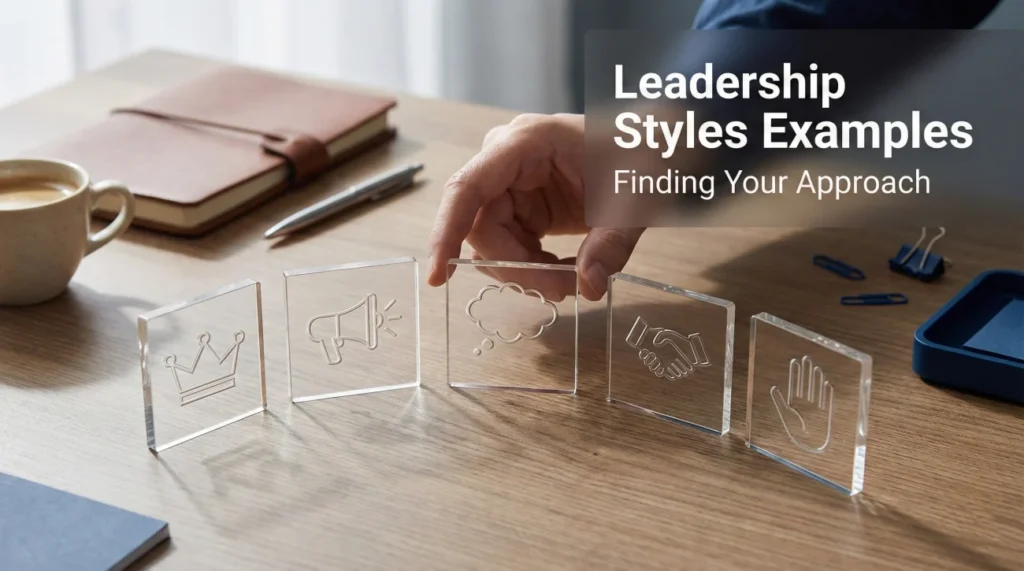
- 👑 Tells (Autocratic extreme): Leader decides and announces, no input sought
- 💬 Sells (Persuasive): Leader decides then convinces team of merits
- 🤔 Consults (Participative): Leader gathers input before deciding
- 🤝 Joins (Democratic): Team decides together with leader as equal participant
- ✅ Delegates (Laissez-faire extreme): Team decides independently within boundaries
Expert advice: Your leadership style reveals itself most clearly under stress. Notice what you do when deadline pressure mounts or crisis erupts: do you seize control and direct, convene team for input, or step back trusting others? This stress response often represents your authentic default. Understanding this pattern enables conscious choice rather than reactive habit, developing intentional leadership rather than autopilot management.
Situational Leadership Model
Situational leadership models argue effective leaders adapt style to follower readiness rather than maintaining consistent approach across situations.
Follower Development Level
The Hersey-Blanchard model suggests matching leadership style to team member’s competence and commitment for specific tasks.
| Development Level | Competence & Commitment | Appropriate Style | Leader Behavior |
|---|---|---|---|
| D1: Enthusiastic Beginner | Low competence, high commitment | Directing (S1) | High directive, low supportive: Clear instructions, close supervision, frequent feedback |
| D2: Disillusioned Learner | Low to moderate competence, low commitment | Coaching (S2) | High directive, high supportive: Explain decisions, encourage input, build confidence |
| D3: Capable but Cautious | Moderate to high competence, variable commitment | Supporting (S3) | Low directive, high supportive: Facilitate problem-solving, share decision-making, encourage |
| D4: Self-Reliant Achiever | High competence, high commitment | Delegating (S4) | Low directive, low supportive: Provide autonomy, monitor from distance, available if needed |
Developing Style Flexibility
Situational effectiveness requires diagnosing follower needs accurately then adjusting leadership approach accordingly, even within same team.
- Individual assessment: Different team members require different styles simultaneously based on their development
- Task-specific variation: Same person needs different support levels across various responsibilities
- Dynamic adjustment: As competence and confidence grow, reduce directive behavior and increase autonomy
- Avoid style rigidity: Treating all team members identically ignores individual development needs
Common mistake: Maintaining directive style with highly competent team members creates resentment and disengagement. Conversely, delegating to inexperienced team members without adequate support sets them up for failure and frustration. Match support level to actual capability, not desired outcome or personal comfort zone.
Identifying Your Natural Leadership Style
Self-awareness about finding your leadership style enables intentional development and authentic leadership rather than imitation of others’ approaches.
Leadership Style Self-Assessment
Reflect honestly on your natural tendencies across key leadership dimensions.
| Leadership Dimension | Reflection Questions | Style Indicators |
|---|---|---|
| Decision-making | Do you typically decide alone then announce, or involve team before choosing? | Autocratic ← → Democratic |
| Control vs. autonomy | Do you prefer close oversight or empowering independence? | Directive ← → Delegative |
| Focus orientation | Do you emphasize tasks/results or people/relationships? | Transactional ← → Transformational |
| Change approach | Do you maintain stability or push transformation? | Transactional ← → Transformational |
| Comfort with ambiguity | Do you need clear plans or embrace emergence? | Structured ← → Adaptive |
Gathering External Perspective
Your self-perception often differs from how others experience your leadership. Seek honest feedback from multiple sources.
- 👥 Team members: How they experience your daily leadership: directive or collaborative, supportive or distant
- 👔 Peers: How you show up in cross-functional settings: dominant or inclusive, rigid or flexible
- 📊 Manager: How your style aligns with organizational expectations and role requirements
- 🔄 360 feedback: Formal assessment tools providing comprehensive multi-rater input
Recognizing Strengths and Growth Areas
Every style offers advantages in certain contexts while creating challenges in others. Understanding your pattern enables leverage and mitigation.
- Autocratic strength: Speed, clarity, crisis management | Limitation: Innovation, engagement, development
- Democratic strength: Buy-in, diverse perspectives, engagement | Limitation: Decision speed, clarity, efficiency
- Laissez-faire strength: Expert autonomy, creativity, ownership | Limitation: Coordination, accountability, support needs
- Transformational strength: Inspiration, change, development | Limitation: Operations, short-term focus, burnout
- Transactional strength: Efficiency, clarity, stability | Limitation: Innovation, intrinsic motivation, adaptability
Expert advice: Don’t force yourself into leadership style that feels fundamentally inauthentic: this creates exhausting performance rather than sustainable leadership. Instead, understand your natural approach deeply, recognize its appropriate applications, and develop just enough versatility to adapt when situation truly demands different style. Authentic leadership within your natural range beats perfect imitation of theoretically ideal approach.
For comprehensive guidance on leadership development in interview contexts, explore professional preparation resources covering management philosophy and leadership scenario responses.
Building Leadership Style Versatility
Strong leaders develop range: ability to shift approach while maintaining authentic core, through deliberate practice and self-awareness.
Style Expansion Strategies
Systematically develop capabilities in approaches outside your natural comfort zone.
| If Your Default Is… | Develop This Complementary Capability | Practice Opportunities |
|---|---|---|
| Highly directive | Asking questions before telling, soliciting input before deciding | Start meetings with “What do you think?” before sharing your view, delegate decisions on non-critical items |
| Very participative | Making timely decisions without perfect consensus, providing clear direction | Set decision deadlines, practice “I’ve heard your input, here’s my decision” statements, lead in crisis simulations |
| Hands-off delegative | Providing structure and support without micromanaging | Regular check-ins with new team members, creating frameworks before delegating, coaching not just delegating |
| Highly transactional | Inspiring through vision, connecting work to purpose | Articulate “why” behind tasks, share organizational strategy context, recognize effort not just results |
| Purely transformational | Managing operational details, ensuring execution excellence | Create project plans, track metrics, ensure follow-through on commitments, celebrate process wins |
Matching Style to Situation
Develop diagnostic capability recognizing which situations demand which approaches.
- Crisis or emergency: Shift toward directive regardless of default: clarity and speed matter most
- Complex problem-solving: Increase participation: diverse perspectives improve solutions
- Routine operations: Delegate or use transactional: efficiency and autonomy appropriate
- Change initiatives: Employ transformational: vision and inspiration overcome resistance
- New team member onboarding: High structure initially: provide direction while building capability
- Expert team leading innovation: Hands-off approach: autonomy enables creativity
💡 Pro tip: Announce style shifts explicitly when changing approach: “Normally I’d involve everyone in this decision, but given the deadline, I’m making the call” or “I know I usually decide quickly, but this complexity requires your input first.” This transparency prevents confusion about inconsistency and helps team understand your intentional adaptation rather than arbitrary mood swings.
❓ FAQ
🎯 Is one leadership style objectively best?
No single style proves superior across all contexts. Effectiveness depends on follower development level, task complexity, organizational culture, time constraints, and situation urgency. Research shows situational leaders who adapt approach outperform those rigidly maintaining single style. However, forced adoption of fundamentally inauthentic style creates exhausting performance. Develop range within your natural tendencies rather than attempting complete personality transformation.
💼 How do I identify my natural leadership style?
Observe your default behavior under stress: how you naturally respond when deadline pressure mounts or crisis emerges reveals authentic tendencies. Seek 360-degree feedback from team members, peers, and manager about how they experience your leadership. Reflect on which aspects of leadership energize versus drain you: directive control versus collaborative facilitation, vision-casting versus operational management. Notice which leaders you admire and why: often indicates values alignment with particular styles.
⏰ What if my natural style conflicts with organizational expectations?
Assess degree of mismatch: minor differences allow adaptation while fundamental conflicts suggest poor organizational fit. If gap is bridgeable, develop specific capabilities the organization values while maintaining authentic core. Communicate your approach transparently, explaining reasoning behind style choices. Consider whether different role within organization better suits your natural tendencies. Sometimes the problem isn’t your style but role-style mismatch: creative laissez-faire approach struggles in compliance-heavy environments regardless of effort.
📋 How much should I adapt my style to individual team members?
Significant adaptation proves necessary: effective leaders provide directive support to beginners while delegating autonomously to experts, even within same team. This doesn’t mean completely different personalities with each person but rather adjusting directive versus supportive behavior based on their competence and commitment for specific tasks. Start by assessing each team member’s development level, then consciously match your approach. Over time this becomes natural rather than exhausting performance.
✨ How do I discuss leadership style during interviews?
Demonstrate self-awareness by articulating your natural approach, its strengths and limitations, and how you adapt to situations. Avoid claiming equal comfort with all styles: sounds either dishonest or lacking self-knowledge. Instead: “My natural tendency is collaborative decision-making, which works well for complex problems but I’ve learned to shift toward directive in crisis situations.” Support with specific examples showing style flexibility. Ask about organizational leadership culture to assess alignment. Your thoughtful analysis matters more than claiming theoretically “correct” style.
Final Thoughts
Understanding leadership styles examples enables intentional development rather than unconscious habit, authentic expression rather than forced imitation, and situational effectiveness rather than rigid consistency. No single leadership approach proves universally superior: autocratic direction excels in crisis while democratic participation generates innovation, transformational vision inspires change while transactional clarity ensures operations, laissez-faire autonomy empowers experts while directive support develops beginners.
Effective leadership requires knowing your natural tendencies deeply: recognizing default patterns, understanding when they serve versus hinder, and developing just enough versatility to adapt when situations truly demand different approaches. This isn’t abandoning authentic self for theoretical ideal but expanding range while honoring core strengths. The goal is conscious choice rather than reactive habit, intentional adaptation rather than autopilot management.
Invest in self-assessment identifying your natural leadership DNA, seek honest feedback about how others experience your leadership, recognize contexts where your default approach excels versus struggles, and deliberately develop complementary capabilities expanding your range. This journey from unconscious habit toward intentional versatility distinguishes developing leaders from stagnant managers, creating sustainable authentic leadership rather than exhausting performance of borrowed styles.
⚠️ Disclaimer: The interview strategies, sample answers, and negotiation tips provided in this guide are for educational purposes only. Hiring decisions are subjective and vary by company and industry. While these strategies are based on professional HR standards, they do not guarantee a specific job offer or result.