The Integrator Behind the Vision
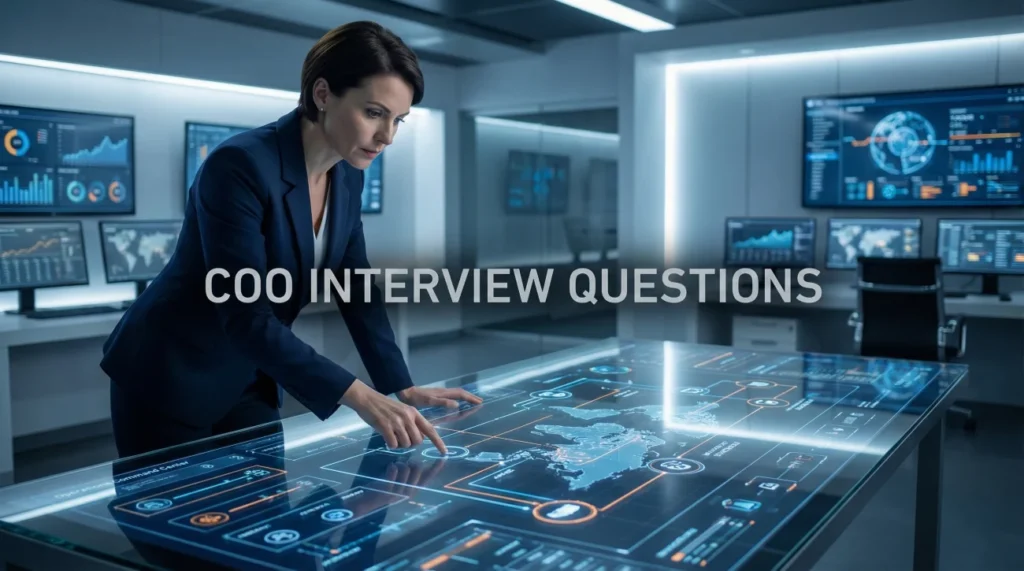
COO interview questions are unique because the role of the Chief Operating Officer is the most variable in the C-Suite. Unlike a CFO (focused on finance) or a CMO (focused on marketing), the COO’s mandate changes based on the CEO’s needs. In 2025, the COO is the “Chief Execution Officer.” You are the bridge between the company’s strategic vision and its daily reality. Hiring committees are looking for a leader who can translate high-level goals into rigorous processes, scale operations without breaking the culture, and serve as the steady hand when the market gets turbulent.
This comprehensive guide dissects the operational leadership required for this role. We explore the Visionary/Integrator Dynamic (how to partner with a founder CEO), the mechanics of Operational Excellence (Lean, Agile, Six Sigma applied to modern business), and the metrics that matter most when Scaling Up. Whether you are stepping into a turnaround situation or joining a hyper-growth unicorn, proving you have the systems thinking to create order out of chaos is your primary objective.
Operational Strategy & Systems Thinking
A COO must build the machine that builds the product. Interviewers want to know if you can design systems that scale.
Q: How do you define “Operational Excellence” in a modern organization?
Answer: Operational Excellence is not just about cost-cutting; it is about “Flow.” It means delivering value to the customer with the least amount of friction and waste. I achieve this by mapping the “Value Stream” of the organization. I look for bottlenecks where information or decisions get stuck. My goal is to create a culture of continuous improvement (Kaizen) where every employee is empowered to fix broken processes, ensuring that as we scale, our efficiency improves rather than degrades.
Q: Describe your framework for scaling a business from $10M to $100M ARR.
Answer: Scaling requires shifting from “Heroics” to “Systems.” At $10M, you rely on individual rockstars. To get to $100M, you need repeatable playbooks. I focus on three pillars: People (hiring ahead of the curve and building middle management), Process (automating manual workflows and documenting SOPs), and Platform (investing in a tech stack that can handle 10x volume). I watch the “Unit Economics” closely to ensure we aren’t just scaling losses.
Q: How do you balance the need for speed with the need for quality/compliance?
Answer: I use the “Guardrails” approach. I set clear non-negotiables (compliance, data security, core brand standards) that act as the brakes. Within those guardrails, I encourage maximum speed and autonomy. I also implement “Feedback Loops” so that if quality slips, we catch it early. It is not about choosing speed OR quality; it is about building a system that makes quality the path of least resistance.
Q: What is your approach to “Tech Debt” in operations?
Answer: Operational Tech Debt (manual spreadsheets, disconnected systems) is a silent killer. I audit our “Ops Stack” annually. If we are throwing bodies at a problem that software could solve, we have debt. I advocate for allocating a percentage of the budget to “Refactoring Operations”: upgrading the ERP, integrating the CRM, or automating billing. Paying down this debt is essential for future agility.
The CEO Partnership (Visionary & Integrator)
The relationship with the CEO is the most critical factor in your success. You must be their complement, not their clone.
Q: How do you view the relationship between the CEO and the COO?
The Strategy: Yin and Yang.
Answer: I view it as “Visionary and Integrator.” The CEO looks out at the horizon (3-5 years); I look at the path directly in front of us (3-12 months). My job is to take their bold ideas and filter them through reality: “That is a great vision; here is the budget, timeline, and headcount required to achieve it.” I liberate the CEO from the weeds so they can focus on external growth, while I ensure the internal engine is humming.
Q: What do you do when you strongly disagree with the CEO’s strategy?
The Strategy: Private Debate, Public Unity.
Answer: I challenge them rigorously in private. I bring data and risk analysis to the table. “If we pursue Market X, we risk destabilizing our core business in Market Y.” However, once the decision is made, I execute it as if it were my own idea. A divided C-Suite paralyzes the company. My loyalty is to the execution of the agreed plan.
Q: How do you handle a CEO who keeps changing their mind (Strategic Whiplash)?
The Strategy: Cost of Change.
Answer: I make the cost of change visible. When the CEO wants to pivot mid-quarter, I show the impact: “We can do this new project, but it means pausing Project A and Project B, and wasting the $50k we invested.” I force a prioritization discussion. I also implement a “Cooling Off” period for new ideas to see if they are still urgent 48 hours later.
Q: How do you divide responsibilities with the CEO?
The Strategy: Clarity of Lanes.
Answer: We must define our lanes explicitly. Typically, Product, Sales, and Marketing might report to the CEO (Growth), while Finance, HR, Legal, and Operations report to me (Execution). However, I prefer a model where the CEO owns the “What” and I own the “How.” We meet daily for a 15-minute sync to ensure we aren’t sending conflicting messages to the team.
Q: Describe your communication style with the Board.
The Strategy: Operational Transparency.
Answer: While the CEO presents the vision, I present the health metrics. I provide the Board with the unvarnished truth about operational risks and performance. I don’t sugarcoat problems, but I always present them with a mitigation plan. My goal is to give the Board confidence that the company is under control and that we are disciplined stewards of capital.
Q: How do you ensure the CEO’s culture flows down to the frontline?
The Strategy: Operationalizing Values.
Answer: Culture is often lost in the middle layers. I operationalize the values into our processes. If we value “Transparency,” I ensure our All-Hands meetings share real financial data. If we value “Speed,” I remove approval layers for small decisions. I ensure our performance review system rewards behaviors that align with the culture, not just results.
Metrics, KPIs & Performance
You cannot manage what you do not measure. A COO must be fluent in the data of the business.
Which 3 KPIs would you look at every morning?
The Strategy: Pulse of the Business.
Answer: It depends on the business model, but generally: 1. Cash Flow / Burn Rate (Survival). 2. Sales Pipeline Velocity (Future Growth). 3. Customer Satisfaction (NPS/CSAT) or Operational Uptime (Current Health). These three give me a balanced view of liquidity, growth, and quality. If any of these are red, I know where to focus my day.
How do you drive cross-functional accountability?
The Strategy: Shared OKRs.
Answer: Silos are the enemy of execution. I implement Shared OKRs (Objectives and Key Results). For example, “Customer Retention” is not just a Customer Success goal; it is shared by Product (usability), Sales (selling to the right fit), and Ops (onboarding speed). I hold weekly cross-functional “Sprint Reviews” where leaders must report on these shared goals together.
We are missing our quarterly targets. How do you intervene?
The Strategy: Diagnostic & Action.
Answer: I don’t just yell “Work harder.” I diagnose the root cause. Is it a Top of Funnel problem (Marketing)? A conversion problem (Sales)? Or a delivery problem (Ops)? Once identified, I create a “Recovery Plan” with daily stand-ups to track progress. I remove non-essential work from the team’s plate so they can focus 100% on the gap. I also communicate the reality to the Board early.
Change Management & Restructuring
COOs are often hired to fix things. This involves changing how people work, which creates resistance.
Q: Describe a time you led a major restructuring. How did you handle the people side?
Answer: I had to merge two departments to eliminate redundancy. I started with transparency: “Here is the business reason why we are doing this.” I mapped out the new structure clearly. For those staying, I re-recruited them into their new roles. For those leaving, I treated them with dignity and generous support. I spent the next 90 days over-communicating to the survivors to rebuild trust and clarify the new workflows. Change fails when communication stops.
Q: How do you handle “Organizational Drag” (bureaucracy)?
Answer: I declare war on unnecessary meetings and processes. I conduct a “Meeting Audit”: if a meeting has no agenda or decision outcome, it is cancelled. I implement a “Two-Pizza Rule” for decision-making teams (keep them small). I empower lower-level managers to make decisions without my approval up to a certain dollar amount. Speed is a function of decision velocity.
Q: How do you implement a new technology that the staff resists?
Answer: I focus on WIIFM (What’s In It For Me). I don’t sell the features; I sell the benefit. “This new ERP will eliminate the manual data entry you hate doing on Fridays.” I identify “Super Users” in each department to pilot the tool and peer-coach others. I expect a productivity dip during the J-Curve of adoption, but I hold firm on the timeline. “We are burning the ships; there is no going back to the old system.”
Crisis & Situational Judgment
When the supply chain breaks or the data center floods, the COO takes command.
A key supplier goes bankrupt overnight, halting production.
The Strategy: Contingency & Agility.
Answer: I activate the Business Continuity Plan. I immediately secure any remaining inventory they have. I contact our secondary/backup suppliers to ramp up volume, even at a premium cost (Revenue protection > Margin protection in a crisis). I communicate with customers about potential delays immediately. Long term, I diversify the supply chain so we are never single-threaded again.
The company is growing too fast and culture is breaking.
The Strategy: Pause & Solidify.
Answer: This is “Hyper-growth Indigestion.” I might tap the brakes on hiring for a quarter to focus on onboarding and assimilation. I codify our culture into a handbook (like Netflix). I invest in management training because bad managers kill culture faster than anything else. I ensure our internal comms infrastructure (Intranet, All-Hands) scales with the headcount.
You discover a compliance violation that could result in a massive fine.
The Strategy: Integrity & Remediation.
Answer: I inform the CEO and Legal Counsel immediately. We self-report to the regulator if required; it is better to come forward than to be caught covering up. I lead the internal investigation to find the process failure (not just the person). I implement a “Corrective Action Plan” to ensure it never happens again. I view compliance not as a constraint, but as a license to operate.
COO Leadership Quiz
Test Your Ops IQ
1. “OKRs” stand for:
- Operational Key Rules
- Objectives and Key Results
- Official Key Reports
- Only Key Revenue
2. “Six Sigma” focuses on:
- Speed only
- Reducing defects and variability in processes
- Marketing reach
- Employee happiness
3. The “Integrator” role is typically held by:
- The CEO
- The COO
- The CMO
- The Founder
4. “CAC” stands for:
- Cost Against Capital
- Customer Acquisition Cost
- Cash At Closing
- Company Annual Cost
5. “LTV” means:
- Long Term Vision
- Lifetime Value (of a customer)
- Last Time Visited
- Loan To Value
6. “SOP” is:
- Standard Operational Plan
- Standard Operating Procedure
- Special Order Process
- Strategic Output Plan
7. “Kaizen” implies:
- Rapid growth
- Continuous improvement through small changes
- Firing staff
- Top-down management
8. “EBITDA” is a proxy for:
- Net Profit
- Operational Cash Flow (Earnings Before Interest, Taxes, Depreciation, Amortization)
- Revenue
- Debt
9. “Supply Chain Resilience” means:
- Buying the cheapest parts
- The ability of the supply chain to withstand and recover from disruptions
- Using one supplier
- Storing no inventory
10. “Churn Rate” measures:
- Hiring speed
- The percentage of customers (or employees) who leave in a period
- Production speed
- Website visits
11. “Tech Debt” refers to:
- Money owed for computers
- The implied cost of future reworking required when choosing an easy solution now instead of a better one
- Software license fees
- Cloud storage costs
12. “Just-in-Time” (JIT) manufacturing aims to:
- Increase inventory
- Reduce inventory costs by receiving goods only as they are needed
- Delay production
- Increase waste
13. “Change Management” handles:
- Counting money
- The people side of organizational transition
- Software updates
- Office moves only
14. “Span of Control” is:
- The length of a project
- The number of direct reports a manager has
- The CEO’s term
- The budget limit
15. “Bottleneck” analysis finds:
- The narrowest part of a bottle
- The step in a process that limits total capacity/throughput
- The fastest step
- The most expensive employee
16. “Lean Management” focuses on:
- Starving employees
- Eliminating waste and maximizing customer value
- Working fast
- Reducing quality
17. “Unit Economics” describes:
- Global economy
- The direct revenues and costs associated with a single unit of business (one customer/product)
- HR budgets
- Office rent
18. “Cross-Functional” teams are:
- Teams that are angry
- Groups of people with different functional expertise working toward a common goal
- Teams in different buildings
- Teams that exercise
19. “Agile” methodology emphasizes:
- Strict planning
- Iterative development, flexibility, and customer feedback
- Running fast
- No documentation
20. “Business Continuity Planning” prepares for:
- The next meeting
- Continuing operations during and after a disaster/disruption
- Selling the business
- Retirement
❓ FAQ
👔 Do I need an MBA to be a COO?
It is common but not mandatory. Many COOs rise through the ranks of Operations, Finance, or Engineering. Experience in scaling teams, managing P&Ls, and executing complex projects is often valued more than the degree itself. However, an MBA helps with the strategic and financial language of the C-Suite.
📈 How is a COO different from a CEO?
The CEO is external-facing (Vision, Investors, Media). The COO is internal-facing (Execution, Teams, Systems). The CEO decides “Where we are going”; the COO decides “How we get there.” The COO makes the CEO’s vision operational.
🌐 Can a COO become a CEO?
Absolutely. It is one of the most common succession paths. Tim Cook (Apple) was the COO before becoming CEO. To make the jump, a COO needs to demonstrate they can develop vision and strategy, not just execute someone else’s.
⚙️ What types of COOs are there?
There are generally 7 types, including: The Executor (gets things done), The Change Agent (leads turnarounds), The Mentor (coaches a young CEO), and The Other Half (complements the CEO’s skills). Knowing which type the company needs is key to the interview.
⚖️ How do I demonstrate “Systems Thinking”?
Don’t talk about solving isolated problems. Talk about how you built a process that prevented the problem from recurring. Use phrases like “Feedback Loops,” “Scalability,” “Automation,” and “Root Cause Analysis.” Show you build engines, not just put out fires.
Final Thoughts
To succeed in answering COO interview questions, you need to be the “Adult in the Room.” The Board and the CEO want to know that you are the bedrock upon which the company rests. You must balance the cold logic of efficiency with the warm empathy of leadership.
Highlight your ability to scale, your partnership mindset, and your resilience in crisis. If you can prove you are the engine that will drive the CEO’s vision to reality, you will secure the role.
⚠️ Disclaimer: The interview strategies, sample answers, and negotiation tips provided in this guide are for educational purposes only. Hiring decisions are subjective and vary by company and industry. While these strategies are based on professional HR standards, they do not guarantee a specific job offer or result.