The Force Multiplier
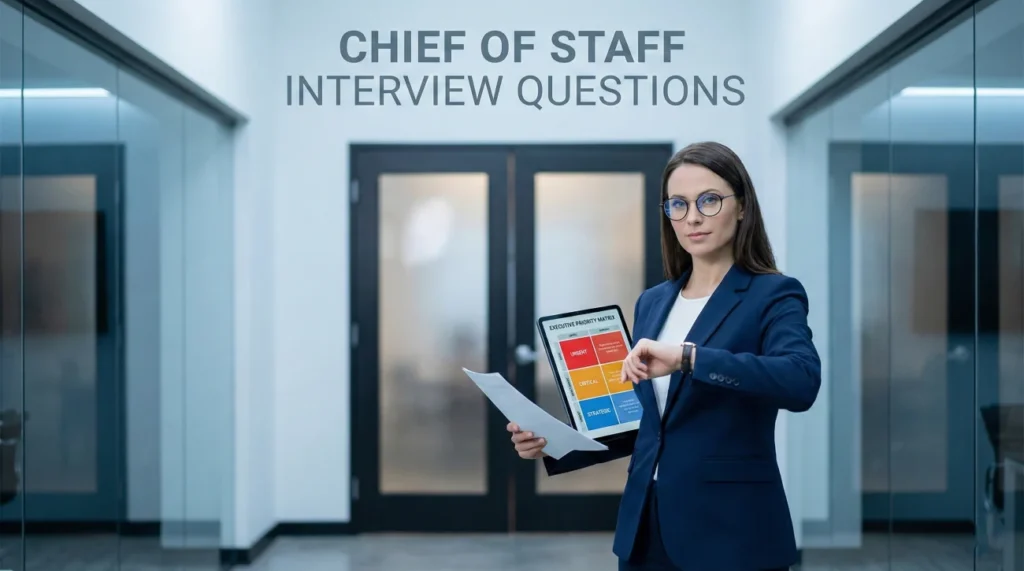
Chief of Staff interview questions are designed to find a unicorn. In 2025, the Chief of Staff (CoS) role has evolved from a political appointment to a critical business function. You are not just an assistant; you are a force multiplier for the CEO. Hiring managers (usually the CEO themselves) are looking for someone who can operate as a “Shadow CEO” : thinking like them, speaking for them, and executing their vision when they are not in the room.
This comprehensive guide decodes the ambiguity of this high-leverage role. We explore the Three Levels of CoS (Organizer, Builder, Advisor), the art of Strategic Gatekeeping (protecting the CEO’s focus without isolating them), and the diplomatic skills required to navigate the C-Suite without formal authority. Whether you are moving from a consulting background or stepping up from a functional leadership role, proving you have the judgment to be the “truth-teller” to power is your ultimate test.
Defining the Undefinable Role
The CoS role varies wildly. You must clarify which “version” of the role you are interviewing for and prove you can adapt.
Q: How do you define the role of a Chief of Staff versus an Executive Assistant (EA)?
Answer: An EA manages the calendar; a CoS manages the time. While an EA ensures the meeting happens logistics-wise, I ensure the meeting is necessary strategically. I prepare the briefing materials, facilitate the decision-making during the meeting, and ensure follow-through on action items afterwards. My job is not just to keep the CEO organized, but to make the CEO effective. I operate at the strategic level of “Why” and “What,” not just “When” and “Where.”
Q: What is your framework for “Proxy Leadership”?
Answer: Proxy leadership means acting with the CEO’s authority when they are absent. To do this, I must “mind-meld” with the CEO. I spend the first 90 days shadowing them to understand their mental models and risk tolerance. When I make a decision in their name, I use the phrase: “Based on our strategic priorities, the CEO’s direction would be X.” I always brief the CEO immediately afterwards to ensure alignment. Trust is the currency of this role.
Q: How do you handle the “Chief Truth Teller” responsibility?
Answer: The CEO often lives in a bubble where people only tell them good news. My job is to burst that bubble. I cultivate a network of “truth-tellers” deep in the organization. When I deliver bad news to the CEO, I do it privately and constructively: “You need to know that the team morale is lower than what the VPs are reporting.” I provide the unvarnished reality so they can make informed decisions, protecting them from their own blind spots.
Q: Describe your experience with “Special Projects.”
Answer: CoS projects are often those that fall into the cracks between departments. For example, leading a post-merger integration or setting up a new international office. I act as the temporary project lead. I assemble a cross-functional Tiger Team, set the milestones, drive execution to 80% completion, and then hand it off to a functional owner to operationalize. I am the “fixer” who jumps into fires so the CEO doesn’t have to.
Strategic Prioritization & Execution
The CEO has 100 priorities. Your job is to cut that list to 3. This section tests your ruthless prioritization skills.
Q: How do you manage the “Office of the CEO” (OOC)?
The Strategy: Operational Rhythm.
Answer: I treat the OOC as a product. I implement a rigorous “Cadence of Accountability.” Weekly staff meetings, Monthly Business Reviews (MBR), and Quarterly Board Prep. I ensure every meeting has a clear agenda and pre-read materials sent 24 hours in advance. If the materials aren’t ready or quality, I cancel the meeting. I protect the CEO’s cognitive load by ensuring they only see decisions that are ripe for making.
Q: A VP demands time with the CEO for an “urgent” issue. How do you triage?
The Strategy: Filter & Empower.
Answer: I ask: “What is the specific decision you need from the CEO?” Often, they just need validation or coordination with another VP. If I can solve it by connecting them with the CFO or General Counsel, I do that. If it truly requires the CEO, I ask for a 1-page briefing first. I schedule them for 15 minutes, not an hour. My goal is to resolve 80% of issues before they hit the CEO’s desk.
Q: How do you prepare the CEO for a Board Meeting?
The Strategy: Narrative Control.
Answer: Preparation starts 4 weeks out. I draft the narrative arc: “What is the headline story?” I assign specific slides to the Executive Team. I review the drafts relentlessly for clarity and consistency (one voice). I schedule a “Dry Run” with the CEO to practice the pitch and anticipate tough questions. I ensure the Board deck is sent out 72 hours in advance. The meeting itself should be a discussion, not a presentation.
Q: How do you track the execution of strategic goals (OKRs)?
The Strategy: The Scorekeeper.
Answer: I am the keeper of the corporate scorecard. I don’t rely on the VPs’ self-reported “Green” status. I look at the leading indicators. I hold monthly “OKR Reviews” where we focus only on the “Red” and “Yellow” items. I ask: “What is the blocker? Do you need resources or a decision?” I create a culture where reporting a problem is safe, but hiding a problem is unacceptable.
Q: How do you handle internal communications from the CEO?
The Strategy: The Ghostwriter.
Answer: I capture the CEO’s voice perfectly. Whether it’s an All-Hands speech, a weekly email, or a crisis memo, I draft it. I balance inspiration with clarity. I ensure the message aligns with our strategic pillars. I also manage the “Feedback Loop” : monitoring Slack/Teams/Glassdoor after a communication to gauge sentiment and advise the CEO on any necessary follow-up or clarification.
Q: How do you ensure cross-functional alignment on critical initiatives?
The Strategy: The Silo-Buster.
Answer: I spot misalignments early. If Product thinks we are launching in Q1 but Marketing thinks Q2, I see that disconnect because I sit in both meetings. I force the “forcing function” meeting: “We are not leaving this room until we agree on the date.” I document the decision and circulate it. I act as the connective tissue between the siloed organs of the company.
Diplomacy & Office Politics
You have high influence but low formal authority over the C-Suite. This requires master-class diplomacy.
Q: How do you manage a C-Suite executive who resents your influence with the CEO?
Answer: I kill them with kindness and utility. I make it clear: “I am not here to replace you or be a shadow COO. I am here to help you get your agenda approved.” I ask: “How can I help you frame this proposal so the CEO says yes?” Once they realize I am an accelerator for their success, not a competitor for power, the resentment usually fades. I check my ego at the door; I don’t need the credit.
Q: The CEO has a “Pet Project” that is distracting the company. How do you kill it?
Answer: I don’t say “No.” I say “Yes, and…” “Yes, we can do this project, and it will require pulling 3 engineers from the core roadmap, which will delay our main launch by 2 months. Is that a trade-off you are comfortable with?” I present the “Opportunity Cost” clearly. Usually, when the CEO sees the price tag in terms of focus, they will kill the project themselves. I let data be the bad guy.
Q: How do you handle confidential information?
Answer: I am a vault. I know salaries, cap tables, and pending layoffs. I never trade gossip to build social capital. I practice “Compartmentalization.” If someone fishes for information (“What did the Board say?”), I give a polite, non-answer: “They are aligned on the strategic direction we discussed at the All-Hands.” My integrity is my only job security; if I leak once, I am done.
Situational & Crisis Management
You are the calm in the eye of the storm. How do you handle the unexpected?
The CEO is incapacitated (medical/family emergency) for a week. What do you do?
The Strategy: Continuity & Calm.
Answer: I do not try to be the CEO. I execute the “Continuity Plan.” I convene the C-Suite and distribute the CEO’s decision-rights according to the pre-agreed matrix (e.g., CFO handles finance approvals, COO handles ops). I cancel non-essential external commitments. I communicate to the Board and key stakeholders: “The CEO is offline, but the leadership team is fully operational.” I keep the ship steady until the Captain returns.
Two executives are in open warfare and refuse to collaborate.
The Strategy: Mediation.
Answer: I step in before it reaches the CEO. I meet with them individually to vent, then bring them together. I reframe the conflict: “We are all on Team Company.” If they can’t agree, I document the two options clearly and bring it to the CEO for a tie-breaker decision. Once the CEO decides, I enforce the “Disagree and Commit” rule. I ensure they don’t relitigate the decision later.
You notice a cultural toxicity issue that the CEO is ignoring.
The Strategy: Mirroring Reality.
Answer: I bring data. “We have lost 3 key female engineers in Q1. Exit interviews cite a hostile environment.” I connect it to business risk: “We cannot hit our product roadmap with this attrition rate.” I propose a solution (Audit, Training, or specific termination). I force the CEO to look at the ugly truth, even if it is uncomfortable. I am paid to protect the company, not the CEO’s feelings.
Chief of Staff IQ Quiz
Test Your Strategic IQ
1. The primary difference between a CoS and an EA is:
- Salary only
- CoS works on strategic/content/decision making; EA works on logistics/calendar
- CoS manages the kitchen
- EA manages the Board
2. “Proxy Leadership” means:
- Fake leadership
- Acting with the authority of the principal (CEO) in their absence
- Using a proxy server
- Leading the IT team
3. “OKRs” stand for:
- Official Key Rules
- Objectives and Key Results
- Only Key Reports
- Office Kitchen Rules
4. A “Tiger Team” is:
- A sports team
- A specialized, cross-functional team assembled to solve a specific critical problem
- A dangerous team
- The marketing team
5. “Gatekeeping” in a CoS context involves:
- Locking the door
- Protecting the leader’s time and cognitive load by filtering requests
- Hiding information
- Firing people
6. “Town Hall” or “All-Hands” meetings are for:
- Voting
- Aligning the entire organization on strategy and culture
- Eating lunch
- Board members only
7. “Information Architecture” for a CEO means:
- Building a library
- Designing how information flows to the CEO (reports, dashboards, meetings) to ensure clarity
- Coding the website
- Organizing files
8. “Shadowing” implies:
- Stalking someone
- Observing the leader closely to learn their decision-making style and context
- Working in the dark
- Being quiet
9. “Managing Up” is:
- Flattery
- Helping your boss be more effective by anticipating needs and providing solutions
- Trying to get their job
- Managing the roof
10. “Briefing Book” or “Pre-Read” is:
- A novel
- A curated document providing all necessary context for a meeting or decision
- A short email
- A legal contract
11. “Cadence of Accountability” refers to:
- Marching band rhythm
- The regular schedule of meetings (Weekly, Monthly, Quarterly) used to drive execution
- Firing schedule
- Daily emails
12. “Servant Leadership” creates value by:
- Being weak
- Empowering and supporting the team to achieve the vision
- Serving food
- Doing everything yourself
13. “Strategic Planning” answers:
- What are we eating?
- Where are we going and how will we get there?
- Who is fired?
- What happened yesterday?
14. “Stakeholder Management” involves:
- Holding stakes
- Balancing the needs and expectations of investors, employees, customers, and board
- Managing the BBQ
- Ignoring complaints
15. “KPI” stands for:
- Keep People Interested
- Key Performance Indicator
- Key Person Index
- Key Profit Item
16. “Change Management” is needed when:
- You change clothes
- Implementing new strategies or structures that affect people’s work
- Counting coins
- Hiring interns
17. “Decision Fatigue” is:
- Being tired of walking
- Deteriorating quality of decisions made by an individual after a long session of decision making
- Hating decisions
- Sleeping in meetings
18. “Post-Mortem” meeting happens:
- At a funeral
- After a project completes (or fails) to analyze what went right and wrong
- Before the project
- During lunch
19. “Silo Busting” means:
- Breaking farm equipment
- Breaking down barriers between departments to foster collaboration
- Firing managers
- Working alone
20. The “North Star” metric is:
- A star in the sky
- The single metric that best captures the core value your product delivers to customers
- Revenue only
- CEO’s salary
❓ FAQ
👔 Is CoS higher than a VP?
It depends. In hierarchy, usually no. VPs run large P&L functions. CoS is an “Influence” role, not a “P&L” role. However, the CoS often has more access to the CEO than a VP. It is a “horizontal” executive role versus a “vertical” one.
⏳ What is the tenure of a CoS?
Typically 18-36 months. It is a high-burnout “tour of duty.” After the rotation, successful Chiefs of Staff often move into VP of Operations, General Manager of a Business Unit, or Strategy roles within the company.
🎓 Do I need an MBA?
It is common but not mandatory. An MBA helps with the broad “Generalist” toolkit (Finance, Strategy, Ops) required. However, ex-consultants or operational leaders with strong EQ and writing skills also thrive.
🤝 How do I avoid being seen as just an assistant?
Focus on outputs not inputs. Don’t just schedule the meeting; prepare the agenda and the decision memo. Don’t just take notes; circulate the action items and follow up on execution. Act like a strategic partner, not a scribe.
🚀 What is the difference between CoS and COO?
A COO runs the business operations and manages the functional heads directly. A CoS runs the CEO’s office and special projects. In smaller startups, the CoS often acts as a “mini-COO” until a real COO is hired.
Final Thoughts
To succeed in answering chief of staff interview questions, you need to project “Servant Leadership” combined with “Executive Presence.” The CEO needs to know you have no ego, but you have a backbone. You are there to serve the mission, even if it means telling the CEO they are wrong.
Highlight your ability to synthesize complexity, manage sensitive relationships, and get things done without formal authority. If you can prove you are the “Connective Tissue” that holds the executive team together, you will secure the role.
⚠️ Disclaimer: The interview strategies, sample answers, and negotiation tips provided in this guide are for educational purposes only. Hiring decisions are subjective and vary by company and industry. While these strategies are based on professional HR standards, they do not guarantee a specific job offer or result.