The Eyes and Ears of Management
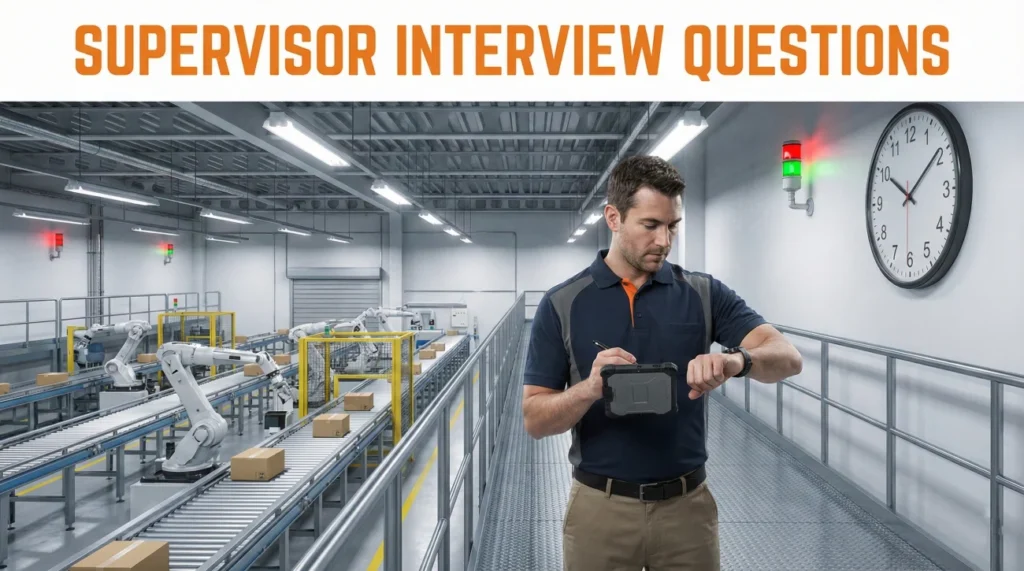
Supervisor interview questions usually come from one fear: “Will this person hold the line when nobody is watching?” A supervisor is the on-the-floor authority who keeps standards consistent, even when the team tries to negotiate every rule.
Most interviews move straight into scenarios: coverage gaps, break schedules, safety compliance, and performance issues that get uncomfortable because they involve real people. The best candidates show steady judgment, fair enforcement, and a habit of solving problems early.
Shift Management & Logistics
The core of your job is ensuring the shift runs smoothly. Interviewers want to see your problem-solving skills in real-time.
Q: Walk me through your process for opening the facility/store.
Answer: I follow a strict checklist. I arrive 30 minutes early to do a perimeter check for safety. I disable the alarm and turn on the lights/systems. I walk the floor to ensure the closing shift left it “ready to trade” (clean and stocked). I review the roster to see who is coming in and identify any gaps. Finally, I conduct a “Pre-Shift Huddle” to communicate targets and safety focuses for the day. A strong start prevents chaos later.
Q: Three employees call out sick 1 hour before a busy shift. What do you do?
Answer: I triage the situation. First, I assess the workload: can we delay non-essential tasks (like stocking) to focus on customers? Second, I blast a message to the team group chat offering overtime for anyone who can come in immediately. Third, I redraw the floor plan to put my strongest people in the busiest spots. Finally, I step in to fill the gaps myself, but I remain “mobile” enough to supervise the whole floor, not just get stuck at one station.
Q: How do you manage break times to ensure coverage?
Answer: I stagger breaks based on traffic flow, not just employee preference. I create a break schedule at the start of the shift and write it on the whiteboard. I ensure no more than one person from a critical department is off at a time. I also ensure everyone actually takes their legal breaks to avoid labor law violations and burnout. I am the timekeeper.
Q: Describe how you handle a “Shift Handoff” to the next supervisor.
Answer: Communication is safety. I don’t just wave goodbye. I do a “Walk and Talk” with the incoming Supervisor. I highlight any issues: “The POS system is lagging on Register 2,” “Sarah is leaving early for a doctor’s appointment,” or “We had a customer complaint at table 4.” I ensure the cash drawers are balanced and the floor is clean so they start fresh. I treat them how I want to be treated.
Discipline & Policy Enforcement
This is the hardest part of the job. Can you hold people accountable?
Q: You see an employee violating a safety rule (e.g., not wearing PPE).
The Strategy: Immediate Correction.
Answer: I stop the work immediately. Safety has no grey area. I pull them aside (to avoid public shaming) and ask: “Where are your safety glasses?” I wait for them to put them on. I explain: “I need you safe. If you get hurt, it affects your family and the team.” I document the verbal warning. If I ignore it, I am liable for the accident.
Q: An employee is consistently 10 minutes late.
The Strategy: Pattern Recognition.
Answer: I address the pattern, not just the instance. “You have been late 3 times this week. Is there a reason?” If it is a bus schedule issue, maybe we adjust their start time. If it is lack of discipline, I revert to policy: “Our start time is 8:00, not 8:10. If this continues, we will move to a written warning.” I am fair but firm; lateness disrespects the colleagues who showed up on time.
Q: You suspect an employee is stealing time (taking long breaks).
The Strategy: Verify then Act.
Answer: I gather facts first. I check the camera logs or swipe-card data. Once I have proof, I have the conversation. “Our records show you were away from your station for 45 minutes on a 15-minute break.” I listen to their explanation. Unless it was a medical emergency, I document it as a policy violation. Theft of time is theft of money.
Q: How do you discipline a former peer/friend?
The Strategy: Separate Roles.
Answer: It is awkward but necessary. I say: “As your friend, I want you to keep this job. As your Supervisor, I cannot ignore this behavior because it’s unfair to everyone else.” I focus on the policy, not the person. “The rule is X, you did Y.” By making it about the rule, I depersonalize the conflict.
Q: An employee refuses a direct request (Insubordination).
The Strategy: Calm Authority.
Answer: I do not yell. I ask: “Are you refusing to do this task?” giving them a chance to clarify. If they say yes, I ask “Why?” If it is a safety concern, I listen. If it is just attitude, I say: “This is a reasonable request required for your role. Refusal is grounds for disciplinary action. I need you to do it now, or punch out and go home.” I resolve the standoff immediately.
Q: How do you handle “Ghosting” (No Call, No Show)?
The Strategy: Documentation.
Answer: I try to contact them once to ensure they are safe/alive. If no response, I document it as a “No Call No Show.” I follow company policy strictly (usually termination after 1-2 instances). I do not hold the spot open indefinitely. I focus my energy on the people who did show up, thanking them for covering the gap.
Motivation & Team Building
Supervisors have the biggest impact on daily morale. How do you keep the energy up?
Q: How do you motivate staff to do unpleasant tasks (cleaning bathrooms/inventory)?
Answer: I lead by example. I am not “too good” to clean a toilet. If the team sees me picking up trash, they will pick up trash. I also rotate the unpleasant duties fairly so no single person is stuck with them every week. I explain the “Why”: “A clean restroom tells the customer the kitchen is clean too.”
Q: Describe your style of giving praise.
Answer: I praise publicly and loudly. “Hey everyone, look at how perfectly Sarah organized this shelf!” I use the “Spot Bonus” if I have a budget, or simple perks like letting them go home 15 minutes early (paid) if the work is done. I make sure the praise is specific, not just “Good job.” Specific praise reinforces the exact behavior I want to see repeated.
Q: How do you handle a “Negative Nancy” who brings down team morale?
Answer: Negativity is contagious. I isolate the behavior. I talk to them privately: “I noticed you’ve been venting a lot about the new schedule. When you do that on the floor, it drains the energy of the new hires.” I ask them to bring complaints to me directly, not to the team. If they can’t stop poisoning the well, I reduce their influence or manage them out.
Situational Scenarios
Real-life problems don’t follow a script. These questions test your judgment.
You suspect an employee is under the influence of drugs/alcohol on shift.
The Strategy: Safety & Liability.
Answer: I bring a witness (another lead/manager) with me. I observe the behavior (slurred speech, smell, unsteadiness). I pull them off the floor immediately to a private office. “I am concerned for your safety; you seem impaired.” I do not diagnose them. I arrange for them to get home safely (taxi/family); I never let them drive. I document everything for HR to handle the next steps (drug test/termination).
A customer is screaming at a cashier and making them cry.
The Strategy: Protect the Team.
Answer: I step in immediately and physically position myself between the customer and the employee. “Sir, please speak to me, let me handle this.” I send the employee to the break room to recover. I am firm with the customer: “I want to help you, but I cannot allow you to yell at my staff.” I de-escalate, but if they remain abusive, I ask them to leave. My loyalty is to my team’s safety.
The Manager gave you instructions that you know will fail on the floor.
The Strategy: Feedback Loop.
Answer: I share my concern privately before the shift. “I understand the goal is speed, but if we reduce staff on the packing line, we will create a bottleneck at dispatch.” I propose an alternative or a pilot test. If the Manager insists, I execute it to the best of my ability (“Disagree and Commit”), but I document the results to discuss later: “We tried the new layout, and output dropped 10%.” Data wins arguments.
Supervisor Knowledge Quiz
Test Your Supervisor IQ
1. “Span of Control” refers to:
- How long you can yell
- The number of employees a supervisor can effectively manage
- The size of the store
- The length of the shift
2. “Progressive Discipline” usually follows this order:
- Fire, Suspended, Warning
- Verbal Warning, Written Warning, Suspension/Final Warning, Termination
- Written Warning, Verbal Warning, Fire
- None of the above
3. “Insubordination” is:
- Being late
- Willful refusal to obey a lawful and reasonable order from a supervisor
- Stealing
- Being bad at the job
4. “Call-Out” or “Call-In” means:
- Yelling at someone
- An employee contacting the employer to say they cannot work their scheduled shift
- Ordering pizza
- Calling a customer
5. “Ghosting” in the workplace is:
- Working late
- An employee stopping work without notice and cutting off communication
- Wearing a costume
- Stealing supplies
6. “MBWA” stands for:
- Making Business Work Always
- Management By Walking Around
- Money Back Warranty Action
- My Boss Will Arrive
7. A “Pre-Shift” or “Stand-up” is for:
- Exercise
- Communicating goals, safety issues, and updates before work begins
- Eating breakfast
- Checking phones
8. “Time Theft” includes:
- Stealing a clock
- Clocking in for a friend (buddy punching) or taking extended breaks while on the clock
- Working too fast
- Working overtime
9. “SOP” stands for:
- Standard Operating Procedure
- Standard Operating Procedure
- Supervisor On Phone
- Staff Orientation Plan
10. “Incident Report” is used to document:
- Good behavior
- Accidents, injuries, theft, or safety breaches
- Inventory levels
- Sales numbers
11. “Keyholder” means:
- Someone who owns a keychain
- An employee trusted with keys/codes to open and close the business
- The janitor
- The owner only
12. “Shrinkage” refers to:
- Cold water
- Loss of inventory due to theft, error, or damage
- Weight loss
- Reduction in staff
13. “Corrective Action” is another term for:
- Fixing a machine
- Disciplinary steps taken to improve employee behavior
- Training
- Hiring
14. “Fair Labor Standards Act” (FLSA) covers:
- Food quality
- Minimum wage, overtime pay, and child labor standards
- Dress code
- Customer rights
15. “Burnout” happens when:
- There is a fire
- Employees are physically/emotionally exhausted from chronic stress
- The shift is short
- The pay is high
16. “Micromanagement” is:
- Good leadership
- Excessive control over small details of work, reducing staff autonomy
- Using a microscope
- Managing a small store
17. “Closing Duties” ensure:
- The door is locked
- The facility is cleaned, stocked, and secured for the next day’s opening team
- Everyone goes home
- The lights are off
18. “Performance Appraisal” is:
- A party
- A formal review of an employee’s work over a period
- A firing
- A training session
19. “Chain of Command” means:
- A metal chain
- The line of authority from top management down to frontline staff
- Military only
- No talking
20. “Coverage” refers to:
- Insurance
- Having enough staff scheduled to handle the workload
- A blanket
- Hiding mistakes
❓ FAQ
🧭 What is the real difference between a Supervisor and a Team Lead?
A Team Lead often influences through coordination. A Supervisor is expected to enforce policy, document issues, and protect compliance and safety. The role has more accountability, not just more tasks.
🧱 How do I answer questions about discipline without sounding harsh?
Focus on fairness and clarity. Describe how you address behavior privately, reference standards, coach first when appropriate, and escalate only when patterns continue.
⏱️ What is a strong way to talk about scheduling and coverage?
Explain how you plan around demand, stagger breaks, and keep critical positions covered. Mention a simple system: a visible schedule, clear handoffs, and quick adjustments when reality changes.
🦺 How do I show I take safety seriously without being rigid?
Talk about non-negotiables and coaching. Correct unsafe behavior immediately, explain the “why,” and document repeat issues. Safety becomes culture when it is consistent, not loud.
😤 How should I handle a customer who is abusive to staff?
Protect the employee first, then manage the situation. Step in, set boundaries, and move the conversation away from the team member. De-escalate when possible, and use security or higher support when needed.
Final Thoughts
To land a Supervisor role, your answers to supervisor interview questions should show backbone with control. Companies promote supervisors to reduce chaos, not to create conflict. Calm enforcement is the skill.
Wrap up with one story that proves you can balance people and policy: you coached, documented, and protected standards without losing the team. If you are also being evaluated for broader ownership, compare your examples against manager interview question themes so your framing scales.
⚠️ Disclaimer: The interview strategies, sample answers, and negotiation tips provided in this guide are for educational purposes only. Hiring decisions are subjective and vary by company and industry. While these strategies are based on professional HR standards, they do not guarantee a specific job offer or result.