- Core message: Interviewers want a strategic mix of hard skills and soft skills, because doing the work and working well with others are both part of performance.
- Clear definitions: Hard skills are teachable and testable abilities, while soft skills are behavioral capabilities judged through stories, patterns, and real examples.
- Balance depends on role: Technical jobs should lead with technical depth and support it with collaboration skills, customer-facing roles need both equally, and leadership roles must prioritize people and judgment.
- Strength and weakness strategy: Choose a primary strength from what the job values most, add a complementary strength from the other side, and pick a safe weakness from the less critical category with a real improvement plan.
- Show integration, not lists: The strongest answers connect a technical action to a human outcome, proving impact through concrete context and results.
The Strategic Skill Portfolio
Understanding hard skills vs soft skills transforms how you position yourself in interviews. Candidates who overemphasize technical capabilities while ignoring interpersonal competencies raise collaboration concerns. Those who showcase only soft skills without demonstrating technical depth struggle to prove they can actually perform job functions. The strategic approach balances both, creating a compelling profile that addresses what interviewers truly assess – whether you can both do the work and work well with others.
The technical vs interpersonal skills balance matters because modern roles rarely succeed on pure technical ability alone. Even highly technical positions require communication, teamwork, and adaptability. Customer-facing roles demand technical knowledge alongside empathy and persuasion. Leadership positions need strategic thinking paired with people management. Interviewers evaluate whether you possess the right mix for your specific role – not whether you excel in one category while neglecting the other.
This guide breaks down the fundamental differences between skill types, strategic approaches to balancing your profile, and specific tactics for choosing strengths and weaknesses that demonstrate well-rounded professional capabilities.
Defining Hard and Soft Skills
Hard skills represent measurable, teachable abilities typically acquired through formal education, training, or practice. Soft skills encompass interpersonal attributes, behavioral traits, and emotional intelligence that affect how you work with others and navigate professional situations.
| Characteristic | Hard Skills | Soft Skills |
|---|---|---|
| Measurability | Easily quantified and tested (certifications, proficiency levels) | Difficult to measure objectively (observed through behavior) |
| Development path | Learned through courses, training programs, structured practice | Developed through experience, self-awareness, coaching |
| Transferability | Often industry or role-specific (SQL, CAD, GAAP accounting) | Highly transferable across roles and industries |
| Verification | Provable through credentials, portfolios, demonstrations | Assessed through behavioral interviews, references, work samples |
| Time to develop | Can be learned relatively quickly with focused effort | Often require longer development through repeated practice |
Common Hard Skills by Role Type
Hard skills vary dramatically by field and position. What qualifies as essential technical knowledge in one industry may be irrelevant in another.
- 💻 Technology roles: Programming languages, database management, cloud platforms, cybersecurity protocols
- 📊 Finance/accounting: Financial modeling, regulatory compliance, tax law, audit procedures, ERP systems
- 🎨 Creative roles: Design software, video editing, animation tools, typography, color theory
- ⚕️ Healthcare: Medical procedures, diagnostic skills, equipment operation, pharmaceutical knowledge
- 🏗️ Engineering: CAD software, structural analysis, materials science, building codes, project management
Universal Soft Skills
Unlike hard skills, soft skills remain valuable across nearly all professional contexts. These capabilities determine how effectively you collaborate, communicate, and contribute beyond pure technical execution.
| Soft Skill Category | Specific Examples | Why It Matters |
|---|---|---|
| Communication | Active listening, clarity, persuasion, presentation, writing | Enables knowledge sharing, alignment, stakeholder management |
| Collaboration | Teamwork, conflict resolution, empathy, inclusivity, compromise | Determines effectiveness working across functions and personalities |
| Adaptability | Flexibility, learning agility, resilience, open-mindedness | Critical in changing environments or ambiguous situations |
| Problem-solving | Critical thinking, creativity, analytical reasoning, resourcefulness | Drives innovation and handles unexpected challenges |
| Leadership | Decision-making, delegation, motivation, mentoring, strategic thinking | Essential for managing others and influencing without authority |
| Work ethic | Reliability, time management, accountability, persistence, professionalism | Determines consistent performance and trustworthiness |
Expert advice: When discussing soft skills in interviews, always back them with concrete examples. “I’m a strong communicator” means nothing. “I simplified our technical documentation, reducing support tickets by 30% because users could solve problems independently” demonstrates communication skill through measurable impact.
Finding Role-Appropriate Balance
The optimal skill balance strategy varies by role, industry, and career stage. Individual contributor positions often weight hard skills more heavily. Management roles prioritize soft skills. Customer-facing positions require balanced emphasis on both.
Technical and Specialized Positions
For roles where technical execution drives core value – engineering, data science, accounting, design – lead with hard skills but acknowledge essential soft skills that enable you to apply technical knowledge effectively.
💡 Pro tip: In technical interviews, emphasize hard skills as primary strengths but mention soft skills that amplify technical capabilities. “My Python expertise enables complex analysis, and my ability to visualize findings helps non-technical stakeholders understand and act on insights.”
- Primary strength: Deep technical capability directly relevant to role requirements
- Supporting strength: Soft skill that enhances technical contribution (communication, collaboration)
- Safe weakness: Soft skill less critical for role (public speaking, networking)
- Avoid as weakness: Core technical competencies or collaboration abilities
Customer-Facing and Service Roles
Sales, customer success, account management, and client services positions require balancing product/service knowledge with interpersonal skills. Both categories matter equally – technical knowledge without people skills alienates customers, while charm without expertise fails to solve problems.
| Position Type | Lead With | Also Emphasize | Safe Weakness |
|---|---|---|---|
| Sales | Relationship building, persuasion, resilience | Product knowledge, market understanding | Technical depth in non-customer-facing areas |
| Customer support | Empathy, patience, problem-solving | Product expertise, troubleshooting skills | Strategic planning, data analysis |
| Account management | Communication, strategic thinking, trust-building | Industry knowledge, business acumen | Technical implementation details |
Leadership and Management Positions
Management roles flip the traditional balance – soft skills become primary qualifications while technical knowledge provides necessary context but doesn’t drive day-to-day success. Effective leaders enable team performance through people skills more than personal technical execution.
- 🎯 Primary focus: Leadership, communication, decision-making, team development
- 💼 Supporting context: Technical or domain knowledge sufficient to guide team effectively
- ⚠️ Common pitfall: Over-emphasizing technical skills suggests difficulty transitioning to leadership mindset
- ✅ Strategic positioning: Demonstrate you’ve evolved from technical expertise to people leadership
For leadership roles, avoid choosing technical weaknesses unless they’re truly peripheral. Saying “I’m less hands-on with code now” works for engineering managers. Admitting “I struggle with strategic planning” raises serious concerns about core management capabilities.
Strategic Strength Selection
When asked about greatest strengths, your answer should demonstrate professional competency mix appropriate for the target role. The strongest candidates choose primary strengths from the category their role values most, then acknowledge complementary strengths from the other category.
Choosing Your Primary Strength
Select your greatest strength from whichever skill category drives core job success. For technical roles, lead with hard skills. For people-intensive positions, emphasize soft skills. This alignment shows you understand what the role actually requires.
Expert advice: Study the job description carefully for emphasis clues. If technical requirements dominate the listing, hard skills matter most. If descriptions focus on teamwork, stakeholder management, or leadership, soft skills take priority. Match your strength emphasis to their stated priorities.
Acknowledging Complementary Strengths
After establishing your primary strength, briefly mention a complementary strength from the opposite category. This demonstrates you’re well-rounded rather than one-dimensional.
| Primary Strength (Hard Skill) | Complementary Strength (Soft Skill) | Combined Impact |
|---|---|---|
| Advanced data analysis capabilities | Ability to translate findings for non-technical audiences | Insights actually drive decisions because stakeholders understand them |
| Cloud architecture expertise | Cross-functional collaboration skills | Technical solutions that align with business needs, not just technical elegance |
| Financial modeling proficiency | Clear communication of complex scenarios | Models that inform strategy because executives can interpret implications |
| Primary Strength (Soft Skill) | Complementary Strength (Hard Skill) | Combined Impact |
|---|---|---|
| Building strong client relationships | Deep product knowledge | Clients trust you and you deliver informed recommendations |
| Leading cross-functional teams effectively | Understanding technical constraints | Leadership grounded in reality, not disconnected from execution |
| Conflict resolution and mediation | Process design and optimization | Resolve disputes through improved systems, not just temporary peace |
For comprehensive guidance on structuring strength answers that balance technical and interpersonal capabilities, explore behavioral interview resources providing detailed frameworks and examples.
Strategic Weakness Selection
Smart weakness selection considers which skill type matters less for your target role, then chooses a genuine but fixable limitation from that category. This prevents admitting deficiencies in critical competencies while still demonstrating honest self-awareness.
Category Selection Rules
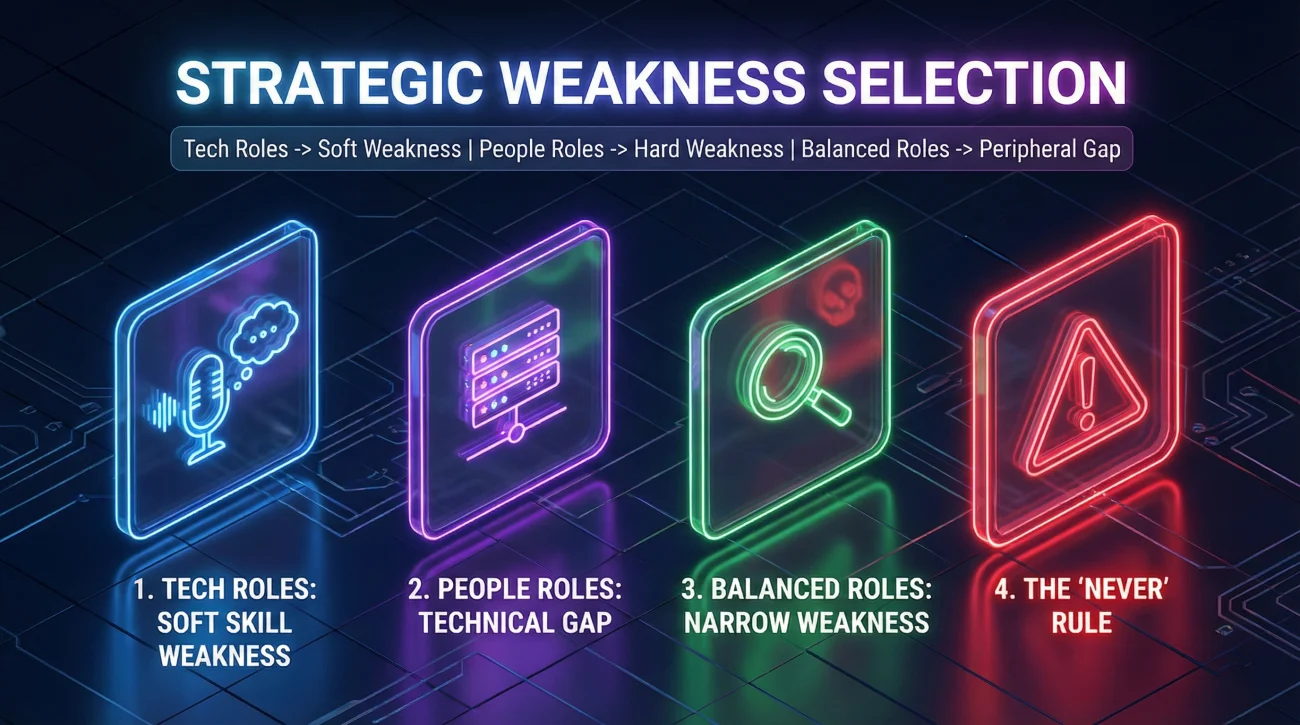
Choose weaknesses from the skill category that’s less central to role success. Technical positions allow soft skill weaknesses. People-intensive roles permit technical weaknesses. This strategic selection acknowledges development areas without undermining your core value proposition.
- 💻 For technical roles: Choose soft skill weaknesses like public speaking, networking, or executive presence
- 👥 For people roles: Choose technical skill gaps in areas peripheral to core responsibilities
- ⚖️ For balanced roles: Select whichever category has less critical gaps, or choose a narrow weakness within either type
- 🚫 Never choose: Weaknesses in the primary skill category your role requires for success
Safe Weakness Examples by Role Type
Understanding which weaknesses work for which roles prevents accidentally disqualifying yourself through poor weakness choices.
| Role Type | Safe Hard Skill Weaknesses | Safe Soft Skill Weaknesses |
|---|---|---|
| Software engineer | Limited experience with specific niche technologies | Public speaking, networking, executive communication |
| Sales representative | Deep technical product details, backend systems | Over-personalizing client relationships (being too friendly) |
| Project manager | Advanced technical implementation skills | Saying no to stakeholders, managing scope creep |
| Data analyst | Advanced programming beyond SQL/Python basics | Translating technical findings to lay audiences |
| Customer support | Backend system architecture, database design | Maintaining emotional boundaries with difficult customers |
💡 Pro tip: Frame weaknesses you’re actively addressing with specific development efforts. “I’m developing public speaking skills through Toastmasters” shows initiative. “I struggle with presentations” without improvement plan suggests acceptance of limitation.
Career Stage Considerations
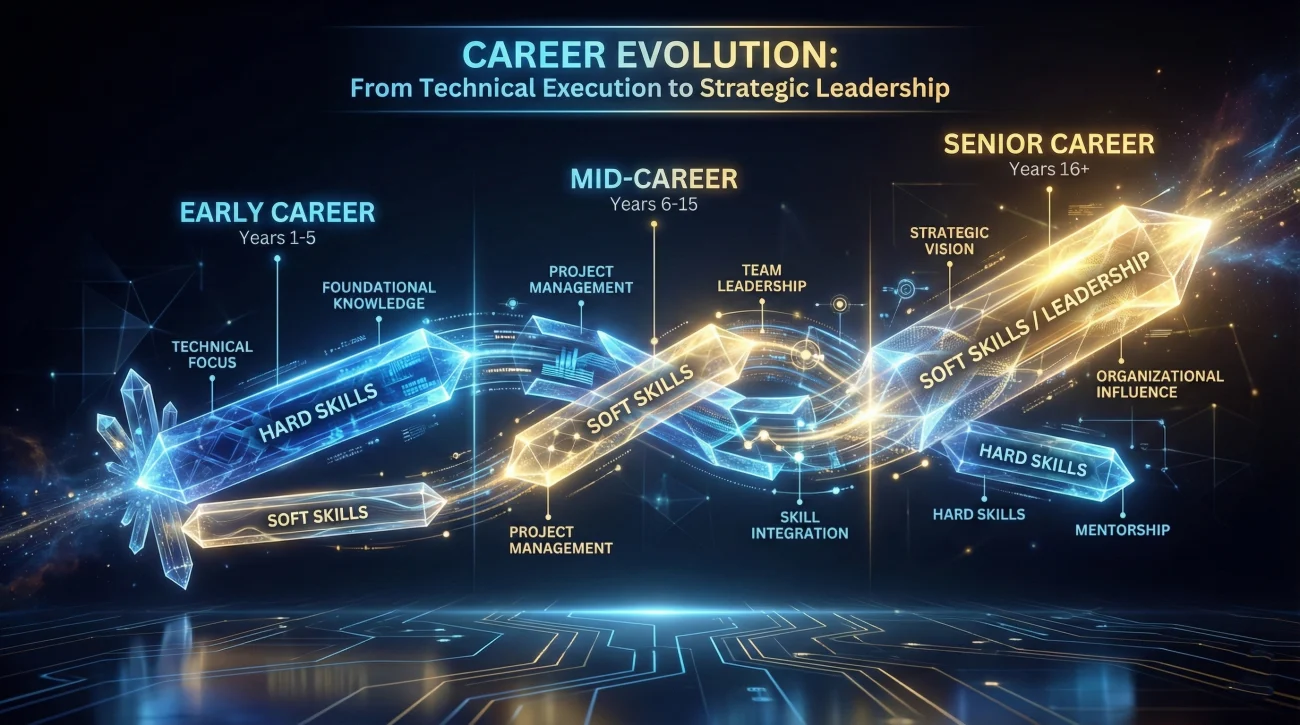
Optimal skill balance shifts as you advance through career stages. Entry-level candidates need more hard skill emphasis. Senior professionals should demonstrate soft skill development alongside maintained technical competence.
Early Career (0-3 years)
Early career professionals should emphasize hard skills proving they can perform job functions, while acknowledging they’re developing professional soft skills through experience.
- Strength focus: Technical skills, certifications, relevant coursework or training
- Complementary strengths: Learning agility, coachability, enthusiasm
- Acceptable weaknesses: Experience-dependent soft skills like executive communication, strategic thinking
- Avoid as weaknesses: Core technical skills or basic professional behaviors (punctuality, reliability)
Mid-Career (4-10 years)
Mid-career professionals should demonstrate balanced mastery of both categories, showing technical depth alongside developed interpersonal capabilities.
Expert advice: Mid-career is the transition point where pure technical skill becomes insufficient. If you’ve focused exclusively on hard skills for 5+ years, deliberately develop and emphasize soft skills to remain promotable. Companies promote based on soft skills at this stage – technical competence is assumed.
Senior Career (10+ years)
Senior professionals should lead with soft skills while maintaining sufficient hard skill currency to provide credible technical guidance. At this level, you’re valued more for judgment, leadership, and strategic thinking than personal technical execution.
| Career Stage | Primary Value Proposition | Skill Balance Strategy |
|---|---|---|
| Entry-level (0-3 years) | Technical capability, learning potential | 70% hard skills, 30% soft skills |
| Mid-career (4-10 years) | Independent execution, mentoring ability | 50% hard skills, 50% soft skills |
| Senior (10-15 years) | Strategic thinking, team leadership | 30% hard skills, 70% soft skills |
| Executive (15+ years) | Vision, organizational leadership, business acumen | 20% hard skills, 80% soft skills |
Demonstrating Integrated Skills
The most compelling candidates don’t just list hard and soft skills separately – they show how both categories work together to produce superior results. This integration demonstrates sophisticated understanding of how professional success actually works.
Integration in Success Stories
Structure achievement stories showing how hard and soft skills combined to solve problems or create value. This approach is more powerful than claiming either skill type in isolation.
Weak example: “I’m skilled at Python programming and I communicate well.”
Strong example: “I used Python to analyze customer churn patterns, discovering that users abandoned our product after specific friction points. I presented these findings to the product team using visualizations they could understand, which led to UX changes reducing churn by 23%.”
This strong version demonstrates technical skill (Python analysis), soft skills (stakeholder communication, data visualization), and measurable impact – showing how both skill types combined to drive results.
Avoid artificial separation of hard and soft skills in your answers. Real work doesn’t separate them – technical problems require people skills to solve, and people challenges need structured thinking. Demonstrate integrated application, not isolated capabilities.
❓ FAQ
🎯 Should I mention both hard and soft skills in every interview answer?
Not necessarily in every answer, but throughout the interview your responses should collectively demonstrate both categories. When asked about greatest strength, emphasize whichever type matters most for the role, then briefly acknowledge the complementary type showing interview skill positioning awareness.
💼 What if I’m weak in both hard and soft skills for a role?
If you lack critical capabilities in both categories, you may not be qualified for the role yet. Focus job search on positions matching your current skill set, or invest time developing missing competencies before applying. Trying to fake capabilities you lack will fail during interviews or performance.
⏰ Can hard skills and soft skills both be weaknesses?
Yes, but choose weaknesses carefully from each category when asked for multiple development areas. Ensure weaknesses aren’t core requirements and that you’re actively addressing them. Never volunteer weaknesses in both categories unless specifically asked to discuss multiple development areas.
📋 How do I prove soft skills when they’re hard to measure?
Use specific behavioral examples with measurable outcomes. “I’m a good communicator” is unprovable. “I simplified technical documentation, reducing support tickets by 30%” demonstrates communication skill through quantifiable impact. Always connect soft skills to concrete results.
✨ Should career changers emphasize transferable soft skills?
Yes, but also demonstrate you’re developing required hard skills for the new field. Career changers should emphasize transferable soft skills (leadership, problem-solving, communication) while showing active hard skill development through courses, projects, or certifications. This combination proves both capability and commitment to the transition.
Final Thoughts
Mastering the hard skills vs soft skills balance determines interview success more than excellence in either category alone. The strongest candidates understand what their target role values most, lead with capabilities from that category, and demonstrate complementary strengths from the other category. This strategic positioning shows you’re both technically capable and professionally mature – able to execute job functions while working effectively with others.
Smart skill balancing extends beyond choosing what to emphasize. It shapes your entire interview narrative – which accomplishments you highlight, how you structure achievement stories, which weaknesses you admit, and how you position your development trajectory. Candidates who understand this strategic dimension stand out from those who simply list skills without considering how the combination affects their perceived fit.
Before your next interview, analyze target role requirements to determine whether hard or soft skills drive success. Structure your strength, weakness, and achievement answers to demonstrate appropriate balance. Practice integrating both skill types in your stories rather than discussing them separately. This preparation ensures your skill portfolio positions you as the complete professional package employers actually want to hire.
⚠️ Disclaimer: The interview strategies, sample answers, and negotiation tips provided in this guide are for educational purposes only. Hiring decisions are subjective and vary by company and industry. While these strategies are based on professional HR standards, they do not guarantee a specific job offer or result.