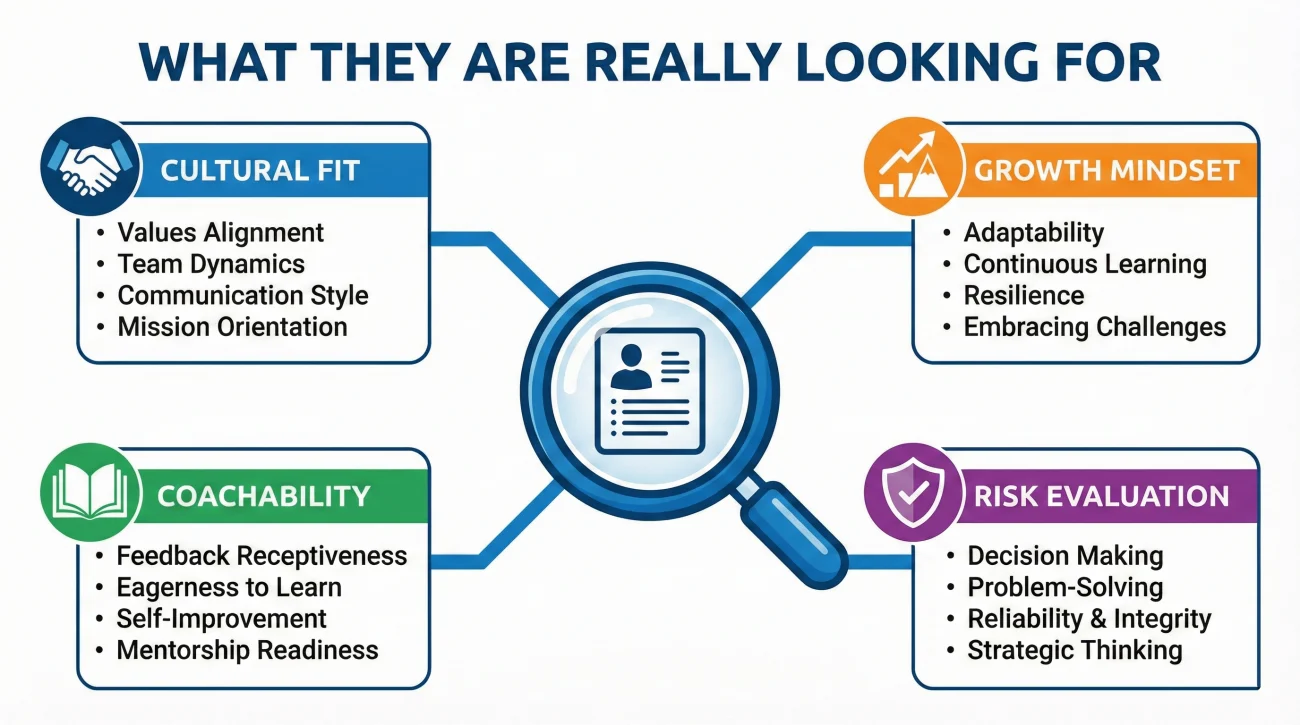
- What They Are Testing: Self-awareness, strategic thinking, cultural fit, coachability, growth mindset, and whether your weaknesses could derail this role.
- How To Pick Strengths: Choose one that matches the job’s real needs, then prove it with a concrete STAR example and measurable impact.
- How To Answer Weaknesses: Use a real but fixable weakness, explain the steps you’re taking, and show clear progress, never pick a core requirement or a fake “humblebrag.”
- Balance And Tailor: Mix hard skills and soft skills wisely, keep multiple strength and weakness options ready, and adjust to different question wordings.
- Prep That Actually Works: Do a personal SWOT using real evidence, practice delivery so each answer lands in about 60–90 seconds, and keep your tone confident and grounded.
The Interview Question Everyone Fears
Preparing for strengths and weaknesses interview questions separates confident candidates from those who freeze or fumble. These questions aren’t asking for honest self-reflection – they’re assessing your self-awareness, strategic thinking, and ability to position yourself effectively. Weak answers reveal poor judgment. Strong answers demonstrate you understand what the role needs and how you fit.
Understanding how to answer weakness questions matters because most candidates either choose terrible weaknesses (admitting deal-breakers) or obviously fake ones (claiming perfectionism while really bragging). Both approaches fail. The strategic approach requires choosing genuine but fixable limitations you’re actively addressing, then demonstrating the growth mindset interviewers actually want to see.
This guide breaks down the psychology behind these questions, frameworks for selecting compelling answers, and strategic approaches that turn potentially awkward moments into opportunities to showcase professional maturity.
Why Interviewers Ask These Questions
Interviewers don’t actually want to hear about your deep personal flaws or amazing superpowers. They’re assessing multiple competencies simultaneously through these deceptively simple questions.
Evaluating Self-Awareness
Can you accurately assess your own capabilities? People who lack self-awareness make poor employees – they overcommit, resist feedback, or blame others when things go wrong. Your ability to articulate realistic strengths and weaknesses signals you can evaluate yourself honestly.
- ✅ Cultural fit assessment: Do your stated strengths align with company values?
- ✅ Coachability check: Can you accept and act on developmental feedback?
- ✅ Growth mindset verification: Do you view abilities as fixed or developable?
- ✅ Risk evaluation: Might your weaknesses derail performance in this role?
Expert advice: Interviewers care less about the specific strength or weakness you choose than how you talk about it. Demonstrating awareness of how your traits affect others and showing active efforts to leverage strengths or address weaknesses signals professional maturity.
Testing Strategic Thinking
Smart candidates choose answers that position them advantageously. Claiming your greatest strength is something irrelevant to the job signals you don’t understand what matters. Admitting a weakness that’s actually a core job requirement reveals poor judgment about what to disclose.
Never choose weaknesses that are actually required competencies for the role. If you’re interviewing for sales, don’t say you struggle with rejection. If it’s customer service, don’t admit you hate dealing with difficult people.
Strategic Approach to Strengths
Effective choosing interview strengths requires balancing authenticity with strategy. Your strength should be genuine, relevant to the role, and backed by concrete evidence.
Relevance Trumps Everything
Study the job description carefully. What skills appear repeatedly? What challenges does the role face? Your stated strength should directly address a core job requirement or solve a known pain point. Being amazing at something irrelevant to the position impresses nobody.
| Role Type | High-Value Strengths | Lower-Value Strengths |
|---|---|---|
| Customer-facing roles | Communication, empathy, conflict resolution | Technical depth, independent work |
| Technical positions | Problem-solving, technical skills, analytical thinking | Extroversion, sales ability |
| Leadership roles | Decision-making, mentoring, strategic thinking | Individual contributor skills |
| Creative positions | Innovation, adaptability, creative problem-solving | Strict adherence to protocols |
Providing Concrete Evidence
Claiming “I’m a great communicator” means nothing without proof. Back every strength with specific examples demonstrating impact. Use the STAR method: describe a Situation where this strength mattered, the Task you faced, Actions you took leveraging this strength, and measurable Results achieved.
💡 Pro tip: Quantify results whenever possible. “Improved team communication” is vague. “Implemented daily standups that reduced miscommunication-related delays by 40%” provides concrete evidence of your strength’s value.
Identifying Your Unique Selling Point
What makes you distinctively valuable compared to other qualified candidates? This becomes your greatest strength – the capability that positions you as the optimal choice. Look for intersections between your skills, the role’s needs, and what competitors likely lack.
- Analyze job requirements against your experience for overlaps
- Consider what combination of skills makes you unique
- Reflect on consistent feedback from managers or colleagues
- Identify strengths you’ve leveraged successfully multiple times
- Choose capabilities you can discuss passionately and authentically
Strategic Approach to Weaknesses
Navigating weakness questions requires careful selection of genuine but manageable limitations you’re actively addressing. This isn’t about confessing fatal flaws – it’s demonstrating self-awareness and commitment to growth.
The Fixable Weakness Principle
Choose weaknesses you’re actively working to improve with visible progress. This shows growth mindset and accountability. Avoid traits you can’t or won’t change, as these signal you’ll bring permanent problems to the role.
- ✅ Skill gaps: Technical abilities you’re learning through courses or practice
- ✅ Process improvements: Organizational habits you’re systematically developing
- ✅ Interpersonal adjustments: Communication patterns you’re consciously modifying
- ❌ Personality traits: Core characteristics unlikely to change significantly
- ❌ Values conflicts: Fundamental misalignments with job requirements
The Growth Arc Framework
Structure weakness answers as transformation narratives: acknowledge the limitation, describe specific steps you’re taking to address it, and demonstrate measurable improvement. This three-part arc transforms potential negatives into evidence of self-directed professional development examples.
Expert advice: The weakness itself matters less than how you’re addressing it. “I struggled with public speaking” becomes compelling when followed by: “So I joined Toastmasters six months ago, have delivered five presentations, and recently presented our quarterly results to 50+ stakeholders with positive feedback.”
| Weak Answer Pattern | Strong Answer Pattern | Why It Works |
|---|---|---|
| “I’m too much of a perfectionist” | “I sometimes over-research before deciding. I’ve implemented 30-minute time-boxes for initial analysis to balance thoroughness with decisiveness” | Specific, genuine, shows active improvement |
| “I don’t have weaknesses in this area” | “Early in my career I struggled with delegation. I’ve since learned to assess task complexity vs team capability and now regularly delegate with clear expectations” | Shows growth over time, professional maturity |
| “I work too hard” | “I’m building stronger boundaries around work hours. I now block focus time and communicate availability, which has improved both productivity and wellbeing” | Addresses real concern, demonstrates self-care |
Avoiding Fatal Flaws
Some weaknesses instantly disqualify candidates. Never admit limitations that directly contradict core job requirements, suggest ethical issues, or indicate you can’t work with others effectively.
Don’t choose weaknesses like: “I struggle meeting deadlines,” “I don’t work well with others,” “I lack attention to detail,” or “I have trouble following directions.” These signal fundamental employability problems.
Balancing Hard Skills and Soft Skills
Strategic candidates choose strengths and weaknesses that balance technical capabilities with interpersonal competencies. Pure technical strength without soft skills suggests collaboration problems. All soft skills without technical depth raises competency concerns.
The Strategic Mix
For strengths, lead with what the role prioritizes but acknowledge the complementary skill. If interviewing for technical work, emphasize technical strength but mention you’re also developing communication skills to explain complex concepts to non-technical stakeholders. This positions you as technically strong while addressing a common tech role concern.
For weaknesses, choose the skill type that’s less critical to the role. In technical positions, admitting you’re developing public speaking skills (soft skill) feels safer than confessing gaps in core programming languages. In sales roles, acknowledging you’re improving technical product knowledge (hard skill) beats admitting difficulty handling rejection (soft skill central to sales).
💡 Pro tip: When discussing skill development, mention specific resources you’re using – courses, mentors, books, practice frameworks. This concreteness proves you’re serious about growth, not just giving lip service.
Conducting Personal SWOT Analysis
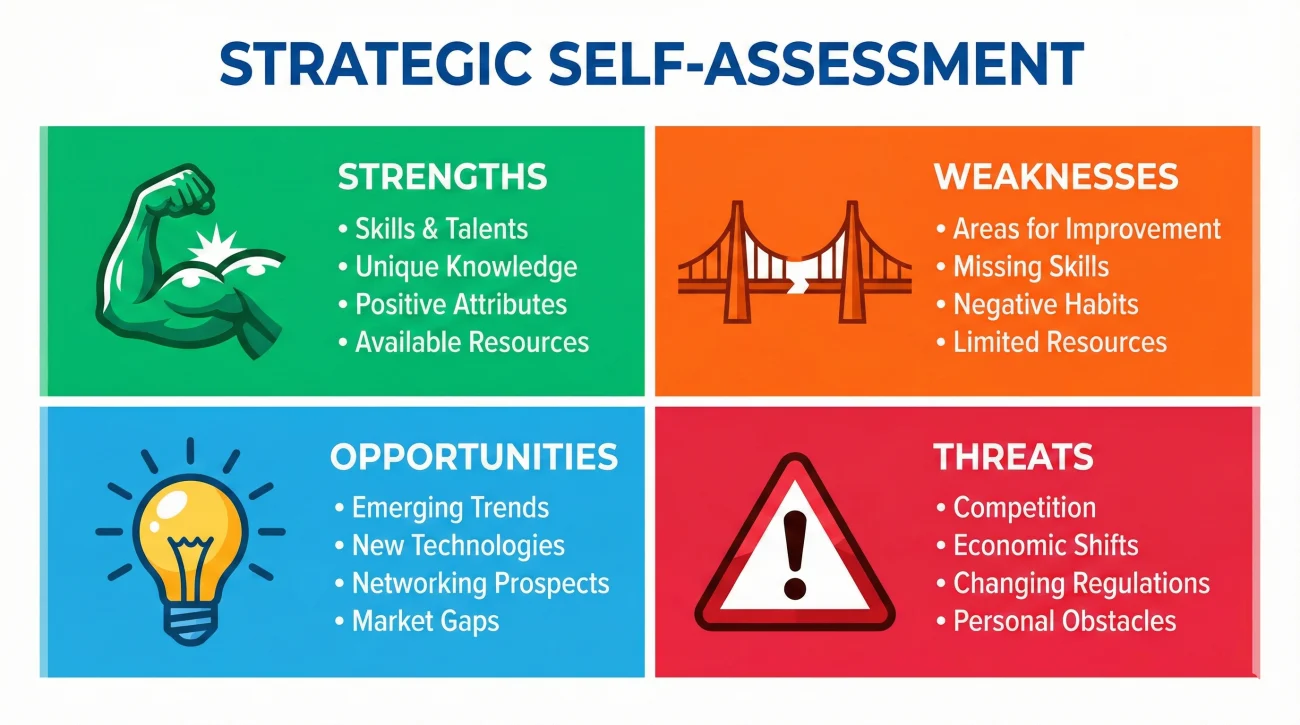
Before interviews, conduct systematic self-assessment to identify authentic material for these questions. The SWOT framework (Strengths, Weaknesses, Opportunities, Threats) provides structured self-analysis that uncovers compelling, genuine answers.
Gathering Evidence
Don’t rely on gut feelings about your capabilities. Review performance feedback, peer comments, accomplishment records, and challenges you’ve faced. Look for patterns – strengths that helped you succeed repeatedly, weaknesses that caused consistent struggles, and areas where you’ve demonstrated measurable improvement.
- Review past performance evaluations for recurring themes
- Recall projects where you excelled and analyze what strengths enabled success
- Identify situations where you struggled and examine root causes
- Seek feedback from trusted colleagues or mentors
- Compare your capabilities against job requirements systematically
For comprehensive frameworks and tools to complete thorough self-assessment before interviews, explore behavioral interview preparation resources that help identify your authentic strengths and development areas.
Common Question Variations
Interviewers ask about strengths and weaknesses in multiple ways. Recognize these variants and adapt your prepared answers appropriately.
| Question Variant | What They’re Really Asking | Strategic Response Focus |
|---|---|---|
| “What’s your greatest strength?” | What makes you valuable for this specific role? | Job-relevant capability with proof of impact |
| “What would your manager say about you?” | Are you self-aware? Can you see yourself through others’ eyes? | Align with likely manager feedback, demonstrate objectivity |
| “What are you working to improve?” | Do you pursue growth proactively? | Current development efforts with specific actions |
| “Describe a time you overcame a weakness” | Can you actually change and grow? | Specific transformation story with measurable results |
| “What skills do you want to develop?” | Does your growth trajectory align with our needs? | Skills valuable to this role but not currently critical |
Explore Detailed Guidance
Each aspect of strengths and weaknesses interviewing requires deeper exploration. Access comprehensive resources for specific situations:
Foundation and Frameworks
| Topic | Focus |
|---|---|
| Personal SWOT Analysis | Identifying your competitive edge through systematic self-assessment |
| Turning Weaknesses into Strengths | The “Sandwich” method and growth arc frameworks |
| Hard Skills vs Soft Skills | Balancing your professional profile strategically |
Strength Question Variations
| Question Type | Strategic Approach |
|---|---|
| What Is Your Greatest Strength? | Choosing your unique selling point |
| Strength: Communication Skills | Example answers demonstrating negotiation, presentation, listening |
| Strength: Problem Solving | Root cause analysis and logical thinking examples |
| Strength: Adaptability | Flexibility examples for dynamic environments |
| Strength: Work Ethic | Reliability and dependability demonstrations |
| Strength: Leadership Skills | Mentoring and team development examples |
Weakness Question Variations
| Question Type | Strategic Approach |
|---|---|
| What Is Your Greatest Weakness? | The “safe” weakness list and avoiding fatal flaws |
| Weakness: Public Speaking | Classic safe weakness with improvement plan examples |
| Weakness: Delegation | Building trust and empowering teams |
| Weakness: Perfectionism | Honest examples avoiding cliché bragging |
| Weakness: Saying No | Managing workload boundaries and overcommitment |
| Weakness: Impatience | Calibrating pace for team alignment |
| Weakness: Too Critical | Self-compassion and work-life balance |
❓ FAQ
🎯 Should I prepare different strength/weakness answers for different roles?
Absolutely. Your answers should align with specific job requirements. The strength relevant for a customer service role differs from what matters in data analysis. Review each job description and select strengths/weaknesses that position you optimally for that particular opportunity.
💼 Can I use the same weakness in multiple interviews?
Yes, if it’s genuinely something you’re working on and remains non-critical across the roles. Just update your improvement progress as you advance. “I’ve been developing public speaking skills” works for many positions and can be updated with new milestones each interview cycle.
⏰ How long should my strength/weakness answers be?
Aim for 60-90 seconds each. State the strength/weakness clearly (10-15 seconds), provide specific example or context (30-45 seconds), and describe impact or improvement efforts (20-30 seconds). Longer answers lose attention; shorter ones lack substance showing self-awareness in interviews.
📋 What if the interviewer asks for multiple strengths or weaknesses?
Prepare 2-3 of each in advance, varying between hard and soft skills. Don’t repeat the same type – if your first strength is technical, make the second interpersonal. This demonstrates well-rounded capabilities rather than one-dimensional skill sets.
✨ Should I admit I’m nervous about the interview as a weakness?
No. Interview nerves aren’t job-relevant weaknesses and suggesting you can’t handle pressure situations signals problems. Stick to professional development areas – skills, processes, or behaviors you’re actively improving that relate to workplace performance.
Final Thoughts
Mastering strengths and weaknesses interview questions requires balancing authenticity with strategic positioning. Your answers should be genuine enough to discuss naturally and confidently, yet selected carefully to align with role requirements and demonstrate professional maturity. The strongest candidates don’t have perfect capabilities – they have clear self-awareness about where they excel, honest acknowledgment of development areas, and concrete evidence of continuous improvement.
Success comes from preparation. Conduct systematic self-assessment before interviews. Identify 2-3 genuine strengths with quantifiable impact stories. Choose fixable weaknesses you’re actively addressing with measurable progress. Practice articulating both until they flow naturally without sounding rehearsed or defensive.
Remember that interviewers assess not just what you say, but how you say it. Confidence discussing strengths without arrogance, vulnerability about weaknesses without undermining your candidacy, and evidence of growth mindset throughout – these qualities separate memorable candidates from forgettable ones. Prepare strategically, answer authentically, and these intimidating questions become opportunities to showcase the professional self-awareness employers actually want to see.
⚠️ Disclaimer: The interview strategies, sample answers, and negotiation tips provided in this guide are for educational purposes only. Hiring decisions are subjective and vary by company and industry. While these strategies are based on professional HR standards, they do not guarantee a specific job offer or result.