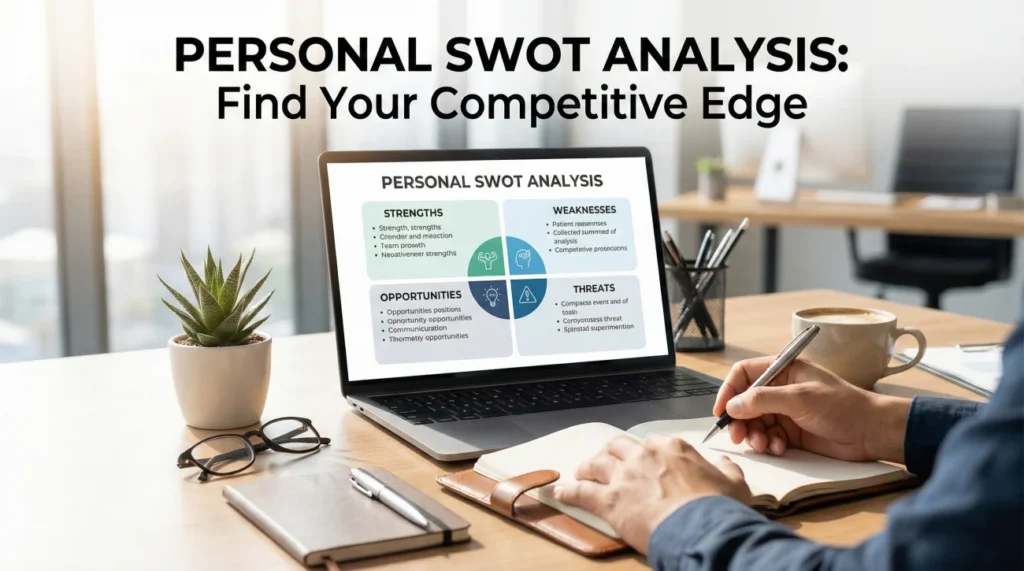
- What a personal SWOT does: Turns vague self-awareness into concrete interview material by mapping Strengths, Weaknesses, Opportunities, and Threats for your target role.
- Internal vs external clarity: Focus strengths and weaknesses on what you control, and opportunities and threats on market, company, and circumstance factors you must navigate.
- Evidence beats vibes: Pull strengths from reviews, achievements, peer feedback, and energy patterns, then choose weaknesses you are already improving, not job-critical dealbreakers.
- Strategy comes from intersections: Match strengths to opportunities to define your edge, and address weaknesses that collide with threats before interviewers raise concerns.
- Interview translation: Convert each key point into STAR stories, growth narratives, and role-fit reasoning, then refresh the SWOT periodically so your answers stay current.
Finding Your Competitive Edge
Completing a thorough personal SWOT analysis transforms vague self-perception into concrete interview material. Most candidates answer strengths and weaknesses questions with the first thing that pops into their heads – resulting in generic, unconvincing responses. Strategic candidates use structured self-assessment to uncover authentic advantages, acknowledge genuine development areas, identify growth opportunities, and anticipate potential obstacles before interviewers expose them.
The swot analysis for job seekers framework originated in business strategy but translates perfectly to career planning. Just as companies assess internal capabilities against external market conditions, you evaluate your skills and limitations within the context of your target role and industry landscape. This systematic approach reveals patterns you’d miss through casual reflection, helping you position yourself strategically rather than hoping interviewers notice your value.
This guide walks through conducting comprehensive personal SWOT analysis, extracting interview-ready material from your results, and using these insights to prepare compelling answers that demonstrate genuine self-awareness.
Understanding the SWOT Framework
SWOT stands for Strengths, Weaknesses, Opportunities, and Threats. The framework divides analysis into internal factors (what you control) and external factors (what exists in your environment), then subdivides each into positive and negative elements.
| Category | Internal/External | Positive/Negative | Interview Application |
|---|---|---|---|
| Strengths | Internal (you control) | Positive (advantages) | Answer “What’s your greatest strength?” with evidence |
| Weaknesses | Internal (you control) | Negative (limitations) | Choose fixable weaknesses you’re actively addressing |
| Opportunities | External (environment) | Positive (favorable conditions) | Explain why you’re pursuing this role now |
| Threats | External (environment) | Negative (challenges) | Prepare for concerns about gaps, competition, or market conditions |
Internal vs External Focus
Internal factors represent your capabilities, skills, traits, and characteristics – elements within your direct control. External factors represent market conditions, industry trends, competitive landscape, and circumstances you can’t directly change but must navigate strategically. Understanding this distinction prevents wasting energy on unchangeable externals while focusing development efforts on controllable internals.
Expert advice: The most powerful insights emerge at intersections. Strengths that align with opportunities become your competitive advantages. Weaknesses that face threats require urgent attention. This intersection analysis reveals strategic priorities more clearly than examining each quadrant in isolation.
Identifying Your Strengths
Strengths represent capabilities you possess that create value – skills you’ve developed, knowledge you’ve accumulated, traits that help you succeed, and resources you can leverage. Effective identifying career strengths requires evidence-based assessment rather than wishful thinking.
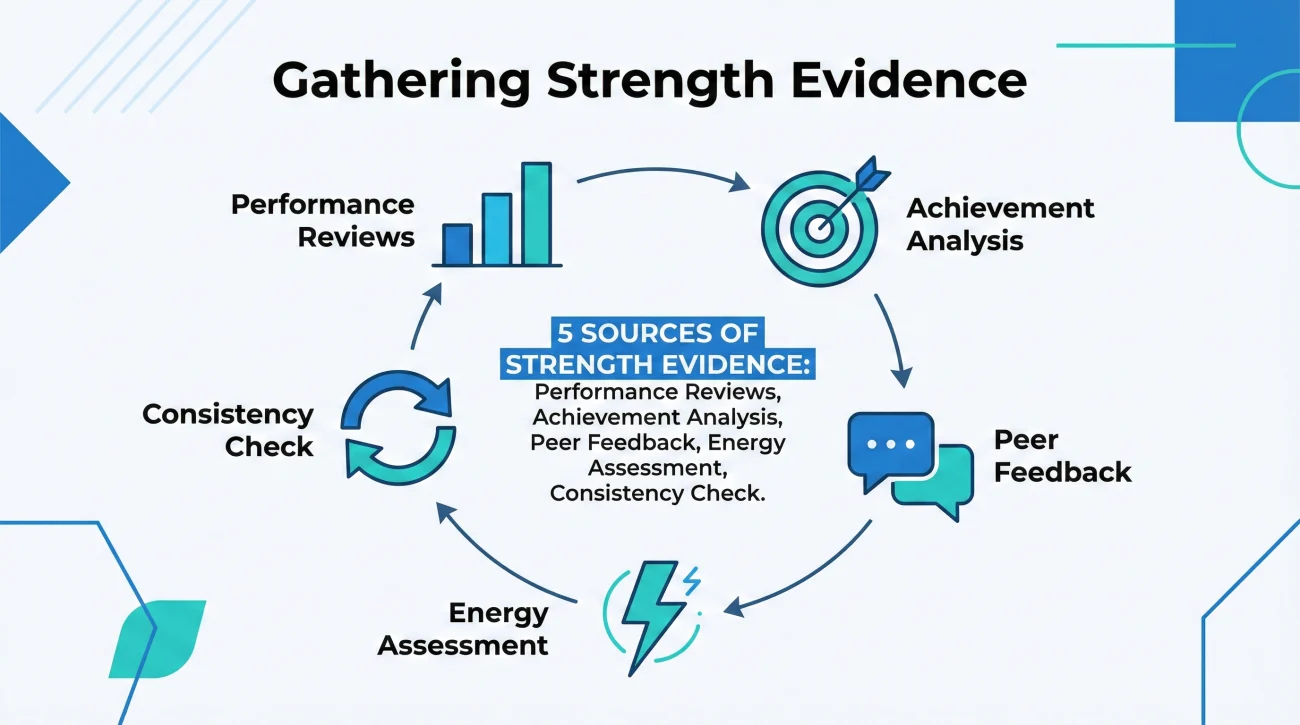
Gathering Strength Evidence
Don’t rely on gut feelings about your strengths. Collect concrete data from multiple sources to build an objective picture of where you genuinely excel.
- 📊 Performance reviews: What do managers consistently praise? Look for patterns across multiple reviews
- 🎯 Achievement analysis: Which accomplishments happened because of specific capabilities you brought?
- 💬 Peer feedback: What do colleagues request your help with? This reveals perceived expertise
- ⚡ Energy assessment: Which tasks energize rather than drain you? Natural strengths feel easier
- 🔄 Consistency check: Which capabilities have you demonstrated successfully multiple times?
Categorizing Your Strengths
Organize identified strengths by type to ensure balanced self-presentation. Interviewers value candidates who combine technical capability with interpersonal skills rather than excelling in just one dimension.
| Strength Type | Examples | Evidence Sources |
|---|---|---|
| Technical Skills | Programming languages, data analysis, design software, industry expertise | Certifications, project outcomes, problem-solving successes |
| Soft Skills | Communication, leadership, empathy, adaptability, conflict resolution | 360 feedback, team collaboration outcomes, client relationships |
| Knowledge | Industry insights, market understanding, regulatory expertise, best practices | Education, experience, thought leadership, strategic contributions |
| Personal Traits | Persistence, creativity, attention to detail, strategic thinking | Consistent behavior patterns, challenging situations handled well |
| Resources | Professional network, educational credentials, unique experiences | Connections leveraged, doors opened by credentials or background |
💡 Pro tip: For each identified strength, prepare a specific STAR story (Situation, Task, Action, Result) demonstrating that strength in action. This transforms abstract claims into concrete evidence interviewers can evaluate.
Finding Your Unique Combination
Your competitive advantage rarely comes from a single exceptional skill – most people can match you on individual capabilities. Instead, look for unique combinations of strengths that few others possess. A data analyst who also excels at visual storytelling stands out. A developer with strong user empathy differentiates from purely technical peers.
- Map your top 3-5 strengths and identify combinations competitors likely lack
- Consider how strengths complement each other to solve specific problems
- Reflect on situations where multiple strengths worked together to create exceptional results
- Identify which strength combinations the target role values most
Acknowledging Your Weaknesses
Weaknesses represent internal limitations – skills you haven’t developed, knowledge gaps, traits that sometimes undermine performance, or resources you lack. Honest weakness assessment prevents blindsiding during interviews and identifies improvement priorities.
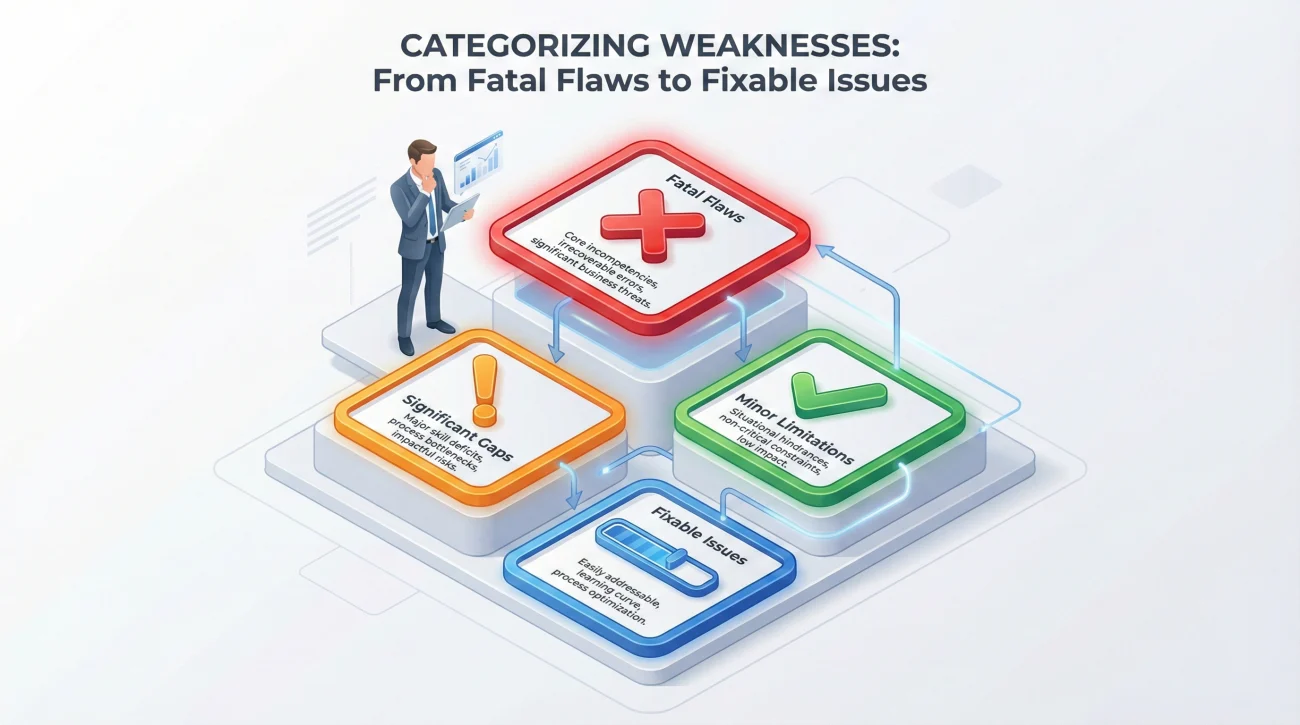
Categorizing Weaknesses
Not all weaknesses matter equally. Some directly impact job performance while others remain largely irrelevant. Focus assessment on weaknesses that could affect the roles you’re pursuing.
- ❌ Fatal flaws: Weaknesses that disqualify you from target roles – never mention these
- ⚠️ Significant gaps: Missing skills or knowledge that could hinder performance – address proactively
- ✅ Minor limitations: Small weaknesses that don’t affect core job functions – safe interview material
- 🔄 Fixable issues: Weaknesses you’re actively working to improve – demonstrates growth mindset
- 📊 Irrelevant weaknesses: Limitations that don’t impact the role at all – ignore these
Gathering Weakness Evidence
Identifying weaknesses requires more honesty than identifying strengths. Look for patterns in constructive feedback, situations where you struggled, and comparisons against job requirements.
Expert advice: The best weakness answers describe limitations you’ve recognized and begun addressing. “I struggled with public speaking, so I joined Toastmasters six months ago and have delivered five presentations since” shows self-awareness and initiative far more effectively than claiming “I’m too much of a perfectionist.”
| Weakness Discovery Method | What to Look For | Interview Application |
|---|---|---|
| Constructive feedback analysis | What do managers or peers suggest you improve? | Choose weaknesses mentioned by trusted sources, showing you accept feedback |
| Struggle situation review | When did projects go poorly? What capabilities were you missing? | Select situations where missing skills caused problems you’ve since addressed |
| Job requirement gap analysis | Which required skills do you lack or possess minimally? | Acknowledge gaps in non-critical areas while emphasizing quick learning ability |
| Energy drain assessment | Which tasks exhaust you or feel difficult? | Mention weaknesses in areas peripheral to core job functions |
Never choose weaknesses that are actually job requirements. If applying for project management roles, don’t admit you struggle with organization or deadline management. If pursuing sales positions, don’t confess you hate rejection or avoid difficult conversations.
Spotting External Opportunities
Opportunities represent favorable external conditions you can leverage – market trends, industry growth areas, organizational changes, emerging technologies, or gaps your skills could fill. Strong career development planning aligns your strengths with available opportunities.
Market and Industry Opportunities
Analyze broader market conditions affecting your target role or industry. Growing sectors offer more positions and faster advancement. Emerging technologies create demand for new skill combinations. Regulatory changes open new specializations.
- Industry growth trends creating increased demand for your skills
- Emerging technologies where your existing knowledge provides advantages
- Market shifts making your unique skill combination more valuable
- Geographic expansion creating opportunities in your preferred location
- Regulatory or policy changes generating new specialization needs
Organizational Opportunities
Within target companies, look for specific circumstances that create openings for your capabilities. Rapid growth, new initiatives, leadership changes, or strategic pivots often generate positions where the right person can make immediate impact.
💡 Pro tip: During interviews, demonstrate you’ve researched company-specific opportunities. “I noticed your recent expansion into European markets. My experience opening international offices and fluency in German position me to contribute immediately to that initiative” shows strategic thinking.
Timing and Personal Opportunities
Sometimes opportunity comes from personal circumstances aligning with professional possibilities. Relocation flexibility, availability for travel, willingness to work unusual hours, or readiness for significant responsibility can become advantages when timing matters.
| Opportunity Type | Interview Relevance |
|---|---|
| Industry experiencing rapid growth or transformation | Explain why you’re entering or advancing in this field now |
| Company launching new products, services, or markets | Connect your background to specific initiative needs |
| Skills you possess becoming highly valued or scarce | Position yourself as solution to talent shortage |
| Your network providing access or insider knowledge | Demonstrate ability to leverage relationships for mutual benefit |
| Personal circumstances enabling commitment others can’t make | Show flexibility or availability as competitive advantage |
Anticipating External Threats
Threats represent unfavorable external conditions that could undermine your candidacy or career progression – intense competition, automation risk, market contraction, skill obsolescence, or circumstantial disadvantages. Acknowledging threats prevents defensive reactions when interviewers probe vulnerable areas.
Competition and Market Threats
Assess the competitive landscape honestly. How many qualified candidates compete for similar roles? What advantages do they possess that you lack? Understanding competitive threats helps you emphasize differentiators and address potential concerns proactively.
- ⚠️ Oversupply: Too many candidates chasing too few roles in your field
- ⚠️ Automation risk: Technologies potentially replacing human workers in your area
- ⚠️ Credential gaps: Competitors holding degrees, certifications, or experience you lack
- ⚠️ Market contraction: Industry or sector experiencing decline or consolidation
- ⚠️ Geographic limitations: Best opportunities concentrated in locations unavailable to you
Personal Circumstance Threats
Some threats stem from personal circumstances that might concern employers – employment gaps, frequent job changes, career pivots, or life situations affecting availability. Identifying these threats allows you to prepare explanations that neutralize concerns before they derail interviews.
Expert advice: When threats relate to gaps or changes in your background, frame them as experiences that developed valuable perspectives or skills. “My career gap caring for family taught me prioritization and efficiency – I now accomplish in focused hours what previously required much longer” reframes potential negative as growth experience.
| Threat Category | Mitigation Strategy |
|---|---|
| Skills becoming obsolete | Demonstrate continuous learning through courses, certifications, practice |
| Younger/cheaper candidates | Emphasize depth, judgment, efficiency gained through experience |
| Overqualification concerns | Explain genuine interest in role, long-term fit, specific attraction to opportunity |
| Career gaps or changes | Provide context, skills developed during gap, strategic reasoning for changes |
| Industry downturns | Show adaptability, transferable skills, research into stable sectors |
Don’t volunteer threat information unnecessarily, but prepare thorough responses for concerns interviewers might raise. Defensive or evasive answers to predictable questions signal lack of preparation.
Conducting Your Personal SWOT
Effective analysis requires structured thinking and honest assessment. Set aside focused time – rushing produces superficial results that won’t serve you in high-stakes interviews.
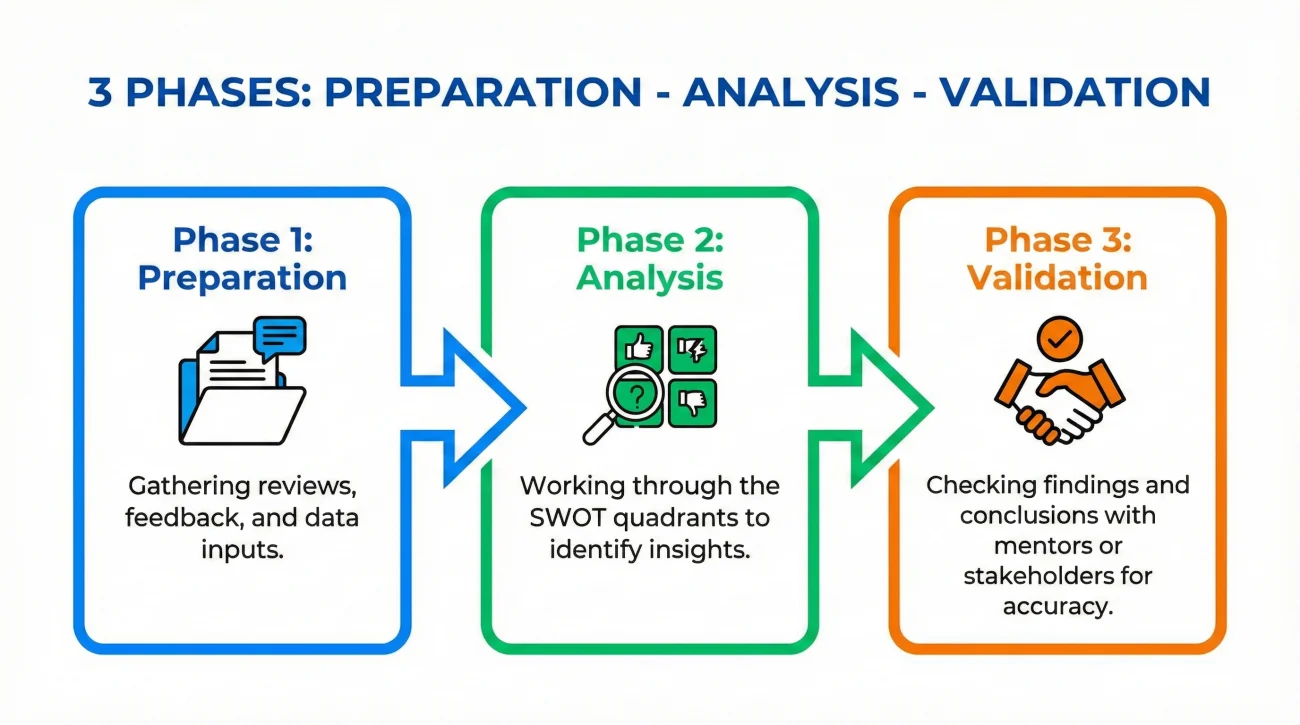
Preparation Phase
Before diving into analysis, gather relevant materials and create an environment conducive to honest self-reflection. Review performance evaluations, project outcomes, feedback from colleagues, and job descriptions for target roles. Block 2-3 hours without interruptions.
- Collect all performance reviews, feedback emails, and accomplishment records
- Research target companies and roles to understand what they value
- Identify 3-5 people who know your work well and could provide honest input
- Create a quiet space with materials for note-taking or digital documentation
- Commit to honesty over self-flattery – accurate assessment serves you better
Analysis Process
Work through each quadrant systematically. Start with strengths (easiest and most comfortable), then weaknesses (requires more honesty), followed by opportunities (requires research), and finish with threats (requires realistic assessment of challenges).
💡 Pro tip: For each item you list in any quadrant, force yourself to provide specific evidence or examples. “Strong communicator” means nothing without proof. “Successfully presented technical concepts to non-technical executives resulting in project approval” provides concrete evidence.
Validation Phase
After completing initial analysis, validate findings with trusted sources. Share your SWOT with mentors, colleagues, or friends who know your professional capabilities. Their perspectives often reveal blind spots – strengths you undervalue or weaknesses you’ve overlooked.
Expert advice: The most valuable validation comes from people who’ve worked with you in situations similar to your target role. A former manager can confirm whether strengths you’ve identified actually drove results. A peer can honestly assess whether weaknesses you acknowledged truly limited performance.
Extracting Interview Material
Completed SWOT analysis provides raw material for multiple interview questions. The key is translating analysis insights into compelling narratives that demonstrate self-awareness and strategic thinking.
From Strengths to Success Stories
Each identified strength should connect to a specific achievement story using the STAR method. This transforms abstract capabilities into concrete evidence interviewers can evaluate and remember.
| Strength | STAR Story Element | Interview Question |
|---|---|---|
| Data analysis | Situation: Sales declining; Task: Identify causes; Action: Analysis revealing pricing issue; Result: 15% revenue recovery | “What’s your greatest strength?” |
| Cross-functional collaboration | Situation: Product launch delayed; Task: Align teams; Action: Created shared timeline; Result: On-time delivery | “Tell me about a time you worked across teams” |
| Creative problem-solving | Situation: Budget cut 30%; Task: Maintain service; Action: Redesigned workflow; Result: Same output, lower cost | “Describe how you approach challenges” |
From Weaknesses to Growth Narratives
Transform identified weaknesses into improvement stories that demonstrate self-awareness, initiative, and measurable progress. The three-part structure – acknowledge, action, advancement – shows growth mindset.
For comprehensive guidance on structuring weakness answers effectively, explore resources on behavioral interview preparation that provide detailed frameworks for discussing development areas confidently.
From Opportunities to Role Fit
Use identified opportunities to explain why you’re pursuing this specific role at this specific company right now. This demonstrates strategic thinking beyond simply needing a job.
- Connect industry opportunities to why you’re excited about the field
- Link company initiatives to how your background enables contribution
- Explain how timing aligns with your readiness for new challenges
- Show you’ve researched beyond surface-level company information
❓ FAQ
🎯 How long should personal SWOT analysis take?
Plan 2-3 hours for thorough initial analysis, plus additional time for validation with trusted sources. Rushing produces superficial results. The investment pays off through multiple interviews as you refine and reuse insights across opportunities.
💼 Should I share my SWOT analysis with interviewers?
No. SWOT analysis is internal preparation tool, not interview deliverable. Use insights to prepare compelling answers, but don’t literally walk through your SWOT framework during interviews. Extract relevant material and present it naturally within conversation context showing self-assessment framework mastery.
⏰ How often should I update my personal SWOT?
Review quarterly or whenever significant changes occur – new role, major project completion, skill acquisition, or market shifts. Regular updates keep self-assessment current and prevent interview answers from feeling stale or outdated.
📋 What if I can’t identify clear strengths?
Seek external input from colleagues, managers, or mentors. Ask specifically: “What do you think I’m particularly good at?” and “When have you seen me add the most value?” Others often recognize strengths we take for granted or undervalue.
✨ Should threats include things like difficult interviewers or tough questions?
No. Focus threats on external factors affecting your candidacy or career – market conditions, competition, industry trends, personal circumstances. Interview difficulty is universal, not a specific threat to assess. Prepare separately for interview challenges through practice and research.
Final Thoughts
Conducting thorough personal SWOT analysis transforms interview preparation from guesswork into strategic planning. The framework forces systematic thinking about capabilities, limitations, favorable conditions, and potential obstacles – revealing patterns and insights casual reflection misses. This structured self-assessment produces authentic interview material grounded in evidence rather than wishful thinking.
The most valuable outcome isn’t the SWOT document itself but the deeper self-understanding it develops. Knowing precisely why certain strengths matter to target roles, understanding which weaknesses require immediate attention versus which can wait, recognizing how external opportunities align with internal capabilities, and anticipating threats before interviewers expose them – this comprehensive awareness shows through in every interview answer, demonstrating the professional maturity employers seek.
Invest time in honest, thorough analysis before your next interview cycle. Gather evidence from multiple sources. Validate findings with trusted colleagues. Extract compelling stories from each quadrant. The preparation effort pays dividends across multiple interviews as refined insights become natural, confident responses that set you apart from candidates who wing it.
⚠️ Disclaimer: The interview strategies, sample answers, and negotiation tips provided in this guide are for educational purposes only. Hiring decisions are subjective and vary by company and industry. While these strategies are based on professional HR standards, they do not guarantee a specific job offer or result.