The Doctors of Comfort
HVAC technician interview questions are designed to test your diagnostic logic. Unlike a manufacturing line worker who performs a repetitive task, an HVAC tech is a problem solver who walks into a new puzzle every day. Why is the compressor humming but not starting? Why is the evaporator coil frozen solid? Why is the furnace blowing cold air?
Hiring managers are looking for candidates who understand the physics of thermodynamics and the logic of electrical circuits. It is not enough to know how to change a part; you must know why it failed. You will be tested on the refrigeration cycle, the sequence of operation for gas furnaces, proper brazing techniques, and the critical importance of airflow.
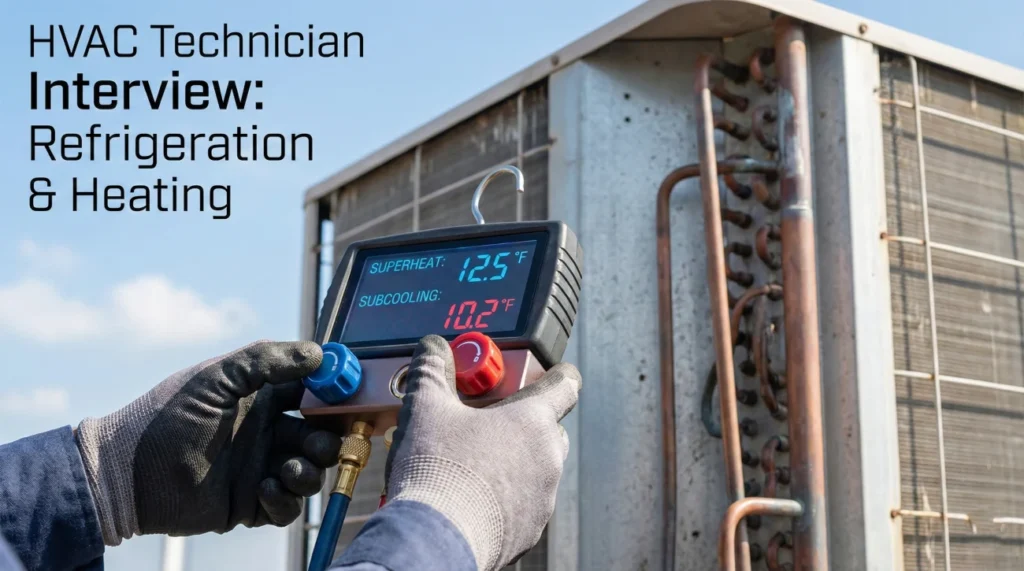
This guide covers the full spectrum of the trade: Residential, Commercial, and Refrigeration. From calculating Superheat and Subcooling to ensure a system is charged correctly, to using a multimeter to chase a low-voltage short, these answers will help you prove you are a skilled technician who can fix it right the first time, safely and efficiently.
The Refrigeration Cycle & Physics
Q: Walk me through the 4 stages of the basic refrigeration cycle.
This is the foundation of the trade.
1. Compressor: Low-pressure, low-temperature vapor enters. It is compressed into a High-pressure, High-temperature vapor.
2. Condenser: The hot gas rejects heat to the outside air (or water). As it cools, it condenses into a High-pressure, Medium-temperature liquid (Saturation).
3. Metering Device (TXV/Piston): The high-pressure liquid hits a restriction. Pressure drops instantly. It flashes into a Low-pressure, Low-temperature liquid/vapor mix (approx 75% liquid, 25% flash gas).
4. Evaporator: The cold liquid absorbs heat from the indoor air. It boils off completely into a Low-pressure, Low-temperature vapor (Superheat) and returns to the compressor to repeat the cycle.
Q: Explain Superheat vs. Subcooling and when to use each for charging.
Superheat is the temperature of the vapor above its boiling point (Saturation temp). It ensures no liquid enters the compressor (which would cause slugging). We measure it at the suction line. It is the primary charging method for systems with a Fixed Orifice (Piston) metering device. Target is usually 10-20°F depending on indoor load.
Subcooling is the temperature of the liquid below its condensing point. It ensures a solid column of liquid reaches the metering device. We measure it at the liquid line. It is the primary charging method for systems with a TXV (Thermostatic Expansion Valve) because the TXV controls superheat automatically. Target is usually 10-15°F per manufacturer specs.
Q: How does a TXV work compared to a Piston?
A Piston is a fixed hole. It cannot adapt to load changes. If the load is high (hot house), superheat drops; if low, superheat rises. It requires precise charging.
A TXV modulates. It has a sensing bulb mounted on the suction line. Ideally, it maintains a constant superheat (e.g., 10°F). If the bulb senses the suction line getting too hot (high superheat), the valve opens to let more refrigerant in. If it gets too cold (low superheat), it throttles back. This makes the system more efficient across varying temperatures but adds a mechanical failure point (e.g., bulb losing charge).
Q: Why is “Airflow” critical to the refrigeration cycle?
Airflow is the medium of heat exchange. If airflow is low (dirty filter, blocked vent), the evaporator cannot absorb enough heat. The refrigerant doesn’t boil off, leading to zero superheat and liquid slugging the compressor. It also causes the coil temperature to drop below 32°F, freezing the moisture in the air until the coil is a block of ice. In heating mode, low airflow overheats the heat exchanger, tripping the high limit switch. I always check static pressure and the filter first before hooking up gauges.
Electrical Diagnostics & Controls
Q: Capacitor Troubleshooting
A capacitor creates the phase shift needed to start a single-phase motor. A dual-run capacitor has Common (C), Hermetic (Herm), and Fan terminals. I test it under load (Back EMF formula: $$Amps \times 2652 / Volts$$) or disconnected using the MFD (Microfarad) setting on my meter. A bad capacitor often looks swollen (“mushroomed”), but weak ones look normal. Tolerance is usually +/- 6%. If a 45uF cap reads 35uF, the compressor will overheat and thermal overload.
Q: Contactor Diagnosis
A contactor switches the high voltage to the compressor/fan using a low voltage (24V) coil. Common failures: 1) Pitted Points: High resistance across the contacts causes voltage drop. I measure voltage drop across the closed contacts; it should be 0V. If I see 2-3V, it’s bad. 2) Burned Coil: Check resistance of the coil (unplugged). If infinite (OL), the coil is open. 3) Stuck Closed: Welded contacts keep the unit running even when the thermostat is off.
Q: Compressor Windings (CSR)
Single-phase compressors have three terminals: Common (C), Start (S), and Run (R). To identify them (if not marked), I measure resistance.
$$R \to S$$ = Highest resistance (Run + Start windings).
$$C \to S$$ = Medium resistance (Start winding).
$$C \to R$$ = Lowest resistance (Run winding).
Mathematically, $$(C \to R) + (C \to S)$$ should equal $$(R \to S)$$. If I read OL between any, the winding is open. If I read continuity to the copper shell, it’s grounded (shorted to ground).
Q: Low Voltage Wiring Colors
Standard thermostat wiring:
R (Red): 24V Power (Hot).
C (Blue/Black): Common (Neutral for 24V).
Y (Yellow): Cooling call (Compressor).
W (White): Heating call (Gas/Electric).
G (Green): Fan call.
O/B (Orange): Reversing Valve (Heat Pump).
I never trust colors blindly; technicians do crazy things. I always verify at the control board.
Q: Finding a Low Voltage Short
If the 3A or 5A fuse on the board pops instantly, there is a dead short. I don’t keep blowing fuses. I use a “Short Pro” tool (resettable breaker) or a light bulb in series. I disconnect wires (Y, W, G) one by one. If the light goes out when I pull the Y wire, the short is in the Y wire circuit (likely the contactor coil or the wire rubbing against the outdoor unit cabinet). Isolation is the key.
Q: Heat Pump Reversing Valve
This valve reverses the flow of refrigerant, turning the evaporator into a condenser and vice versa. It is usually pilot-operated by a solenoid. “Energize to Cool” (O terminal) is standard for Rheem/Ruud. “Energize to Heat” (B terminal) is standard for almost everyone else. Troubleshooting: If I have 24V at the solenoid but it doesn’t shift, I tap it (might be stuck). If it shifts but pressure differential is low, the internal slide might be leaking (bypassing).
Heating & Airflow Scenarios
A gas furnace attempts to start but shuts down after 3 seconds of flame. What is the most likely cause?
This is a classic Flame Sensor failure. The sequence is: Inducer -> Pressure Switch -> Igniter -> Gas Valve Opens -> Flame Lights -> Sensor Detects Flame. If the sensor is dirty (coated in silica/carbon), it cannot conduct the microamp ($$\mu A$$) signal (Flame Rectification) to the board. The board assumes no fire exists and cuts the gas for safety.
I would remove the sensor and clean it with steel wool or a dollar bill (not sandpaper, which leaves silica). I would then measure the flame current in series; typically 2-5 microamps is good. If it drops below 0.5, it cuts out. Also, I verify the furnace is properly grounded; flame rectification requires a solid ground path.
You find a system with high head pressure and high suction pressure. The subcooling is low.
This profile typically indicates a bad compressor valves (inefficient pumping) or, less likely, a significant overcharge if subcooling was high. But “High/High with Low SC” is tricky. Let’s rethink.
Actually, High Head + High Suction usually points to Overcharge (if SC is high) or Non-Condensables (air in system).
If the compressor valves are bad, the head would be low and suction high (pressures equalizing).
Let’s look at Lack of Airflow across Condenser (Dirty Coil). Head pressure shoots up because heat isn’t rejected. The liquid line gets hot (Low SC? No, usually High SC because liquid stacks up).
Wait, the classic logic: Recirculation of hot air or a dirty condenser creates High Head.
If Subcooling is LOW with High Head/Suction? This implies we don’t have enough liquid in the condenser despite the high pressure. This is rare.
Let’s pivot to the most common High/High scenario: Excessive Load (It’s 100°F inside the house). The system is overwhelmed. I would wait for the house to cool down before condemning parts.
A customer complains of high humidity despite the AC running constantly.
The unit is likely Oversized or the airflow is too high. An oversized unit cools the air so fast that the thermostat satisfies before the moisture has time to condense on the coil (short cycling).
Alternatively, the fan speed is set too high. Faster air = higher coil temperature = less dehumidification. I would lower the fan speed (e.g., from 400 CFM/ton to 350 CFM/ton) to get a colder coil and longer run times. I would also check for a stuck-open fresh air damper bringing in humid outdoor air, or a return duct leak in a crawlspace.
Safety & Best Practices
Q: Describe the proper procedure for Brazing with Nitrogen.
When we braze copper (usually with 15% silver rod), the heat creates copper oxide “scale” inside the pipe. This scale flakes off and clogs the TXV screen or filter drier. To prevent this, I must flow Nitrogen through the lines while brazing.
I hook up my regulator and flow a very low pressure (2-3 PSI, a “whisper”) into the system to displace the oxygen. Without oxygen, oxidation cannot occur. The inside of the pipe remains bright and clean. This is mandatory for R-410A systems using POE oil, which is a scrubbing agent that will loosen any scale left behind.
Q: What is the “Triple Evacuation” method?
Pulling a vacuum removes moisture and non-condensables. Moisture turns to acid with refrigerant oil. The Triple Evac ensures a dry system.
1. Pull vacuum to roughly 1,500 microns. Break the vacuum with Nitrogen (to about 2-3 psig). The dry nitrogen absorbs moisture.
2. Pull vacuum again to 1,500 microns. Break with Nitrogen.
3. Pull final vacuum to below 500 microns.
I perform a “Decay Test” – valve off the pump and ensure the microns don’t rise rapidly. If they stabilize below 1000, it’s dry. If they keep rising to atmospheric, I have a leak. If they plateau at 2000, I have moisture.
Q: EPA 608: What constitutes a “Major Repair”?
According to EPA Section 608, a Major Repair involves the removal of the Compressor, Condenser, Evaporator, or Auxiliary Heat Exchanger Coil. When performing a major repair, I must evacuate the system to the required levels (usually 10-25 inches Hg depending on appliance type) before opening it. I am strictly prohibited from venting refrigerant (“de minimis” releases are only allowed during hose disconnection with low-loss fittings).
Q: How do you measure Static Pressure and why?
External Static Pressure (ESP) acts like “blood pressure” for the duct system. I use a manometer. I place one probe in the supply plenum (positive pressure) and one in the return plenum (negative pressure, before the furnace). The sum (ignoring negatives) is the Total ESP.
If the TESP is 1.0″ w.c. and the furnace is rated for max 0.5″, the motor is straining, airflow is low, and the component life is reduced. High Return static means dirty filter or undersized return drop. High Supply static means blocked vents, crushed ducts, or undersized plenum. It tells me where the restriction is.
HVAC Technician Knowledge Check
Test Your Diagnostic IQ
1. What is the purpose of the “Common” wire (C-wire) on a smart thermostat?
- To control the fan
- To provide a constant 24V return path to power the thermostat display/WiFi
- To control the compressor
- To ground the unit
2. A “Delta T” (Temperature Split) across an evaporator coil in cooling should typically be:
- 5°F to 10°F
- 18°F to 22°F
- 30°F to 40°F
- It doesn’t matter
3. If you have high superheat and low subcooling, the most likely diagnosis is:
- Overcharge
- Undercharge (Low refrigerant)
- Dirty Filter
- Restriction in the liquid line
4. Which component protects the compressor from liquid slugging?
- Filter Drier
- Suction Line Accumulator
- Liquid Line Solenoid
- Crankcase Heater
5. R-410A operates at pressures roughly _____ than R-22.
- Lower
- 50-60% Higher
- The same
- Double
6. A “Limit Switch” in a furnace opens when:
- The flame goes out
- The heat exchanger gets too hot (overheating safety)
- The pressure drops
- The door is opened
7. What is the target vacuum level for a deep evacuation?
- 30 inches Hg
- 500 Microns
- 1000 Microns
- 0 PSIG
8. A “Crankcase Heater” is used to:
- Keep the compressor warm in winter for starting
- Prevent refrigerant migration and mixing with oil in the compressor sump during off-cycles
- Heat the house
- Defrost the coil
9. On a manifold gauge set, the Red hose is connected to:
- The suction line (Low side)
- The liquid line / discharge line (High side)
- The vacuum pump
- The refrigerant tank
10. “Wet Bulb” temperature accounts for:
- Temperature only
- Temperature and Humidity (Enthalpy)
- Pressure
- Air velocity
11. If a contactor coil measures 0 Ohms resistance, it is:
- Good
- Open
- Shorted
- Grounded
12. Which refrigerant is banned for new production/import in the US as of 2020?
- R-410A
- R-22 (HCFC)
- R-290
- R-134a
13. A “Rollout Switch” detects:
- The fan rolling
- Flame rolling out of the heat exchanger (usually due to a crack or blockage)
- The inducer motor speed
- Gas pressure
14. What happens if you overcharge a TXV system?
- Superheat goes to zero
- High Head Pressure and High Subcooling (liquid backs up in condenser)
- Low Head Pressure
- The TXV shuts off
15. “Sensible Heat” is heat that:
- Causes a change of state (liquid to gas)
- Causes a change in temperature you can measure with a thermometer
- Makes sense
- Is hidden
16. The “Inducer Motor” on a gas furnace:
- Blows air into the house
- Creates a draft to pull exhaust gases through the heat exchanger and out the flue
- Lights the gas
- Opens the gas valve
17. POE (Polyolester) oil is extremely:
- Flammable
- Hygroscopic (absorbs moisture from air rapidly)
- Toxic
- Thick
18. To reverse the rotation of a 3-phase motor, you must:
- Replace the motor
- Swap any two leads (T1 and T2)
- Flip the capacitor
- Turn it upside down
19. A “Bi-Flow” filter drier is required for:
- Gas Furnaces
- Heat Pumps (because refrigerant flow reverses direction)
- AC only units
- Refrigerators
20. If a pressure switch fails to close, the most common cause is:
- Bad gas valve
- Blocked flue pipe or blocked port in the inducer housing
- Bad igniter
- Bad thermostat
❓ FAQ
📜 Which EPA Certification do I need?
You need the EPA 608 Universal Certification. This covers Type I (Small Appliances), Type II (High Pressure – Resi/Commercial), and Type III (Low Pressure – Chillers). It is mandatory by federal law to handle refrigerant. Without it, you cannot buy Freon or work on sealed systems.
🧰 What tools are essential for a starter?
Manifold gauges (digital or analog), multimeter (with microfarads and temp), vacuum pump, micron gauge, recovery machine, drill, hand tools (nut drivers, wire strippers, swaging tool), and a nitrogen regulator. It’s an investment of $1k-$2k minimum.
🏠 Residential vs. Commercial HVAC?
Residential: Attics, crawlspaces, homeowners, sales-oriented, seasonal spikes. Commercial: Rooftops (RTUs), chillers, corporate clients, steady hours, heavier equipment. Commercial often pays more, but Residential can be lucrative if you have sales skills.
⏰ What is the “On-Call” rotation?
HVAC breaks when it’s hottest or coldest. Service techs typically rotate “On-Call” weekends or nights (e.g., one week every month). You must be ready to respond to emergencies at 2 AM. It is a standard part of the industry.
❄️ Is the job physically hard?
Yes. You will be carrying compressors up ladders, working in 140°F attics, and kneeling in snow. It demands physical fitness and heat tolerance. Dehydration is a real risk in summer.
Keeping Your Cool
To succeed with HVAC technician interview questions, you must demonstrate a calm, logical approach to chaos. When a customer is sweating and angry, you need to be the person who methodically finds the loose wire or the leak.
Focus on your diagnostic process. Don’t just say “I replaced the capacitor.” Say “I measured the winding resistance, checked the capacitor MFD, found it weak, and replaced it.” Show them you are a technician, not a parts changer, and you will be hired on the spot.
⚠️ Disclaimer: The interview strategies, sample answers, and negotiation tips provided in this guide are for educational purposes only. Hiring decisions are subjective and vary by company and industry. While these strategies are based on professional HR standards, they do not guarantee a specific job offer or result.