Powering the Global Economy
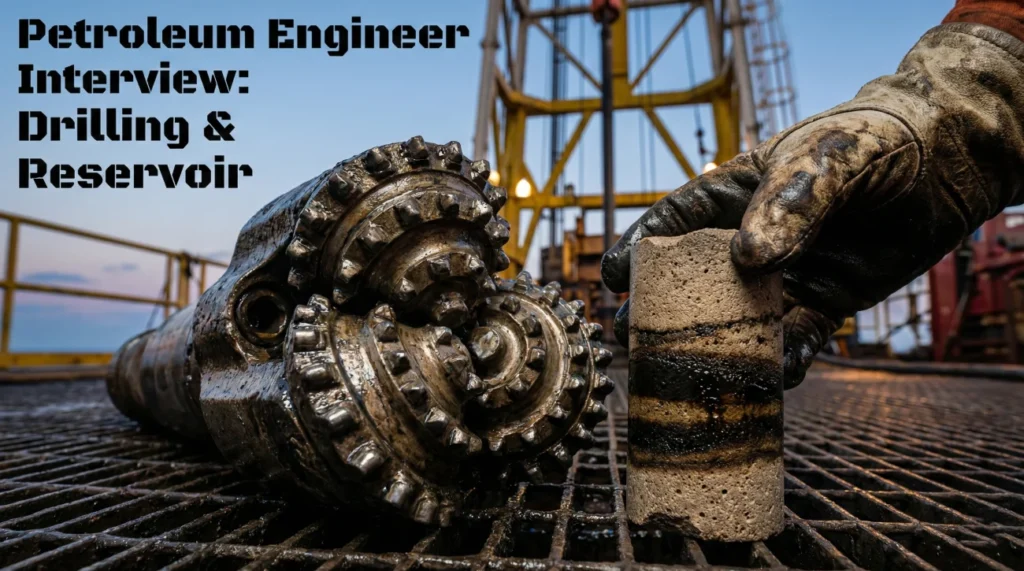
Petroleum engineer interview questions test your ability to extract energy from the earth safely, efficiently, and economically. This is a high-stakes profession where a single calculation error can lead to a catastrophic blowout or a multimillion-dollar dry hole. Hiring managers are looking for engineers who understand the subsurface geology as well as they understand the mechanical stress on a drill string.
The field typically splits into three main disciplines: Drilling (making the hole), Reservoir (estimating the reserves and flow), and Production (bringing the oil to surface). Whether you are designing a deepwater well in the Gulf of Mexico or optimizing a hydraulic fracturing campaign in the Permian Basin, you must demonstrate a mastery of fluid mechanics, thermodynamics, and rock physics.
This guide covers the technical depth required for upstream oil and gas roles. We explore the critical “Mud Weight Window,” the physics of Darcy’s Law in porous media, the selection of Artificial Lift systems, and the strict safety protocols of Well Control. These answers will help you prove that you have the technical rigor to operate in one of the world’s most challenging industries.
Subsurface & Drilling Fundamentals
Q: Explain the relationship between Porosity and Permeability.
These are the two defining characteristics of a reservoir rock. Porosity ($$\phi$$) is the storage capacity – the percentage of the rock volume that is void space (pores) capable of holding fluid. It tells us how much oil is there. Permeability ($$k$$) is the flow capacity – the ability of the rock to transmit fluids through connected pore throats. It tells us how fast we can produce it.
While often correlated, they are not the same. Clay has high porosity (holds lots of water) but near-zero permeability (water can’t move). A successful reservoir needs both. In tight shale formations, we have porosity but low permeability, which is why we use hydraulic fracturing to create artificial permeability.
Q: What is the “Mud Weight Window” and why is it critical?
The Mud Weight Window is the safe operating range for drilling fluid density. The lower limit is the Pore Pressure (formation fluid pressure). If the mud weight drops below this, formation fluids enter the wellbore (a “Kick”), risking a blowout. The upper limit is the Fracture Gradient (formation strength). If the mud weight exceeds this, we fracture the rock, lose circulation (mud flows into the formation), and the fluid level drops, which can also lead to a kick.
In deepwater or depleted reservoirs, this window is extremely narrow. I must calculate the Equivalent Circulating Density (ECD) – which includes the static mud weight plus the friction pressure of the pumps – to ensure we stay within this narrow window while drilling.
Q: Describe Darcy’s Law for linear flow.
Darcy’s Law describes fluid flow through a porous medium. The equation is $$q = \frac{kA(P_1 – P_2)}{\mu L}$$.
Where $$q$$ is flow rate, $$k$$ is permeability, $$A$$ is cross-sectional area, $$\Delta P$$ is pressure drop, $$\mu$$ is fluid viscosity, and $$L$$ is length.
As an engineer, this equation guides my decision making. To increase production ($$q$$), I can increase permeability ($$k$$) via stimulation (acid/frac), increase the pressure drawdown ($$\Delta P$$) using artificial lift, or increase the area of flow ($$A$$) by drilling a horizontal lateral instead of a vertical well.
Q: What is the primary function of Casing and Cementing?
Casing (steel pipe) and Cement serve three main purposes:
1. Zonal Isolation: Preventing fluids from one formation (e.g., saltwater) from migrating into another (e.g., freshwater aquifers or the oil zone).
2. Wellbore Stability: Preventing the hole from collapsing (sloughing shale) under tectonic stress.
3. Well Control: Providing a high-pressure anchor for the Blowout Preventer (BOP) stack.
A bad cement job creates a “micro-annulus” that allows gas migration to surface (Sustainability casing pressure), which is a major integrity failure.
Production & Reservoir Engineering
Q: Primary vs. Secondary vs. Tertiary Recovery
Primary uses natural reservoir energy (gas cap, solution gas, water drive) to push oil to the surface (Recovery: 10-20%). Secondary involves injecting water or gas to maintain pressure and sweep oil (Waterflooding), increasing recovery to 30-40%. Tertiary (EOR) changes the oil’s properties (Steam injection to lower viscosity, CO2 miscible flooding to reduce surface tension) to extract the remaining oil, potentially reaching 60%+ recovery.
Q: Artificial Lift Selection: ESP vs. Gas Lift
ESP (Electrical Submersible Pump) is a downhole centrifugal pump. It moves massive volumes of fluid and is ideal for high-rate, deep offshore wells or high water-cut wells. However, it is expensive and sensitive to solids/gas. Gas Lift injects high-pressure gas into the casing to lighten the fluid column in the tubing. It is robust, handles sand/gas well, and has no moving parts downhole, but it requires a gas source and is less efficient at very low reservoir pressures.
Q: Decline Curve Analysis (DCA)
DCA forecasts future production based on historical trends. The standard Arps equation models Exponential ($$b=0$$), Hyperbolic ($$0<b<1$$), or Harmonic ($$b=1$$) decline. For unconventional shale wells, hyperbolic decline is standard due to the transient flow regime. I use DCA to estimate the EUR (Estimated Ultimate Recovery) and determine the economic limit of the well – the point where operating costs exceed revenue.
Q: Skin Factor ($$S$$)
Skin Factor measures damage to the formation near the wellbore caused by drilling fluids or perforation debris. A positive Skin ($$+S$$) acts like an extra pressure drop, restricting flow. A negative Skin ($$-S$$) indicates stimulation (like acidizing or fracturing) has improved connectivity. I calculate Skin using Pressure Transient Analysis (Well Testing). My goal is to minimize skin damage to maximize the Productivity Index (PI).
Q: Material Balance Equation (MBE)
MBE is the “Accounting” of the reservoir. $$Production = Expansion + Influx + Injection$$. It relates cumulative production to the drop in reservoir pressure. I use it to determine the drive mechanism. If pressure drops rapidly, it’s a volumetric (gas expansion) reservoir. If pressure stays constant despite production, there is a strong aquifer water drive supporting it. This informs the development strategy.
Q: Nodal Analysis
Nodal Analysis optimizes the complete production system. We select a node (usually the bottom-hole). We plot the Inflow Performance Relationship (IPR) – what the reservoir can deliver – and the Tubing Performance Curve (VLP) – what the piping requires to lift the fluid. The intersection is the operating point. I use this to size tubing strings; too large, and the velocity drops (liquid loading); too small, and friction restricts the rate.
Drilling Operations & Safety Scenarios
You are drilling and notice the return flow rate is higher than the pump output rate. What is happening and what do you do?
This is a positive indicator of a Kick (influx of formation fluid). The formation pressure has exceeded the hydrostatic pressure of the mud column.
Immediate Action:
1. Stop Drilling (pick up off bottom).
2. Stop Pumps (check for flow). If the well flows with pumps off, it is a confirmed kick.
3. Shut In the Well using the BOP (Annular or Pipe Rams).
4. Record Pressures: Shut-In Drill Pipe Pressure (SIDPP) and Shut-In Casing Pressure (SICP).
Only after the well is secured do we calculate the “Kill Mud Weight” to circulate the kick out safely.
A producing gas well starts “loading up” (production drops, pressure spikes). How do you diagnose and fix it?
Liquid Loading occurs when the gas velocity drops below the “Critical Velocity” (Turner or Coleman algorithm), and it can no longer lift the liquids (water/condensate) to surface. The liquids fall back and kill the well.
Diagnosis: I look for a “sawtooth” pattern on the production chart or a divergence between casing and tubing pressure.
Fix:
1. Intermittent Flow: Shut in the well to build pressure, then open it to blow out the liquid.
2. Velocity String: Install smaller diameter tubing to increase gas velocity.
3. Plunger Lift: A mechanical piston that uses the well’s own energy to lift a slug of liquid efficiently.
You are planning a hydraulic fracture (frac) job, and a nearby “Parent Well” is producing. What is the risk?
The risk is a Frac Hit (well interference). The high-pressure frac fluid from the new “Child Well” can travel through natural fractures and communicate with the depleted “Parent Well.” This can load the parent well with water, damage its proppant pack, or even cause a blowout at the surface if the parent wellhead isn’t rated for frac pressures.
Mitigation: I would recommend “Pre-loading” or “Shutting-in” the parent well to pressurize the area around it, creating a “pressure wall” that diverts the new fractures away from the old well.
Advanced Technology & Strategy
Q: What is MWD/LWD and how does it enable geosteering?
MWD (Measurement While Drilling) provides directional data (Inclination and Azimuth) in real-time using mud pulse telemetry or EM waves. It tells us where the bit is. LWD (Logging While Drilling) provides formation data (Gamma Ray, Resistivity) at the bit.
Geosteering combines these. We compare the real-time Gamma Ray log to offset well logs. If we see the Gamma reading change, we know we are exiting the target zone (e.g., drilling out of the shale into the limestone above). We send a command to the Rotary Steerable System (RSS) to steer the bit back down, keeping the wellbore 100% “in zone” for miles.
Q: Describe PVT analysis and its importance.
Pressure-Volume-Temperature (PVT) analysis studies the phase behavior of the reservoir fluid. We take a sample and test it in the lab. Key parameters include the Bubble Point (where gas breaks out of oil) and the Formation Volume Factor ($$B_o$$) (how much 1 barrel of reservoir oil shrinks when it reaches surface conditions). Understanding PVT is crucial for reserve estimation. If we don’t account for shrinkage ($$B_o$$), we massively overestimate the stock tank barrels (STB) we can sell.
Q: What is Managed Pressure Drilling (MPD)?
MPD is an advanced drilling technique used when the drilling window (between pore pressure and fracture gradient) is too narrow for conventional drilling. Instead of relying solely on mud weight and gravity (open system), MPD uses a closed-loop system with a Rotating Control Device (RCD) and a back-pressure choke manifold.
By applying back-pressure at the surface, we can artificially increase the bottom-hole pressure (BHP) instantly without mixing heavier mud. If we stop pumps (which usually drops BHP), the choke closes to compensate. This allows us to drill “undearbalanced” or “at balance” safely.
Q: How do you assess Pore Pressure Prediction before drilling?
I use seismic data and offset well logs. The primary method is Eaton’s Method using sonic or resistivity logs. Under-compacted shales (which cause high pressure) have higher porosity and slower sonic velocities than normal trends. By plotting the “Normal Compaction Trend” and observing the deviation, I can estimate the overpressure magnitude. This prediction dictates the Casing Point selection – we must set casing before entering the high-pressure zone to protect the weaker rock above.
Petroleum Engineering Knowledge Check
Test Your Oilfield IQ
1. “Viscosity” is best defined as:
- The density of the fluid
- The fluid’s resistance to flow (thickness)
- The boiling point of the fluid
- The color of the crude oil
2. A “Blowout Preventer” (BOP) is used to:
- Pump mud into the hole
- Seal the wellbore in the event of a kick to prevent uncontrolled release
- Prevent the drill bit from breaking
- Separate oil and gas at the surface
3. In the API gravity scale, a higher number indicates:
- Heavier, thicker oil (like bitumen)
- Lighter, thinner oil (more valuable)
- Higher water content
- Higher sulfur content
4. “Proppant” in hydraulic fracturing is used to:
- Dissolve the rock
- Prop open the created fractures after pressure is released to maintain permeability
- Lubricate the casing
- Explode the formation
5. The “Kelly Bushing” (KB) elevation refers to:
- Sea level
- The reference datum on the rig floor from which depth is measured
- The bottom of the well
- The ground level
6. What is the main component of Natural Gas?
- Ethane
- Methane (CH4)
- Propane
- Butane
7. “Directional Drilling” uses a Motor or RSS to:
- Drill faster vertically
- Steer the wellbore along a planned trajectory (build, hold, drop)
- Core the rock
- Cement the casing
8. A “Packer” is a downhole tool used to:
- Pack sand into the formation
- Isolate the annulus between tubing and casing to direct flow up the tubing
- Measure pressure
- Filter the oil
9. “Swabbing” a well can cause a kick because:
- It adds pressure to the formation
- Pulling pipe out too fast creates suction (piston effect), lowering bottom-hole pressure
- It breaks the casing
- It introduces air
10. The unit “Darcy” measures:
- Porosity
- Permeability
- Viscosity
- Pressure
11. What is “Workover” operations?
- Building the rig
- Re-entering an existing well to perform maintenance (e.g., replace tubing, fix casing)
- Drilling a new well
- Seismic surveying
12. “Sour Gas” contains high levels of:
- Carbon Dioxide (CO2)
- Hydrogen Sulfide (H2S)
- Nitrogen (N2)
- Helium (He)
13. The “Christmas Tree” is:
- A decoration in the mess hall
- The assembly of valves and fittings on top of the wellhead to control production
- The bottom hole assembly
- The derrick structure
14. “Water Cut” refers to:
- Cutting water usage
- The ratio of water produced compared to the total volume of liquids
- The price of water disposal
- A water injection well
15. Which log distinguishes between Oil and Water saturation?
- Gamma Ray
- Resistivity (Oil is resistive, Water is conductive)
- Caliper
- Density
16. “Fishing” in drilling means:
- Recreational time for the crew
- Retrieving an object (junk, stuck pipe) left in the wellbore
- Looking for oil
- Running wireline logs
17. A “Separator” vessel uses gravity to separate:
- Oil and Sand
- Oil, Gas, and Water (3-Phase Separation)
- Drilling mud and cuttings
- Cement and Water
18. “GOR” stands for:
- Gas Oil Rating
- Gas-Oil Ratio (scf/bbl)
- Gross Operating Revenue
- Global Oil Reserve
19. In cementing, the “Shoe Track” ensures:
- The casing fits in the hole
- Contaminated tail cement remains inside the casing bottom, not in the annulus
- The drill bit can drill out easily
- The shoe doesn’t fall off
20. The “Dogleg Severity” (DLS) measures:
- The roughness of the pipe
- The rate of change in hole curvature (degrees per 100 ft)
- The weight of the BHA
- The temperature of the mud
❓ FAQ
📜 Is a PE license required?
In the US oil industry, due to the “Industrial Exemption,” a PE license is not required for most company engineers. However, it is highly respected and becoming more common for independent consultants or those signing off on spill prevention (SPCC) plans.
💻 What software is industry standard?
For Reservoir: Petrel (Schlumberger), Eclipse, or CMG. For Drilling: Landmark (Halliburton), Compass, or WellPlan. For Production: Pipesim or OFM. Excel/VBA and Python (data analytics) are increasingly essential.
✈️ What is the lifestyle (Rotation)?
Field engineers (Service Companies) often work rotas like 14 days on / 7 days off, living in man-camps or offshore rigs. Operator engineers (Office) typically work 9/80 schedules in city hubs (Houston, Aberdeen). The field path is lucrative but demanding on family life.
🌍 What about the Energy Transition?
Petroleum engineering skills are transferable. Geothermal uses drilling and reservoir skills. Carbon Capture (CCS) uses injection and reservoir modeling skills. The industry is evolving, not disappearing.
🛢️ Upstream vs. Downstream?
Petroleum Engineers work in Upstream (Exploration & Production). Chemical Engineers dominate Downstream (Refining & Petrochemicals). Midstream (Pipelines) uses Civil/Mechanical. Know which sector you are applying for.
Fueling the Future
To succeed with petroleum engineering interview guide, you must prove you are a risk manager. The interviewer needs to know that you respect the forces of nature you are tapping into.
Focus on your integrated understanding. Don’t just talk about drilling the hole; talk about how the hole quality affects the cement job, which affects the zonal isolation, which affects the long-term production. Show them you see the whole lifecycle of the well, from spud to abandonment.
⚠️ Disclaimer: The interview strategies, sample answers, and negotiation tips provided in this guide are for educational purposes only. Hiring decisions are subjective and vary by company and industry. While these strategies are based on professional HR standards, they do not guarantee a specific job offer or result.