The Safety Moment Nobody Forgets
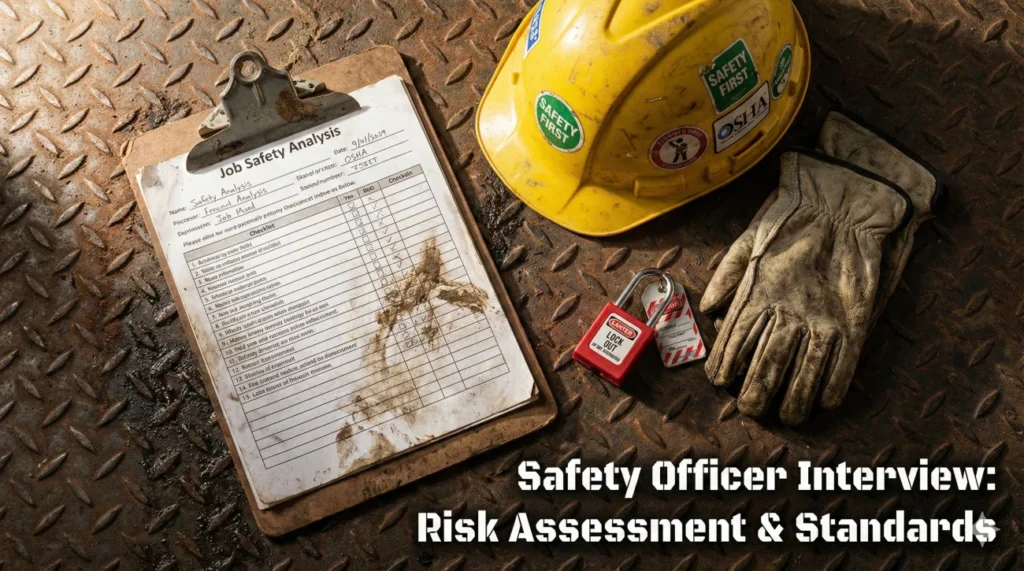
Safety officer interview questions test your ability to protect people by shaping behavior and systems. Knowledge of standards matters, but the real job is creating a site where shortcuts do not feel “normal.”
Hiring managers look for someone who can be firm without being a bully. They want to hear how you use the hierarchy of controls, how you run JSAs and permits, and how you respond when a near miss is reported instead of hidden.
This guide covers compliance, critical hazards, and the leadership side of safety: coaching veteran crews, investigating incidents with root cause discipline, and turning lessons into site-wide prevention.
Core Safety Principles
Q: Explain the “Hierarchy of Controls” and give an example for silica dust.
The Hierarchy of Controls is the fundamental framework for hazard reduction. It ranks strategies from most effective to least effective.
1. Elimination: Physically remove the hazard. (Best)
2. Substitution: Replace the hazard.
3. Engineering Controls: Isolate people from the hazard.
4. Administrative Controls: Change the way people work.
5. PPE: Protect the worker with gear. (Last Resort)
For Silica Dust (concrete cutting):
– Elimination/Substitution: Design the building with precast concrete to avoid on-site cutting.
– Engineering: Use a wet-saw or a vacuum attachment (LEV) to capture dust at the source.
– Administrative: Rotate workers to limit exposure time.
– PPE: Wear an N95 respirator. PPE is the least effective because it relies on the worker wearing it correctly every time.
Q: What is the difference between a JSA (Job Safety Analysis) and a Safe Work Permit?
A JSA (or JHA) is a planning tool used before a task begins. The crew breaks the job down into steps (e.g., 1. Setup ladder, 2. Climb roof), identifies hazards for each step (1. Ladder slip, 2. Fall from height), and defines controls (1. Tie off ladder, 2. Wear harness). It is a living document discussed during the toolbox talk.
A Safe Work Permit is a formal authorization required for high-risk activities. Examples include Hot Work, Confined Space Entry, or Critical Lifts. It requires a Competent Person to verify specific conditions (e.g., checking oxygen levels, verifying fire watch is present) before granting permission to start. You can do a JSA for painting a wall; you need a Permit for welding inside a tank.
Q: Unsafe Acts vs. Unsafe Conditions: Which causes more accidents?
Heinrich’s Law suggests that 88-90% of accidents are caused by Unsafe Acts (human behavior, like taking a shortcut or not wearing PPE), while only 10% are caused by Unsafe Conditions (equipment failure, missing guardrail). However, modern safety thinking (Human Organizational Performance – HOP) challenges this binary.
While the “act” might be the trigger, it is often the “condition” or the “system” that allowed the act to happen. For example, a worker standing on the top rung of a ladder (Unsafe Act) usually does so because the company didn’t provide a tall enough ladder (Unsafe Condition/System). As a Safety Officer, I focus on fixing the system that drives the behavior, rather than just blaming the worker.
Q: Describe the “Heinrich Triangle” (Safety Pyramid).
The pyramid illustrates the statistical relationship between minor incidents and major fatalities. The classic ratio is 300:29:1. For every 300 Near Misses (unsafe acts/conditions with no injury), there will be 29 Minor Injuries (First Aid/Recordables), and eventually 1 Major Injury/Fatality.
This concept drives proactive safety. If we ignore the near misses at the bottom of the pyramid, we are statistically guaranteeing a fatality at the top. My job is to widen the base of reporting – encouraging workers to report “close calls” so we can fix the precursors before they result in a ambulance ride.
Technical Compliance & Standards
Q: Confined Space: Permit-Required vs. Non-Permit
A Confined Space is large enough to enter, has limited entry/exit, and is not designed for continuous occupancy. It becomes Permit-Required if it contains a serious hazard: hazardous atmosphere, engulfment potential (grain/sand), entrapment configuration (sloping floors), or any other recognized safety hazard. For Permit spaces, I require an Attendant (hole watch), continuous atmospheric monitoring, and a rescue plan. If I can eliminate the hazard (e.g., Force Air Ventilation), I might reclassify it to Non-Permit.
Q: Fall Protection: The ABCs
A – Anchorage: The tie-off point. Must support 5,000 lbs per worker. I check that workers aren’t tying off to conduit or PVC pipes. B – Body Wear: The full-body harness. I inspect it for fraying, UV damage, and ensure the D-ring is between the shoulder blades. C – Connecting Device: The lanyard or SRL (Yo-Yo). I ensure they calculate “Fall Clearance” – verifying they won’t hit the ground before the shock absorber fully deploys.
Q: Lockout / Tagout (LOTO)
LOTO prevents the accidental release of hazardous energy (electrical, hydraulic, pneumatic, gravity) during maintenance. The most critical step often missed is Verification (“Tryout”). After locking the disconnect, the worker must try to start the machine to prove it is dead (“Lock, Tag, Try”). I also enforce the “One Person, One Lock, One Key” rule – no one can remove another person’s lock. Group LOTO boxes are used for complex crews.
Q: GHS & HazCom Standard
The Globally Harmonized System (GHS) standardizes chemical labeling. I ensure every chemical container on site has a label with the Signal Word (Danger/Warning), Pictograms (e.g., Skull & Crossbones, Flame), and Hazard Statements. I maintain the SDS (Safety Data Sheet) binder – now often digital. If a worker is using a solvent, I ask them, “Where is the SDS and what PPE does it require?” If they don’t know, it’s a violation.
Q: Scaffolding Competent Person
Scaffolds must be erected, moved, and dismantled under the supervision of a Competent Person. I check for the “Tag” (Green/Yellow/Red) at the access point. I look for: full planking (no gaps > 1 inch), guardrails on all open sides, toe boards to prevent falling objects, and proper base plates/mud sills. The “4 to 1” rule applies to stability: if the scaffold is 4 times higher than its base width, it must be tied to the structure.
Q: Electrical Safety: GFCI vs. Assured Grounding
On construction sites, we prevent shock using one of two methods. 1) GFCI (Ground Fault Circuit Interrupters): These trip instantly if current leaks to ground (indicating a shock). I prefer this; every extension cord should be plugged into a GFCI spider box or puck. 2) Assured Equipment Grounding Conductor Program (AEGCP): A documented program of testing every cord and tool for continuity quarterly (color-coded tape scheme). GFCI is safer because it’s active protection.
Incident Management & Leadership
You see a veteran foreman working unsafely (e.g., no safety glasses). He has been with the company 20 years. How do you handle it?
Confrontation without respect builds resistance. I wouldn’t yell from across the site. I would walk up to him, greet him respectfully, and ask to speak privately. I’d say, “John, I respect your experience, and the younger guys look up to you. When they see you without glasses, they think it’s okay. I need you to lead by example on this.”
By framing it as a leadership issue rather than a compliance issue, I appeal to his pride. If he refuses, I have to be firm: “I can’t let you work without them. It’s my job to protect you even if you don’t think you need it.” I aim for a handshake agreement, but I document the interaction.
An accident occurs: A worker falls off a ladder and breaks a leg. Walk me through the investigation.
1. Immediate Response: Secure the scene, ensure medical care, and preserve evidence (don’t move the ladder). 2. Data Collection: Take photos of the ladder feet, the ground surface, the worker’s boots. Interview witnesses separately: “What did you see?” not “Did he slip?”
3. Root Cause Analysis (5 Whys): Why did he fall? Ladder slipped. Why? It was on mud. Why? He didn’t have a stable surface. Why? He couldn’t find plywood. Why? The site was disorganized. 4. Corrective Action: The “fix” isn’t just “Warning Letter to Worker.” The fix is “Establish designated material laydown areas and mandatory mud-sills for ladders.” I focus on preventing recurrence, not assigning blame.
An OSHA inspector arrives at the gate unannounced. What do you do?
I stay calm and professional. I ask for their credentials and the reason for the visit (Complaint? Programmed inspection? Referral?). I notify the Project Manager and Corporate Safety Director immediately. I ask the inspector to wait (typically up to 1 hour is reasonable) until the corporate representative arrives, if policy dictates.
During the walkaround, I stick to the inspector like glue. If they take a photo, I take the same photo. If they interview a worker, I ensure the worker knows their rights (though I cannot coerce them). I fix any simple violations immediately during the walk (e.g., “Move that cord”). I do not volunteer information; I answer exactly what is asked. My goal is to show cooperation while protecting the company’s legal interests.
Advanced Safety Management
Q: Differentiate between Leading and Lagging Indicators.
Lagging Indicators look backward at failures. They measure outcomes: TRIR (Total Recordable Incident Rate), DART (Days Away/Restricted/Transferred), and EMR (Experience Modification Rate). They tell you how many people got hurt, but not how to prevent the next one.
Leading Indicators look forward at prevention. They measure proactive activities: Number of near misses reported, percent of Toolbox Talks completed, number of safety audits performed, or hazards fixed within 24 hours. A healthy safety culture focuses on driving the Leading Indicators up, knowing the Lagging Indicators will follow.
Q: What is Behavior-Based Safety (BBS)?
BBS is a methodology that focuses on at-risk behaviors as the root of accidents. It involves peer-to-peer observation. Workers observe each other and give feedback: “I noticed you didn’t check your blind spot.” The key is that it is non-punitive and anonymous. The data is collected to find trends (e.g., “80% of our at-risk behaviors are related to rushing”). We then target our training/campaigns to address “Rushing.” It shifts safety from “Management Enforcement” to “Team Ownership.”
Q: How does the EMR (Experience Modification Rate) impact the business?
The EMR is a number used by insurance companies to gauge past cost of injuries and future risk. The industry average is 1.0. If our EMR is 0.7, we pay 30% less for Workers’ Comp insurance. If it’s 1.5, we pay 50% more. Furthermore, many large clients and General Contractors will strictly disqualify any bidder with an EMR > 1.0. Therefore, a poor safety record directly destroys the company’s ability to win work and profit margin. Safety is a profit center, not an overhead.
Q: Explain ISO 45001.
ISO 45001 is the international standard for Occupational Health and Safety Management Systems (replacing OHSAS 18001). It requires a “Plan-Do-Check-Act” cycle. It differs from old standards by emphasizing Worker Participation and Management Leadership. It requires safety to be integrated into the strategic business plan, not just a side department. Implementing ISO 45001 proves to global clients that we have a robust, audited system for managing risk.
Safety Officer Knowledge Check
Test Your Safety IQ
1. At what height is fall protection required in General Construction (OSHA Subpart M)?
- 4 feet
- 6 feet (lower levels or edges)
- 10 feet
- Whenever you feel scared
2. Which is the MOST effective method in the Hierarchy of Controls?
- PPE (Personal Protective Equipment)
- Administrative Controls
- Elimination
- Engineering Controls
3. A “Competent Person” is defined by OSHA as someone who:
- Has a college degree in safety
- Can identify existing/predictable hazards AND has the authority to take prompt corrective measures (stop work)
- Has worked for 10 years
- Is the owner of the company
4. What is the minimum oxygen level required for Safe Entry into a confined space?
- 16.0%
- 19.5%
- 21.0%
- 23.5%
5. The “General Duty Clause” (Section 5(a)(1) of the OSH Act) states:
- Employers must pay overtime
- Employers must provide a workplace free from recognized hazards causing or likely to cause death/harm (The “Catch-All” clause)
- Employees must buy their own boots
- Safety is optional for small companies
6. In LOTO, who removes the lock?
- The supervisor
- The authorized employee who applied it
- The safety manager
- The next shift worker
7. What is a “Recordable Incident” (OSHA 300)?
- A small cut requiring a Band-Aid (First Aid)
- An injury requiring medical treatment beyond First Aid, restricted work, or days away
- A near miss
- Property damage only
8. A “Swing Fall” hazard occurs when:
- The harness is too loose
- The anchor point is not directly overhead, causing the worker to swing like a pendulum into an obstruction
- The worker jumps from the scaffold
- The lanyard breaks
9. For trenching, a protective system (shoring/sloping) is required at what depth?
- 2 feet
- 5 feet (or less if soil is unstable)
- 10 feet
- Only if there is water
10. Class G Hard Hats are proof tested to:
- 20,000 Volts (Class E)
- 2,200 Volts (General use)
- No voltage protection (Conductive)
- Falling anvils
11. A “Hot Work” permit is needed for:
- Working outside in summer
- Operations producing flames, sparks, or heat (Welding/Grinding) near combustibles
- Working with hot water
- Changing a lightbulb
12. The “IDLH” atmosphere stands for:
- Ideal Daily Limit for Health
- Immediately Dangerous to Life or Health
- Internal Damage to Lungs and Heart
- In Door Light Hazard
13. Which fire extinguisher type is used for Electrical Fires?
- Class A (Water)
- Class C (Non-conductive)
- Class K (Kitchen grease)
- A bucket of sand
14. What does the acronym “PASS” stand for in fire extinguisher use?
- Pull, Aim, Spray, Stop
- Pull (pin), Aim (base), Squeeze (lever), Sweep (side to side)
- Point, Aim, Shoot, Spray
- Panic And Scream Soundly
15. Silica dust exposure primarily causes:
- Mesothelioma (Asbestos)
- Silicosis (Lung scarring)
- Lead poisoning
- Hearing loss
16. A “Toolbox Talk” should happen:
- Once a year
- Ideally daily or weekly, before the shift starts
- After an accident only
- When the inspector arrives
17. What is the max gap allowed between a scaffold plank and the upright?
- 6 inches
- 1 inch
- 12 inches
- No gap allowed ever
18. The “3-Point Contact” rule applies to:
- Electrical wiring
- Climbing ladders or mounting equipment (2 hands 1 foot, or 2 feet 1 hand)
- Crane signaling
- Meeting agendas
19. In incident investigation, “Root Cause” refers to:
- Who to blame
- The fundamental systemic failure that allowed the incident to occur (e.g., lack of training)
- The immediate cause (e.g., slipped)
- The cost of the damage
20. OSHA fines for a “Willful” violation can be up to approx:
- $7,000
- $161,323 (adjusted for inflation 2024) per violation
- $500
- Zero, just a warning
❓ FAQ
🦺 How do you balance being the “cop” and being the “coach”?
Set non-negotiables for life-critical rules, and coach everything else with respect and repetition. People follow safety when it feels like ownership, not humiliation.
🧓 What do you do when a veteran foreman ignores PPE rules?
Speak privately, connect it to leadership influence, and be consistent. If they still refuse, escalate and enforce policy. Inconsistent enforcement destroys credibility faster than any lecture.
🕳️ What makes a confined space permit-required?
If it has serious hazards like a dangerous atmosphere, engulfment risk, entrapment geometry, or other recognized hazards. Permit-required means monitoring, attendant, rescue planning, and documented authorization.
🧾 What is your approach to incident investigations?
Start with care and evidence. Preserve the scene, gather facts, interview without blame, then use a root cause method like 5 Whys. Corrective actions should fix the system, not just scold the worker.
🗣️ How do you increase near-miss reporting?
Make reporting safe and useful. Close the loop quickly: thank the reporter, fix something visible, and share the lesson. When workers see action, reports increase.
Zero Harm Is a System
If you want extra reps beyond this page, jump to the main construction interview questions library and drill a few questions out loud until your answers sound natural, not memorized.
When you answer, show that you manage safety like operations: anticipate, control, verify, and improve. The strongest candidates can describe one incident, one root cause, and one change that prevented the next one.
⚠️ Disclaimer: The interview strategies, sample answers, and negotiation tips provided in this guide are for educational purposes only. Hiring decisions are subjective and vary by company and industry. While these strategies are based on professional HR standards, they do not guarantee a specific job offer or result.