The Inbox That Builds Buildings
Project engineer interview questions focus on the information flow that keeps the field moving. Your job is not “paperwork” for its own sake. It is removing uncertainty before it becomes rework.
Hiring managers are listening for precision: RFIs that include context and a proposed solution, submittals that are reviewed against the spec before they ever hit the architect’s desk, and meeting minutes that turn talk into action items with dates and owners.
This guide leans into the real PE workload: submittal registers, shop drawing coordination, RFI tracking, as-built redlines, and the soft skill of pushing for answers without burning relationships.
The RFI & Submittal Ecosystem
Q: What makes a “good” RFI versus a “bad” RFI?
An RFI (Request for Information) is a formal tool to clarify ambiguity, but poorly written RFIs waste time. A “bad” RFI simply asks an open-ended question: “How do I build this detail?” This forces the Architect to do the work and often results in a vague response or a “See Drawings” rejection. It shows a lack of effort from the PE.
A “good” RFI follows a three-part structure: Condition, Conflict, and Proposed Solution. First, I state the context (Drawing A101, Detail 5). Second, I identify the specific conflict (e.g., “The ductwork shown clashes with the steel beam at elevation 12′”). Third, and most importantly, I propose a solution (e.g., “Proposed Solution: Route ductwork through web opening at column line 4, per attached sketch”). This allows the Architect to simply stamp “Conforms as Noted,” reducing the turnaround time from weeks to days.
Q: Walk me through the Submittal Workflow from start to finish.
The submittal process ensures that the materials installed match the design intent. The cycle starts with me creating the Submittal Register based on the Specifications (Spec Book). I send a request to the Subcontractor. The Sub prepares the data (Product Data, Shop Drawings, Samples) and sends it to me.
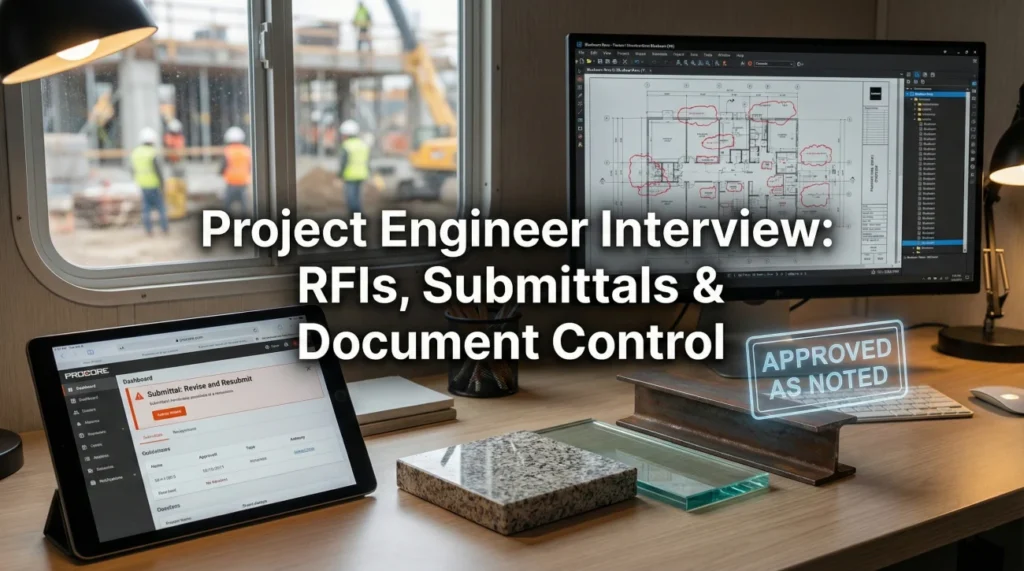
Here is the critical step: I review it first. I don’t just rubber-stamp it to the Architect. I verify it against the spec. Is it the right model? The right color? Does it meet the fire rating? If it’s wrong, I reject it back to the Sub (“Revise and Resubmit”). If it looks good, I stamp it and forward it to the Design Team. They review and return it (Approved, Approved as Noted, or Revise and Resubmit). I then distribute the approved package to the Field Superintendent and the Subcontractor. Installing work without an approved submittal is a major risk I never take.
Q: Explain the difference between “Shop Drawings” and “Contract Drawings”.
Contract Drawings (Design Drawings) are produced by the Architect/Engineer. They show design intent – the finished look, general dimensions, and performance criteria. They typically do not show means and methods or exact fabrication details.
Shop Drawings are produced by the Contractor/Manufacturer. They bridge the gap between design and fabrication. They show exact field measurements, installation clearance, specific connection details, and assembly steps. For example, the Contract Drawing shows a steel beam size and location; the Shop Drawing shows the exact length to the millimeter, the bolt hole spacing, and the coping required for the connection. Shop Drawings superseding Contract Drawings (once approved) is how we build.
Q: Why are Meeting Minutes critical, and what is your strategy for taking them?
Meeting minutes are not just a transcript; they are a binding record of decisions and assignments. In a dispute years later, if it’s not in the minutes, it didn’t happen. My strategy focuses on Action Items. I don’t just record “We talked about the roof.”
I record: “Item 1.02: Roof leak at Grid A4. Action: Roofer to inspect and repair. Due Date: Nov 12th. Status: Open.” I designate a “Old Business” and “New Business” section. I send the minutes out within 24 hours of the meeting and state, “Please notify us of any discrepancies within 3 days, otherwise these minutes stand as the record.” This forces accountability.
Document Control & Technical Skills
Q: Reading the Spec Book (CSI Divisions)
The Specifications are just as legally binding as the drawings. I am fluent in the CSI MasterFormat (50 Divisions). I know that Concrete is Division 03, Steel is 05, Thermal/Moisture is 07, and Electrical is 26. When a question arises, I check the spec first. The drawing might show a generic “sealant,” but Spec Section 07 92 00 tells me exactly which silicone product is required and the warranty terms.
Q: Managing Long Lead Items
A “Long Lead Item” is a material with a procurement time longer than the construction schedule allowance (e.g., Switchgear, Generators, Elevators, Custom Glazing). I identify these during the pre-construction phase. I prioritize these submittals immediately. Once approved, I track the “Fabrication Release” and get a committed shipping date. I update the Procurement Log weekly to flag any slippage before it delays the critical path.
Q: As-Builts vs. Record Drawings
As-Builts are the “Redlines” kept on site by the contractor. We mark up the contract drawings in red ink to show every deviation, RFI change, and exact location of underground utilities. Record Drawings are the final set produced by the Architect. They take our messy As-Builts and formally incorporate the changes into the CAD/BIM file for the owner’s permanent record. Maintaining accurate As-Builts daily is part of my job to ensure the final turnover isn’t a scramble.
Q: Change Order Request (COR) Backup
When a scope change occurs (via ASI or RFI response), I must generate a COR. The Project Manager negotiates the price, but I build the backup. I collect the quotes from the subs, verify quantities (takeoffs), and check labor rates against the contract. I ensure we aren’t being double-billed for work already in the base scope. A solid COR package includes the narrative, the breakdown, the sub-quotes, and the schedule impact analysis.
Q: Punch List Management
The Punch List details incomplete or deficient work near the end of the project. My role is to filter the Architect’s list and distribute items to the specific trades. I use software like Procore or PlanGrid to pin photos to the floor plan. I walk with the Subs to ensure they understand the issue. I don’t call the Architect back for a re-inspection until I have verified the work is 100% done. Calling the Architect for a failed re-inspection damages credibility.
Q: Closeout Documentation
Closeout is the “last 5% that takes 20% of the effort.” I compile the O&M Manuals (Operation and Maintenance), Warranties, Attic Stock (spare materials), and Training Videos. I start this process months before completion. I verify that the warranty start dates align with Substantial Completion, not the shipping date. The owner will not release the final retainage check until this package is perfect.
Coordination Scenarios
The Architect has rejected a critical submittal twice, and it’s now threatening the schedule. What do you do?
The standard “submit and wait” process has failed. I need to break the cycle. I would pick up the phone or set up a virtual meeting with the Architect and the Subcontractor together. I would ask the Architect specifically, “What exactly do you need to see to approve this?”
Often, the rejection is due to a misunderstanding of a specific detail or a formatting issue. By facilitating a direct conversation, we can redline the submittal live in the meeting. I would then document the agreed-upon changes in an RFI or email and have the Sub resubmit formally the next day. I take ownership of closing the communication gap.
You notice a Subcontractor installing work in the field that conflicts with a pending (unapproved) RFI.
This is a major risk (“Work at Risk”). I would immediately notify the Superintendent to stop that specific portion of the work. I would tell the Subcontractor, “RFI #24 regarding this duct routing is still open. If you install it now and the answer comes back differently, you will have to tear it out at your own cost.”
However, if the schedule pressure is immense, I would escalate to the Project Manager. Sometimes we make a calculated decision to proceed based on the most likely answer, but this must be a documented decision by leadership, not an accidental assumption by a field crew.
The field condition contradicts the architectural drawings (e.g., a column is 6 inches off from the plan).
I need data, not just an opinion. I would go to the field and measure it myself to verify. I would take clear photos with a tape measure visible. I would then overlay the architectural plan with the structural plan to see if it’s a coordination error between design disciplines.
I would draft an RFI titled “Field Condition – Column Grid Line Conflict.” I would attach the photos and a sketch showing the actual vs. planned location. I would propose a solution: “Please confirm if wall framing should align with the actual column location or the grid line.” Getting the Architect’s direction in writing is essential before we frame the wall.
Advanced Management & Software
Q: How do you utilize Procore (or similar PM software) effectively?
Procore is the “Single Source of Truth.” I ensure that every drawing revision (ASI, CCD) is uploaded and “slipped sheeted” so the field team on iPads is always looking at the current set. I use the RFI tool to link RFIs directly to the specific location on the drawing. I use the Submittal tool to enforce workflow deadlines. I treat the software not just as file storage, but as a communication engine that automatically notifies stakeholders of overdue items.
Q: Explain the relationship between the PE and the Superintendent.
It’s a symbiotic relationship. The Superintendent is the “General” of the field; the PE is the “Chief of Staff.” The Super tells me what they need to build (materials, answers), and I get it for them. I rely on the Super for field reality checks (“Can we actually build this detail?”), and they rely on me to cover their back with paperwork and updated drawings. A PE who never leaves the trailer fails; I must walk the site daily to build trust and understand the physical context of the RFIs I’m writing.
Q: What is an ASI vs. CCD vs. RFI Response?
ASI (Architectural Supplemental Instruction): A change to the drawings that the Architect believes has no cost or time impact (minor clarification). CCD (Construction Change Directive): A directive to do work that definitely has an impact, but price is not yet agreed; used to avoid delay. RFI Response: An answer to a question. It might become a Change Order if it adds scope, or it might just be a clarification. I review every single one of these to determine if it warrants a Cost Issue (PCO – Potential Change Order).
Q: How do you manage QA/QC (Quality Assurance/Quality Control) as a PE?
My role is verifying compliance. I maintain the “Mock-up Log” to ensure benchmark samples are approved. Before a major concrete pour, I might walk the deck with the pre-pour checklist to verify sleeve locations against the shop drawings. I manage the “Third Party Testing” reports (e.g., concrete cylinder breaks, weld inspections). If a report comes back failing (e.g., low concrete strength), I immediately flag it, create a Non-Conformance Report (NCR), and track the corrective action until closure.
Project Engineer Knowledge Check
Test Your Documentation IQ
1. What does “RFI” stand for?
- Request for Inspection
- Request for Information
- Ready for Installation
- Required Field Item
2. Which document supersedes the other for fabrication purposes?
- Contract Drawings supersede Shop Drawings
- Approved Shop Drawings supersede Contract Drawings (for specific details)
- The rough sketch on a napkin
- The verbal instruction from the owner
3. An “ASI” (Architectural Supplemental Instruction) typically implies:
- A massive change in scope with high cost
- A clarification or minor change with NO cost/time impact
- A stop work order
- A safety violation
4. What is “Attic Stock”?
- Old files stored in the attic
- Extra material (tile, carpet, paint) turned over to the owner for future repairs
- Stock market shares in the attic company
- Insulation material
5. “O&M” stands for:
- Overhead and Margin
- Operations and Maintenance
- Owner and Manager
- Occupancy and Moving
6. Who typically generates the “Shop Drawings”?
- The Architect
- The Owner
- The Subcontractor or Manufacturer
- The City Inspector
7. A “Cloud” on a drawing indicates:
- Where the sky is visible
- A revision or change to that specific area
- A wet area
- A future expansion zone
8. What is a “Mock-up”?
- A joke
- A physical sample of a construction assembly built for approval of workmanship
- A failed inspection
- A preliminary budget
9. In the submittal process, “Revise and Resubmit” means:
- You can proceed with fabrication
- The submittal is rejected; corrections must be made and sent back for review
- The architect will fix it for you
- The project is cancelled
10. “Takeoff” refers to:
- Leaving the job site early
- Quantifying materials from the drawings (counting/measuring)
- Removing old demolition material
- The crane lifting a load
11. Division 26 of the CSI MasterFormat covers:
- Concrete
- Finishes
- Electrical
- Plumbing
12. A “Cut Sheet” (Product Data) typically shows:
- How to cut the material
- Manufacturer specifications, dimensions, and performance data
- The price of the labor
- The delivery driver’s schedule
13. “Redlines” are:
- Prohibited areas on site
- Drawings marked up in red to show As-Built changes
- The critical path schedule bars
- Budget deficits
14. What is a “PCO” (Potential Change Order)?
- A change that has been rejected
- A tracking item for an issue that might result in a cost impact
- A Purchase Change Option
- Project Control Officer
15. “Lead Time” is:
- The weight of the material
- The time between ordering a material and its delivery to site
- The time needed to install the material
- The time the project manager leads the meeting
16. Which software is commonly used for PDF markup and overlay?
- Word
- Bluebeam Revu
- Excel
- PowerPoint
17. A “Transmittal” is:
- A part of a car engine
- A document recording the sending of information/drawings from one party to another
- A radio message
- A delay claim
18. “Slip-sheeting” refers to:
- Falling on ice
- Replacing old drawing sheets with revised versions in the current set
- Sleeping on the job
- Covering the floor with paper
19. “BIM” stands for:
- Building Inspection Management
- Building Information Modeling
- Basic Installation Method
- Big Iron Machine
20. The “Submittal Log” is used to:
- Log the hours of the subs
- Track the status and due dates of all required material approvals
- Record daily weather
- List the project team contacts
❓ FAQ
📨 How do you write an RFI that actually gets a useful answer?
Keep it tight: condition, conflict, and your proposed solution. Attach a marked-up sketch or screenshot. The goal is to make it easy for the designer to approve or correct, not to force them to guess what you mean.
🧾 What does “Approved as Noted” mean in practice?
It means you must follow the notes exactly, and you should distribute the marked-up version to the field. A quick miss on a note can turn an “approval” into a costly reinstall later.
🗣️ How do you push an architect for an urgent response without damaging the relationship?
Bring clarity, not pressure. Explain the schedule impact, offer two viable options, and propose a quick call. People respond faster when the problem is framed with solutions and consequences.
🗂️ What is your best method for staying organized day to day?
One source of truth for logs, consistent file naming, and a daily habit: close out yesterday’s open items before adding new ones. A clean log beats heroic memory every time.
⏱️ How do you manage long-lead items as a Project Engineer?
Identify them early, prioritize their submittals, and track release dates like milestones. If the approval is late, escalate with facts: lead times, shipping windows, and the task it blocks on the schedule.
Make the Paperwork Work
If you want extra reps beyond this page, jump to the full construction interview questions collection and drill a few questions out loud until your answers sound natural, not memorized.
When you answer, show that you prevent problems instead of documenting them after the fact. The best PE stories are small wins that quietly saved weeks: a clean RFI, a caught spec miss, a long-lead item pushed early.
⚠️ Disclaimer: The interview strategies, sample answers, and negotiation tips provided in this guide are for educational purposes only. Hiring decisions are subjective and vary by company and industry. While these strategies are based on professional HR standards, they do not guarantee a specific job offer or result.