- Why it matters: Construction safety is professional responsibility, because shortcuts can turn minor time savings into permanent, preventable harm.
- Culture first: Safety over schedule means anyone can stop work for imminent danger, and teams must feel safe reporting hazards without retaliation.
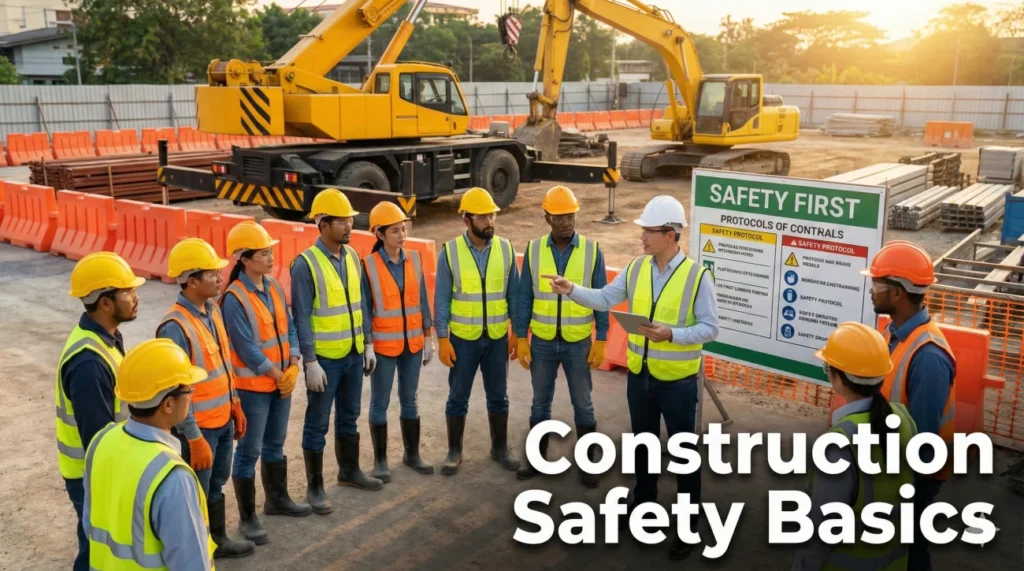
- PPE basics: Wear the site baseline correctly, add task-specific protection when needed, and replace damaged or expired gear instead of “making it work.”
- Spot and report hazards: Watch the Fatal Four risks, report hazards and near-misses immediately, document what you saw, and verify the fix before work resumes.
- Daily protocols: Toolbox talks, inspections, permits, lockout/tagout, housekeeping, and emergency plans keep safety consistent when pressure builds.
Why Safety Comes First
Construction sites rank among the most hazardous work environments: workers operating heavy equipment near fall hazards, handling dangerous materials under time pressure, coordinating complex activities in confined spaces, and facing electrocution, crushing, and struck-by risks daily. Understanding construction safety basics isn’t optional knowledge for compliance checkbox checking: it represents fundamental professional responsibility protecting human life, preventing devastating injuries, and ensuring workers return home safely to their families every single day.
The challenge is that schedule and cost pressures create constant temptation to cut safety corners. Skipping fall protection saves 10 minutes, working without proper PPE feels more comfortable, bypassing lockout/tagout seems expedient when equipment restart takes time. Yet these shortcuts kill workers predictably and preventably. Professional construction personnel understand that no schedule, budget, or client demand justifies compromising safety: temporary productivity gains pale against permanent life-altering consequences of accidents.
This guide establishes foundational safety knowledge for construction professionals at all levels. You’ll learn core safety culture principles prioritizing life over deadlines, essential PPE requirements and proper usage, systematic hazard recognition and reporting protocols, site-specific safety procedures, and effective toolbox talk practices maintaining daily safety focus.
Safety Culture Fundamentals
True safety culture principles extend beyond compliance requirements to organizational values where everyone takes personal responsibility for safe conditions.
Core Safety Culture Principles
Effective safety culture rests on foundational beliefs shaping how organizations and individuals approach risk.
| Principle | What It Means | How It Shows in Practice |
|---|---|---|
| Safety over schedule | No deadline justifies unsafe work, production stops for safety concerns | Empowering anyone to stop work for safety, accepting delays for proper procedures, leadership modeling |
| Everyone responsible | Safety isn’t just safety officer’s job, every worker owns it | Workers correcting unsafe conditions, peer accountability, speaking up about hazards |
| Zero tolerance for shortcuts | Proper procedures followed every time, no exceptions for convenience | Consistent enforcement, leadership compliance, consequences for violations regardless of seniority |
| Continuous improvement | Learn from near-misses and incidents, evolve practices | Incident investigation focus on prevention not blame, implementing lessons, sharing across sites |
| Psychological safety | Workers feel safe reporting hazards without retaliation | Anonymous reporting systems, thanking hazard reporters, no punishment for raising concerns |
💡 Pro tip: Safety culture reveals itself most clearly when leadership isn’t watching. Strong safety culture means workers follow procedures when alone because they believe in protecting themselves and colleagues, not just avoiding discipline. Weak culture shows workers cutting corners whenever supervision absent. Your personal safety commitment matters regardless of organizational culture: protect yourself even if others don’t.
Stop Work Authority
Empowering any worker to halt operations upon recognizing imminent danger represents fundamental safety principle.
- ⚠️ Anyone can stop work: No permission needed if you see immediate danger to yourself or others
- 🛡️ Protection from retaliation: Workers cannot be punished for good-faith safety stops
- 🔍 Assessment before resuming: Don’t restart until hazard addressed and supervisor approves
- 📢 Communication responsibility: Clearly explain reason for stop to supervisor and affected workers
Expert advice: The hardest safety moments involve choosing between protecting yourself and meeting deadline, avoiding conflict with aggressive supervisor, or appearing “difficult” to colleagues. Remember: You cannot rebuild your career if you’re dead or permanently disabled. No job, schedule, or relationship worth serious injury. Speak up, stop work, remove yourself from danger: professional construction companies respect workers prioritizing safety even when initially creating friction.
Personal Protective Equipment Standards
PPE requirements construction sites establish minimum equipment protecting workers from common hazards, with additional gear required for specific tasks.
Universal Site PPE Requirements
Most construction sites mandate baseline protective equipment for all personnel entering work areas.
| PPE Item | Purpose | Usage Requirements |
|---|---|---|
| Hard hat (helmet) | Protects head from falling objects, bumps, electrical hazards | Worn at all times on active sites, replaced after impact or every 5 years, proper fit critical |
| Safety glasses/goggles | Shields eyes from debris, dust, chemicals, projectiles | ANSI Z87.1 rated, side shields required, prescription glasses need safety rating or worn under goggles |
| High-visibility vest | Ensures worker visibility to equipment operators and vehicles | ANSI Class 2 or 3 depending on site, clean and visible, worn over all clothing |
| Steel-toed boots | Protects feet from crushing, punctures, slips | ASTM rated, ankle support, slip-resistant soles, waterproof for wet conditions |
| Work gloves | Hand protection from cuts, abrasions, splinters, chemicals | Task-appropriate (cut-resistant, chemical-resistant, insulated), proper fit, replace when damaged |
Task-Specific Additional PPE
Certain activities require supplemental protection beyond universal site requirements.
- Fall protection: Harness, lanyard, anchor points for work above 6 feet (1.8m), proper training mandatory
- Respiratory protection: Dust masks, respirators, or SCBAs for airborne hazards, fit testing required
- Hearing protection: Earplugs or earmuffs in high-noise areas (85+ dB), double protection sometimes needed
- Face shields: Full face protection for grinding, welding, chemical handling beyond safety glasses
- Arc flash gear: Specialized clothing and face protection for electrical work on energized equipment
- Chemical suits: Impermeable protection for hazardous material handling, level determined by exposure risk
Never modify PPE to improve comfort: drilling ventilation holes in hard hats, removing side shields from safety glasses, or cutting off glove fingers compromises protection defeating their purpose. If PPE uncomfortable or ill-fitting, request proper size or different approved model. Discomfort never justifies compromising protective capability.
PPE Inspection and Maintenance
Equipment protects only when properly maintained and replaced when damaged or expired.
- 🔍 Pre-use inspection: Check for damage, wear, expiration before each use
- 🧼 Regular cleaning: Maintain equipment per manufacturer instructions, replace if contaminated
- 📅 Replacement schedule: Follow expiration dates (hard hats 5 years, fall protection per inspection)
- 🗑️ Immediate replacement: Remove damaged equipment from service, don’t leave for others to use
Hazard Recognition and Reporting
Systematic hazard reporting protocols identify dangers before they cause injuries, creating proactive safety management rather than reactive incident response.
The “Fatal Four” and Common Construction Hazards
OSHA identifies four hazard categories causing majority of construction fatalities, requiring particular vigilance.
| Hazard Category | Common Scenarios | Prevention Measures |
|---|---|---|
| Falls (33% of deaths) | Unprotected edges, ladder falls, scaffold collapse, roof work | Guardrails, fall arrest systems, proper ladder use, scaffold inspection, hole covers |
| Struck-by objects (11%) | Falling tools/materials, vehicle strikes, swinging loads, equipment contact | Hard hats, barricades, spotters, secured loads, tool tethers, high-visibility clothing |
| Electrocution (9%) | Power line contact, damaged cords, improper grounding, wet conditions | Maintain clearance distances, GFCI protection, lockout/tagout, cord inspection, qualified electricians |
| Caught-in/between (7%) | Trench collapse, machinery entanglement, crushing between equipment/structures | Trench shoring, machine guards, traffic control, spotter communication, isolation procedures |
Hazard Identification and Reporting Process
Effective hazard management requires systematic identification, documentation, and resolution.
- Pre-task hazard assessment: Identify risks before starting work, plan mitigation, verify controls in place
- Ongoing observation: Continuously scan environment for changing conditions, new hazards, control failures
- Immediate reporting: Alert supervisor and affected workers about identified hazards without delay
- Documentation: Record hazard details, location, potential severity, witnesses, corrective actions needed
- Follow-up verification: Confirm hazard corrected before resuming work, document resolution
- Near-miss reporting: Report close calls and potential incidents: they predict future injuries
Expert advice: Never assume someone else will report obvious hazard. If you see danger, report it immediately even if you think supervisor must already know. Assumption kills: the exposed rebar you walked past assuming “someone will cap that” might impale next worker. Your voice could prevent tragedy. Speak up every time, accept brief social awkwardness over permanent injury guilt.
Essential Site Safety Protocols
Construction site safety requires adhering to standardized procedures governing daily operations and emergency response.
Daily Safety Procedures
Routine protocols maintain baseline safety throughout normal operations.
| Protocol | Purpose | Implementation |
|---|---|---|
| Toolbox talks | Daily safety briefings on specific hazards, reinforcing awareness | 15-minute pre-shift meetings, topic rotation, worker participation, sign-in sheets |
| Site inspections | Regular systematic review of conditions identifying emerging hazards | Daily supervisor walks, weekly safety team audits, documented findings, corrective tracking |
| Permit systems | Control high-risk work through authorization verifying safety measures | Hot work permits, confined space entry, excavation permits, documented prerequisites |
| Lockout/tagout (LOTO) | Prevent unexpected equipment energization during maintenance | Energy isolation, lock placement, verification, authorized removal only, personal locks |
| Housekeeping | Maintain clean, organized site reducing trip hazards and fire risk | Designated material storage, waste removal, clear walkways, end-of-shift cleanup |
Effective Toolbox Talk Practices
Daily safety meetings maintain focus and reinforce critical safety messages when done effectively.
- 🎯 Relevant topics: Address actual site hazards, upcoming tasks, seasonal risks, recent incidents
- 🗣️ Interactive format: Encourage questions and discussion, not just lecture, worker experiences valuable
- ⏰ Consistent timing: Hold at same time daily before work starts, brief but focused (10-15 minutes)
- 📝 Documentation: Sign-in sheets prove attendance, topic records demonstrate training coverage
- 🔄 Follow-up: Reference toolbox topics when observing related work, reinforce lessons throughout day
Emergency Response Protocols
Prepared emergency response minimizes injury severity and prevents secondary incidents during crises.
- Emergency contact numbers posted visibly, all workers know who to call (911, site safety officer, emergency coordinator)
- Evacuation routes and assembly points clearly marked, regularly practiced through drills
- First aid stations stocked and accessible, trained first responders identified
- Incident command system understood, clear authority during emergencies preventing chaos
- Equipment shutdown procedures established for fire, structural failure, severe weather
- Communication methods defined: how to alert all workers quickly (air horn, radio, etc.)
For comprehensive guidance on construction safety in interview contexts, explore professional preparation resources covering safety scenario responses and hazard management examples.
❓ FAQ
🎯 What should I do if I see coworker violating safety rules?
Address immediately if creating imminent danger: “Hey, you need fall protection for that height” or stop the work if serious risk. For less urgent violations, speak privately with colleague first: most violations stem from ignorance or habit, not intentional recklessness. If behavior continues after direct conversation, notify supervisor: protecting colleagues from injury outweighs social discomfort. Never ignore safety violations hoping someone else addresses them. Remember: you may witness the unsafe act that eventually kills someone unless intervened.
💼 Can I be fired for refusing unsafe work?
OSHA protects workers from retaliation for refusing work posing immediate danger of death or serious injury. However, refusal must be reasonable: you genuinely believe imminent danger exists, you’ve requested correction without satisfactory response, and insufficient time exists to go through normal OSHA channels. Document your concerns, notify supervisor clearly, offer to perform alternative safe work. Legitimate safety refusals should be supported by professional companies. If terminated for good-faith safety concern, contact OSHA and employment attorney.
⏰ What constitutes a reportable incident?
OSHA requires reporting work-related deaths within 8 hours and hospitalizations, amputations, or eye loss within 24 hours. Internal company policies typically require reporting any injury needing medical treatment beyond first aid, property damage above threshold, near-misses with serious potential, and environmental releases. When uncertain, report: over-reporting beats missing critical incident. Near-misses especially valuable: they reveal hazards before causing actual injury, enabling prevention.
📋 How often should PPE be replaced?
Replacement depends on equipment type and condition. Hard hats typically replaced every 5 years or after any impact. Fall protection harnesses inspected before each use, replaced per manufacturer schedule or if damage detected. Safety glasses replaced when scratched impairing vision. Gloves replaced when torn or contaminated. General rule: if PPE damaged, worn, or doesn’t fit properly, remove from service immediately. Never wait until scheduled replacement if equipment compromised. Your life depends on PPE integrity.
✨ How do I demonstrate safety commitment during interviews?
Share specific examples showing safety prioritization: time you stopped work for hazard, how you addressed unsafe condition, safety improvement you suggested and implemented. Discuss safety training and certifications (OSHA 10/30, first aid, etc.). Explain your approach to toolbox talks or pre-task planning. Describe situation where you chose safety over schedule pressure. Authentic safety commitment shows through concrete examples and decision rationale, not generic “safety is my top priority” claims. Strong candidates discuss safety naturally throughout interview, not just when directly asked.
Final Thoughts
Understanding construction safety basics represents fundamental professional responsibility for anyone working in or around construction sites. Safety isn’t bureaucratic nuisance or obstacle to productivity: it’s the baseline commitment ensuring workers survive their employment. Every safety procedure exists because someone died or suffered catastrophic injury performing the task unsafely. Those procedures represent lessons written in blood, not arbitrary regulations.
The challenge is maintaining safety vigilance despite familiarity breeding complacency, schedule pressure creating shortcut temptation, and discomfort motivating non-compliance. Professional construction workers understand that consistent safety requires conscious discipline: choosing proper procedure over convenient shortcut every single time, speaking up about hazards despite social awkwardness, and stopping work when danger emerges regardless of deadline pressure.
Commit to personal safety accountability starting today: wear required PPE correctly every time, report hazards immediately when identified, refuse unsafe work without exception, and hold colleagues to same standards through peer accountability. Your safety commitment protects not just yourself but everyone around you. The five minutes saved cutting corners cannot restore crushed limbs, blindness, or death. No schedule, profit margin, or supervisor demand justifies compromising safety: your life and colleagues’ lives matter infinitely more than any construction project.
⚠️ Disclaimer: The interview strategies, sample answers, and negotiation tips provided in this guide are for educational purposes only. Hiring decisions are subjective and vary by company and industry. While these strategies are based on professional HR standards, they do not guarantee a specific job offer or result.