Engineering a Cleaner Future
Environmental engineer interview questions occupy a unique space where rigorous engineering principles meet strict legal frameworks. Unlike mechanical or civil engineers who primarily design for function and safety, environmental engineers design for compliance and sustainability. Hiring managers are looking for candidates who can navigate the complex intersection of chemistry, biology, hydraulics, and federal regulations (like the Clean Air Act or CWA).
The role requires a “systems thinker” who understands that solving a problem in one medium (e.g., scrubbing air emissions) often creates a problem in another (e.g., generating wastewater). Whether you are designing a bioreactor for a municipal treatment plant, modeling plume dispersion for an industrial stack, or managing a brownfield remediation project, you must demonstrate technical depth and regulatory fluency.
This guide dives deep into the core competencies of the profession: water and wastewater treatment technologies, solid and hazardous waste management, air quality control, and the environmental impact assessment process. It moves beyond basic definitions to explore the design parameters and operational challenges that define modern environmental engineering.
Core Concepts & Chemistry
Q: Explain the difference between BOD (Biochemical Oxygen Demand) and COD (Chemical Oxygen Demand), and why the ratio matters.
This is the most fundamental question in wastewater treatment. BOD measures the amount of dissolved oxygen consumed by aerobic microorganisms to decompose the organic matter in water over a specific period (typically 5 days at 20°C). It represents the biodegradable fraction of the waste. COD measures the oxygen equivalent of the organic matter that can be oxidized chemically (using a strong oxidant like dichromate). COD is always greater than or equal to BOD because it includes both biodegradable and non-biodegradable organics.
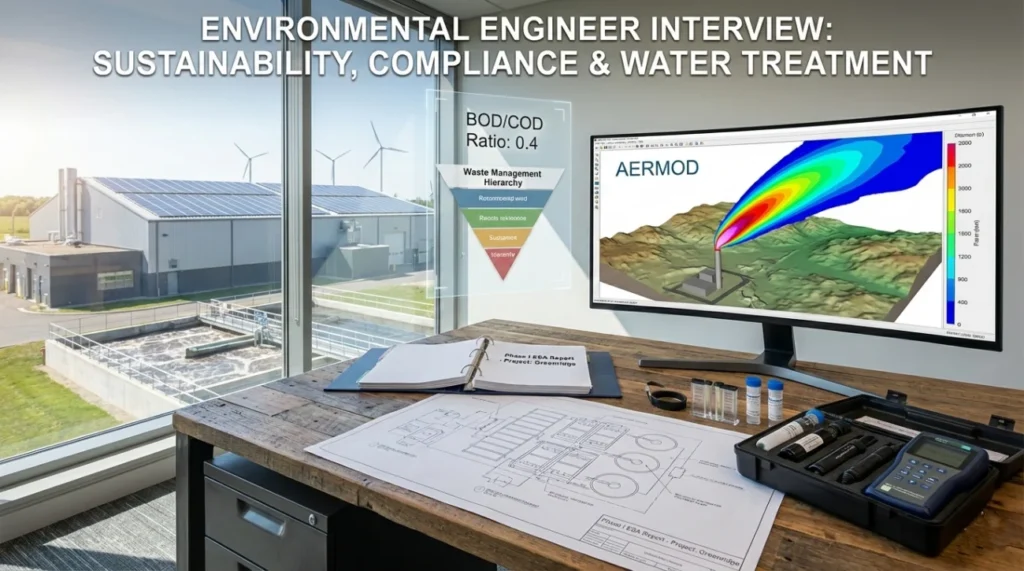
The BOD/COD ratio is critical for process selection. A high ratio (>0.5) indicates the waste is easily biodegradable, making biological treatment (like Activated Sludge) a good choice. A low ratio (<0.3) suggests the waste contains toxic or non-biodegradable compounds (refractory organics), meaning biological treatment will fail, and we must use physical-chemical methods like Advanced Oxidation Processes (AOP), adsorption, or coagulation/flocculation.
Q: How does pH affect metal solubility in wastewater?
pH is the master variable in water chemistry. Most heavy metals (Lead, Copper, Zinc, Chromium) are soluble at low pH (acidic) and precipitate out as hydroxides at high pH (alkaline). For example, to remove dissolved copper from an industrial effluent, I would raise the pH to approximately 9.0-10.0 using lime or caustic soda, causing $$Cu(OH)_2$$ to precipitate as a solid sludge that can be filtered out.
However, it is not a “higher is better” linear relationship. Many metals are amphoteric, meaning they become soluble again at very high pH levels (forming anionic complexes). Therefore, I must look at the solubility curve for the specific metal cocktail in the waste stream. Often, we use a two-stage precipitation process or add sulfide precipitation if the theoretical solubility limit of hydroxide precipitation isn’t low enough to meet discharge permits.
Q: Describe Darcy’s Law and its application in groundwater remediation.
Darcy’s Law describes the flow of fluid through a porous medium. The equation is $$Q = -KA(dh/dl)$$, where $$Q$$ is discharge, $$K$$ is hydraulic conductivity (permeability), $$A$$ is cross-sectional area, and $$dh/dl$$ is the hydraulic gradient. In remediation, this is the foundation for designing “Pump and Treat” systems or groundwater barriers.
I use it to calculate the capture zone of an extraction well. If I know the soil’s $$K$$ value (from a slug test) and the natural groundwater gradient, I can determine the pumping rate required to create a “cone of depression” that encompasses the entire contaminant plume, preventing it from migrating off-site. It also helps in designing permeable reactive barriers (PRBs) by ensuring the barrier permeability is higher than the surrounding soil to encourage flow through the treatment media.
Q: What is the Waste Management Hierarchy?
The EPA’s hierarchy ranks waste management strategies from most environmentally preferred to least preferred. At the top is Source Reduction (P2 – Pollution Prevention): designing the process to not generate waste in the first place (e.g., switching to aqueous cleaners instead of solvents). Next is Reuse/Recycling: recovering value from the waste stream (e.g., solvent recovery units).
Lower down is Energy Recovery (waste-to-energy incineration) and Treatment (neutralization, stabilization). The last resort is Disposal (landfilling). As an engineer, my primary job is to move operations up this pyramid. For example, instead of designing a larger treatment plant for a factory’s effluent, I would first audit the factory to implement counter-current rinsing, which drastically reduces water usage and waste volume at the source.
Treatment Technologies & Compliance
Q: Activated Sludge Process Control
The Activated Sludge Process (ASP) relies on a suspended culture of microorganisms to eat pollutants. The key control parameter is the F/M Ratio (Food to Microorganism). “Food” is the incoming BOD load, and “Microorganism” is the MLSS (Mixed Liquor Suspended Solids) in the tank. If F/M is too high (too much food), the bugs grow rapidly but don’t settle well (bulking sludge). If F/M is too low, the bugs starve and die (pin floc). I control this by adjusting the RAS (Return Activated Sludge) rate and the WAS (Waste Activated Sludge) rate to maintain the optimal “Sludge Age” (SRT).
Q: Wet Scrubber Design
Wet scrubbers remove particulates or gases from exhaust streams. For gas absorption (e.g., removing $$SO_2$$ or Ammonia), I design a packed tower to maximize gas-liquid surface area. The critical design parameter is the Liquid-to-Gas Ratio (L/G). We must supply enough scrubbing liquid to absorb the pollutant without flooding the column. I also select the packing material (Raschig rings, saddles) to prevent fouling if the gas stream contains particulates. Maintenance of the mist eliminator at the top is crucial to prevent “carryover” of chemical droplets.
Q: Phase I vs. Phase II ESA
Environmental Site Assessments (ESAs) are critical for real estate due diligence. A Phase I ESA is purely qualitative: reviewing historical records, aerial photos, and walking the site to identify “Recognized Environmental Conditions” (RECs) like old underground tanks or history of chemical use. No sampling is done. If Phase I identifies RECs, we trigger a Phase II ESA, which involves physical sampling: drilling soil borings and installing monitoring wells to test for contamination (VOCs, SVOCs, metals) and delineate the extent of the plume.
Q: Air Dispersion Modeling (AERMOD)
AERMOD is the EPA’s preferred regulatory model for near-field dispersion (up to 50km). It predicts ground-level concentrations of pollutants emitted from stacks. I input the emission rate, stack height, exit velocity, and temperature. Crucially, I must also input Meteorological Data (wind roses, stability classes) and Terrain Data. The model helps determine the required stack height to ensure we don’t exceed National Ambient Air Quality Standards (NAAQS) at the property fenceline. “Downwash” from nearby buildings is a common issue I must model.
Q: RCRA Hazardous Waste (Cradle-to-Grave)
RCRA (Resource Conservation and Recovery Act) governs hazardous waste. I must determine if waste is “Listed” (F, K, P, U lists) or “Characteristic” (Ignitability, Corrosivity, Reactivity, Toxicity). As a generator, I am responsible for the waste from the moment it is created until it is destroyed (“cradle to grave”). Even after I pay a hauler to take it away, if they dump it illegally, my company is liable (Superfund). Therefore, I rigorously audit TSDFs (Treatment, Storage, and Disposal Facilities) and track manifests.
Q: Reverse Osmosis (RO) Operations
RO uses high pressure to force water through a semi-permeable membrane, rejecting dissolved salts. It is standard for desalination and ultrapure water. The enemy of RO is Fouling and Scaling. I must design robust pretreatment (filtration, anti-scalant dosing) to protect the delicate membranes. I monitor “Normalized Permeate Flow” to detect fouling early. RO systems produce a concentrated reject stream (brine) which can be challenging to dispose of, often requiring evaporation ponds or deep well injection.
Field Scenarios & Crisis Management
The effluent from your treatment plant has exceeded the NPDES permit limit for Ammonia. What is your reaction?
Immediate transparency is the law. I would report the exceedance to the regulatory agency within the mandated timeframe (usually 24 hours). Then, I launch a root cause analysis. For ammonia, the culprit is usually the Nitrification process. Nitrifying bacteria are extremely sensitive to temperature and pH.
I would check: Did the water temperature drop? Did pH drop below 7.0 (consuming alkalinity)? Was there a toxic shock load from the factory? I might temporarily reduce the influent flow rate or increase aeration (DO) to help the bacteria recover. I would also divert non-compliant effluent to a holding tank if possible to prevent it from reaching the river.
Residents complain about a “rotten egg” smell coming from your facility. The sensors show zero H2S release.
I never dismiss community complaints, as the human nose is often more sensitive than industrial sensors, and odor is a nuisance violation. “Zero” on a sensor might just mean below the detection limit (e.g., 1 ppm), but Hydrogen Sulfide ($$H_2S$$) is detectable by smell at 0.0005 ppm.
I would perform a perimeter walk to verify the odor plume. I would investigate anaerobic zones in the process – stagnant lift stations, sludge holding tanks, or equalization basins where septicity occurs. Even if we are technically compliant with mass emission limits, odor complaints can shut a plant down politically. I might propose dosing ferric chloride or nitrate to control the generation of sulfides, or installing carbon adsorption filters on tank vents.
A contractor accidentally punctures a drum of unknown liquid on the loading dock. It starts flowing toward the storm drain.
My priority is Containment. I act to stop the path to the environment first. I would deploy spill berms, socks, or drain covers to seal the storm drain immediately. Only after the path is blocked do I worry about identifying the liquid.
Once contained, I check the label or manifest. If unknown, we treat it as hazardous. I evacuate the area if there are fumes. We use absorbent materials to clean up the spill. The contaminated absorbents must then be characterized and disposed of as hazardous waste. Finally, I would file a spill report if the quantity exceeds the “Reportable Quantity” (RQ) for that substance.
Advanced Sustainability & Analysis
Q: How do you conduct a Life Cycle Assessment (LCA)?
LCA quantifies the environmental impact of a product from “cradle to grave” (or “cradle to cradle”). I follow ISO 14040 standards. The steps are: 1) Goal and Scope: Define the functional unit (e.g., “one liter of drink delivered”). 2) Inventory Analysis (LCI): Tally all energy/material inputs and emission outputs for every stage (raw material extraction, transport, manufacturing, use, disposal). 3) Impact Assessment (LCIA): Convert those inputs/outputs into environmental categories like Global Warming Potential ($$CO_2e$$), Eutrophication Potential, or Ozone Depletion. 4) Interpretation: Identify the hotspots. Often, the biggest impact isn’t manufacturing but the energy used during the product’s use phase.
Q: Explain the basics of ISO 14001 certification.
ISO 14001 is the international standard for an Environmental Management System (EMS). It doesn’t set specific technical limits; rather, it prescribes a framework for continuous improvement. The core cycle is Plan-Do-Check-Act. We must identify our “Significant Environmental Aspects” (how we interact with the environment), set objectives to reduce them, implement procedures, audit our compliance, and management review the results. Certification is crucial for global trade as it proves we are proactively managing environmental risk, not just reacting to regulations.
Q: Compare Soil Vapor Extraction (SVE) vs. Bioremediation.
SVE is a physical method used for volatile contaminants (VOCs) in the vadose zone (unsaturated soil). We apply a vacuum to extraction wells, pulling air through the soil which strips the volatile chemicals into the vapor phase, which we then treat above ground (e.g., carbon adsorption). It is fast and effective for solvents like TCE or benzene.
Bioremediation uses microorganisms to degrade contaminants. It can be in-situ (injecting oxygen/nutrients) or ex-situ (landfarming). It is effective for heavier, non-volatile organics (like diesel or oil) that SVE can’t move. However, it is much slower (months to years) and sensitive to soil conditions (temperature, toxicity). I choose SVE for “light/volatile” spills and Bioremediation for “heavy/stuck” spills.
Q: How do you calculate Scope 1, 2, and 3 Carbon Emissions?
Carbon accounting is becoming a standard reporting requirement. Scope 1 covers direct emissions from sources we own (e.g., burning natural gas in our boiler, fleet vehicles). Scope 2 covers indirect emissions from purchased energy (e.g., the electricity we buy from the grid). Scope 3 is the hardest: it covers all other indirect emissions in the value chain, both upstream (purchased goods, business travel) and downstream (use of sold products, end-of-life treatment). As an engineer, I focus on calculating Scope 1 & 2 accurately using utility bills and EPA emission factors, while working with supply chain teams to estimate Scope 3.
Environmental Engineering Knowledge Check
Test Your Environmental IQ
1. In wastewater treatment, “Primary Treatment” focuses on removing:
- Dissolved organics and nutrients
- Settleable solids and floating grease via physical gravity separation
- Pathogenic bacteria using chlorine
- Microplastics using reverse osmosis
2. Which EPA regulation governs the management of hazardous waste from generation to disposal?
- CERCLA (Superfund)
- RCRA (Resource Conservation and Recovery Act)
- TSCA (Toxic Substances Control Act)
- SDWA (Safe Drinking Water Act)
3. “Eutrophication” in a lake is primarily caused by an excess of:
- Heavy metals like Lead and Mercury
- Suspended sediment and mud
- Nutrients, specifically Nitrogen and Phosphorus
- Dissolved Oxygen
4. What is the main purpose of “Coagulation” in water treatment?
- To kill bacteria
- To neutralize the negative charge on particles so they can stick together
- To adjust the pH of the water
- To remove dissolved salts
5. A “baghouse” is used for:
- Storing hazardous waste bags
- Removing particulate matter from air emissions using fabric filters
- Scrubbing acidic gases like SO2
- Biological treatment of odors
6. In a sanitary landfill, the “leachate collection system” is designed to:
- Prevent rainwater from entering the landfill
- Collect the liquid that drains through the waste to prevent groundwater contamination
- Capture methane gas for energy production
- Monitor the stability of the slope
7. Which of the following is a greenhouse gas with a Global Warming Potential (GWP) much higher than CO2?
- Oxygen (O2)
- Nitrogen (N2)
- Methane (CH4)
- Argon (Ar)
8. “Head loss” in a pipe or filter refers to:
- The amount of water lost to evaporation
- The pressure drop due to friction as fluid flows through the system
- The physical height of the water column
- The loss of pump efficiency over time
9. The “Cone of Depression” occurs:
- When a landfill cap collapses
- In the water table around a pumping well
- In an air dispersion plume during a temperature inversion
- Inside a cyclone separator
10. “Brownfield” redevelopment refers to:
- Building on pristine, undeveloped land (Greenfield)
- Redeveloping land that may be complicated by the presence of hazardous substances
- Agricultural land used for farming
- Land that has turned brown due to drought
11. In air permitting, “Title V” refers to:
- Small sources with negligible emissions
- The operating permit program for major sources of air pollution
- Mobile sources like cars and trucks
- The noise control act
12. What is the role of the “vadose zone”?
- The saturated zone below the water table
- The unsaturated soil zone between the ground surface and the water table
- The zone of mixing in a river
- The combustion zone in an incinerator
13. “Breakthrough” in a carbon adsorption filter means:
- The filter has physically broken
- The effluent concentration of the contaminant has reached a specific limit, indicating the carbon is saturated
- Water has started flowing through the filter
- The pressure drop has decreased
14. Which parameter is critical for Ultraviolet (UV) disinfection effectiveness?
- Water pH
- Transmittance (UVT) and Turbidity (clarity of the water)
- Dissolved Oxygen levels
- Water conductivity
15. “Nitrification” is the biological process of converting:
- Nitrate to Nitrogen Gas
- Ammonia to Nitrite and then to Nitrate
- Organic Nitrogen to Ammonia
- Nitrogen Gas to Ammonia
16. A “DNAPL” (Dense Non-Aqueous Phase Liquid) behaves differently than oil because:
- It floats on top of the water table
- It sinks through the water table to the bottom of the aquifer
- It dissolves completely in water
- It evaporates instantly
17. In noise control, “decibels” (dB) are measured on a scale that is:
- Linear
- Logarithmic
- Exponential
- Quadratic
18. The “Manifest System” is used to track:
- Employee hours
- Hazardous waste shipments from generator to disposal
- Air emissions data
- Water quality samples
19. “Hardness” in water is primarily caused by:
- Sodium and Potassium ions
- Calcium and Magnesium ions
- Iron and Manganese ions
- Suspended clay particles
20. What is “Toxicity Characteristic Leaching Procedure” (TCLP)?
- A test to see if water is safe to drink
- A lab test simulating landfill leaching to determine if waste is hazardous
- A test for air toxicity
- A method to measure BOD
❓ FAQ
📜 Is the PE license mandatory for Environmental Engineers?
In consulting and design, Yes, it is highly critical. You typically cannot sign off on remediation plans, SPCC plans, or permit applications without a PE stamp. For industry/EHS compliance roles (working inside a factory), it is less critical but still valuable for credibility.
💻 What modeling software should I learn?
For air dispersion: AERMOD and CALPUFF. For groundwater: MODFLOW. For wastewater process modeling: BioWin or GPS-X. For hydraulic design: AutoCAD Civil 3D and StormCAD.
🚧 How much field work is involved?
Early in your career, expect 30-50% field work – collecting soil samples, gauging wells, and overseeing contractors. This “boots on the ground” experience is vital to understanding the site conditions you will later model in the office.
♻️ How does “Sustainability” differ from “Compliance”?
Compliance is meeting the legal minimum (not getting fined). Sustainability is going beyond the law to create value, reducing carbon footprint, closing the water loop, or achieving zero-waste-to-landfill. Modern roles demand both.
🧪 Do I need to be a chemist?
You need a strong foundation in chemistry (stoichiometry, equilibrium, kinetics), but you don’t need to be a research chemist. Your job is applying chemical principles to design large-scale treatment systems, not synthesizing new molecules.
Designing for a Greener World
To succeed with environmental engineer interview guide, you must demonstrate that you are a pragmatic problem solver. Regulations are black and white, but engineering solutions are often gray. Employers want to see that you can balance the strict demands of the law with the economic realities of the client.
Focus on your understanding of the fundamental science, the biology of the bugs, the chemistry of the metals, and the physics of the flow. Combine this with a working knowledge of the regulatory framework, and you will position yourself as an asset who protects both the environment and the company’s bottom line.
⚠️ Disclaimer: The interview strategies, sample answers, and negotiation tips provided in this guide are for educational purposes only. Hiring decisions are subjective and vary by company and industry. While these strategies are based on professional HR standards, they do not guarantee a specific job offer or result.