Where Numbers Become Leverage
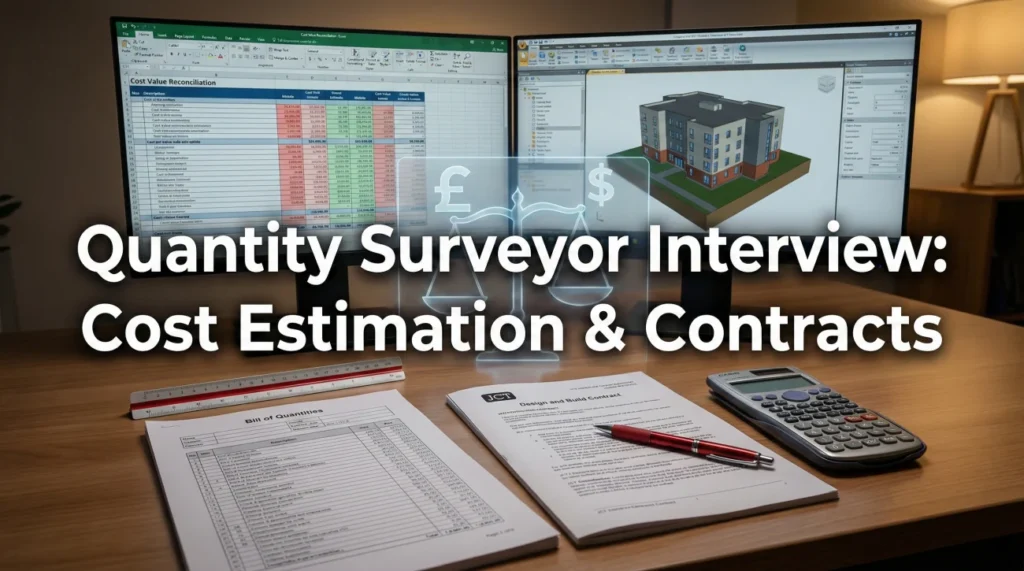
Quantity surveyor interview questions are built to test your commercial judgment under contract pressure. You are not only measuring scope, you are defending margin, cash flow, and risk allocation.
Interviewers want a QS who can read a contract like a map, value work fairly without giving away money, and negotiate variations without turning every conversation into a fight. They also look for comfort with reporting: CVR, forecasts, and what the numbers mean for decisions on site.
This guide covers measurement logic, interim valuations, change control, LADs, and rolling final account thinking, the habits that stop “surprises” from showing up at closeout.
Measurement & Cost Fundamentals
Q: Differentiate between a “Prime Cost Sum” and a “Provisional Sum”.
This is a classic question regarding budget allowances. A Prime Cost (PC) Sum is an allowance for a specific item of work or material that has not yet been selected (e.g., “Allow $50,000 for door handles to be selected by Client”). The contractor is paid the actual cost of the item plus a profit margin defined in the contract.
A Provisional Sum is an allowance for work that is foreseeable but not fully defined (e.g., “Allow $100,000 for undefined rock excavation”). It comes in two flavors: Defined (the contractor must allow for programming/prelims) and Undefined (contractor makes no allowance). The critical difference is risk allocation; Provisional Sums are usually re-measured based on actual work done, meaning the final price can fluctuate significantly compared to the allowance.
Q: Explain the purpose of a Bill of Quantities (BoQ) and how it aids contract administration.
The BoQ is a document that itemizes the quantities of work required (m3 of concrete, tons of steel) based on the design drawings and a Standard Method of Measurement (like NRM2). In the tender phase, it provides a level playing field for all bidders to price the same scope. In the construction phase, it becomes the vital tool for valuing the work.
It aids administration by providing clear “rates” for valuing variations. If the client adds a wall, I don’t need to invent a price; I look at the BoQ rate for “Brickwork” and multiply it by the new quantity. It also simplifies interim valuations; we simply assess the percentage complete of each BoQ line item. Without a BoQ, every change and payment becomes a negotiation.
Q: What is “Retention” and when is it released?
Retention is a percentage of the contract value (typically 5% or 10%) held back from interim payments as security against defective work or insolvency. It acts as a financial lever to ensure the contractor completes the job. Typically, half of the retention (the “First Moiety”) is released upon the issuance of the Certificate of Practical Completion (PC). The remaining half (the “Second Moiety”) is released after the expiry of the Defects Liability Period (DLP), usually 12 months later, provided all defects (snags) have been rectified. Managing the release of retention is critical for a contractor’s cash flow.
Q: Describe the “Cost Value Reconciliation” (CVR) process.
The CVR is the monthly financial health check for a contractor. It compares Cost (what we have actually spent on labor, plant, materials) against Value (what we are entitled to be paid by the client, including certified work and variations). It is not just cash flow; it includes accruals for work done but not billed (liabilities).
I use the CVR to calculate the project’s current margin. If Cost exceeds Value, we are “bleeding” money. The CVR helps identify why: are we under-claiming value? Is a subcontractor over-billing us? Or are we simply inefficient on site? It is the primary tool for forecasting the final profit or loss of the project.
Contract Administration & Valuation
Q: JCT vs. NEC Contracts
JCT (Joint Contracts Tribunal) is a traditional, adversarial form. It focuses on fixed dates and costs. If a change occurs, we argue about “Relevant Events” and “Extensions of Time” retrospectively. NEC (New Engineering Contract) is collaborative and forward-looking. It relies on “Early Warning Notices” and “Compensation Events.” The key difference is the NEC requires us to agree on the time/cost impact of a change before or during the work (prospective), whereas JCT often settles it at the end (Final Account).
Q: Interim Valuation Process
Every month, I conduct a site walk to assess progress. I verify the percentage complete of each trade against the activity schedule or BoQ. I verify “Materials on Site” (MOS) – are they stored correctly and insured? I deduct the previous payments and retention. I then issue an “Application for Payment.” If I represent the Client, I issue a “Payment Certificate” stating the amount certified. The “Pay Less Notice” is the critical legal tool if I intend to pay less than applied for.
Q: Defined Cost (NEC)
In NEC contracts (specifically Options C, D, E), the contractor is paid their “Defined Cost” plus a Fee. Defined Cost includes the actual cost of people, equipment, plant, and materials used to provide the works. It specifically excludes costs deemed to be part of the Fee (overhead, profit) or Disallowed Costs (defects, costs without proof). As a QS, auditing these Defined Cost records is a massive part of the workload.
Q: Valuing Variations (Change Orders)
When the scope changes, I value it using a hierarchy of rules. 1) Bill Rates: If the work is similar to BoQ items, use the contract rates. 2) Pro-Rata Rates: If work is similar but conditions differ (e.g., excavating in a confined space), adjust the bill rate logically. 3) Fair Valuation: If no similar items exist, build a new rate from first principles (labor + plant + material). 4) Dayworks: If the work cannot be measured, pay based on time sheets and invoices (last resort).
Q: Liquidated Damages (LADs)
LADs are a pre-agreed financial remedy for delay. If the contractor fails to meet the Completion Date, the client deducts a fixed sum (e.g., $5,000/week). It must represent a “genuine pre-estimate of loss” (e.g., lost rent), not a penalty. As a Contractor’s QS, I fight LADs by proving “Concurrent Delay” or “Prevention” – showing that the Client also caused delays, which may set “Time at Large” and invalidate the LAD clause.
Q: Final Account Negotiation
The Final Account is the definitive agreement on the total contract sum. It includes the original contract sum + all approved variations + loss/expense claims – omitted work. My strategy is “rolling final account.” I try to agree on the value of variations as we go, rather than leaving 200 items for the end. Once signed, it bars either party from reopening financial claims (except for latent defects), providing commercial closure.
Commercial Strategy Scenarios
A subcontractor claims extra payment for “hard digging” in the ground, but the contract is fixed price. How do you handle it?
I go straight to the contract and the Geotechnical Report. If the report (provided at tender) showed rock or hard clay, the risk sits with the subcontractor; they should have priced it. I would reject the claim (“foreseeable ground conditions”).
However, if the report showed soft sand and they hit granite, this is a “latent condition” or “unforeseen ground condition.” In this case, I would evaluate the claim. I would check their daily allocation sheets to verify the reduced productivity. I would ask, “Did you notify us immediately so we could inspect it?” If they dug it up and threw it away without notification, I might reject the claim due to lack of evidence.
The project is delayed by 4 weeks. 2 weeks due to bad weather, 2 weeks due to late drawings. How do you assess the Extension of Time (EoT)?
This is a classic “Concurrent Delay” scenario. Weather is typically a “Neutral Event” – the contractor gets Time but no Money. Late drawings are a “Relevant Event” (Client Fault) – the contractor gets Time and Money (Loss & Expense for preliminaries).
The standard approach (Malmaison logic) is that if the delays run parallel, the contractor gets the time (relieved of LADs) but usually does not get the money for the concurrent period, because they would have been on site anyway due to the weather. I would grant a 4-week extension to the completion date, but only pay prolongation costs (prelims) for the 2 weeks that were exclusively caused by the drawings, protecting the client’s budget.
A subcontractor goes insolvent halfway through the job. What are your immediate steps?
This is a crisis. 1) Secure the Site: Lock the gates. Don’t let them remove materials or plant. Once materials are on site and paid for in previous valuations, they belong to us (vesting). 2) Valuation: Immediately perform a “termination valuation” to determine exactly what work is done and what is left. 3) Notices: Issue formal contractual notices of default/termination.
4) Re-tendering: I need to find a replacement sub fast. The cost to complete will likely be much higher (distress premium). I track these extra costs carefully because we will offset them against any retention or unpaid money owed to the original sub. If the extra cost exceeds what we owe them, we claim against their bond/administrators.
Advanced Cost Management
Q: What is Value Engineering (VE) and how do you lead it?
VE is not just cost cutting (making it cheaper); it’s maximizing function/cost. As a QS, I lead VE workshops by challenging the design. I use the Pareto Principle: focus on the 20% of items driving 80% of the cost (usually Structure, Facade, MEP). Examples: “Can we switch from a steel frame to a concrete frame to reduce fireproofing costs?” or “Can we use a standard curtain wall system instead of bespoke?” I calculate the net saving (Capital Cost + Time Saving – Redesign Fees) to present a business case to the client.
Q: Explain Life Cycle Costing (LCC).
LCC looks beyond the construction budget (CAPEX) to the cost of running the building over 30-50 years (OPEX). A cheap boiler saves money today but costs a fortune in gas and maintenance later. I use LCC to justify higher upfront spending. I discount future cash flows (Net Present Value) to compare options. For example, “Option A costs $10k and lasts 10 years. Option B costs $15k but lasts 25 years. Option B is cheaper in LCC terms.” This is crucial for PFI/PPP projects where the contractor maintains the asset.
Q: How do you handle a “Letter of Intent” (LOI)?
An LOI is a dangerous tool used to start work before the main contract is signed. I am very cautious with them. An LOI must clearly state: 1) The Scope (what they are authorized to do). 2) The Cap (maximum expenditure, e.g., “Not to exceed $50k”). 3) The Terms (if the main contract is never signed, what applies?). My priority is to convert the LOI to a full contract ASAP. Letting an LOI run for months creates a “Quantum Meruit” risk where the contractor claims “reasonable value” rather than contract rates.
Q: What is a “Collateral Warranty”?
A construction contract is between Client and Contractor. If the building collapses, a future tenant or funder has no contract to sue the Contractor (Privity of Contract). A Collateral Warranty creates a direct contractual link between the Contractor/Consultant and a third party (Tenant/Bank), allowing them to sue for defects. As a QS, I ensure these warranties are drafted, signed, and sealed before releasing the final retention, as banks often refuse to release funding without them.
Quantity Surveyor Knowledge Check
Test Your Commercial IQ
1. Which method of measurement is currently standard in the UK for building works?
- SMM7 (Standard Method of Measurement 7)
- NRM (New Rules of Measurement) – specifically NRM2
- CESMM4 (Civil Engineering)
- POMI (Principles of Measurement International)
2. A “Lump Sum” contract puts the risk of quantities on:
- The Client
- The Contractor (they must build the whole design for the fixed price)
- The Quantity Surveyor
- The Architect
3. In the NEC contract, what is an “Early Warning”?
- A threat to fire the contractor
- A notification of a risk that could increase price or delay completion, requiring a risk reduction meeting
- A warning about bad weather
- A penalty notice
4. “Preliminaries” typically cover:
- The concrete foundation
- Site management, scaffolding, temporary power, cranes, and site offices
- The architect’s fees
- The land purchase cost
5. What does “Contra Charge” mean?
- Charging the client extra
- Deducting money from a subcontractor’s payment for damage they caused or services provided to them
- A discount for early payment
- A charge for contravening safety rules
6. A “Schedule of Rates” is used when:
- The design is 100% complete
- The nature of work is known but quantities are unknown (e.g., maintenance contracts)
- The contractor wants to charge whatever they want
- The client has a fixed budget
7. “O&P” stands for:
- Operations and Planning
- Overhead and Profit
- Owner and Partner
- Overtime and Pay
8. Under JCT, a “Relevant Event” entitles the contractor to:
- More money only
- Extension of Time (relief from LADs) only (unless it is also a Relevant Matter)
- A bonus
- Nothing
9. “Vesting Certificate” is used to:
- Certify the building is finished
- Transfer ownership of off-site materials to the client upon payment
- Certify the safety of the site
- Hire new staff
10. Which estimation method is most accurate?
- Functional Unit method (Cost per bed)
- Superficial Area method (Cost per m2)
- Detailed Unit Quantity method (Takeoff)
- Cube method (Cost per m3)
11. A “Snagging List” is prepared:
- Before construction starts
- Near completion to identify minor defects for rectification
- To order snacks for the site
- During the ground investigation
12. “Dayworks” are usually valued at:
- A fixed lump sum
- Prime Cost of labor/material/plant + Percentage Addition for overhead/profit
- Market rates
- Free of charge
13. The “Defects Liability Period” (DLP) typically lasts:
- 1 month
- 6 to 12 months (sometimes 24) after Practical Completion
- 10 years
- Until the building is demolished
14. What is a “Performance Bond”?
- An investment in the stock market
- A guarantee by a surety/bank to pay the client (usually 10% of contract) if the contractor defaults
- A bond between workers
- A type of glue
15. “Re-measurement” contracts are common in:
- Residential housing
- Civil Engineering / Earthworks (where quantities change significantly)
- Interior fit-out
- Painting
16. The “QS” representing the Contractor is often called:
- PQS (Professional QS)
- CQS (Contractor’s QS) or Commercial Manager
- Site Agent
- Clerk of Works
17. “Fluctuation” clauses in a contract deal with:
- Changes in the weather
- Changes in the cost of labor/materials (inflation/deflation) over the project duration
- Water pressure
- Staff turnover
18. What is the “Pareto Principle” in cost planning?
- Costs always double
- 80% of the cost is in 20% of the items (focus on the big ticket items)
- The lowest bid is always wrong
- Time is money
19. A “Variation Order” (VO) is the same as:
- A Purchase Order
- A Change Order (CO)
- An Invoice
- A Receipt
20. “Acceleration” costs are paid when:
- The contractor works fast naturally
- The client instructs the contractor to finish earlier than the contract date (requiring overtime/extra shifts)
- The project is delayed by the contractor
- Vehicles drive fast on site
❓ FAQ
💷 What is the difference between a PQS and a CQS?
A PQS represents the client and focuses on cost control and value for money. A CQS represents the contractor and focuses on protecting entitlement, margin, and commercial position under the contract.
📏 Do I need to memorize NRM or SMM to interview well?
You do not need to recite tables, but you must show you understand the method and can apply it consistently. Interviewers care more about your logic, accuracy, and audit trail than perfect memorization.
🧾 How do you value variations quickly without losing control?
Start with contract rates when the work is truly similar. If conditions change, justify an adjusted rate with evidence. When it is unique, build a fair rate from labor, plant, and material, and document assumptions.
🧮 What is CVR and why do good teams take it seriously?
CVR compares cost versus value to show the real financial health of the job. It highlights under-claiming, over-spend, and risk early enough to act, not after the profit is gone.
🤝 What is your approach to final account negotiation?
Keep it rolling. Agree items as you go, keep your backup clean, and separate emotion from entitlement. The goal is closure that both sides can live with, not a late-stage brawl.
Protect the Margin, Protect the Trust
If you want extra reps beyond this page, jump to the construction interview prep library and drill a few questions out loud until your answers sound natural, not memorized.
Your best answers sound commercial and practical: you know the contract, you know the numbers, and you know how the site actually builds. If you can show you prevent disputes by keeping entitlement clear and records clean, you will stand out.
⚠️ Disclaimer: The interview strategies, sample answers, and negotiation tips provided in this guide are for educational purposes only. Hiring decisions are subjective and vary by company and industry. While these strategies are based on professional HR standards, they do not guarantee a specific job offer or result.