Before the Gate Opens
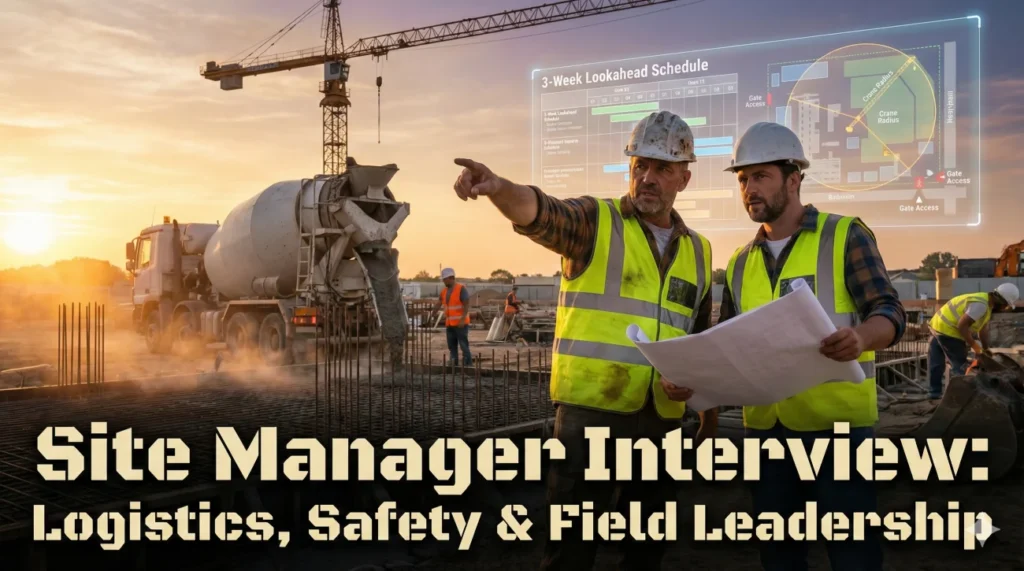
Site manager interview questions (often interchangeable with Superintendent questions in the US) are really about one thing: can you run the day when the plan collides with reality. You are the first set of eyes on the job site and the last person blamed when the schedule slips.
Hiring teams want a field leader who earns trust fast, keeps the site clean and predictable, and catches safety risks before they become an incident. They also listen for your “quiet systems”: lookahead planning, laydown logic, delivery control, and the way you communicate when two trades both swear they were here first.
In this guide, you will see questions that test how you build a 3-week lookahead, how you keep logistics tight on a messy site, how you document the day like it might end up in a claim, and how you hold quality lines before the inspector shows up.
Operational Fundamentals
Q: Differentiate between the Master Schedule and the 3-Week Lookahead. How do you use them?
The Master Schedule (CPM) is the strategic roadmap created by the PM/Scheduler to track milestones and long-lead items. It tells us what needs to happen this month. The 3-Week Lookahead is my tactical battle plan. It breaks down the Master Schedule activities into daily tasks for the specific crews on site. I create this weekly in coordination with the trade foremen.
The Lookahead serves three purposes: 1) Resource Check: Do we have the materials and manpower for next week’s tasks? 2) coordination: Does the plumber need to be in the wall before the drywaller closes it up on Tuesday? 3) Accountability: If a sub misses a date on the Lookahead, they are directly impacting the Master Schedule. I use it to drive daily production.
Q: Describe your process for Site Logistics Planning on a tight urban site.
Urban logistics is about flow. I start by defining the Gate Strategy. I need separate gates for deliveries and personnel if possible. I designate a “just-in-time” delivery zone because there is no room for long-term storage. I schedule deliveries in 15-minute windows (using software like StruxHub) to prevent trucks from queuing on the city street, which attracts fines.
Crane Placement is critical. I ensure the tower crane has coverage of the loading dock and the entire building footprint without swinging loads over public sidewalks (or installing protection overhead). I also plan for the “vertical transportation” of workers (hoists/buck hoists) early, as getting 500 workers to the 30th floor takes time and eats into productivity.
Q: Why are Daily Construction Reports (Daily Logs) important, and what must be included?
The Daily Log is the legal history of the project. In a court of law 5 years from now, the Daily Log is the truth. It must be factual, objective, and detailed. I include: Weather conditions (critical for delay claims), Manpower count by trade (to track against the schedule), Work performed (specific locations), Equipment onsite (active vs. idle), Inspections passed/failed, and any safety incidents.
I also document what didn’t happen. If the painter was scheduled to start but didn’t show up, I write “Painters no-show, notified PM.” This documentation protects the General Contractor against claims of delay or mismanagement from subcontractors or owners.
Q: How do you enforce Quality Control (QC) before the inspector arrives?
I don’t use the city inspector as my QC manager. If the inspector finds a failure, I have failed. I implement a “First Work in Place” or “Benchmark” inspection. When a trade starts a new scope (e.g., laying the first 100 sq ft of tile), we stop. I inspect it with the Architect and the Foreman. Once approved, that becomes the standard for the rest of the job.
I also use “Pre-Pour Checklists” for concrete and “Pre-Cover Checklists” for walls. I physically walk the area, verifying penetrations, blocking, and electrical rough-ins against the drawings. I take photos of everything inside the wall before it is closed. This proactive approach prevents the expensive rework of tearing down drywall to find a missing pipe.
Site Logistics & Safety Technicals
Q: Crane Signaling & Safety
A “Blind Lift” is when the operator cannot see the load. This is the most dangerous operation. I ensure there is a dedicated, certified rigger/signalperson in constant radio contact with the operator. We use a dedicated radio channel (no chatter). I strictly enforce the “exclusion zone” under the pick path – no one walks under a live load. I check the wind speed anemometer constantly; if winds exceed the crane’s rating (usually 30-35 mph), we shut it down immediately.
Q: Concrete Slump Test
The slump test measures the workability (consistency) of fresh concrete. A cone is filled, removed, and the “slump” (drop in height) is measured. If the spec says 4″ +/- 1″, and it slumps 8″, the mix is too wet (too much water), which drastically reduces compressive strength. I reject the truck. I do not allow drivers to “add water” on site unless they have a specific hold-back allowance on the ticket and the drum is spun for mixing.
Q: SWPPP Field Maintenance
Stormwater Pollution Prevention Plan (SWPPP) compliance is my responsibility. I inspect silt fences, storm drain inlet protection, and construction entrances (tracking pads) weekly and after every rain event. The goal is “No sediment leaves the site.” If a truck tracks mud onto the public road, I stop operations and deploy the street sweeper immediately. Fines from the EPA or city for dirty water runoff are massive and halt the project.
Q: Temporary Power Planning
I cannot build without power. I plan the temporary electrical distribution (“temp power”) to ensure spider boxes are within 50-100 feet of work areas so we don’t have a trip-hazard maze of extension cords. I ensure all temp circuits are on GFCI (Ground Fault Circuit Interrupter) breakers to prevent shock. As the building rises, I plan for the “jump” of the temporary standpipe and power spine to keep up with the decks.
Q: Fall Protection Hierarchies
Falls are the #1 killer. I follow the hierarchy: 1) Elimination (do the work on the ground). 2) Passive Protection (Guardrails). This is preferred because it requires no worker action. 3) Active Restraint (tether that prevents reaching the edge). 4) Active Arrest (harness/lanyard that catches a fall). If relying on arrest, I must have a “Rescue Plan” in place – how do we get them down in 15 minutes before suspension trauma sets in?
Q: Material Handling & Hoisting
Materials must be handled as few times as possible (“Touch it once”). I coordinate with subs to land heavy materials (like drywall bunks or HVAC units) directly onto the floor deck via crane before the floor above is poured or enclosed. This saves thousands of man-hours compared to bringing them up the buck hoist later. I verify deck loading capacity with the structural engineer before stacking heavy materials to prevent collapse.
Field Leadership Scenarios
Two subcontractors (Electrician and Plumber) are arguing over who gets to run their pipe/conduit in a tight ceiling space. Work has stopped.
I step in as the arbitrator. First, I send the workers to break or another area to de-escalate. Then I meet with the two Foremen. We look at the coordination drawings (BIM model). If the model shows the Plumber has priority (gravity lines always have priority over pressure lines or conduit), the Electrician moves.
If there is no model or it’s a conflict not on the drawings, I make a field decision based on “Difficulty of Installation.” Large rigid pipe is harder to offset than flexible conduit. I decide, “Plumber runs straight, Electrician offsets over.” I mark it on the floor, they shake hands, and we get back to work. I document the conflict in the daily log.
You catch a worker not wearing fall protection on a roof edge. This is his second violation.
Safety allows zero compromise. I stop him immediately and have him step back to a safe area. Since this is a second violation (and a life-threatening one), I enforce the “Three Strikes” or “Zero Tolerance” policy defined in our safety manual.
Typically, for a life-critical violation like this, I would remove him from the site permanently. I call his Foreman and the Safety Director. I document the incident with photos and a violation report. Allowing him to stay sends a message to the entire site that safety rules are optional, which inevitably leads to an accident. My job is to ensure everyone goes home alive, even if it means firing someone.
Materials are being stolen from the site at night. How do you address this?
Theft kills morale and the budget. I would immediately review the site security plan. Is the perimeter fence intact? Are gates locked with heavy-duty chains? I would improve lighting – thieves hate light. I might install motion-sensor cameras or hire a night security guard if the loss value justifies it.
Internally, I would implement a “JIT” (Just-in-Time) delivery policy for high-value items like copper wire or tools. We don’t store them onsite for weeks; they arrive the day they are installed. I would also require subs to gang-box their tools and lock them daily.
Technology & Productivity
Q: How do you use BIM (Building Information Modeling) in the field?
BIM isn’t just for the office. I use it on an iPad (using tools like Procore, PlanGrid, or BIM 360) to visualize complex assemblies. If a sub is confused about a detail, I pull up the 3D model right there. We can rotate it, section it, and see exactly how the rebar fits around the embed plate. It eliminates the “I couldn’t read the 2D drawing” excuse. I also use it for clash detection verification – ensuring the ductwork is actually installed where the model said it would be.
Q: Explain your strategy for a “Zero Punch List” closeout.
The traditional method of waiting until the end to list thousands of defects is inefficient. I advocate for “Rolling Punch Lists.” As soon as a room is framed, I punch it. As soon as it’s drywalled, I punch it again. I use blue tape and a digital tracking app to assign items immediately to the sub.
I also implement a “Room to Room” sign-off. The painter doesn’t start until the drywaller has signed off that the wall is ready, and I have verified it. This prevents the “not my damage” arguments later. By fixing small issues continuously, the final punch list becomes a formality, not a nightmare.
Q: How do you track Labor Productivity?
I track “installed quantities” vs. “man-hours.” If the budget allows 10 hours to install 100 feet of pipe (0.1 hours/ft), and the daily report shows we spent 20 hours to install 100 feet, we are bleeding money. I identify this trend early (by Wednesday of the week). I investigate: Is it a material shortage? Is the area congested? Is the crew unskilled? I work with the foreman to remove the obstacle or re-balance the crew size to get the production rate back on track.
Q: What is your role during Commissioning (Cx)?
Commissioning is the functional testing of building systems (HVAC, Electrical, Fire Alarm). My role is coordination. I ensure the equipment is “Start-Up Ready” (power connected, pipes flushed, filters installed) before the Cx Agent arrives. I schedule the necessary trades (Electrician, Controls Tech, TAB agent) to be present during testing to fix issues instantly. I treat Commissioning as a milestone, not an afterthought, because a building that doesn’t run is not a finished building.
Site Management Knowledge Check
Test Your Field Knowledge
1. Who is primarily responsible for daily safety enforcement on site?
- The OSHA inspector
- The Site Manager / Superintendent
- The Project Manager in the office
- The Architect
2. A “Toolbox Talk” is:
- A meeting to inventory tools
- A short safety meeting held with the crew at the start of the shift
- A discussion about buying new equipment
- A disciplinary hearing
3. In a 3-Week Lookahead, tasks should be detailed down to:
- Monthly milestones
- Daily or specific zone activities
- Yearly goals
- Hourly movements
4. What does “JSA” stand for in safety?
- Job Site Announcement
- Job Safety Analysis (or JHA – Job Hazard Analysis)
- Joint Structure Agreement
- Just Stand Around
5. Concrete “curing” involves:
- Drying it out as fast as possible with heaters
- Maintaining moisture and temperature to allow chemical hydration
- Painting it immediately
- Vibrating it to remove air
6. A “Laydown Area” is:
- Where workers take naps
- Designated space for storing and organizing materials on site
- The area where the foundation is poured
- The parking lot for visitors
7. Which document tracks the daily weather and workforce?
- The RFI Log
- The Daily Construction Report (Daily Log)
- The Submittal Register
- The Invoice
8. “PPE” stands for:
- Pre-Project Execution
- Personal Protective Equipment
- Professional Project Engineer
- Public Private Entity
9. A “mock-up” is used to:
- Make fun of a bad design
- Establish a quality standard for workmanship and aesthetics before full production
- Test the structural strength of the building
- Hide mistakes
10. When lifting a load, the “tag line” is used to:
- Lift the load higher
- Control the rotation and swing of the load from the ground
- Secure the load to the crane hook
- Measure the weight of the load
11. “Just-in-Time” (JIT) delivery helps to:
- Increase the amount of material stored on site
- Reduce site congestion and risk of material damage/theft
- Delay the project
- Increase shipping costs
12. What is a “Hot Work Permit”?
- Permission to work in the summer
- Authorization for operations involving open flames or sparks (welding, cutting)
- Permission to work on live electrical circuits
- A permit to turn on the heating system
13. The “SDS” (formerly MSDS) provides information on:
- Structural Design Standards
- Safety Data Sheets for chemicals used on site
- Site Drainage Systems
- Subcontractor Daily Schedules
14. “Backfilling” refers to:
- Replacing an employee who quit
- Refilling an excavated trench with soil around a pipe or foundation
- Billing the owner for past work
- Painting the back of a wall
15. A “Spotter” is required when:
- Walking on the site
- Heavy equipment is backing up or operating near overhead lines/personnel
- Using a drill
- Eating lunch
16. Which trade typically sets the pace for the rough-in phase?
- Painters
- Framers / HVAC (Ductwork usually goes in first due to size)
- Carpet layers
- Landscapers
17. “As-Builts” (Redlines) must be updated:
- Only at the end of the project
- Continuously as changes occur in the field
- By the Architect only
- Never
18. The “Critical Path” affects:
- Only the finish trades
- The project completion date
- The lunch schedule
- The parking arrangement
19. A “Stand-Down” is:
- A strike by workers
- A pause in work to address a specific safety issue or incident globally
- Laying off workers
- A break for rain
20. Who is responsible for “Housekeeping” (cleanliness)?
- The laborers only
- Every trade is responsible for cleaning up their own debris daily
- The cleaning crew at the end of the job
- The owner
❓ FAQ
🏗️ Do I need a degree to become a Site Manager?
Not always. Many strong site managers came up through the trades or as assistant superintendents. What matters most is proven field leadership, planning discipline, and a track record of safe, on-time delivery.
🗓️ What does a “good” 3-week lookahead actually look like?
It is specific enough to drive crews day by day. It calls out constraints early: materials, access, inspections, and trade stacking. If it cannot answer “who is here, doing what, in which area” it is still too vague.
🧭 How do you earn respect on a new site quickly?
Show up prepared, be consistent, and keep your word. When you say a delivery window is 9:00, protect it. When a rule is a rule, enforce it every time. Crews do not need speeches, they need predictability.
🤝 What is the hardest part of the job?
Keeping momentum during conflict. Most days are not “technical” problems, they are coordination and ego problems. Your job is to de-escalate fast, make a clear field decision, and get production moving again.
📱 What tools should I be comfortable with?
At minimum: a daily log workflow and drawing access in Procore, markups in Bluebeam, and a simple way to track constraints and deliveries. Tools do not replace leadership, but they prevent chaos.
Lead With Calm
If you want extra reps beyond this page, jump to the broader construction interview question hub and drill a few questions out loud until your answers sound natural, not memorized.
The strongest answers sound like field decisions: clear, calm, and backed by a repeatable process. Tell stories where you protected safety, solved logistics, and kept trades aligned, especially when the day tried to break your plan.
⚠️ Disclaimer: The interview strategies, sample answers, and negotiation tips provided in this guide are for educational purposes only. Hiring decisions are subjective and vary by company and industry. While these strategies are based on professional HR standards, they do not guarantee a specific job offer or result.