Scaling Chemistry to Industry
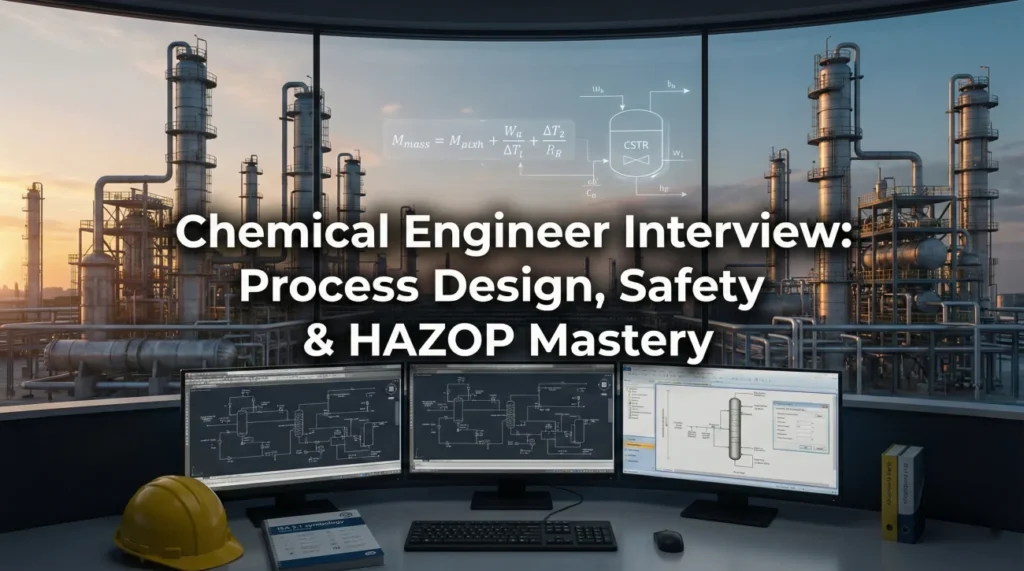
Chemical engineer interview questions bridge the gap between laboratory chemistry and industrial-scale manufacturing. While a chemist discovers the reaction in a beaker, the chemical engineer designs the massive steel vessels, piping networks, and control systems required to produce that reaction safely at the rate of tons per hour. Hiring managers in 2025 are looking for engineers who possess a deep intuition for thermodynamics, fluid mechanics, and transport phenomena, but who also prioritize process safety above all else.
Whether you are interviewing for a role in oil and gas, pharmaceuticals, specialty chemicals, or semiconductors, the core competency remains the same: optimizing the transformation of raw materials into valuable products. You will be tested on your ability to read P&IDs (Piping and Instrumentation Diagrams), participate in HAZOP (Hazard and Operability) studies, and troubleshoot unit operations that are acting up. This guide covers the technical depth required for Process Design and Safety roles, moving beyond textbook formulas to real-world plant challenges.
Process Engineering Fundamentals
Q: Explain the difference between Batch and Continuous processing. How do you decide which to use?
This is a fundamental strategic decision in process design. Batch processing involves loading raw materials, processing them (reacting, heating, etc.) over time, and then discharging the product before cleaning the vessel for the next batch. It is inherently transient (dynamic). Continuous processing involves a constant flow of input and output, where the system reaches a steady state.
The decision relies on volume and flexibility. I choose Continuous for high-volume, commodity chemicals (like oil refining or ammonia production) because it offers better energy efficiency (heat integration), consistent product quality, and lower labor costs per unit. I choose Batch for low-volume, high-value products (like pharmaceuticals or specialty polymers) where flexibility is key. Batch allows me to make Product A on Monday and Product B on Tuesday using the same equipment, and it provides easier traceability for quality control batches, which is critical in regulated industries.
Q: What is the Reflux Ratio in distillation, and how does it affect column cost vs. operating cost?
The Reflux Ratio ($$R = L/D$$) is the ratio of the liquid returned to the column ($$L$$) to the liquid withdrawn as product distillate ($$D$$). It is the primary “knob” we turn to control separation purity. Increasing the reflux ratio improves separation efficiency because it increases the liquid-vapor contact inside the column, driving the composition closer to equilibrium. This allows us to achieve higher purity products.
However, there is a trade-off. Increasing reflux requires boiling more liquid at the reboiler and condensing more vapor at the condenser. This increases the Operating Cost (OPEX) significantly due to steam and cooling water usage. Conversely, if I design for a lower reflux ratio (closer to the minimum reflux, $$R_{min}$$), I save on energy, but I need more theoretical stages (trays or packing height) to achieve the same separation. This increases the column height and therefore the Capital Cost (CAPEX). A typical optimal design point is usually $$1.2$$ to $$1.3$$ times $$R_{min}$$.
Q: Describe the significance of NPSH (Net Positive Suction Head) in pump selection.
For a chemical engineer, NPSH is about preventing cavitation, which can destroy pumps and disrupt process flow. NPSH Available ($$NPSH_A$$) is the absolute pressure at the suction port of the pump minus the vapor pressure of the liquid. NPSH Required ($$NPSH_R$$) is the minimum pressure required by the pump design to prevent bubbles from forming.
If $$NPSH_A < NPSH_R$$, the liquid flashes into vapor inside the pump. When these bubbles collapse in the high-pressure discharge regions, they create shockwaves that erode the impeller (Cavitation). In process design, I ensure $$NPSH_A$$ is sufficiently high (typically providing a 1-meter safety margin) by elevating the supply tank (increasing static head), sub-cooling the fluid (reducing vapor pressure), or shortening the suction line (reducing friction losses).
Q: How do you verify a Mass and Energy Balance?
The Law of Conservation of Mass and Energy is the bedrock of chemical engineering: $$Accumulation = In - Out + Generation - Consumption$$. In a steady-state process, Accumulation is zero. To verify a balance, I start by defining the system boundary (control volume). I list all streams entering and leaving.
For Mass, I check the total mass flow first, then the component balance (moles of Carbon in = moles of Carbon out). For Energy, I sum the enthalpy of all input streams plus any heat added ($$Q$$) or work done on the system ($$W$$), and compare it to the output enthalpy. If they don’t match (within a small tolerance for measurement error), there is a leak, a meter error, or an unaccounted reaction side-product. In simulation software like Aspen Plus, getting the balance to converge is the first step before trusting any equipment sizing.
Unit Operations & Equipment
Q: Shell & Tube vs. Plate Heat Exchangers
Shell and Tube (S&T) is the workhorse of the industry. It handles high pressures ($$>30$$ bar) and high temperatures effectively. It is robust and easier to clean mechanically if fouling occurs on the tube side. Plate and Frame (PHE) offers a much larger surface area in a smaller footprint, providing extremely efficient heat transfer (close approach temperatures). However, PHE is limited by gasket materials (temperature/pressure limits) and is prone to leaks if gaskets fail. I choose S&T for high-pressure/hazardous services and PHE for low-pressure/clean services where space is tight.
Q: Control Valve Fail Modes
This is a critical safety concept. A control valve can be Fail-Open (Air-to-Close) or Fail-Closed (Air-to-Open). If the instrument air supply acts as the energy source to move the valve, the spring dictates the failure position. For a cooling water valve on an exothermic reactor, I specify Fail-Open so that if we lose power/air, max cooling is applied to prevent a runaway. For a fuel gas valve feeding a furnace, I specify Fail-Closed to cut off the fuel source immediately upon loss of signal.
Q: Distillation Column Flooding
Flooding occurs when the vapor velocity is so high that it prevents the liquid from flowing down the column. Liquid accumulates (entrainment or backing up in downcomers), causing a sharp increase in pressure drop and a collapse in separation efficiency. It typically happens if we push the feed rate too high or if the reboiler duty is excessive. To fix it, we must reduce the vapor load (lower reboiler duty) or reduce the feed rate. In design, we size the column diameter to operate at about 80% of the flood point.
Q: Reactor Choice: CSTR vs. PFR
CSTR (Continuous Stirred-Tank Reactor) assumes perfect mixing. The concentration inside is uniform and equal to the outlet. It is easier to control temperature (no hot spots) but has a lower conversion rate per volume because the reactant concentration is diluted immediately. PFR (Plug Flow Reactor) is a tube where concentration changes along the length. It acts like a series of infinite mini-batches, offering higher conversion per volume (kinetic advantage) but makes temperature control harder (potential for hot spots). I select CSTR for complex reactions requiring strict temp control, and PFR for simple, high-throughput reactions.
Q: Reading P&IDs
A P&ID (Piping and Instrumentation Diagram) is the master map of the process. I look for line types (process vs. signal), instrumentation bubbles (circles with letters), and valve symbols. For example, “TIC-101” is a Temperature Indicator Controller. A solid line usually denotes piping, while a dashed line denotes an electrical signal. Understanding the symbology (ISA 5.1 standard) is mandatory to trace logic, such as seeing that a Level Transmitter (LT) sends a signal to a Level Controller (LC) which actuates a Control Valve (LV).
Q: Steam Trap Function
Steam traps are automatic valves that discharge condensate and non-condensable gases (like air) without letting live steam escape. If a trap fails open, we waste massive amounts of steam (energy loss). If it fails closed, condensate backs up into the heat exchanger (“waterlogging”), drastically reducing heat transfer area and potentially causing water hammer which can rupture pipes. Regular steam trap surveys are the lowest hanging fruit for energy efficiency in a plant.
Process Safety & Troubleshooting
A Pressure Relief Valve (PSV) on a reactor lifts during normal operation. What do you do?
A PSV lifting is a major safety event. First, I verify if the pressure actually exceeded the setpoint or if the valve lifted prematurely (mechanical failure). I check the pressure transmitter trends.
If the pressure was high, I investigate the cause immediately: Did the cooling water fail? Did a feed valve fail open? Is there a runaway reaction? I must stabilize the plant, which likely means initiating an emergency shutdown or stopping the feed. Even if the valve reseats, we cannot simply resume. A lifted PSV may not seal perfectly afterwards (simmering/leaking), and the release may have violated environmental permits. We must document the release quantity and investigate the root cause before restarting.
The product yield from a reactor has dropped by 5% over the last week. How do you troubleshoot?
I systematically eliminate variables. First, Sensors: Is the flow meter measuring the feed correctly? If it’s drifting, we might be feeding the wrong ratio. Second, Raw Materials: Did we switch suppliers? I’d check the lab analysis of the input feeds for impurities that could poison the catalyst.
Third, Process Conditions: Are Temperature and Pressure at setpoint? A fouled thermocouple might report a temperature higher than actual. Fourth, Catalyst Activity: If it’s a catalytic process, the catalyst might be deactivating or sintering. I would check the temperature profile across the bed; a shift in the “hot spot” often indicates catalyst aging. I rely on data trends to pinpoint when the deviation started.
Production wants to bypass a safety interlock to keep the plant running during a sensor malfunction.
This is a “Management of Change” (MOC) scenario. My answer is “No” to an ad-hoc bypass. Safety interlocks (SIS) exist to prevent catastrophic failure. Bypassing a sensor blind leaves us flying without instruments.
However, I would look for a safe engineered solution. Can we use a redundant sensor? can we grab manual samples every 15 minutes to verify the parameter? If we can implement a temporary, approved mitigation plan with increased operator surveillance and a signed Risk Assessment, we might proceed for a limited time (e.g., 4 hours) to fix the sensor. But simply bypassing it to meet production quotas is negligent and illegal under PSM regulations.
Advanced Process Design & HAZOP
Q: Walk me through a HAZOP (Hazard and Operability) study session.
A HAZOP is a structured, team-based brainstorming session to identify risks. We break the P&ID into “Nodes” (e.g., the feed line to the reactor). For each node, we apply Guidewords to process Parameters. Common combinations include “NO FLOW,” “MORE PRESSURE,” “LESS TEMPERATURE,” or “REVERSE FLOW.”
For each deviation, the team asks:
1) Cause: What could cause “More Pressure”? (e.g., regulator failure).
2) Consequence: What happens if pressure rises? (e.g., vessel rupture).
3) Safeguards: What protects us? (e.g., PSV, High Pressure Alarm).
4) Recommendations: Is the risk acceptable? If not, we recommend an action item (e.g., install a high-pressure trip).
As a process engineer, my role is often to explain the physics of the consequence to the team.
Q: How do you size a Relief Valve for a “Fire Case”?
Sizing a PSV for fire exposure is usually the governing case for storage vessels. The logic is based on API 520/521. We assume there is a pool fire surrounding the vessel. The heat from the fire boils the liquid inside, generating massive amounts of vapor. The PSV must be able to vent this vapor fast enough to keep the internal pressure below 121% of the MAWP (Maximum Allowable Working Pressure).
I calculate the wetted surface area ($$A_{wetted}$$) exposed to the fire (usually up to 25ft height). The heat input ($$Q$$) is calculated using $$Q = 21,000 \cdot F \cdot A^{0.82}$$. Then, I determine the latent heat of vaporization of the liquid at the relief pressure. The required mass flow rate is $$W = Q / \Delta H_{vap}$$. The valve orifice is then selected to pass this mass flow.
Q: Explain the concept of Fugacity and Activity Coefficients.
In ideal systems, we use Raoult’s Law (partial pressure = vapor pressure * mole fraction). But real chemical plants are rarely ideal. Fugacity is the “effective pressure” of a component in a mixture, representing its tendency to escape from one phase to another. For phase equilibrium, the fugacity of component $$i$$ in the liquid must equal its fugacity in the vapor.
The Activity Coefficient ($$\gamma$$) accounts for non-ideal behavior in the liquid phase (like interactions between polar and non-polar molecules). If $$\gamma > 1$$, the component is more volatile than ideal (positive deviation, like Ethanol/Water). If $$\gamma < 1$$, it is less volatile. Understanding this is crucial for simulation; choosing the wrong thermodynamic package (e.g., using Peng-Robinson for a polar system instead of NRTL or UNIQUAC) will lead to completely wrong distillation column designs.
Q: What is the purpose of a “Line Sizing” criteria regarding velocity?
We don’t just size pipes to fit the flow; we optimize for velocity. For Liquids, we typically aim for 1-3 m/s. Too slow (< 1 m/s) allows solids to settle out or requires excessively large (expensive) pipes. Too fast (> 4 m/s) causes erosion, noise, hydraulic hammer, and excessive pressure drop (wasting pumping energy).
For Gases/Vapors, velocities are higher, typically 15-30 m/s. We must stay well below the sonic velocity (Mach 1) to avoid choking the flow and noise vibration issues. On suction lines for pumps, velocity criteria is stricter (lower) to minimize friction loss and maximize NPSH Available.
Chemical Engineering Knowledge Check
Test Your Process IQ
1. In a distillation column, if the feed tray is moved higher up the column, what generally happens to the distillate purity?
- It always increases because there are more stripping trays
- It generally decreases because there are fewer rectifying trays to enrich the vapor
- It stays exactly the same regardless of feed location
- The column will immediately flood
2. A “runaway reaction” is best described as:
- A reaction that stops prematurely due to lack of reactants
- An exothermic reaction where heat generation exceeds heat removal, accelerating the rate exponentially
- A reaction that produces the wrong product
- A leak of reactants onto the floor
3. The “LMTD” in heat exchanger design stands for:
- Lowest Mean Temperature Difference
- Logarithmic Mean Temperature Difference
- Linear Mass Transfer Diffusion
- Liquid Molar Thermal Density
4. Which control loop tuning parameter responds to the “rate of change” of the error?
- Proportional (P)
- Integral (I)
- Derivative (D)
- Gain (K)
5. What does the term “Turndown Ratio” mean for a flow meter?
- The ratio of the pipe diameter to the meter diameter
- The ratio of maximum flow to minimum flow that the meter can measure accurately
- The angle at which the meter is installed
- The ratio of pressure drop to flow rate
6. In a HAZOP, the guideword “REVERSE” applied to “FLOW” typically indicates:
- The pump is spinning backwards
- Fluid flowing back from a high-pressure destination to a low-pressure source (Check valve failure)
- The flow rate is too low
- The piping is installed upside down
7. What is the primary purpose of a “Weir” inside a distillation tray?
- To support the weight of the tray above it
- To maintain a liquid level on the tray to ensure vapor-liquid contact
- To filter out solid particles
- To separate oil from water
8. Cavitation damage in a centrifugal pump typically appears on the:
- Discharge flange
- Outer casing
- Suction side or tips of the impeller vanes
- Motor shaft coupling
9. An “Azeotrope” is a mixture that:
- Will separate easily into two liquid phases
- Cannot be separated by simple distillation because the vapor and liquid compositions are identical
- Is highly explosive when exposed to air
- Has a very high viscosity
10. The Bernoulli equation is a statement of conservation of:
- Mass
- Energy (for flowing fluids)
- Momentum
- Temperature
11. In Process Safety Management (PSM), “MOC” stands for:
- Maintenance of Columns
- Management of Change
- Method of Calculation
- Maximum Operating Condition
12. A “Bursting Disc” (Rupture Disc) differs from a PSV because:
- It opens at a lower pressure
- It is a non-reclosing device; once it opens, it must be replaced
- It can be reset manually
- It is made of plastic only
13. The “HETP” in a packed column stands for:
- Height of Empty Tower Plate
- Height Equivalent to a Theoretical Plate
- Heat Energy Transfer Potential
- High Efficiency Tray Packing
14. What is the advantage of a “Double Mechanical Seal” on a pump?
- It allows the pump to spin twice as fast
- It provides a barrier fluid to prevent hazardous process fluid from leaking to the atmosphere
- It is cheaper than a single seal
- It eliminates the need for lubrication
15. “Deadheading” a centrifugal pump means:
- Running the pump with no liquid inside (dry run)
- Running the pump with the discharge valve fully closed
- Shutting down the pump motor
- Removing the pump head for maintenance
16. The “Leidenfrost Effect” is relevant when:
- Distilling alcohol
- A liquid contacts a surface significantly hotter than its boiling point, creating an insulating vapor layer
- Mixing two immiscible liquids
- Designing a cyclone separator
17. A “Demister Pad” is used to:
- Cool down the vapor
- Remove liquid droplets entrained in a vapor stream to prevent carryover
- Filter solid particles from the liquid
- Mix two gas streams
18. Why is “Steam” the preferred heating medium in industry?
- It is free
- It has a very high latent heat of vaporization, transferring massive energy at constant temperature
- It is non-corrosive
- It can be stored in tanks easily
19. “Bound Water” in drying operations refers to:
- Water that is frozen
- Moisture trapped inside the solid structure exerting a vapor pressure lower than pure liquid water
- Water poured on top of the solid
- Water used to wash the equipment
20. The “Flash Point” of a liquid is:
- The temperature where it boils spontaneously
- The lowest temperature at which vapors form an ignitable mixture in air
- The temperature where it freezes
- The pressure at which it explodes
❓ FAQ
📜 Do I need a PE license to work as a Chemical Engineer?
In most manufacturing industries (Oil & Gas, Pharma, Chemicals), a PE is not required due to the “Industrial Exemption.” However, obtaining your PE is highly respected and may be required if you work for an EPC (Engineering, Procurement, Construction) firm where you sign off on public safety designs.
💻 What software is standard in the industry?
Aspen HYSYS or Aspen Plus is the gold standard for process simulation. AutoCAD/SmartPlant P&ID is used for drafting. HTRI is used specifically for heat exchanger design. Familiarity with data historians like PI System is also valuable for operations roles.
🏭 Is the job mostly in the office or the plant?
A Process Design Engineer is typically 80% office / 20% plant. A Production/Contact Engineer is 80% plant / 20% office. Employers value candidates who are willing to put on PPE and climb columns to troubleshoot, rather than just trusting the simulation.
🧪 Do I need to be an expert in Chemistry?
Surprisingly, no. You need to understand the results of the chemistry (kinetics, stoichiometry, heat of reaction) to design the equipment. You don’t need to know how to synthesize the molecule from scratch; that’s the Chemist’s job. You are a process systems engineer first.
💥 What is the biggest challenge in this role?
Balancing Safety, Quality, and Cost. You will often face pressure to increase production rates (throughput) which can push equipment near its safety limits. The challenge is having the technical backbone to say “No” when safety margins are compromised.
The Elements of Success
To succeed with chemical engineering interview questions, you must prove that you can think in systems. An isolated pump curve means nothing if you don’t understand how it interacts with the control valve downstream and the reactor pressure upstream.
Focus on your ability to visualize the process inside the pipes. Show the interviewer that you respect the hazards of the materials you handle, that you follow rigorous design methodologies like HAZOP, and that you are driven to optimize efficiency without ever compromising on safety.
⚠️ Disclaimer: The interview strategies, sample answers, and negotiation tips provided in this guide are for educational purposes only. Hiring decisions are subjective and vary by company and industry. While these strategies are based on professional HR standards, they do not guarantee a specific job offer or result.