The CEO of the Project
Construction manager interview questions assess your ability to orchestrate the chaotic symphony of a construction project. Unlike a Site Manager or Superintendent who focuses on the daily logistics of “boots on the ground,” a Construction Manager (CM) operates at a strategic level. You are responsible for the project’s overall health: the schedule, the budget, the contracts, and the risk profile.
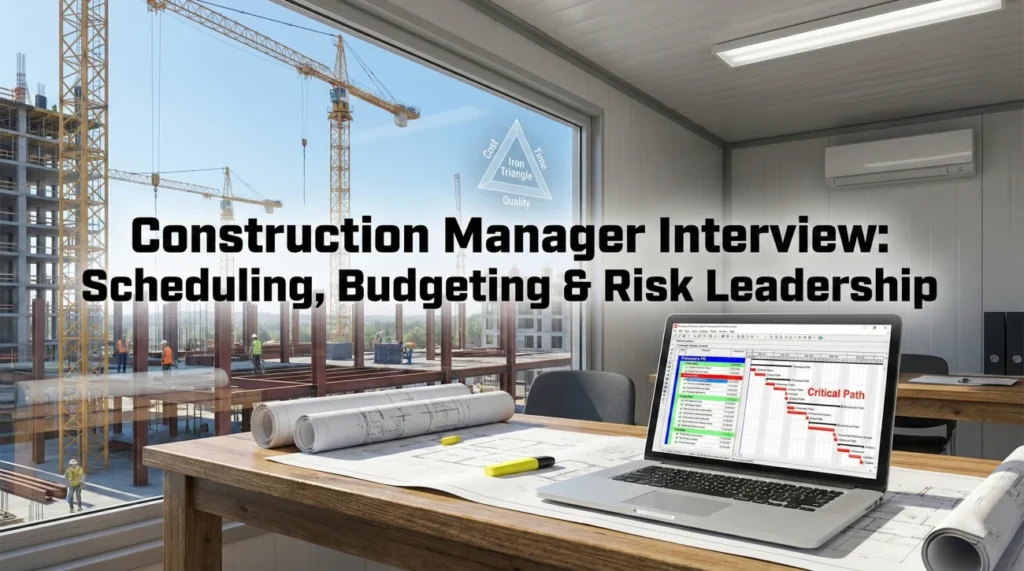
Hiring managers are looking for leaders who can navigate the “Iron Triangle” of Cost, Quality, and Time. You need to demonstrate mastery of Critical Path Method (CPM) scheduling to predict delays before they happen, and financial acumen to manage multi-million dollar budgets through Earned Value Management. You must also be fluent in the language of contracts (AIA documents) to protect your company from liability.
This guide covers the full spectrum of the CM role, from pre-construction buyout and value engineering to closeout and commissioning. Whether you are dealing with a difficult owner, a failing subcontractor, or a complex safety compliance issue, these answers will help you prove you have the executive presence and technical knowledge to deliver projects successfully.
Scheduling & Budget Control
Q: Explain the Critical Path Method (CPM) and the difference between “Free Float” and “Total Float”.
The Critical Path Method is the backbone of construction scheduling. It identifies the longest sequence of dependent activities that determines the minimum duration of the project. If any activity on the critical path is delayed, the project completion date is delayed day-for-day. I use software like Primavera P6 or MS Project to model this logic (Predecessors/Successors).
Total Float is the amount of time an activity can be delayed without delaying the project’s final completion date. Free Float is the amount of time an activity can be delayed without delaying the start of the very next successor activity. Understanding this distinction is vital for resource leveling. I might consume Total Float to manage a manpower shortage, but I am very careful with Free Float to avoid stacking trades on top of each other, which kills productivity.
Q: How do you manage a “Buyout” process to prevent Scope Gaps?
Buyout is the transition from estimate to contract. It involves issuing subcontracts and purchase orders for every line item in the budget. The biggest risk here is “Scope Gap” – work that is required but not assigned to any specific sub. For example, the drywaller excludes blocking, and the framer excludes blocking, so nobody owns it.
My strategy is to hold detailed “Pre-Award Meetings” (Scope Review) with every major subcontractor. I use a detailed checklist to review their proposal against the drawings and specs line-by-line. I specifically ask, “What is excluded?” and “What do you need from the trade before you?” I also create a “General Requirements” bucket to catch miscellaneous items like dumpsters, street cleaning, and temporary heat that trades rarely carry.
Q: Describe your process for approving a “Pay Application” (AIA G702/G703).
The G702 (Application for Payment) and G703 (Continuation Sheet) are industry standards. My review is a three-step verification. First, I walk the job site to verify the “Percent Complete” claimed in the G703 matches physical reality. Subcontractors often “front-load” the schedule of values (billing more early on) to help their cash flow, but this puts us at risk if they default later.
Second, I check for Stored Materials. If they bill for materials not yet installed, I need proof of insurance, photos, and a bill of sale proving transfer of title. Third, and most importantly, I ensure the math aligns with the contract sum including approved Change Orders, and that the correct Retainage (typically 10%) is withheld. I never approve payment without an unconditional lien waiver for the previous month’s payment.
Q: How do you calculate Earned Value to forecast the budget?
Earned Value Management (EVM) allows me to see if we are truly on budget. I look at three metrics: Planned Value (PV), Earned Value (EV), and Actual Cost (AC). Simply comparing Budget vs. Actuals is misleading because it doesn’t account for how much work is actually done.
I calculate the Cost Performance Index (CPI = EV / AC). If CPI is less than 1.0, we are over budget for the work performed. I also calculate the Schedule Performance Index (SPI = EV / PV). If SPI is less than 1.0, we are behind schedule. If I see a CPI of 0.8 early in the project (e.g., in excavation), I know we have a serious problem that will compound unless we re-strategize means and methods immediately.
Contracts & Risk Management
Q: Contract Types (GMP vs. Lump Sum)
Lump Sum (Stipulated Sum) is a fixed price. The risk is on the contractor; if we build it cheaper, we keep the profit, but if we go over, we eat the loss. It requires complete design documents. GMP (Guaranteed Maximum Price) is common in CM-at-Risk. We give a cap price. Costs are reimbursed up to that cap. If costs are lower, savings are often shared (e.g., 75/25) with the owner. If higher, we pay. GMP promotes transparency and open-book accounting.
Q: Liquidated Damages (LDs)
LDs are financial penalties defined in the contract for failing to finish by the Substantial Completion date (e.g., $5,000/day). They are meant to cover the owner’s actual loss (lost rent), not to be punitive. To protect against LDs, I diligently document all “Excusable Delays” (weather, strikes, design changes) and submit formal Time Extension requests immediately to extend the contract date.
Q: Change Order vs. CCD
A Change Order (CO) is a modification to the contract (cost and/or time) signed by Owner, Architect, and Contractor. Everyone agrees. A Construction Change Directive (CCD) is issued when there is no agreement on price/time, but the work must proceed to avoid delay. The owner orders the work, and the final adjustment is negotiated later. I track CCD work on a “Time and Material” (T&M) basis to ensure fair payment.
Q: Subcontractor Default Insurance (SDI) vs. Bonds
To protect against a sub going bankrupt, we traditionally require Performance and Payment Bonds (Surety). However, on large projects, we might use SDI (Subguard). This is an insurance policy held by the GC. It is often cheaper and gives the GC more control over the default process (we can replace the sub quickly without waiting for a surety investigation), but it requires the GC to have a robust pre-qualification process.
Q: RFI Management Strategy
RFIs (Requests for Information) clarify design ambiguity. Poor RFI management kills projects. I require subs to propose a solution (“Suggested Solution”) with every RFI. This speeds up the Architect/Engineer’s review. I also categorize RFIs: “Critical/Delaying” vs. “General”. I review the RFI log weekly in OAC (Owner-Architect-Contractor) meetings to flush out old items before they impact the critical path.
Q: Safety EMR Rating
The Experience Modification Rate (EMR) is a benchmark of a company’s safety history used by insurance companies. A 1.0 is average. Below 1.0 is excellent (lower insurance premiums); above 1.0 is poor. Many owners disqualify GCs with an EMR > 1.0. I maintain a low EMR by enforcing a “Safety Culture” – mandatory orientations, daily toolbox talks, and a zero-tolerance policy for high-risk violations (like fall protection).
Field Management & Problem Solving
A key subcontractor is falling behind schedule and blaming “labor shortages.” How do you handle this?
I address this contractually and practically. First, I review the contract – “labor shortage” is rarely an excusable delay; it’s a risk the sub accepted. I would issue a formal “Notice to Cure” letter (48 or 72-hour notice depending on the contract), documenting the lack of progress.
Simultaneously, I sit down with the sub’s owner (not just the foreman) to find a solution. Can they work overtime (premium time)? Can they subcontract a portion of their scope to a second tier? If they fail to recover, I prepare to “supplement” their workforce – hiring another company to assist and deducting the cost from the original sub’s contract (Backcharge). This is a last resort, but the project schedule takes priority.
The Owner demands a scope change on site but refuses to sign a Change Order because they think it’s “too expensive.” The work needs to happen now.
This is a trap. If I do the work without a signature, I might never get paid. If I stop, I delay the job. I would follow the “Claims and Disputes” clause. I would proceed with the work Under Protest, notifying the owner in writing that we consider this extra work.
I would strictly track all costs on T&M (Time and Material) tickets, requiring the owner’s rep to sign daily to verify the hours/material (even if they don’t agree to the price). This creates an indisputable audit trail. I would then present the final package as a CCD conversion or a Claim. I maintain the relationship by explaining, “I want to build this for you, but I must protect my company’s financial interest.”
There is a serious safety incident on site (a fall). Walk me through the first hour.
The immediate priority is the injured worker. 1) Call 911 and ensure medical care. 2) Secure the scene – stop work in the area and tape it off to preserve evidence. Do not move anything unless it poses an immediate danger.
3) Notify corporate leadership and the Safety Director immediately. 4) Photograph everything and take witness statements while memories are fresh. 5) Notify OSHA if required (e.g., hospitalization or fatality). 6) DO NOT speculate on fault. The investigation will determine root cause later. My job in the first hour is care, containment, and documentation.
Advanced Construction Strategies
Q: What is “Lean Construction” and the “Last Planner System”?
Lean Construction adapts Toyota’s manufacturing principles to construction to minimize waste. The Last Planner System (LPS) flips scheduling on its head. Instead of the CM dictating a schedule from the top down, the “Last Planners” (the trade foremen) collaboratively build the schedule from the bottom up.
We use “Pull Planning” sessions with sticky notes on a wall, working backward from a milestone. Trades commit to what they can do, not what they should do. We track reliability using “Percent Plan Complete” (PPC). This creates buy-in and reveals constraints (e.g., “I can’t paint because the drywall isn’t sanded”) weeks before they become delays.
Q: Describe your experience with Value Engineering (VE).
VE is not just cost cutting; it’s optimizing value (Function/Cost). Effective VE happens early in pre-construction. If we do it during construction, the redesign costs often eat the savings.
I look for “low hanging fruit”: changing material specs (e.g., aluminum feeder wire instead of copper), modifying means and methods (e.g., using a precast foundation instead of poured-in-place to save winter heating costs), or simplifying MEP systems (e.g., switching from VAVs to VRF if suitable). I present VE options as a menu to the owner: “Option A saves $50k but reduces life expectancy. Option B saves $20k with no impact.”
Q: How do you handle Closeout to ensure Final Payment?
Closeout is often where profit fades because overhead continues while we chase the last check. I start closeout during the project, not at the end. I collect O&M manuals and warranties as submittals are approved.
My strategy focuses on the “Punch List.” I perform a “pre-punch” with the subs before the Architect arrives to clear 90% of issues. I tie the release of the sub’s retainage strictly to the completion of their punch list and closeout docs (As-Builts, Attic Stock). I don’t release the check until the file is complete.
Q: What is the difference between “Mediation” and “Arbitration”?
These are methods of Alternate Dispute Resolution (ADR). Mediation is non-binding. A neutral third party tries to help the Owner and GC reach a negotiated settlement. If we fail to agree, we go to the next step. Arbitration is binding (like a private court). An arbitrator (usually a construction expert) hears evidence and makes a ruling. There is typically no appeal. Most contracts require Mediation as a condition precedent to Arbitration or Litigation.
Construction Management Knowledge Check
Test Your Management IQ
1. In CPM scheduling, the “Critical Path” is defined as:
- The path with the most important activities
- The longest sequence of activities that determines the shortest project duration (Zero Total Float)
- The path with the highest cost activities
- The sequence of safety inspections
2. Retainage is typically held at what percentage?
- 1% to 2%
- 5% to 10%
- 20% to 25%
- 50%
3. The AIA G702 form is primarily used for:
- Requesting Information (RFI)
- Application and Certificate for Payment
- Change Order Authorization
- Substantial Completion Certificate
4. What is a “Mechanic’s Lien”?
- A tool used by mechanics to fix trucks
- A legal claim against a property by a contractor/supplier who has not been paid
- A type of insurance policy
- A government fine for safety violations
5. “Scope Gap” refers to:
- The distance between two buildings
- Work required by the contract documents that was missed in the subcontracts (nobody bought it)
- The profit margin of the project
- The time between project phases
6. Which bond guarantees that the contractor will pay their subcontractors and suppliers?
- Performance Bond
- Payment Bond
- Bid Bond
- Maintenance Bond
7. A “Schedule of Values” (SOV) breaks down:
- The daily schedule of workers
- The entire contract sum into line items for billing purposes
- The list of value engineering options
- The dates of value delivery
8. “Substantial Completion” is the point where:
- The contractor is 50% done
- The owner can occupy or utilize the work for its intended use
- The final punch list is 100% complete
- The warranty period expires
9. What does “OSHA 300 Log” record?
- Daily weather conditions
- Work-related injuries and illnesses
- Material deliveries
- Employee attendance
10. “Float” in a schedule represents:
- Water accumulation on site
- Flexibility or slack time for an activity
- The profit margin
- Concrete leveling
11. A “Cost Plus” contract is best defined as:
- A fixed price regardless of actual cost
- Reimbursement for actual costs incurred plus a defined fee
- A unit price contract
- A pro-bono contract
12. “As-Built” drawings show:
- The original design intent
- The actual conditions and deviations installed in the field
- Future expansion plans
- The architect’s dream
13. Which document formally authorizes a change in time or cost?
- RFI (Request for Information)
- Change Order (G701)
- ASI (Architectural Supplemental Instruction)
- Meeting Minutes
14. “Procurement” involves:
- Firing employees
- Purchasing materials, equipment, and hiring subcontractors
- Designing the structure
- Cleaning the site
15. The “Punch List” is created:
- Before excavation begins
- Near the end of the project to identify uncompleted or deficient items
- After the warranty expires
- During the bid phase
16. “O&M Manuals” stand for:
- Owner and Manager Manuals
- Operation and Maintenance Manuals
- Overhead and Margin Manuals
- Occupancy and Moving Manuals
17. A “Lien Waiver” serves to:
- Allow a contractor to file a lien
- Relinquish the right to file a lien in exchange for payment
- Waive the project schedule
- Cancel the insurance policy
18. SPI (Schedule Performance Index) < 1.0 means:
- The project is ahead of schedule
- The project is behind schedule
- The project is exactly on schedule
- The project is over budget
19. “General Conditions” typically include costs for:
- Concrete and Steel
- Site management, temporary utilities, trailer, and insurance
- Land acquisition
- Marketing fees
20. Which entity usually holds the contract with the Architect in a Design-Bid-Build model?
- The General Contractor
- The Owner
- The City
- The Subcontractor
❓ FAQ
📜 Is a PMP certification required?
While PMP (Project Management Professional) is respected, in construction, the CCM (Certified Construction Manager) credential is more specific and valuable. However, experience (track record of completed projects) is the primary hiring criteria.
💻 What software must I know?
Procore is the industry standard for project management (RFIs/Submittals). Primavera P6 or Microsoft Project is essential for scheduling. Bluebeam Revu is critical for PDF markup and takeoffs. Excel proficiency is assumed.
🚧 Office vs. Field time?
A CM is typically based in the job site trailer or main office. Expect a 70/30 split (Office/Field). You manage the business of building, while the Superintendent manages the physical building. However, you must walk the site daily to verify what you are billing for.
🏗️ How do I handle a “bust” in the budget?
Transparency is key. Identify the miss immediately. Look for savings elsewhere (buyout savings, contingency usage). If it’s a true bust, present it to the client with solutions (VE options), not just the problem.
🤝 How do I build relationships with subs?
Pay them on time. The #1 thing a sub cares about is cash flow. If you process their pay apps quickly and treat them fairly on change orders, they will move mountains for you when you need a schedule recovery.
Building Your Leadership Legacy
To succeed with construction manager interview guide, you must project confidence and control. The interviewer needs to believe that you can take a set of drawings and a pile of money and turn them into a building without getting sued.
Focus on your ability to predict problems before they happen. Talk about how you use the schedule as a proactive tool, not a reactive report. Highlight your financial discipline and your fairness in contractual dealings. Show them you are the calm hand on the tiller in the stormy seas of construction.
⚠️ Disclaimer: The interview strategies, sample answers, and negotiation tips provided in this guide are for educational purposes only. Hiring decisions are subjective and vary by company and industry. While these strategies are based on professional HR standards, they do not guarantee a specific job offer or result.