Electricity Rewards the Careful
Electrician interview questions are meant to reveal how you think when the panel door opens. Anyone can recite terms. The real test is whether you work safely, read the situation, and troubleshoot in a way that does not create the next problem.
Hiring managers listen for two signals: respect for code and respect for consequence. They want to know you lock out, verify, and document. They also want to hear that you can diagnose issues logically instead of guessing with expensive parts.
This guide covers theory, installation habits, and the kind of field scenarios that show true trade skill. Use it to present yourself as a safe, steady electrician who delivers clean work the first time and owns the quality of the finished circuit.
Trade Fundamentals & Theory
Q: Explain Ohm’s Law and how you use it in the field to troubleshoot.
Ohm’s Law ($$E = I \times R$$) isn’t just theory; it’s my primary troubleshooting tool. If a circuit breaker keeps tripping (High Current, $$I$$), I know that either Voltage ($$E$$) spiked (unlikely) or Resistance ($$R$$) dropped to near zero (Short Circuit). By measuring resistance with my meter, I can find the short.
Conversely, if a load isn’t working but has voltage, I check resistance. An open heating element will show infinite resistance (OL). A loose connection creates high resistance, which causes a voltage drop ($$V = I \times R$$) and heat ($$P = I^2 \times R$$), leading to melted wire nuts. I use these formulas constantly to verify if a reading makes sense before I touch a wire.
Q: What is the difference between specific wire colors: Black, White, Green, and Gray?
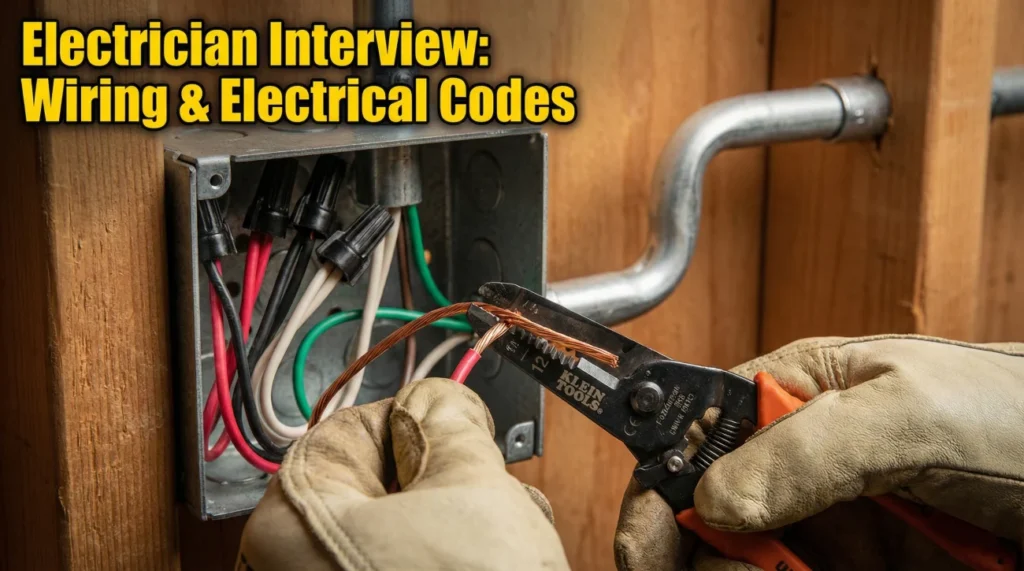
Color coding is the language of the trade (per NEC). Green (or bare copper) is always the Equipment Grounding Conductor – it’s for safety, carrying fault current to trip the breaker. White or Gray is the Grounded Conductor (Neutral) – it carries the return current in a 120V or 277V circuit. You cannot use white for hot unless you re-identify it with tape (e.g., in a switch loop).
Black is the ungrounded “Hot” conductor in standard residential/commercial 120/208V systems. In 277/480V industrial systems, we typically use Brown, Orange, Yellow for hots and Gray for neutral. Mixing these up causes dead shorts or 277V being sent to a 120V outlet, destroying equipment.
Q: Describe the difference between a Parallel Circuit and a Series Circuit.
In a Series Circuit, there is only one path for current. If one light burns out, they all go out. Voltage divides across the loads. We rarely use this in building wiring, except for old Christmas lights or specific control loops.
In a Parallel Circuit, each load has its own path to the source. Voltage is constant across all loads (e.g., every outlet gets 120V). Current adds up. This is how 99% of building wiring is done. If I plug a toaster into one outlet, the lamp in the next outlet stays on because they are in parallel. Understanding this is crucial for load calculations.
Q: How do you determine the correct box size (Box Fill)?
Overstuffing a junction box is a fire hazard and a code violation (NEC 314.16). I count the “volume allowances.” Each conductor entering the box counts as 1. All grounds together count as only 1. Internal clamps count as 1. A device (switch/receptacle) counts as 2.
I multiply the total count by the volume per conductor (e.g., 2.00 in³ for #14 wire, 2.25 in³ for #12). If the total exceeds the stamped volume on the box (e.g., 18 in³), I must use a larger box or add an extension ring. I never force wires in with a hammer; that causes insulation damage and arcing.
Installation & Code Proficiency
Q: 3-Way Switch Wiring
A 3-way switch setup controls one light from two locations. It uses two “Traveler” wires between the switches. The power (Line) feeds the “Common” screw of the first switch. The “Common” screw of the second switch feeds the light (Load). The travelers connect the two remaining screws on both switches. If the light works from one switch but not the other, or if flipping one switch kills the other, I know the travelers are crossed or the common is misidentified.
Q: GFCI vs. AFCI Breakers
GFCI (Ground Fault Circuit Interrupter) prevents shock. It monitors the balance between Hot and Neutral. If 5mA leaks (through a person to ground), it trips instantly. Required in wet locations (kitchens, baths). AFCI (Arc Fault Circuit Interrupter) prevents fire. It listens to the sine wave for the electronic signature of arcing (sparking from a loose wire or nail). Required in bedrooms and living areas. They protect against different hazards.
Q: Bending Conduit: The Saddle
A 3-Point Saddle is used to cross a small obstruction (like a pipe). I mark the center of the obstruction and the center of my bend. I make a 45-degree center bend, then flip the pipe and make two 22.5-degree bends on the sides. The shrinkage is typically 3/16″ per inch of obstruction height. A 4-Point Saddle involves two offset bends and is better for wider obstructions. A good saddle sits flat on the wall without “dog-legging” (twisting).
Q: Sizing Conductors (Ampacity)
I use NEC Table 310.16 (formerly 310.15(B)(16)). I verify the wire material (Copper vs. Aluminum) and insulation rating (THHN is 90°C). However, I cannot just use the 90°C column if the breaker terminals are rated for 75°C (which is standard). I must use the 75°C column. I also apply Derating Factors: if there are more than 3 current-carrying conductors in a pipe, or if the ambient temp is high (rooftop), the ampacity drops significantly.
Q: Motor Starters: N.O. vs N.C.
In a standard Stop/Start motor control circuit: The Stop button is wired Normally Closed (N.C.) in series so pressing it breaks the circuit (fail-safe). The Start button is wired Normally Open (N.O.) in parallel with a holding contact (seal-in) from the contactor. When you press Start, the contactor closes, the seal-in contact closes, and power flows even after you release the button. If the motor jogs but won’t run, the seal-in contact is bad.
Q: Bonding vs. Grounding
Grounding connects the system to the earth (ground rod) to limit voltage from lightning/surges. Bonding connects all metal parts (pipes, frames, enclosures) together to create a low-impedance path for fault current. Bonding is what trips the breaker. If a motor shorts to its frame and the frame isn’t bonded back to the panel, the breaker won’t trip, and the frame becomes electrified and lethal. Bonding saves lives; grounding saves equipment.
Troubleshooting & Safety Scenarios
A client asks you to add a new outlet but the panel is full. What are your options?
I cannot double-tap a breaker (two wires under one screw) unless the breaker is designed for it (e.g., Square D QO), and even then, it’s bad practice for separate circuits. My options are: 1) Install “Tandem” or “Cheater” breakers (twin breakers in one slot), provided the panel labeling allows it (CTL vs Non-CTL). 2) Add a Sub-panel fed from a larger breaker in the main panel. 3) Verify if the new outlet can be tapped off an existing general-purpose circuit that isn’t overloaded. I explain the cost difference to the client.
You are troubleshooting a dead circuit. You measure 120V Hot-to-Ground but 0V Hot-to-Neutral. What is the problem?
This is a classic Lost Neutral (Open Neutral). The hot wire is live (hence 120V to ground), but the return path is broken. This is dangerous because the device can still be energized but won’t work.
I would trace the neutral back. Is it loose in the wire nut at the receptacle? Is it loose in the panel bus bar? If it’s a multi-wire branch circuit (shared neutral), an open neutral can send 240V to 120V appliances, blowing them up. I would turn off the breaker immediately before investigating connections.
The foreman tells you to work on a 277V lighting circuit “hot” because they can’t shut down the office computers. What do you do?
I refuse. NFPA 70E is clear: “convenience” is not a justification for energized work. Live work is only permitted if de-energizing increases the hazard (e.g., life support systems) or is infeasible (testing). Office computers do not qualify.
I would say, “I am not comfortable risking my life or my license for uptime. We need to schedule a shutdown after hours.” If he insists, I cite the company’s safety policy. 277V is the “widow maker” – it grabs you and doesn’t let go. No paycheck is worth dying for.
Advanced Systems & Industrial
Q: What are Harmonics and how do they affect the neutral?
Harmonics are currents at multiples of the fundamental frequency (e.g., 180Hz on a 60Hz system). They are caused by non-linear loads like VFDs, LED drivers, and computers. In a 3-phase system, the fundamental currents cancel out in the neutral. However, Triplen Harmonics (3rd, 9th, 15th) do not cancel; they add up.
This means you can have 0 Amps on the phases but high current on the neutral, causing it to overheat and burn isolation. In office buildings or data centers, we often use “Super Neutrals” (double-sized) or K-Rated transformers to handle this heat.
Q: Explain the Delta vs. Wye transformer configuration.
Delta (triangle) has 3 wires and no neutral. It is used for power transmission and heavy motor loads. Wye (star) has 4 wires (3 phases + Neutral). It provides a central ground point.
Most distribution transformers are Delta-Primary / Wye-Secondary. This traps harmonics in the delta primary and provides a stable neutral for 120V/277V loads on the secondary. High-Leg Delta is a weird hybrid (240/120V 3-phase) where the “B” phase is 208V to ground (the “Stinger” or “Wild Leg”). You must never connect a 120V load to the High Leg.
Q: What is an “Arc Flash Boundary”?
The Arc Flash Boundary is the distance from an exposed energized part at which an arc flash would result in the onset of a second-degree burn (1.2 cal/cm²). Inside this boundary, you must wear appropriate Arc Rated (AR) clothing (Category 2 or 4 suit) and PPE.
There is also the Limited Approach Boundary (unqualified persons must stay back) and the Restricted Approach Boundary (only qualified workers with PPE). I read the Arc Flash sticker on the panel door to know the specific boundary distance and PPE Cal rating before opening it.
Q: How do you verify a VFD (Variable Frequency Drive) installation?
VFDs control motor speed by changing frequency. When installing, I use Shielded VFD Cable to prevent electromagnetic interference (EMI) from messing up control signals. I ensure the shield is bonded at one end only (usually the drive end) to prevent ground loops. I check that the motor is “Inverter Duty” rated so the insulation doesn’t break down under the high-voltage spikes (standing waves). I also check parameters like ramp-up time and max Hz.
Electrician Knowledge Check
Test Your Code Knowledge
1. According to NEC, what is the maximum distance between supports for 1/2″ EMT conduit?
- 5 feet
- 10 feet (and within 3ft of a box)
- 8 feet
- 12 feet
2. A “Four-Way” switch is used when you want to control a light from:
- One location
- Two locations
- Three or more locations (placed between two 3-ways)
- A dimmer
3. What is the standard voltage to ground of the “High Leg” in a 120/240V 3-phase Delta system?
- 120V
- Approx 208V (120 x 1.732)
- 240V
- 277V
4. Which wire size (AWG) is rated for 20 Amps?
- #14 Copper
- #12 Copper
- #10 Copper
- #16 Copper
5. “LOTO” stands for:
- Lights On Two Off
- Lock Out / Tag Out
- Load Over Time Output
- Line Of Terminal Operation
6. A multimeter set to “Continuity” mode will beep when:
- The circuit is live (Voltage present)
- The resistance is near zero (Closed circuit)
- The resistance is infinite (Open circuit)
- The battery is low
7. What is the maximum number of degrees of bends allowed in a conduit run between pull points?
- 180 degrees
- 270 degrees
- 360 degrees
- Unlimited
8. Which NEC Article covers the grounding and bonding of electrical systems?
- Article 100
- Article 250
- Article 310
- Article 430
9. A “Dedicated Neutral” is required for:
- Every outlet
- AFCI circuits and generally most modern circuits to avoid interference
- Only 240V loads
- Outdoor lights only
10. “THHN” wire insulation stands for:
- The Hard Heat Nylon
- Thermoplastic High Heat-resistant Nylon-coated
- Tested High Heat Neutral
- Tough Heavy Hot Netting
11. When wiring a receptacle, the “Brass” screw is for:
- The Neutral (White) wire
- The Hot (Black) wire
- The Ground (Green) wire
- It doesn’t matter
12. An “LB” conduit body is used to:
- Connect two pipes straight
- Make a 90-degree turn with an access cover on the back
- Terminate a wire
- Hang a light fixture
13. In a 3-Phase panel, the standard color code for 277/480V is:
- Black, Red, Blue
- Brown, Orange, Yellow (BOY)
- Black, White, Red
- Red, White, Blue
14. What tool is used to “fish” wire through a conduit?
- Snake skin
- Fish Tape (or a vacuum/mouse)
- Crowbar
- Hammer
15. A “Keep-Out Zone” in front of an electrical panel must be at least:
- 12 inches deep
- 36 inches deep, 30 inches wide (Working Space)
- 6 feet deep
- Only necessary if the door is open
16. Which device protects a motor from overheating due to mechanical overload?
- The disconnect switch
- The Overload Relay (Heaters)
- The Fuse
- The Transformer
17. “PVC” conduit is best used for:
- Areas with high physical damage potential
- Underground or corrosive environments
- High heat areas (above 150°C)
- Shielding EMI
18. What is “Voltage Drop”?
- When the power goes out
- The loss of voltage over a long wire distance due to resistance
- Dropping a voltmeter
- Reducing voltage with a transformer
19. A “Pig-tail” is:
- A messy wire
- A short wire connecting a device to a wire nut bundle
- A type of conduit bend
- A twisted ground rod
20. If you cut a “Truss” to run a wire, you have:
- Improved the structure
- Violated building code and compromised structural integrity
- Saved money on drilling
- Created a nice path
❓ FAQ
📜 Do I need a license to work as an electrician?
Requirements vary by location and role. Many jobs require an apprenticeship progression and a journeyman license for independent work.
Even when a license is not required for entry roles, employers still want to see formal training, logged hours, and safe work habits.
🏗️ Residential vs commercial: what is the biggest shift?
Residential often emphasizes speed, rough-in consistency, and customer-facing professionalism. Commercial adds more conduit, coordination, and systems thinking.
In interviews, connect your experience to the environment: prints, equipment, and the way teams coordinate on larger sites.
📚 Do I have to memorize the entire code book?
You do not need to memorize every line, but you do need a strong working knowledge of the rules you touch daily.
Hiring managers want to hear that you know where to look, how to interpret, and how you avoid shortcuts that fail inspection.
🛡️ Is the job dangerous?
It can be, which is why safety discipline matters more than bravado.
Talk about lockout-tagout, verifying absence of voltage, PPE, and refusing unsafe energized work when it is not justified.
🔄 How often do electrical codes change?
Codes update on a cycle, but local adoption and job requirements vary.
A strong answer is that you keep learning: you follow updates, ask questions, and treat code compliance as part of being a professional.
Show Safety, Then Skill
As you review the full set of interview questions, practice answering in the order a good electrician works: safety check, code requirement, then technical solution.
If you can explain your troubleshooting steps, your workmanship standards, and the safety line you will not cross, you will sound like someone a foreman can trust on a live jobsite.
⚠️ Disclaimer: The interview strategies, sample answers, and negotiation tips provided in this guide are for educational purposes only. Hiring decisions are subjective and vary by company and industry. While these strategies are based on professional HR standards, they do not guarantee a specific job offer or result.