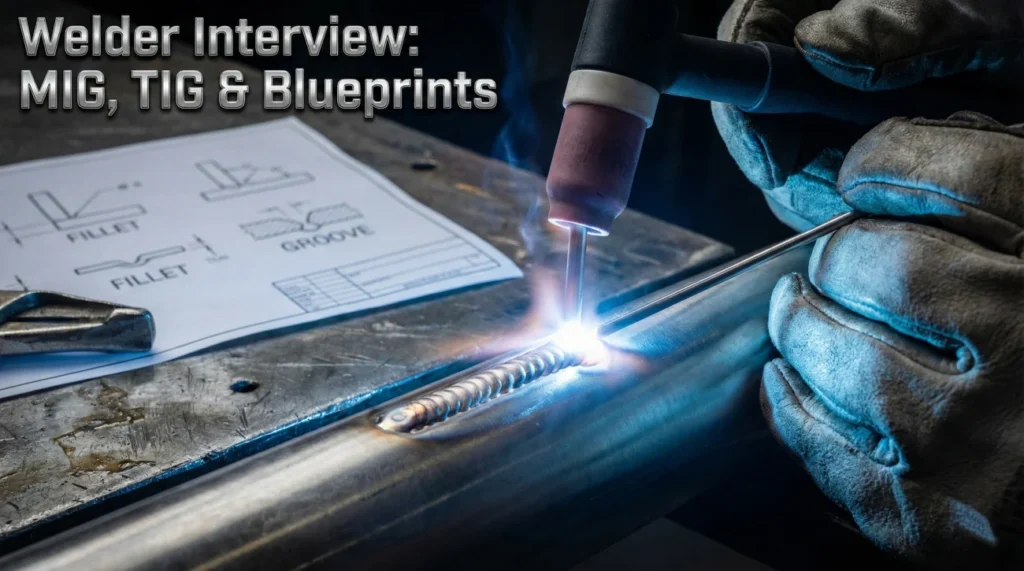
Your Bead Tells the Truth
Welder interview questions have a blunt purpose: can you produce sound welds on demand, under supervision, and to a procedure. You can talk your way through many jobs. You cannot talk your way through a bend test.
Hiring managers listen for preparation and consistency. They want to hear that you understand fit-up, cleanliness, heat control, and why defects happen. They also want to know you take safety seriously and do not rush just to look tough.
This guide covers processes, symbols, and field scenarios that show whether you can think like a professional welder. Use it to communicate that you follow the WPS, control your variables, and deliver welds that pass inspection the first time.
Process Fundamentals & Theory
Q: Compare the applications of MIG, TIG, and Stick welding.
MIG (GMAW – Gas Metal Arc Welding) uses a continuous wire feed and shielding gas. It is the fastest process (high deposition rate), ideal for production environments, structural steel, and fabrication shops. It is easy to learn but sensitive to wind (blows away gas) and prone to “cold lap” if not adjusted correctly.
TIG (GTAW – Gas Tungsten Arc Welding) uses a non-consumable tungsten electrode and manual filler rod. It offers the highest quality and precision but is the slowest process. It requires high skill (two hands + foot pedal). It is standard for stainless steel, aluminum, and critical pipe roots where aesthetic and purity are paramount.
Stick (SMAW – Shielded Metal Arc Welding) uses a flux-coated electrode. It is the most versatile for outdoor/field work because the flux creates its own shield (wind doesn’t bother it) and it can dig through rust and paint. It is the standard for structural erection and pipeline repair.
Q: Explain the difference between DCEP and DCEN polarity.
Polarity dictates where the heat goes. DCEP (Direct Current Electrode Positive), also called Reverse Polarity, means the current flows from the work to the electrode. This concentrates about 70% of the heat at the electrode tip, providing deep penetration. This is the standard for most Stick (e.g., 7018) and MIG welding.
DCEN (Direct Current Electrode Negative), or Straight Polarity, flows current from the electrode to the work. This puts 70% of the heat into the workpiece and only 30% into the electrode. This is used for TIG welding (to keep the tungsten from melting) or for thin sheet metal where you want to avoid burn-through. Knowing which to use prevents equipment damage and failed welds.
Q: What causes “Porosity” in a weld and how do you prevent it?
Porosity (holes/bubbles in the weld bead) is caused by trapped gas (nitrogen/hydrogen/oxygen) solidifying in the metal. The most common cause in MIG/TIG is Loss of Shielding Gas due to wind, a clogged nozzle, or an empty tank. In Stick welding, it’s often caused by Long Arc Length (losing the gas shield) or damp electrodes.
Surface contamination (oil, rust, paint, moisture) also releases gas when burned, causing porosity. To prevent it: 1) Clean the base metal (grind to bright metal). 2) Check gas flow rate (typically 15-25 CFH). 3) Use wind screens outdoors. 4) Keep low-hydrogen rods in an oven.
Q: How do you read the numbers on a Stick electrode (e.g., E7018)?
The AWS classification tells you everything. “E” stands for Electrode. “70” indicates the minimum tensile strength of the weld metal in thousands of psi (70,000 psi). “1” indicates the welding position (1 = All positions: Flat, Horizontal, Vertical, Overhead). A “2” would mean Flat/Horizontal only.
The last digit “8” (combined with the previous digit) indicates the coating type and current. “18” means it is a low-hydrogen, iron powder coating, run on AC or DCEP. Knowing this prevents using a flat-only rod for a vertical climb, or using a rod that isn’t strong enough for the steel grade.
Welding Symbols & Techniques
Q: Welding Symbols: Arrow Side vs. Other Side
The reference line is the horizontal line of the symbol. Symbols placed below the reference line refer to the Arrow Side (the side the arrow touches). Symbols placed above the reference line refer to the Other Side (the opposite side of the joint). A symbol on both sides means weld both sides. Getting this wrong means welding the wrong side of a wall or beam, resulting in expensive rework.
Q: 6G Pipe Position
6G is the “Monster Coupon” test. The pipe is fixed at a 45-degree angle and cannot be rotated. The welder must move around the pipe. This position tests all skills simultaneously: flat, vertical, and overhead. If you qualify in 6G, you are typically qualified for all positions (1G, 2G, 3G, 4G) on both pipe and plate. It requires mastering body positioning and ambidextrous welding skills.
Q: Interpass Temperature
For thick plate or alloy steels, managing heat is critical. Interpass Temperature is the temperature of the weld metal just before starting the next pass. If it’s too hot, the grain structure grows large, reducing toughness (brittle). If it’s too cold (below preheat), you risk hydrogen cracking. I use a temp stick (crayon) or infrared gun to ensure the steel is within the specified range (e.g., 300°F – 500°F) before striking the arc again.
Q: Aluminum Welding Challenges
Aluminum is tricky because it has an oxide layer that melts at 3700°F, while the base metal melts at only 1200°F. If you don’t clean the oxide, the aluminum melts inside while the skin stays solid. In TIG, we use AC (Alternating Current). The electrode positive half-cycle blasts off the oxide (cleaning action), and the negative half-cycle penetrates. I also must move fast because aluminum dissipates heat rapidly.
Q: Undercut Defects
Undercut is a groove melted into the base metal at the toe of the weld that is not filled with filler metal. It creates a weak point (stress riser) prone to cracking. It is caused by: 1) Amperage too high (gouging). 2) Travel speed too fast. 3) Incorrect torch angle. 4) “Long arcing.” I prevent it by watching the puddle “wash in” to the edges and pausing slightly at the toes during the weave.
Q: Stainless Steel Purging
When TIG welding stainless pipe, the back side of the weld (inside the pipe) reacts with oxygen, forming “Sugaring” (granulation) which ruins corrosion resistance. I must Purge the inside of the pipe with Argon gas to displace the oxygen. I tape off the ends and use a purge monitor to ensure oxygen levels are near zero before striking the arc. Without a purge, the root pass is rejected.
Field Scenarios & Troubleshooting
You are MIG welding and the wire keeps “birdnesting” (tangling) at the drive rolls. What is wrong?
This is a mechanical feed issue. First, I check the Liner in the gun cable. If it’s kinked or clogged with copper dust, the friction stops the wire, but the rollers keep pushing, creating a mess. I would blow out or replace the liner.
Next, I check the Contact Tip size (is it too small?) and verify the Drive Roll Tension. If the tension is too tight, it deforms the wire; too loose, it slips. I also check if I’m using the correct rollers (Knurled for flux core, Smooth-V for solid wire, U-groove for aluminum).
You are welding a thick beam to a column in the field, and it’s 20°F (-6°C) outside.
Cold steel is dangerous. Welding on freezing steel causes “Thermal Shock” – the rapid heating and cooling creates a brittle microstructure (Martensite) susceptible to cracking. I must pre-heat the joint.
I would use a rosebud torch to bring the steel up to the minimum preheat temperature specified in the WPS (Welding Procedure Specification), typically at least 150°F to 225°F. This drives out moisture (preventing hydrogen porosity) and slows the cooling rate to preserve ductility. I wouldn’t strike an arc until the steel is warm.
You are burning through thin gauge metal repeatedly. How do you adjust?
Heat input is too high. My strategy: 1) Switch Polarity: If using TIG, ensure I am on DCEN. 2) Technique: Use a “stitch” or “pulse” technique – weld for a second, stop to let it cool, then weld again. 3) Heat Sink: Clamp a thick piece of copper or aluminum backing behind the joint to absorb the excess heat.
4) Parameters: Lower the amperage/voltage and use a smaller diameter wire/rod. 5) Travel Speed: Move faster. The longer I stay in one spot, the more likely I am to blow a hole.
Advanced Fabrication & Safety
Q: What is the “Heat Affected Zone” (HAZ) and why is it a concern?
The HAZ is the area of base metal adjacent to the weld that didn’t melt but had its microstructure altered by the heat. It is often the weakest part of the joint. In tempered steels, the HAZ can lose its temper and become soft. In high-carbon steels, it can become hard and brittle. I minimize the HAZ by controlling heat input (Volts x Amps / Travel Speed) – welding efficiently without excessive weaving or dwell time.
Q: Describe the “Walking the Cup” technique for TIG pipe welding.
“Walking the Cup” involves resting the ceramic nozzle (cup) on the pipe bevel and rocking it back and forth in a figure-8 motion while moving forward. This technique creates a consistent arc length and a beautiful, uniform “snake skin” weave pattern. It is less tiring for the hand than free-handing and allows for higher travel speeds on heavy-wall pipe. However, it requires a clean surface so the cup doesn’t slip.
Q: How do you identify a “Slag Inclusion” on an X-Ray?
Slag inclusion happens when flux residue is trapped inside the weld or between passes. On an X-Ray (Radiograph), it appears as dark, irregular blobs or elongated lines (tram tracks). It is less dense than steel, so radiation passes through easier. It is almost always caused by poor cleaning between passes. I prevent it by chipping and wire-brushing every pass thoroughly until it shines, paying special attention to the “toes” of the weld where slag hides.
Q: What are the dangers of welding on Galvanized Steel?
Galvanized steel is coated with Zinc. Burning zinc creates Zinc Oxide fumes, which cause “Metal Fume Fever” (chills, nausea, fever). It hits a few hours after exposure. To weld it safely, I must grind the galvanizing off the weld area completely (at least 2 inches back). If I can’t remove it, I must wear a respirator (P100 or fresh air hood) and ensure massive ventilation. I never breathe the “white smoke.”
Welder Knowledge Check
Test Your Welding IQ
1. Which shielding gas is most commonly used for MIG welding mild steel (Short Circuit)?
- 100% Argon
- 75% Argon / 25% CO2 (C25)
- 100% Helium
- 100% Nitrogen
2. A “Fillet Weld” joins two pieces of metal that are:
- Aligned in the same plane (Butt joint)
- Perpendicular or at an angle (T-joint, Lap joint, Corner joint)
- Round pipes
- Made of plastic
3. The term “Duty Cycle” on a welder refers to:
- How many years the machine lasts
- The percentage of a 10-minute period the machine can weld at max amperage before overheating
- The speed of the wire feeder
- The warranty period
4. E6010 electrodes are known for:
- Smooth finish and easy slag removal
- Deep penetration and fast-freezing (great for root passes)
- Welding aluminum
- Requiring an oven
5. What does the “G” stand for in “3G”?
- Ground
- Groove (as opposed to F for Fillet)
- Gas
- Gravity
6. In a welding symbol, a flag at the break of the arrow line indicates:
- Weld all around
- Field Weld (weld on site, not in the shop)
- Stop welding
- Use a specific process
7. “Spatter” is:
- A cleaning agent
- Small droplets of molten metal expelled from the arc that stick to the base metal
- The sound of the arc
- A type of flux
8. Which shade lens is typical for high amperage Stick welding?
- Shade 5
- Shade 10-12
- Shade 3
- Clear
9. “FCAW” stands for:
- Fast Current Arc Welding
- Flux Cored Arc Welding
- Fused Carbon Arc Welding
- Fillet Cut Arc Welding
10. Why are low-hydrogen rods (7018) stored in an oven?
- To make them easier to light
- To keep moisture out of the flux coating, preventing hydrogen cracking
- To prevent them from rusting
- To keep them warm for the welder’s hands
11. A “Weave Bead” is created by:
- Moving in a straight line quickly
- Oscillating the electrode side-to-side to widen the weld deposit
- Using a robot
- Turning the voltage down
12. Which metal requires the highest frequency for TIG welding?
- Steel
- Aluminum (High frequency is used for arc starting and stabilization in AC)
- Copper
- Titanium
13. The “Root Opening” is:
- The start of the weld
- The separation between the members to be joined at the root of the joint
- A hole in the pipe
- The time it takes to weld
14. What happens if the travel speed is too slow?
- The arc goes out
- Excessive heat input, wide bead, and potential burn-through
- The weld is too narrow
- Porosity occurs
15. “Tungsten Inclusion” is a defect specific to:
- MIG Welding
- TIG Welding (dipping the tungsten into the puddle)
- Stick Welding
- Oxy-Fuel Cutting
16. The AWS code D1.1 covers:
- Aluminum Structures
- Structural Welding – Steel
- Bridges
- Sheet Metal
17. A “Plug Weld” is used to:
- Fix a leak in a pipe
- Join two overlapping pieces by welding through a hole in the top piece
- Connect a wire
- Stop water flow
18. Which shielding gas provides the deepest penetration in MIG welding?
- Argon
- 100% CO2 (Carbon Dioxide)
- Helium
- Oxygen
19. A “WPS” stands for:
- Welder Protection System
- Welding Procedure Specification (The recipe for the weld)
- Welding Project Schedule
- Weekly Pay Sheet
20. If a Stick electrode sticks to the work, you should:
- Pull up as hard as you can
- Quickly twist the holder to break it free or release the electrode from the holder
- Wait for it to melt
- Pour water on it
❓ FAQ
📜 Which certifications matter most for welders?
It depends on the work. Structural jobs may focus on common plate tests, while pipe roles may require position qualifications like 6G.
In interviews, mention your most relevant tests and be clear about the material and process you qualified on.
🔥 Should I learn MIG, TIG, or Stick first?
MIG is often the fastest entry point for production work, while Stick is valuable for field and dirty conditions. TIG demands more coordination but opens doors in stainless and aluminum.
A strong plan is to start with what the job needs, then broaden. Employers like welders who keep expanding their range.
🧪 What should I expect in a weld test?
Most tests check fit-up, root quality, and your ability to keep the weld consistent. Some are visually inspected, others are bent or X-rayed.
The key is to stay calm, prep carefully, and follow the procedure instead of improvising.
👓 Can I weld if I wear glasses?
Yes. Many welders wear glasses under a hood. The main concern is comfort and clear vision, not the glasses themselves.
Make sure your hood fits well, keep lenses clean, and use the right shade. Safety gear should work with you, not against you.
💰 What tends to pay more: pipe welding or structural?
Pay depends on region, industry, travel, and how demanding the job is. Pipe work can pay well because qualification standards are strict and environments can be challenging.
A good interview answer focuses on building skill and reliability first. High pay follows consistent quality and hard-to-fill capability.
Prep, Control, Repeat
When you review these interview questions, practice describing your setup: cleaning, fit-up, settings, and how you avoid common defects.
If you can explain your process and your safety discipline with the same confidence you bring to the weld test, you will come across as a welder who produces results that inspectors and crews can count on.
⚠️ Disclaimer: The interview strategies, sample answers, and negotiation tips provided in this guide are for educational purposes only. Hiring decisions are subjective and vary by company and industry. While these strategies are based on professional HR standards, they do not guarantee a specific job offer or result.