The Heart of the Vessel
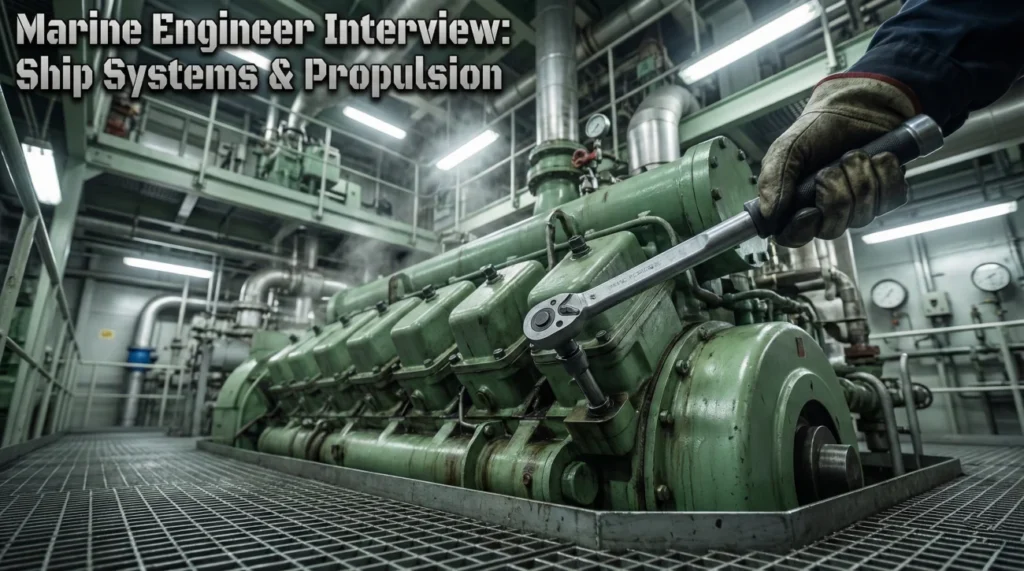
Marine engineer interview questions test your ability to keep a floating city operational in the middle of the ocean. Unlike land-based engineers who can call a specialist or order a spare part for next-day delivery, a marine engineer (or “ship’s engineer”) must be a jack-of-all-trades: mechanic, electrician, plumber, and firefighter. The engine room is a hostile, complex environment where systems rely on each other, and a failure in one can lead to a “dead ship” scenario.
Hiring managers for shipping lines, cruise companies, or offshore support vessels are looking for competence under pressure. They want to know if you understand the thermodynamics of a massive 2-stroke slow-speed diesel engine, the strict environmental regulations of MARPOL, and the precise chemistry required to prevent a boiler explosion. Whether you are a Fourth Engineer starting out or a Chief Engineer managing the department, you must demonstrate a deep respect for safety and procedure.
This guide covers the technical depth required for the engine department. We explore the critical operation of Oily Water Separators (OWS), the emergency procedures for scavenge fires and crankcase explosions, and the maintenance strategies for purifiers and turbochargers. These answers will help you prove that you have the technical rigor to maintain propulsion and power, ensuring the vessel reaches its destination safely.
Engine Room Fundamentals
Q: Compare the operating cycle of a 2-stroke crosshead engine vs. a 4-stroke trunk piston engine.
This is the definitive propulsion question. 2-Stroke Crosshead Engines (like MAN B&W or Wärtsilä-Sulzer) are low-speed giants used for main propulsion. They have a power stroke every revolution. The key feature is the Crosshead, which connects the piston rod to the connecting rod. This isolates the crankcase (system oil) from the cylinder (cylinder oil), preventing combustion byproducts from contaminating the lube oil. Scavenging is done via ports in the liner and a single exhaust valve.
4-Stroke Trunk Piston Engines are medium/high-speed engines typically used for auxiliary generators (Gensets). They have a power stroke every two revolutions. The connecting rod attaches directly to the piston (gudgeon pin), meaning there is no separation between the combustion chamber and the crankcase; the same oil lubricates both. They use intake and exhaust valves in the cylinder head. I choose 2-stroke for efficiency in direct-drive propulsion and 4-stroke for compact power generation.
Q: Explain the working principle of a Fresh Water Generator (Vacuum Distillation).
A Fresh Water Generator (FWG) produces potable water from seawater using waste heat from the main engine jacket water. The key principle is Vacuum. By creating a vacuum inside the shell (using an ejector), we lower the boiling point of seawater to roughly 40-50°C. The hot jacket water (approx 80°C) passes through a heat exchanger (Evaporator), boiling the seawater.
The vapor rises through a Demister (mesh) to remove salt droplets and then hits the Condenser (cooled by seawater). The vapor condenses into fresh water, which is pumped out to the tanks. Critical parameters are the vacuum level (maintained by the ejector) and the salinity alarm (set at 10 ppm). If the vacuum drops, boiling stops. If salinity spikes, the dump valve opens to recycle the water back to the evaporator.
Q: Describe the Bunkering procedure and how you prevent spills.
Bunkering (refueling) is a critical operation with high environmental risk.
Pre-Bunkering: I create a Bunkering Plan, calculating tank capacities to ensure we don’t exceed 85-90% fill. We plug all deck scuppers (save-alls) to contain potential spills. We test communications with the bunker barge and agree on stop signals and flow rates.
During Bunkering: We start at a slow rate to prove the line path. I continuously monitor tank levels (sounding/ullage) and the manifold pressure. I take continuous drip samples for lab analysis (Marpol sample).
Post-Bunkering: We blow the lines with air to clear them before disconnecting hoses. We measure the final quantity with the barge rep and sign the Bunker Delivery Note (BDN). The “SOPEP” (Shipboard Oil Pollution Emergency Plan) kit is always ready nearby.
Q: What is the function of the Oily Water Separator (OWS) and the 15 ppm alarm?
The OWS treats bilge water before discharge overboard to comply with MARPOL Annex I. It typically uses gravity separation (oil floats) followed by a coalescing filter to remove emulsified oil. The critical component is the Oil Content Monitor (OCM) or “15 ppm alarm.”
If the effluent exceeds 15 parts per million of oil, the OCM triggers an alarm and activates a 3-way valve to divert the water back to the bilge tank, preventing overboard discharge. Tampering with the OWS or the OCM (using a “Magic Pipe” or flushing with fresh water) is a criminal offense that leads to jail time for engineers and massive fines for the company. I treat the OWS logbook with absolute integrity.
Machinery & Systems Maintenance
Q: Centrifugal Purifier Operation
Purifiers (Separators) use centrifugal force to separate fuel/lube oil (light phase) from water (heavy phase) and sludge (solids). The key is the Gravity Disc (dam ring), which sets the interface line between oil and water. If the disc is too large, the interface moves out, and oil is lost with the water (“breaking the seal”). If too small, water enters the clean oil outlet. Modern purifiers (Alcap) eliminate the gravity disc, using transducers to monitor water content and trigger sludge discharge automatically.
Q: Boiler Water Treatment
Boiler water must be treated to prevent Scale and Corrosion. Scale (calcium/magnesium) insulates the tubes, causing overheating and failure. We prevent it by dosing Phosphate to precipitate salts as soft sludge. Corrosion is caused by dissolved Oxygen and low pH. We use an Oxygen Scavenger (Hydrazine or DEHA) and maintain alkalinity (pH 9-11). I test the water daily. If chlorides are high, it indicates seawater contamination in the condenser, requiring immediate blowdown.
Q: Turbocharger Surging
Surging is the reversal of air flow through the compressor. It sounds like a loud “bark” or cough. It happens when the discharge pressure is higher than the pressure the compressor blade can sustain at that RPM. Common causes: 1) Dirty scavenge air cooler or economizer (restriction downstream). 2) Dirty nozzle ring on the turbine side (restriction upstream). 3) Sudden load reduction on the engine. Continued surging destroys the thrust bearing.
Q: ICCP (Impressed Current Cathodic Protection)
ICCP protects the ship’s hull from corrosion. Instead of sacrificial zinc anodes, the ship uses titanium anodes mounted on the hull connected to a DC power source. Reference cells measure the potential of the hull in the seawater. A control panel adjusts the current output to the anodes to maintain the hull potential (typically -200mV) to neutralize the electrochemical reaction. I monitor the Amps/Volts daily; a sudden drop might indicate a damaged anode or reference cell.
Q: Stern Tube Sealing (Lip Seals)
The stern tube seal keeps seawater out and lube oil in. It typically consists of 3 or 4 lip seals (Viton) running on a chrome liner. The space between the seals is pressurized with oil. To prevent pollution, the oil pressure is usually kept slightly lower than the seawater pressure (Draft dependent) so if a leak occurs, water comes in rather than oil going out. Air-type seals (Airguard) are becoming standard to ensure zero pollution.
Q: Emergency Generator Testing
The Emergency Gen must start and connect to the bus automatically upon Blackout within 45 seconds. I test it weekly. The test involves simulating a blackout (or using the test switch) to verify the Auto-Start logic. I check battery voltage, hydraulic starter pressure, and fuel tank level. I also run it “on load” periodically to prevent “wet stacking” (carbon buildup) in the exhaust due to light loading.
Emergency & Troubleshooting Scenarios
The ship suffers a Blackout (Total Power Loss) at sea. Walk me through the recovery procedure.
A Blackout is the highest priority emergency. Immediate Action: The Emergency Generator should start automatically and supply the Emergency Switchboard (lighting, steering, navigation). If not, I manually start it.
Recovery Steps:
1. Isolate: Ensure the main breaker on the dead board is open.
2. Prime Mover: Go to the main Diesel Generator. Reset trips (Overspeed/Low Oil Pressure). Start the pre-lube pump. Air start the engine.
3. Connect: Once voltage and frequency are stable (e.g., 440V/60Hz), close the breaker to the Main Switchboard.
4. Sequencing: Start essential pumps (Seawater, Jacket Water, Lube Oil) for the Main Engine. Do not start heavy loads (AC compressors/Cranes) yet to avoid tripping the generator again.
5. Main Engine: Reset the safety system, verify auxiliaries are running, engaging turning gear if needed, then prepare for restart.
You detect a “Scavenge Fire” in the main engine (high scavenge temp alarm, paint blistering). What do you do?
A scavenge fire is caused by the ignition of carbon/oil sludge in the scavenge air space (usually due to blow-by from bad rings or a faulty fuel injector).
Action:
1. Inform Bridge: “Slow Down immediately.” Reducing load reduces air flow and heat.
2. Fuel Off: Cut fuel to the affected cylinder(s).
3. Lubrication: Increase cylinder oil lubrication to seal the liner/rings (controversial, follow specific engine manual, but often recommended to restore seal).
4. Smother: Close the turbocharger air inlet to starve the fire of oxygen. Engage the Scavenge Space Fire Extinguishing system (Steam or CO2) if equipped.
5. Wait: Do NOT open the scavenge doors until the engine has cooled down. Opening them introduces oxygen and can cause a flashover/explosion.
The Oil Mist Detector (OMD) triggers a high alarm and shuts down the Main Engine automatically.
This indicates a potential Crankcase Explosion. Oil mist forms when a bearing overheats (hotspot) and vaporizes the lube oil.
Critical Rule: Do NOT open the crankcase doors. Opening them lets air in, which can mix with the hot oil mist and cause a secondary, massive explosion.
Procedure: Leave the engine stopped. Keep cooling pumps running to cool the engine. Wait at least 20 minutes (or per company checklist) for the mist to settle and the hotspot to cool. Once safe, enter with breathing apparatus to inspect bearings (feel for heat, look for white metal debris/discoloration).
Advanced Regulations & Technology
Q: Explain MARPOL Annex VI and the role of Scrubber Systems (EGCS).
MARPOL Annex VI limits air pollution, specifically $$SO_x$$ (Sulfur) and $$NO_x$$ (Nitrogen). The Global Sulfur Cap (2020) limits fuel sulfur content to 0.50% (and 0.10% in ECAs – Emission Control Areas). Ships have two options: switch to expensive Low Sulfur Fuel Oil (VLSFO/MGO) or install an Exhaust Gas Cleaning System (Scrubber).
A Scrubber washes the exhaust gas with water (seawater or freshwater + caustic soda) to neutralize the sulfur dioxide before it leaves the funnel. As an engineer, I must monitor the washwater pH, PAH (Polycyclic Aromatic Hydrocarbons), and turbidity before discharging it overboard (Open Loop) or storing the sludge (Closed Loop).
Q: What is the EEDI and SEEMP?
These are energy efficiency measures mandated by the IMO. EEDI (Energy Efficiency Design Index) applies to new ships, mandating a minimum efficiency (CO2 per ton-mile) in the design phase. SEEMP (Ship Energy Efficiency Management Plan) applies to all ships. It is an operational manual. I use it to implement best practices like Weather Routing, Trim Optimization, Hull Cleaning intervals, and Speed Optimization (Slow Steaming) to reduce fuel consumption and carbon footprint.
Q: Describe the challenges of LNG as a marine fuel (IGF Code).
LNG (Liquefied Natural Gas) reduces emissions but introduces cryogenic hazards (-162°C). The IGF Code governs safety. The fuel is stored in vacuum-insulated tanks. The main challenge is “Boil-Off Gas” (BOG). As the tank warms slightly, pressure builds.
We must use this gas in Dual-Fuel engines (burning it) or re-liquefy it. If tank pressure gets too high, we might have to vent methane (bad for environment) or burn it in a Gas Combustion Unit (GCU). Another risk is the double-walled piping: the annular space must be ventilated and monitored for gas leaks constantly.
Q: How does a Shaft Generator / PTO system work?
A Power Take-Off (PTO) Shaft Generator is driven by the Main Engine shaft. It produces electricity while the ship is at sea, allowing us to shut down the auxiliary diesel generators. This saves fuel (the main engine is more efficient) and maintenance hours on the auxiliaries.
The challenge is frequency control. Since the main engine speed varies (fixed pitch propeller) or stays constant (controllable pitch propeller – CPP), we need a frequency converter (Thyristor/Inverter) to ensure the output remains steady at 60Hz/50Hz regardless of shaft RPM fluctuations.
Marine Engineering Knowledge Check
Test Your Engine Room IQ
1. The “TBN” of a lube oil refers to its ability to:
- Lubricate under high pressure
- Neutralize acids formed during combustion (Total Base Number)
- Separate from water
- Resist oxidation
2. A “Cascade Tank” is typically part of which system?
- Fuel Oil system
- Boiler Feedwater / Condensate system (observation tank)
- Sewage system
- Lube Oil system
3. What does “MCR” stand for regarding engine power?
- Minimum Continuous Rating
- Maximum Continuous Rating (100% Load)
- Main Control Room
- Marine Combustion Ratio
4. In an Oily Water Separator, the “15 ppm” limit is mandated by:
- SOLAS
- MARPOL Annex I
- STCW
- ISM Code
5. “Stuffing Box” oil drains usually indicate the condition of:
- The propeller shaft seal
- The piston rod scraper rings (sealing cylinder oil from system oil)
- The turbocharger bearings
- The fuel injectors
6. Which fire extinguishing system is safe for use on live electrical boards?
- Water Mist
- Foam
- CO2 (Carbon Dioxide)
- Dry Chemical Powder (Messy but safe-ish, CO2 preferred)
7. A “Sacrificial Anode” is made of a metal that is:
- More noble than steel (e.g., Gold)
- Less noble (more anodic) than steel (e.g., Zinc or Aluminum)
- The same as steel
- Plastic
8. The “Hotwell” is associated with:
- The main engine sump
- The boiler feed water system (collects condensate)
- The sewage treatment plant
- The galley
9. “Viscosity” of fuel oil must be controlled at the injectors to ensure:
- It doesn’t freeze
- Proper atomization for combustion (typically 10-15 cSt)
- It lubricates the pump
- It weighs less
10. What is the purpose of the “Turning Gear”?
- To steer the ship
- To rotate the engine slowly for maintenance or pre-lubrication
- To change the propeller pitch
- To lift cylinder heads
11. A “Dead Ship Start” implies:
- Starting a ship that has been scrapped
- Restoring power from a complete shutdown with no stored air or battery power (using emergency air bottle/compressor)
- Starting the ship at night
- Towing the ship
12. “ISM Code” stands for:
- International Ship Mechanics
- International Safety Management Code
- Internal System Monitor
- Integrated Sea Manual
13. The “Expansion Tank” in the jacket water system accommodates:
- Fuel expansion
- Volume change of water due to temperature and makeup water supply
- Exhaust gas expansion
- Crew swimming
14. What causes “Microbial Degradation” in fuel tanks?
- High temperature
- Water presence at the tank bottom interface (The “Bug”)
- High sulfur content
- Mixing incompatible fuels
15. A “Salinometer” measures:
- Sugar content
- Salt content (conductivity) in fresh water
- Oil content
- Engine speed
16. The “Quick Closing Valve” is used to:
- Shut off water quickly
- Remotely shut off fuel supply to tanks in case of fire
- Start the engine quickly
- Drain the bilges
17. “Parameter P-max” refers to:
- Maximum pump pressure
- Maximum combustion pressure in the cylinder (Peak Pressure)
- Propeller max speed
- Power Maximum
18. Why do we take “Crankshaft Deflection” readings?
- To check if the shaft is bent
- To check the alignment of the main bearings and hull deflection
- To measure the length of the shaft
- To check the oil clearance
19. A “Pyrometer” measures:
- Pressure
- High Temperatures (Exhaust Gas)
- Vibration
- Speed
20. “UMS” notation for a ship means:
- Under Maintenance Ship
- Unattended Machinery Spaces (Engine room unmanned at night)
- Underwater Marine System
- Universal Motor Ship
❓ FAQ
📜 What license do I need?
You need a Certificate of Competency (CoC) issued by your country’s maritime authority (e.g., USCG in USA, MCA in UK) in accordance with STCW (Standards of Training, Certification and Watchkeeping). You start as an Engine Cadet/Oiler, then 4th Engineer, up to Chief Engineer.
⚓ What is the typical rotation?
It varies by sector. Deep-sea cargo ships often do 4 months on / 2 months off. Offshore supply vessels might do 28 days on / 28 days off. Cruise ships often do 10 weeks on / 10 weeks off. You live on the ship 24/7 during your contract.
🧰 Do I need my own tools?
No. The ship is fully stocked with tools, from spanners to lathes and welding gear. You just need your PPE (boots/boiler suit) and a flashlight. However, knowing how to use the lathe or welding machine is a critical skill for an engineer.
🌊 Do engineers get seasick?
Sometimes, especially in the beginning. The engine room is usually low in the ship (near the center of gravity), so the motion is less than on the bridge, but the smell of diesel and heat can trigger it. You adapt quickly (“get your sea legs”).
📈 Can I move to a shore job later?
Yes. Marine Engineers are highly sought after for shore roles: Technical Superintendents, Power Plant Managers, Classification Society Surveyors, or Service Engineers for engine manufacturers (MAN, Wärtsilä). The skills are universally transferable.
Steady as She Goes
To succeed with marine engineering interview prep, you must prove you are self-reliant. There is no roadside assistance in the middle of the Pacific.
Focus on your diagnostic logic. Explain how you trace a fault from the alarm panel to the sensor to the machinery. Show that you respect the environment (MARPOL) and the safety of your crew (SOLAS). The interviewer needs to trust that when the alarm sounds at 3 AM, you will know exactly what to do to save the ship.
⚠️ Disclaimer: The interview strategies, sample answers, and negotiation tips provided in this guide are for educational purposes only. Hiring decisions are subjective and vary by company and industry. While these strategies are based on professional HR standards, they do not guarantee a specific job offer or result.